
SPYB Price Holds Near Record After US Retail Sales Miss

 Prefer us on Google
American consumers just had their worst month in over a year. The tokenized S&P 500 barely noticed.
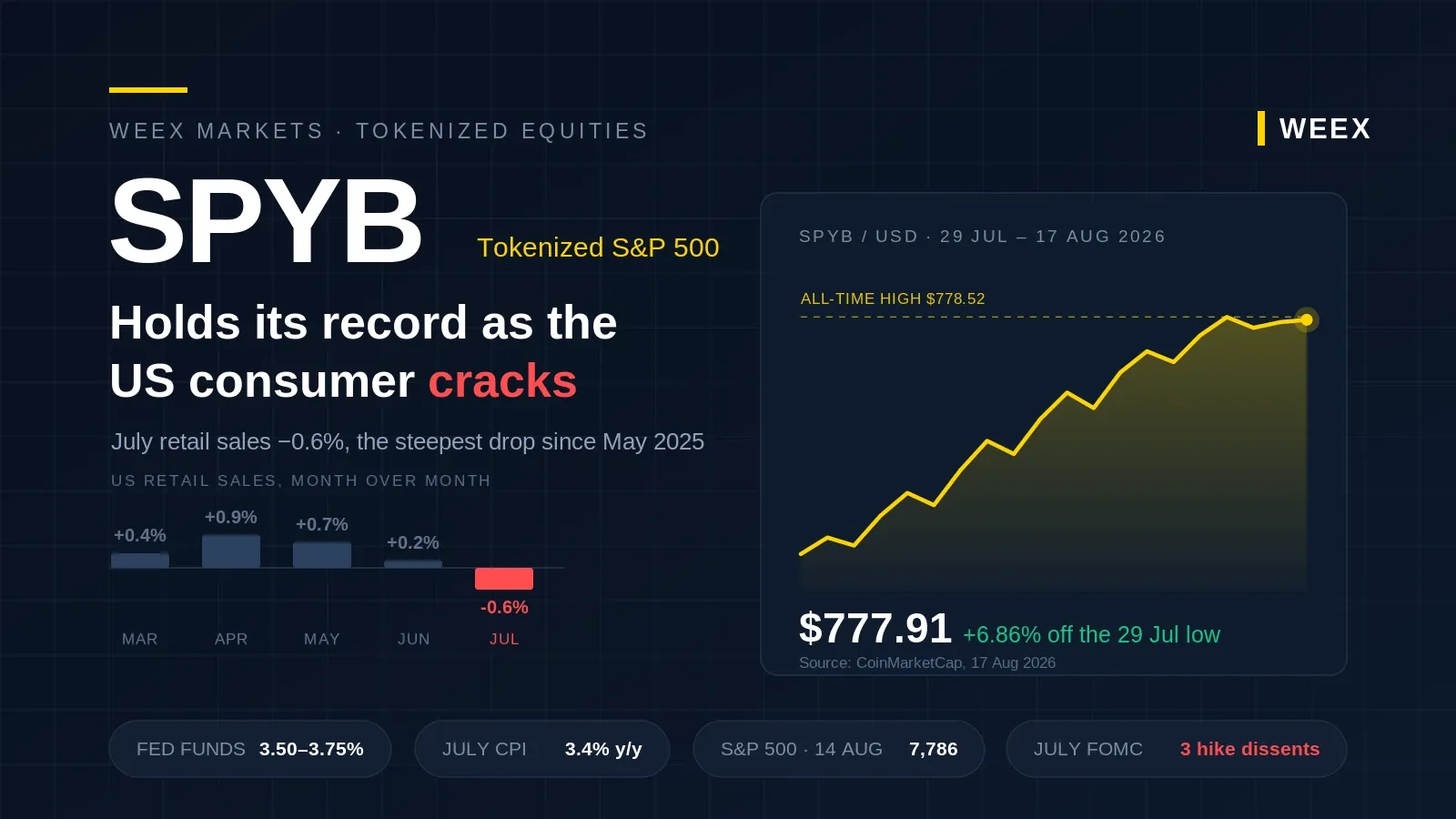
Retail sales fell 0.6% in July, the Commerce Department reported on 14 August 2026 — the steepest drop since May 2025, against economist forecasts of a small gain. The University of Michigan's preliminary August sentiment reading fell the same morning, its first decline in three months. And yet SPYB, the tokenized State Street SPDR S&P 500 ETF issued under the bStocks brand, was trading at $777.91 as of 17 August 2026, roughly 0.08% below the all-time high of $778.52 it set on 13 August.
That gap between the data and the price is the story. It is also the thing every SPYB ticker page on the internet will not explain to you.
What Is SPYB, and What Do You Actually Own?
SPYB is a BEP-20 token on BNB Smart Chain that carries the economic exposure of one share of the SPDR S&P 500 ETF Trust. Each token is backed 1:1 by an actual SPY share held by the issuer at a US-regulated broker-dealer, and eligible holders can convert back to the underlying security through Binance.com. Holders get price movement and dividend economics. The contract sits at 0x7138b48df7d98d7e3cc221bfe7192d0a178182d8.
What you do not get is a shareholder relationship with State Street. You hold a claim on an issuer who holds the share. That distinction is invisible when everything works and decisive when it does not — a point worth internalising across the whole category, not just this token. It is the same structural question that runs through every tokenized equity product, from index trackers to the pre-IPO tokenized stock wrappers that trade on the same rails.
The practical upside is straightforward: 24/7 access to the world's most-tracked equity benchmark, without a US brokerage account, settling on-chain in seconds.
SPYB Price Today: Reading the Tape, Not Just the Ticker
| Metric (as of 17 Aug 2026) | Value |
|---|---|
| Price | $777.91 (+0.16% / 24h) |
| 24h range | $775.42 – $778.23 |
| All-time high | $778.52 (13 Aug 2026) |
| All-time low | $728.00 (29 Jul 2026) |
| Move off the low | +6.86% in ~19 days |
| Market cap | $17.2M |
| 24h volume | $15.6M |
| Volume / market cap | 90.72% |
| Circulating supply | 22,113 SPYB |
| Holders | 38,650 |
| Chain | BNB Smart Chain |
Source: CoinMarketCap, 17 August 2026.
Two numbers in that table deserve more attention than the price.
The first is 90.72%. SPYB turns over nearly its entire market cap every day. An S&P 500 ETF is the most boring buy-and-hold instrument in global finance; its tokenized twin is being traded like a momentum altcoin. That tells you the holder base skews short-term, and it means the float is thin enough that a single large order can move the print away from the underlying.
The second is the 29 July all-time low of $728.00 — the day the FOMC met. SPYB has run 6.9% since that session. This token has existed for a matter of weeks, so it has no long history to lean on, but its entire price record so far is a straight-line reaction to Fed positioning.
Why a Weak US Consumer Is Bullish for SPYB Right Now
Most coverage will tell you softer spending revives rate-cut hopes. In August 2026, that framing is simply wrong, and getting it wrong will cost you money.
The Fed has held the funds rate at 3.50%–3.75% for months. At the 29 July meeting it held again — but three officials, Hammack, Kashkari and Logan, dissented in favour of a quarter-point hike. That is the first time since September 2016 that three policymakers broke ranks in the same direction. Headline CPI was 3.4% year-over-year in July, down from 3.5% in June but still well clear of the 2% target, with the gap driven by the energy shock from the Iran conflict. Gasoline hit $4.08 a gallon, 92 cents above a year earlier, according to AAA.
So the live question this summer has not been when do they cut. It has been do they have to hike.
Read the July data through that lens and it reframes cleanly. Retail sales at -0.6%, the control group at -0.4%, July PPI flat against a forecast of +0.2%, sentiment rolling over — that combination does not deliver a cut. It does something more immediately useful for equity multiples: it removes the hike from the table. The S&P 500 set its 27th record close of 2026 on 13 August at 7,798.99, slipped just 0.17% to 7,786 on the retail sales print, and still closed out a third straight weekly gain.
The better reading is that SPYB is not pricing a rescue. It is pricing the absence of a punishment. Those are different trades, and they behave very differently if the September data comes in hot.
-- Price
SPYB vs SPYX vs SPYon: Same Index, Different Wrappers
Search "tokenized S&P 500" and you get at least three tickers that look interchangeable and are not. Traders routinely buy the wrong one, then discover the redemption terms afterwards.
| SPYB | SPYX | SPYon | |
|---|---|---|---|
| Brand | bStocks | xStocks | Ondo |
| Chain | BNB Smart Chain | Solana / multi-chain | Multi-chain |
| Underlying | SPY ETF share | SPY ETF share | SPY ETF share |
| Convert to underlying | Yes, 1:1 via Binance.com, eligibility-gated | Issuer-dependent | Mint/redeem for eligible non-US users |
| Where it trades | CEX + BNB Chain DEX | CEX + Solana DeFi | CEX + DeFi |
| Practical catch | Thin float, high turnover | Fragmented liquidity across chains | Eligibility gating on redemption |
Compiled from issuer documentation and exchange listings, August 2026.
The column that matters is redemption. A tokenized share whose price you can see but whose underlying you cannot claim is a synthetic, whatever the marketing says. Check whether you — in your jurisdiction, with your verification level — are actually eligible to convert, before you size the position. Most people check after.
What SPYB's Weekend Price Says About 24/7 Risk
Here is the thing a 24/7 index token does that the index cannot: it prices the weekend.
The New York Stock Exchange closed Friday 14 August. SPYB kept trading. Over the following 24 hours it moved in a $775.42–$778.23 band — about 0.36% top to bottom, on a day when the S&P 500 itself did not exist as a tradeable price.
That is remarkably tight, and it is easy to read as reassuring. It should not be. A narrow weekend range on a token with a $17M market cap mostly reflects the absence of anyone with a reason to trade, not a robust price discovery mechanism. The risk is asymmetric: liquidity is thinnest precisely when a headline is most likely to land unopposed. If a geopolitical shock hits on a Saturday — and the Strait of Hormuz has been generating exactly that kind of headline all summer — SPYB reprices into an empty book, with no arbitrageur able to hedge in the cash market until Monday's open.
Experienced traders handle this in a dull, effective way: they use limit orders exclusively outside US market hours, and they size weekend positions smaller than weekday ones. Market orders into a thin weekend book on a tokenized equity is one of the more reliable ways to donate money in this category.
How to Trade Tokenized S&P 500 Exposure on WEEX
If you want index exposure on crypto rails, the workflow is short:
- Fund the account with USDT. Stablecoin funding avoids a second FX leg on top of your equity exposure.
- Pick the venue. Stock tokens sit in WEEX spot markets under the Stocks tab; the broader tokenized-equity lineup lives in the WEEX TradFi zone. Deeper books generally sit where the listing is most established, so compare before you route.
- Check the spread before the chart. On instruments this size, spread and depth will cost you more than a well-timed entry earns you.
- Use limit orders, especially outside 09:30–16:00 ET.
- Verify custody. Tokenized equity stacks two counterparties — the token issuer and the venue. WEEX publishes a 1:1 proof of reserves covering user assets, alongside a 1,000 BTC protection fund. Read the issuer's backing disclosure too; they are separate risks and both have to hold.
WEEX spot has listed 200+ stock tokens with 24/7 trading. Start trading stock tokens on WEEX spot.
The WEEX TradFi zone now carries 310+ stock tokens with deeper books and tighter execution. Explore the WEEX TradFi zone.
WEEX operates a strict 1:1 reserve mechanism so every user asset is backed by an equivalent reserve, publicly verifiable. View WEEX Proof of Reserves.
Can SPYB Keep Tracking the S&P 500 Higher?
SPYB has no independent thesis. It goes where the S&P 500 goes, plus or minus a wrapper premium. So the forecast question is really about the index — and the next six sessions are unusually dense.
| Date | Catalyst | Why it matters for SPYB |
|---|---|---|
| 17–21 Aug | Walmart, Target, Home Depot earnings | The direct read on whether July's spending drop was a blip or a trend |
| ~19 Aug | July FOMC minutes | Shows how close the three hike dissenters came to a majority |
| 21–22 Aug | Jackson Hole symposium | Chair Warsh's framing sets the September expectation |
| Sept FOMC | Rate decision | A hold extends the current regime; a hike breaks it |
The bull case is that inflation keeps easing, the hike faction stays outvoted, and AI-driven earnings carry multiples higher — JPMorgan has an 8,000 target on the index. The bear case is narrower but nastier: energy prices reaccelerate on Middle East headlines, CPI turns back up toward the May high of 4.2%, and the Fed hikes into an already-slowing consumer. That is the scenario in which SPYB gives back more than the 6.9% it has gained since 29 July.
For SPYB holders specifically, there is a third risk that has nothing to do with the index: the wrapper. Thin float, high turnover and weekend illiquidity mean SPYB can underperform the thing it tracks even when the tracking is working. Index risk and product risk are separate, and only one of them shows up on the chart.
The Bottom Line
SPYB near its record after a bad consumer print is not a contradiction. It is the market concluding that a soft consumer buys the Fed's patience, and patience is what an expensive equity index needs most. That logic holds right up until inflation reasserts itself.
If you are using SPYB for index exposure, treat it as two positions stacked on top of each other — a bet on the S&P 500, and a bet on a $17 million tokenized wrapper holding its peg through thin sessions. The first is well understood. The second is where the surprises live.
FAQ
1. What is SPYB?
SPYB is the State Street SPDR S&P 500 ETF Tokenized bStocks — a BEP-20 token on BNB Smart Chain backed 1:1 by an SPY ETF share held at a US-regulated broker-dealer, giving holders the ETF's price and dividend economics with 24/7 tradability.
2. What is the SPYB price today?
SPYB traded at $777.91 as of 17 August 2026, up 0.16% over 24 hours and about 0.08% below its all-time high of $778.52 set on 13 August 2026.
3. Does SPYB pay dividends?
SPYB is structured to pass through the underlying ETF's dividend economics rather than pay a separate on-chain yield. Confirm the exact mechanism in the issuer's current terms, since implementation varies across tokenized equity products.
4. Is SPYB the same as SPYX or SPYon?
No. All three track the SPDR S&P 500 ETF, but they come from different issuers on different chains with different redemption rules. Check which one you are buying and whether you are eligible to redeem it.
5. Did weak US retail sales hurt SPYB?
Barely. The S&P 500 fell 0.17% on the 14 August print and still posted a third straight weekly gain. Softer spending reduces the case for a Fed rate hike, which supports equity valuations in the near term.
6. Is the Fed cutting rates in September 2026?
A cut is not the base case. The Fed has held at 3.50%–3.75% and three officials dissented in July in favour of a hike. Weak July data mainly reduces hike risk rather than making a cut imminent.
7. Can I trade SPYB-style stock tokens on weekends?
Yes, and that is where the specific risk lives. The US cash market is closed, liquidity thins, and prices can move without arbitrageurs able to hedge. Use limit orders and smaller size outside regular hours.
8. What is the biggest risk in holding a tokenized S&P 500 token?
Issuer and liquidity risk, not index risk. You hold a claim on the issuer's custody arrangement, and SPYB's small market cap means execution can be poor even when the S&P 500 is calm.
Risk Warning
Tokenized equities carry both stock market risk and crypto market risk, and prices may fall sharply or result in partial or total loss. SPYB specifically involves: issuer and custody risk — you hold a claim on an issuer's off-chain share position, not a direct shareholder relationship with State Street or S&P Dow Jones Indices; liquidity risk — a market capitalisation near $17M with roughly 91% daily turnover means spreads can widen and slippage can exceed expectations, particularly outside US market hours; redemption and eligibility risk — the right to convert 1:1 into the underlying is jurisdiction-dependent and may not be available to you; smart contract risk on BNB Smart Chain; and regulatory risk, as tokenized securities remain unevenly treated across jurisdictions and access can change with little notice. Macro figures cited here are dated and will move. Nothing above is investment advice. Never allocate more than you can afford to lose.
This content is provided for general informational purposes only and doesn't constitute financial, investment, legal, or tax advice. Any events, rewards, online promotions, or related information mentioned herein should not be considered a recommendation, solicitation, or invitation to purchase, sell, trade, or otherwise deal in any crypto assets. Crypto assets are highly volatile and may result in loss. The availability of WEEX services, products, and related events may vary by region. You are responsible for ensuring that your participation is in accordance with applicable local laws and regulations.
You may also like
SMS 2FA vs Authenticator App: Which Is Actually Safer?

What Is 2FA? A Beginner's Guide

SNDK Stock Price Surges Past $1,700: What the Five-Day Winning Streak After Investor Day Actually Signals

OpenAI Stock Price: What Investors Who Want Exposure to ChatGPT Can Actually Buy Today

What Is OpenAI Stock? Why You Cannot Buy It Yet and What the IPO Timeline Actually Looks Like

XSolut, Stealth, or a Copycat? The XST Ticker Confusion Explained 2026
NVDA Stock Price Before August 26 Earnings: What Bank of America's $94-95 Billion Revenue Estimate Actually Requires
Nike Stock Price Prediction 2026-2027: Can NKE Recover After Hitting an 11 Year Low
How to Invest in XST Coin: What Due Diligence Actually Requires Before Buying XSolut

XST Coin on Coinbase: Why the Tokens You Find There Are Not the Real XSolut

XST Coin Has Fallen More Than 50% From Its All-Time High: What the Correction After the Peak Actually Means
SNDK Stock: Inside the 56% Crash and 76% Rebound of 2026

Kioxia Stock Before the Oct 1 Split: The 24/7 Perp Problem
Dow Jones Today: The 5.31% Yield Matters More Than the Dip
MRVL Stock Before August 27: The Number That Decides the Print
MU Stock Is Down 24% While Micron's Profits Hit Records
Why Is ZEC Price Up Today? Zcash Jumps 5% as Trading Volume Surges
Pakistan Stock Market Gains 23% in One Year: What Is Driving the PSX Rally?
PSX Today: KSE-100 Closes Above 180,500 as Trading Activity Surges

ZKsync (ZK) Price Today: How the Latest ZKsync Token Unlock Could Affect Trading Liquidity
ZKsync (ZK) Token Release Explained: Circulating Supply, Unlock Schedule and Market Impact
What Is Driving MANTA/USDT Volatility? Manta Network Tokenomics and Market Catalysts
MANTA Price Today: What Traders Are Watching Around the Latest Token Release
Ether.fi (ETHFI) Token Unlock on August 18, 2026: Release Size, Schedule and Market Impact
Is MU Stock Cheap at 20x Earnings Despite 346% Revenue Growth? What the Valuation Gap Actually Means
New Street Upgrades MU Stock to Buy: What Reaching Multi-Trillion Market Cap Requires
BlackBerry Stock Up 125%: Why BB and BBX Are Not the Same
XST Coin Has $12,000 of Real Depth Behind a $31 Million Price
Netflix Stock Is Down 38%: What the Tape Is Pricing
Nasdaq Futures vs Stocks: NQ at 30,141 and 3 Ways to Trade
SMS 2FA vs Authenticator App: Which Is Actually Safer?
What Is 2FA? A Beginner's Guide
SNDK Stock Price Surges Past $1,700: What the Five-Day Winning Streak After Investor Day Actually Signals
OpenAI Stock Price: What Investors Who Want Exposure to ChatGPT Can Actually Buy Today
What Is OpenAI Stock? Why You Cannot Buy It Yet and What the IPO Timeline Actually Looks Like
XSolut, Stealth, or a Copycat? The XST Ticker Confusion Explained 2026
Contents
Popular coins
Latest articles


