
Dow Jones Today: The 5.31% Yield Matters More Than the Dip

 Prefer us on Google


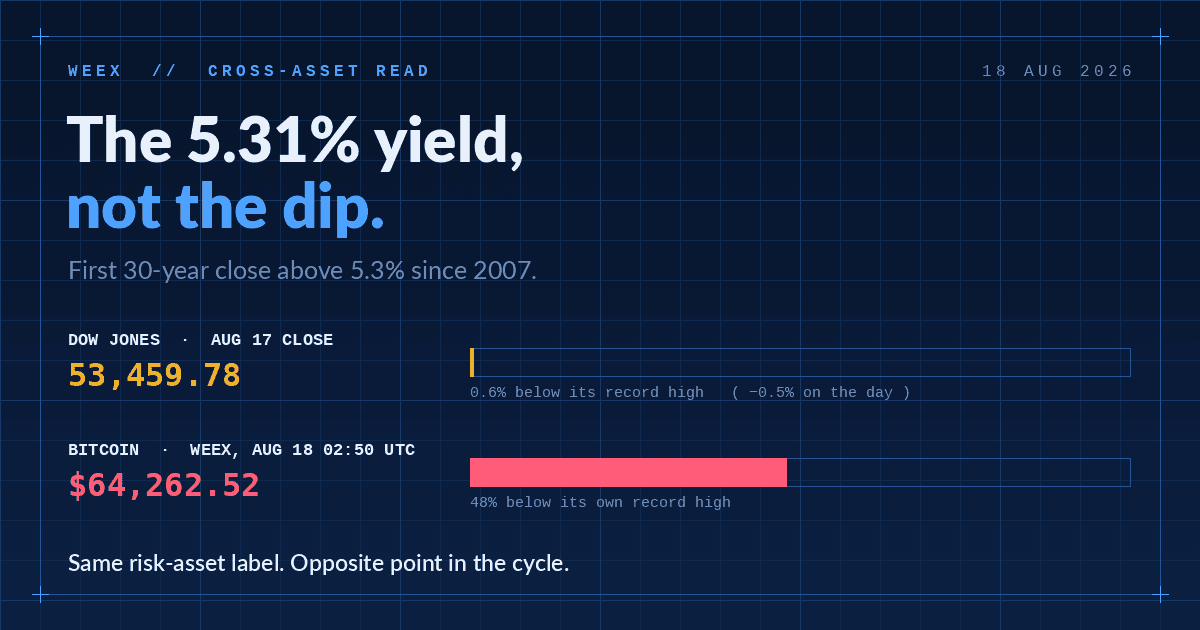
The Dow Jones Industrial Average closed at 53,459.78 on Monday, August 17, 2026, down about 0.5% on the day. That leaves the index roughly 0.6% below its record close of 53,770.27 set on August 12 — a dip, not a turn.
The number worth staring at is somewhere else. The 30-year Treasury yield closed at 5.31%, its first finish above 5.3% since June 2007. For anyone holding leveraged crypto positions, that line moved more risk than the Dow did.
Dow Jones today: the closing numbers
| Indicator | Level (Aug 17, 2026 close) | Change |
|---|---|---|
| Dow Jones Industrial Average | 53,459.78 | −0.5% |
| S&P 500 | 7,745.06 | −0.5% |
| Nasdaq Composite | 26,644.91 | −0.3% |
| 30-year Treasury yield | 5.31% | Highest close since June 2007 |
| 10-year Treasury yield | 4.725% | Up from 4.695% |
| Brent crude | Above $88 | Roughly +3% on the session |
| Spot gold | ~$4,388.62/oz | Near record territory |
Source: session close data reported for August 17, 2026. Levels move continuously once U.S. cash markets reopen at 9:30 a.m. ET.
The Dow, remember, is 30 blue-chip names weighted by share price rather than market value. A single high-priced constituent can push it around more than a much larger company. It is a sentiment gauge, not a census of the U.S. market — which is exactly why a 0.5% Dow move is a weaker signal than a 30-year yield printing a 19-year high. For the longer trend context behind this level, see the Dow Jones price analysis breakdown of the drivers that carried the index into record territory.
Why the Dow Jones fell today: oil above $88 and a 5.31% long bond
Two pressures did the work, and neither started on the equity desk.
Crude gained roughly 3% as expectations for progress in U.S.–Iran talks faded and traffic through the Strait of Hormuz came back into focus. WTI traded above $83, Brent above $88. Energy shares benefited; almost everything exposed to fuel, freight, or discretionary spending did not. Above the $85–$90 band, oil stops being a sector story and becomes an inflation-forecast story.
Long-end yields did the rest. The 30-year's move above 5.3% is not a Federal Reserve message — the market still leans toward no September hike. It is a supply-and-deficit message: buyers are demanding more to absorb long-dated Treasury issuance. Higher discount rates compress the present value of distant earnings, which is why the most expensive parts of the market feel it first.
The consumer picture underneath is softer than the index level implies. U.S. retail sales fell 0.6% in July, the largest monthly drop in more than a year. Chip stocks rallied on AI infrastructure demand and still could not carry the tape — a narrow bid failing to lift a broad index is usually worth more information than the headline percentage.
Dow near a record, Bitcoin 48% below its own
This is the comparison the market-recap pages skip, and it reframes what "risk-on" means right now.
| Metric | Dow Jones | Bitcoin (WEEX) |
|---|---|---|
| Latest level | 53,459.78 (Aug 17 close) | $64,262.52 (Aug 18, 02:50 UTC) |
| Record high | 53,770.27 (Aug 12, 2026) | $124,457.11 (Aug 14, 2025) |
| Distance below record | ~0.6% | ~48% |
| 7-day change | — | +3.19% |
| 30-day change | — | +7.00% |
| 1-year change | — | +54.24% |
| 24h trading volume | — | $21.19B |
Bitcoin data: WEEX token page, last updated August 18, 2026 02:50 UTC. Market cap $1.29T.
Both assets get filed under "risk," but they are standing in completely different places in their own cycles. Blue-chip equities are consolidating a fraction below an all-time high. Bitcoin is up 54% over twelve months and still less than halfway back to a peak set a year ago.
The practical reading: treating a red Dow print as a sell signal for crypto imports a correlation that is not reliably there at these levels. Crypto's larger drivers this year have been ETF flows, dollar liquidity, and positioning — not the daily direction of 30 industrial-era tickers. Where equities and crypto genuinely rhyme is on the rates channel. When the long bond sells off hard, both feel it, because both are discounting cash flows or liquidity that arrive later.
Trading Dow exposure from a crypto account, and the gap that catches people
If you want index or single-stock exposure without a brokerage account, USDT-margined WEEX TradFi futures cover precious metals, crude oil, and stocks from the same balance you trade crypto with. Published parameters, as documented by WEEX:
| Parameter | Detail |
|---|---|
| Margin asset | USDT |
| Max leverage — stocks | Up to 100× |
| Max leverage — crude oil | Up to 50× |
| Max leverage — precious metals | Up to 400× |
| Settlement | Perpetual, no expiry date |
| Trading hours | Follow the underlying market's hours |
| Direction | Long or short |
Read row six again, because it is where people get hurt. Crypto perpetuals run 24/7. TradFi contracts do not — you can only open or close while the underlying market is open, and funding may still apply during certain periods. Take 20× stock exposure into a Friday close and you cannot reduce it when a Sunday headline hits oil or the Middle East. The position sits, the risk does not.
The compounding version of that trap: USDT collateral shared across a crypto book and a market-hours book. A weekend drawdown in your BTC positions can pull margin toward liquidation on a stock position you are locked out of managing. Size TradFi exposure on the assumption you may not be able to touch it for 60 hours, and keep the two books' margin requirements separately accounted for. If leverage is new to you, the risk management guide for WEEX users covers position sizing and stop placement before it becomes an expensive lesson.
For the cross-asset read itself, the cleaner workflow is to check the Dow alongside the live Bitcoin price chart rather than in isolation — you want to know whether crypto is following macro risk sentiment or trading its own catalyst that day.
What could move the Dow Jones this week
| Catalyst | Timing | Why it matters |
|---|---|---|
| Walmart, Target, Home Depot, Lowe's, TJX earnings | This week | First clean read on the consumer after July retail sales fell 0.6% |
| 30-year Treasury auctions and yield path | Ongoing | A sustained hold above 5.3% pressures valuations across equities and crypto |
| Brent crude vs. the $90 line | Daily | Above $90, inflation forecasts and 2026 margin estimates get rewritten |
| Strait of Hormuz shipping headlines | Unscheduled | Weekend or overnight risk that cash equity markets cannot price until the open |
| Fed commentary on September | Ongoing | Markets currently lean toward no hike; hawkish tone would compound the yield move |
The retail prints are the swing factor. Guidance on traffic, discounting, and inventory will tell you whether the softness in July was a blip or the start of demand rolling over. Confirmation of a resilient consumer likely puts the Dow Jones back at record levels quickly. Weak guidance stacked on top of a 5.31% long bond is the combination that turns a 0.5% dip into something that needs a real explanation.
The honest summary of the Dow Jones today: the index is fine, the bond market is the story, and neither one is currently driving Bitcoin as much as crypto-native flows are. Watch the 30-year, not the ticker on the screen.
Ready to trade macro and crypto from one account? Open a WEEX account and check the live Bitcoin market before you size your first position.
FAQ
1. What is the Dow Jones today?
The Dow Jones Industrial Average closed at 53,459.78 on August 17, 2026, down about 0.5%. That is roughly 0.6% below its record close of 53,770.27 from August 12, 2026. The level changes continuously once U.S. markets open at 9:30 a.m. ET.
2. Why did the Dow Jones fall today?
Crude oil rose about 3%, with Brent above $88, and the 30-year Treasury yield closed at 5.31% — its first close above 5.3% since June 2007. Higher energy costs revive inflation concerns, and higher long-end yields compress equity valuations. Caution ahead of major retail earnings added to the pullback.
3. Does the Dow Jones affect Bitcoin?
Indirectly, and less than most people assume. As of August 18, 2026, Bitcoin trades around $64,262 — roughly 48% below its August 2025 record — while the Dow sits within 1% of its own. The shared channel is interest rates: when long-end yields spike, both asset classes tend to feel it. Day-to-day Dow moves are a weaker signal for crypto than ETF flows or dollar liquidity.
4. Can I trade the Dow Jones 24/7 on a crypto exchange?
No. Stock and index products on crypto platforms, including USDT-margined TradFi futures, follow the underlying market's trading hours. You cannot open or close those positions overnight or on weekends, even though your crypto positions keep trading — which is why weekend gap risk is the main hazard of holding leveraged stock exposure from a crypto account.
5. Is a falling Dow a reason to sell crypto?
Not on its own. A single 0.5% session says little about crypto positioning. A sustained move in the 30-year yield, a sharp dollar rally, or heavy ETF outflows are more informative inputs. Use the Dow as one macro screen among several, not as a standalone trigger.
Risk Warning
Crypto assets, tokenized equity products, and leveraged futures are volatile and can result in partial or total loss of capital. The figures above are dated snapshots — index levels, yields, crude prices, and Bitcoin prices change continuously and may be stale by the time you read this. TradFi futures carry specific risks that crypto perpetuals do not: positions can only be adjusted during the underlying market's trading hours, which means overnight and weekend gaps cannot be managed in real time, and shared USDT margin can transmit a drawdown in one book into a liquidation in another. Leverage of 100× on stocks or 400× on metals magnifies both outcomes and shortens the distance to liquidation dramatically. Oil shocks, geopolitical headlines, sovereign debt supply, and thin liquidity can all move prices faster than orders fill. Nothing here is investment advice. Size positions on the assumption you may be unable to close them when you most want to.
This content is provided for general informational purposes only and doesn't constitute financial, investment, legal, or tax advice. Any events, rewards, online promotions, or related information mentioned herein should not be considered a recommendation, solicitation, or invitation to purchase, sell, trade, or otherwise deal in any crypto assets. Crypto assets are highly volatile and may result in loss. The availability of WEEX services, products, and related events may vary by region. You are responsible for ensuring that your participation is in accordance with applicable local laws and regulations.
You may also like

Niulai Coin Price Prediction: What Happens to Meme Tokens After a Viral Peak on BNB Chain
SK Hynix Stock Price Has 43% Upside According to Wall Street: What the $245 Consensus Target Actually Requires

Tesla Stock Price Is Down 30% in 2026: What the Q2 Earnings Miss and 1.4% Operating Margin Actually Signal

MSFT Stock Price Prediction 2026-2027: What the $569 Analyst Consensus Target Actually Requires

SNDK Stock Price Surges Past $1,700: What the Five-Day Winning Streak After Investor Day Actually Signals
OpenAI Stock Price: What Investors Who Want Exposure to ChatGPT Can Actually Buy Today

What Is OpenAI Stock? Why You Cannot Buy It Yet and What the IPO Timeline Actually Looks Like
XSolut, Stealth, or a Copycat? The XST Ticker Confusion Explained 2026
NVDA Stock Price Before August 26 Earnings: What Bank of America's $94-95 Billion Revenue Estimate Actually Requires

Why Does XSolut (XST) Show Different Prices on CoinGecko, Phantom, and Solana DEXs? 2026 Guide

Niulai Coin Price Surges Over 200% in 24 Hours: What the Viral Film Story Actually Means for NIULAI
Nvidia Discloses a $21 Billion Stake in SpaceX: What the World's Largest AI Chipmaker Owning SPCX Actually Signals
How to Buy Niulai Coin: Where to Trade NIULAI and What to Check Before Buying
MU Stock Price Targets Range From $1,150 to $1,625: What UBS and New Street's AI Memory Thesis Actually Requires
Nike Stock and the China Sales Collapse: What a 30% Revenue Drop and Cutting Thousands of Distributors Actually Signals

What Is Niulai Coin? How a 342 Yuan Chinese Animated Film Spawned a Viral BNB Chain Meme Token
Nike Stock Price Prediction 2026-2027: Can NKE Recover After Hitting an 11 Year Low
Nike Stock Price Is Down 51% From Its 52 Week High: Is NKE a Buy at Current Levels

How to Invest in XST Coin: What Due Diligence Actually Requires Before Buying XSolut
Meta Stock Price Prediction 2026-2027: Can META Continue Climbing After the AI Infrastructure Surge
XST Coin on Coinbase: Why the Tokens You Find There Are Not the Real XSolut
XST Is Not a Stock: What XSolut Actually Is and How to Buy It Correctly
MU Stock Price Crosses $1,000 for the First Time Since July: What the Psychological Milestone Actually Signals
XST Coin Has Fallen More Than 50% From Its All-Time High: What the Correction After the Peak Actually Means

BTC to MYR: Why the Ringgit Price of Bitcoin Has Two Legs
MRVL Stock Before August 27: The Number That Decides the Print
SNDK Stock: Inside the 56% Crash and 76% Rebound of 2026
SOXL Stock After the 63% Crash: The Math Traders Missed
Why Is ZEC Price Up Today? Zcash Jumps 5% as Trading Volume Surges
Pakistan Stock Market Gains 23% in One Year: What Is Driving the PSX Rally?
Niulai Coin Price Prediction: What Happens to Meme Tokens After a Viral Peak on BNB Chain
SK Hynix Stock Price Has 43% Upside According to Wall Street: What the $245 Consensus Target Actually Requires
Tesla Stock Price Is Down 30% in 2026: What the Q2 Earnings Miss and 1.4% Operating Margin Actually Signal
MSFT Stock Price Prediction 2026-2027: What the $569 Analyst Consensus Target Actually Requires
SNDK Stock Price Surges Past $1,700: What the Five-Day Winning Streak After Investor Day Actually Signals
OpenAI Stock Price: What Investors Who Want Exposure to ChatGPT Can Actually Buy Today




