
XST Coin Has $12,000 of Real Depth Behind a $31 Million Price

 Prefer us on Google
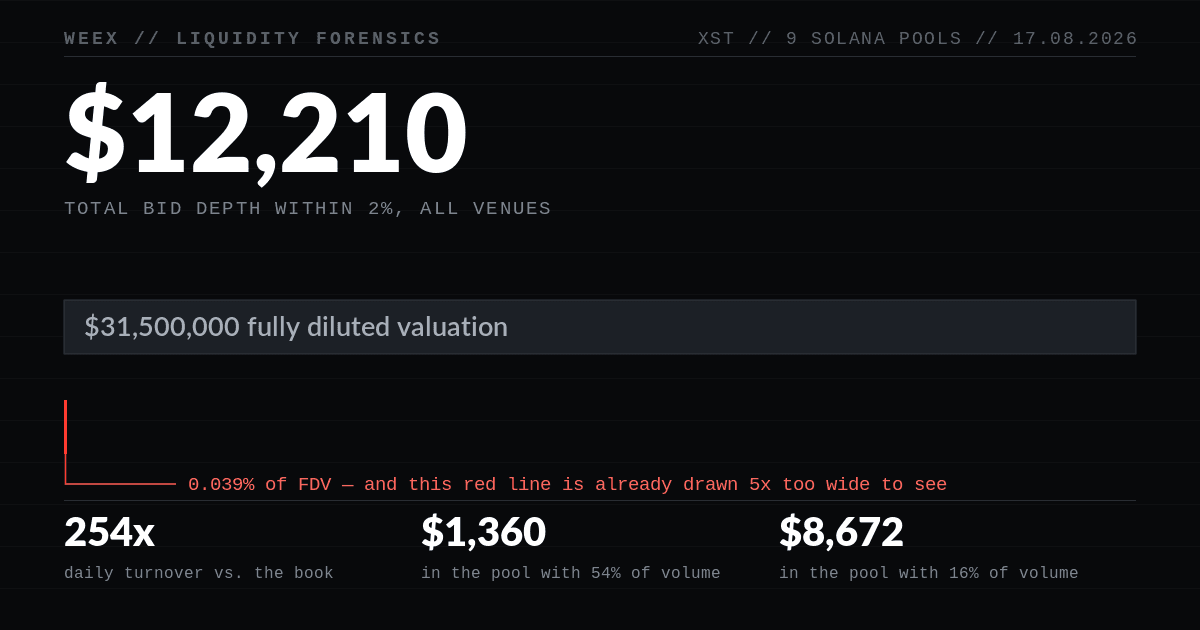
XST coin printed an all-time high of $0.07071 on 13 August 2026 and traded at $0.03147 four days later — a 55.5% drawdown in under a week. Most coverage is arguing about whether XSolut's AI-infrastructure pitch is real. That argument misses the more immediate problem: add up every buy order sitting within 2% of the mid price across all nine XST pools on Solana and you get roughly $12,200. Against a $31.5 million fully diluted valuation, that is the entire visible exit door.
This piece is about XST coin's market structure — where it actually trades, how thin the book is, and what that thinness did to holders between 5 and 13 August. It is not a price forecast and not a recommendation.
What Happened to XST Coin Between August 5 and August 13
The round trip was fast enough that daily charts flatten it out. The sequence matters more than the shape.
| Date (2026) | Event | XST price |
|---|---|---|
| 5 Aug | All-time low recorded | $0.008356 |
| 6 Aug | Tapbit reports multiple contract addresses on DEX Screener claiming to be XSolut | — |
| 13 Aug | All-time high; Bubblemaps publishes its holder map the same day | $0.07071 |
| 13 Aug | Bubblemaps flags ~74% of supply under concentrated control | — |
| 17 Aug | Price four days after the peak | $0.03147 |
Sources: CoinGecko (price, ATH/ATL dates), Lookonchain and Cryptopolitan (Bubblemaps report, 13 August), Tapbit (6 August contract-address report).
That is an 8.5x move up in eight days, then a halving in four. The 7-day range alone ran from $0.01615 to $0.07048 — a 4.4x spread inside a single week. A token that can do that is not being priced by anything resembling a discounted-cash-flow argument about data centres. It is being priced by whoever is willing to hit the bid that afternoon.
The Bubblemaps map landing on the exact day of the high is worth sitting with. It does not prove causation. But when an independent on-chain analyst publishes that 74% of supply sits in coordinated-looking wallets — with one cluster of 244 addresses accounting for close to half the float on its own — and the token peaks within hours, the more useful reading is that the marginal buyer had already run out and the warning simply removed the last of the cover.
XST Coin's Entire 2% Book Is About $12,200
Here is the number nobody is publishing. CoinGecko lists nine XST markets, all decentralised, all on Solana. Their +2% depth — the dollar value of bids you could hit before pushing the price down 2% — looks like this.
| Venue and pair | +2% depth | 24h volume | Share of volume |
|---|---|---|---|
| Meteora XST/WSOL | $1,359.65 | $1,762,297 | 54.5% |
| Meteora DAMM V2 XST/USDC | $8,671.77 | $526,769 | 16.3% |
| Meteora XST/WSOL (2nd pool) | $732.38 | $267,231 | 8.3% |
| Meteora XST/USDC | $705.96 | $45,511 | 1.4% |
| Orca XST/USDC | $385.00 | $565,880 | 17.5% |
| Orca XST/USDC (2nd pool) | $248.65 | $49,740 | 1.5% |
| Meteora XST/USDC (3rd pool) | $45.37 | $1,696 | 0.05% |
| Meteora XST/WSOL (3rd pool)* | $41.27 | $1.15 | 0.0% |
| Orca XST/WSOL* | $20.28 | $15,504 | 0.5% |
| Total | $12,210 | ~$3.1M | 100% |
*Flagged by CoinGecko as inactive — no trades in the last three hours. Depth data retrieved 17 August 2026 and will have moved since.
Three things fall out of that table.
Daily turnover is roughly 254 times the book. About $3.1 million changed hands against $12,200 of two-percent depth. That ratio is what a hot small-cap looks like from the inside: the same shallow liquidity being recycled dozens of times a day by fast money, not a market absorbing real size.
The depth is 0.039% of the valuation. A $31.5 million FDV rests on about twelve thousand dollars of nearby bids. Put differently, a single $50,000 market sell — small enough that a mid-size retail holder could place it — would have to walk through roughly four times the entire visible book. It is not that the price would drop; it is that there is no meaningful price to drop to until the next liquidity band.
CoinGecko reports no market cap at all, because circulating supply is unreported. Every "$70 million market cap" figure floating around during the run was an FDV calculation dressed up as a market cap. On a token with 1 billion max supply and near-full circulation, FDV is the honest number — and even that is a price stamped on a very thin trade.
Why XST Coin's Busiest Pool Is Not Its Deepest
The routing detail in that table is the part experienced DEX traders will notice first, and it is genuinely counterintuitive.
The Meteora XST/WSOL pool handles 54.5% of XST's volume on $1,360 of 2% depth. The Meteora DAMM V2 XST/USDC pool handles 16.3% of volume on $8,672 — seven times the depth, one-third the flow. The deepest book on the token is not where most of the trading is going.
That mismatch usually means flow is being routed on habit, on a bookmarked pool link, or by an aggregator optimising a quote for a small notional rather than for fill quality on size. For a small buy it barely matters. For anyone exiting a position of consequence, it is the difference between a fill and a wound. If you are sizing a trade in XST coin, the practical move is to price the same order across both pools before signing, rather than accepting the first route an interface offers.
There is a second trap in the same data. Two of the WSOL pools were quoting $0.05 while the six active pools quoted $0.03 — a 67% gap between screens showing the same ticker on the same chain at the same moment. Both stale pools were flagged inactive. A portfolio tracker or wallet that happens to read one of those pools will show a holder a number that no one will actually pay. On a token this fragmented, "the price of XST" is not one number; it is whichever pool your interface happened to poll.
-- Price
Is XST Coin a Rug Pull? What the Concentration Flag Actually Establishes
Bubblemaps used the word "rug" and the coverage ran with it. The precise claim is narrower and more useful: about 74% of total supply sits in a tightly connected wallet cluster capable of coordinated movement. That is a measurement of capability, not of intent or of any action taken.
The distinction matters, because concentration alone does not condemn a token. Early treasuries, market-maker inventory, and liquidity-provider positions all show up as large connected wallets. What changes the calculus for XST coin is the combination sitting alongside it: Phantom marks the token unverified, there is no visible third-party audit, the project's platform is described as a proposed marketplace rather than a shipped product, and — as the table above shows — the liquidity underneath is measured in four figures.
Concentrated supply above a deep book is a governance concern. Concentrated supply above a $12,000 book is an execution problem. If even a fraction of that cluster decides to sell, there is no bid structure to absorb it. That is the honest version of the risk, and it does not require anyone to accuse anyone of fraud. For readers who want the wallet-level breakdown, WEEX has covered XST's holder concentration in detail.
One more identity note, because it compounds every number above: XST is a shared ticker. The Solana XSolut token is mint XSTuo1fV7HHMhs4BYiwtrWSLsMCJNrooH2AssWTYZqP. Stealth (XST) is a separate 2014 privacy chain. A third asset trades on Base as "X SOLUT - XST" at roughly $0.00027. Reading depth or volume data for the wrong one produces confident conclusions about an asset you do not own — the contract-verification steps are worth doing first.
What Traders Usually Miss on a Token This Thin
The mistake is rarely the entry. It is assuming the exit works the same way the entry did.
Buying $2,000 of XST coin at the peak felt frictionless — $2,000 is well inside a $12,000 book, and the fill would have looked clean. The asymmetry appears on the way out, because on the way out you are competing with everyone else who is also leaving, into a book that has typically thinned further precisely because the price is falling. Liquidity providers pull ranges during volatility. The $12,200 you measured on a calm afternoon is not the $12,200 available during a 30% hour.
Three habits follow from that, none of them exotic:
| Situation | What the depth data implies |
|---|---|
| Sizing a position | Treat total 2% depth, not FDV or volume, as the ceiling on what you can exit cleanly |
| Choosing a route | Quote across both Meteora DAMM V2 and the main WSOL pool; the busiest is not the deepest |
| Reading a price | Confirm which pool your tracker polls — two pools were 67% off consensus on 17 August |
| Planning an exit | Scale out in tranches; a single order sized above ~$10,000 has no book to land in |
WEEX's walkthrough on how to exit an XSolut position covers the mechanics of doing this on Solana.
What Would Have to Change for XST Coin to Hold a Bid
The bullish case for XST coin is not impossible, but it has a specific and measurable shape, and none of it is about the AI narrative.
Depth would need to grow by an order of magnitude — meaningful two-sided liquidity, not more pools splitting the same thin float further. Volume would need to come from somewhere other than TikTok-driven momentum, which by nature does not return. The concentrated cluster would need to visibly distribute or lock, verifiably on-chain. And XSolut would need to ship something: the marketplace connecting capital to data centres, power and fibre is currently a description, not a product, and the project's stated scope is considerably larger than anything demonstrated.
Until at least the first of those changes, the AI-infrastructure thesis is not what determines the XST coin price. Order flow into a $12,000 book determines it. That is a less interesting story than tokenised data centres, but it is the one the market has actually been trading, and it is the one that decided what happened between 13 and 17 August.
The takeaway for anyone still holding or still tempted: check the depth before you check the chart. On XST coin, the chart is downstream of about twelve thousand dollars.
FAQ
1. Why did XST coin fall 55% after 13 August 2026?
XST reached $0.07071 on 13 August and traded at $0.03147 by 17 August, per CoinGecko. The drop coincided with Bubblemaps publishing a holder map the same day as the peak, flagging roughly 74% of supply in concentrated wallets. With about $12,200 of total 2% depth across all pools, there was very little bid structure to absorb selling once momentum reversed.
2. How much XST coin can I sell without moving the price?
Based on 17 August 2026 CoinGecko data, roughly $12,200 across all nine pools before pushing price 2% — and the deepest single pool held about $8,672. Depth changes constantly and typically shrinks during volatility, so treat that figure as an upper bound measured on a calm day, not a guarantee.
3. Is XST coin a rug pull?
Bubblemaps flagged supply concentration consistent with rug-pull characteristics; it did not document a rug pull occurring. The verifiable facts are that ~74% of supply sits in a connected cluster, Phantom marks the token unverified, no third-party audit is visible, and liquidity is very thin. That is a high-risk profile, which is a different claim from proven fraud.
4. Which XST is the real one?
The Solana XSolut token has mint address XSTuo1fV7HHMhs4BYiwtrWSLsMCJNrooH2AssWTYZqP. Stealth (XST) is an unrelated privacy blockchain launched in July 2014. A third token trades on Base as "X SOLUT - XST" at around $0.00027. Always search by full contract address rather than by ticker.
5. Why do different sites show different XST prices?
Partly because they may be tracking different assets sharing the ticker, and partly because XST's own pools disagree. On 17 August 2026 two inactive pools quoted $0.05 while six active pools quoted $0.03 — a 67% gap on the same chain at the same time.
6. Does XST coin trade on centralized exchanges?
CoinGecko listed all nine XST markets as decentralised exchanges — Meteora, Meteora DAMM V2, and Orca — as of 17 August 2026. Acquiring it requires a Solana wallet, SOL for fees, and an on-chain swap through Meteora, Orca, or an aggregator such as Jupiter.
Risk Warning
Crypto assets are volatile and you may lose part or all of the money you put in. XST coin carries risks well above a large-cap token, and they are specific rather than generic.
Liquidity risk is the dominant one: approximately $12,200 of total 2% depth across all venues as of 17 August 2026 means an order of even modest size may fill far below the quoted price, or fail to fill at all. Concentration risk follows from roughly 74% of supply sitting in a connected wallet cluster that could move together. Execution risk is elevated by pool fragmentation and stale quotes — two pools were 67% away from consensus price on the same day. Identity risk is real because at least three distinct assets use the XST ticker across Solana, Base, and an independent 2014 chain; buying the wrong contract is unrecoverable. Custody and smart-contract risk apply because XST trades only on decentralised venues, where a lost seed phrase, a signed malicious approval, or a contract flaw has no support desk behind it. Disclosure risk rounds it out: the token is marked unverified in Phantom, no third-party audit is visible, and the platform remains a stated plan rather than a shipped product.
All market figures cited are dated 17 August 2026 and will have changed. Nothing here is investment advice. Verify the contract address and current pool depth yourself before trading.
This content is provided for general informational purposes only and doesn't constitute financial, investment, legal, or tax advice. Any events, rewards, online promotions, or related information mentioned herein should not be considered a recommendation, solicitation, or invitation to purchase, sell, trade, or otherwise deal in any crypto assets. Crypto assets are highly volatile and may result in loss. The availability of WEEX services, products, and related events may vary by region. You are responsible for ensuring that your participation is in accordance with applicable local laws and regulations.
You may also like
SMS 2FA vs Authenticator App: Which Is Actually Safer?

What Is 2FA? A Beginner's Guide

SNDK Stock Price Surges Past $1,700: What the Five-Day Winning Streak After Investor Day Actually Signals

OpenAI Stock Price: What Investors Who Want Exposure to ChatGPT Can Actually Buy Today

What Is OpenAI Stock? Why You Cannot Buy It Yet and What the IPO Timeline Actually Looks Like

XSolut, Stealth, or a Copycat? The XST Ticker Confusion Explained 2026
NVDA Stock Price Before August 26 Earnings: What Bank of America's $94-95 Billion Revenue Estimate Actually Requires
Nike Stock Price Prediction 2026-2027: Can NKE Recover After Hitting an 11 Year Low
How to Invest in XST Coin: What Due Diligence Actually Requires Before Buying XSolut

XST Coin on Coinbase: Why the Tokens You Find There Are Not the Real XSolut

XST Coin Has Fallen More Than 50% From Its All-Time High: What the Correction After the Peak Actually Means
SNDK Stock: Inside the 56% Crash and 76% Rebound of 2026

Kioxia Stock Before the Oct 1 Split: The 24/7 Perp Problem
Dow Jones Today: The 5.31% Yield Matters More Than the Dip
MRVL Stock Before August 27: The Number That Decides the Print
MU Stock Is Down 24% While Micron's Profits Hit Records
Why Is ZEC Price Up Today? Zcash Jumps 5% as Trading Volume Surges
Pakistan Stock Market Gains 23% in One Year: What Is Driving the PSX Rally?
PSX Today: KSE-100 Closes Above 180,500 as Trading Activity Surges
ZKsync (ZK) Price Today: How the Latest ZKsync Token Unlock Could Affect Trading Liquidity
ZKsync (ZK) Token Release Explained: Circulating Supply, Unlock Schedule and Market Impact
What Is Driving MANTA/USDT Volatility? Manta Network Tokenomics and Market Catalysts
MANTA Price Today: What Traders Are Watching Around the Latest Token Release
Ether.fi (ETHFI) Token Unlock on August 18, 2026: Release Size, Schedule and Market Impact
Is MU Stock Cheap at 20x Earnings Despite 346% Revenue Growth? What the Valuation Gap Actually Means
SPYB Price Holds Near Record After US Retail Sales Miss
New Street Upgrades MU Stock to Buy: What Reaching Multi-Trillion Market Cap Requires
BlackBerry Stock Up 125%: Why BB and BBX Are Not the Same
Netflix Stock Is Down 38%: What the Tape Is Pricing
Nasdaq Futures vs Stocks: NQ at 30,141 and 3 Ways to Trade
SMS 2FA vs Authenticator App: Which Is Actually Safer?
What Is 2FA? A Beginner's Guide
SNDK Stock Price Surges Past $1,700: What the Five-Day Winning Streak After Investor Day Actually Signals
OpenAI Stock Price: What Investors Who Want Exposure to ChatGPT Can Actually Buy Today
What Is OpenAI Stock? Why You Cannot Buy It Yet and What the IPO Timeline Actually Looks Like
XSolut, Stealth, or a Copycat? The XST Ticker Confusion Explained 2026
Contents
Popular coins
Latest articles


