
Nasdaq Futures vs Stocks: NQ at 30,141 and 3 Ways to Trade

 Prefer us on Google
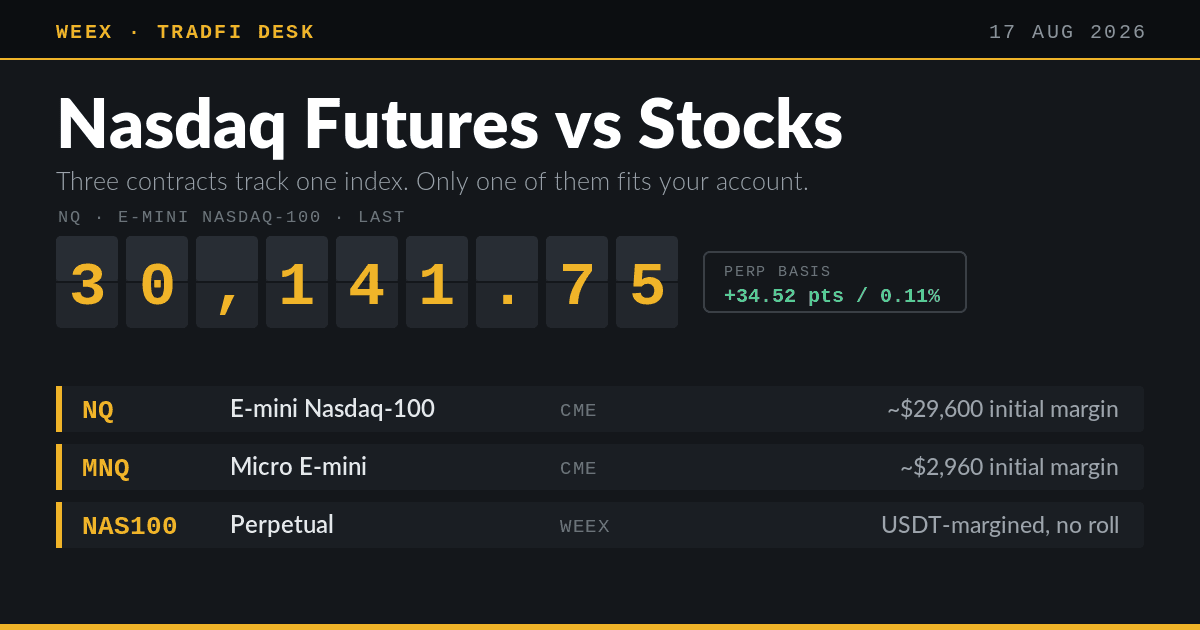
Nasdaq futures are contracts on the future value of the Nasdaq-100 index — not on any single Nasdaq stock. You are trading the index level, and the index level is what CNBC and Bloomberg are quoting at 6 a.m. when they say "futures are up." On 17 August 2026 the front-month E-mini Nasdaq-100 contract (NQ) was quoted at 30,141.75, after opening at 30,210.75 and trading a 30,028.50–30,283.00 range.
That number matters right now because the index has gone nearly vertical. Bloomberg reported on 5 August 2026 that a four-day tech melt-up added roughly $3.5 trillion to the Nasdaq-100's market capitalization, and the S&P 500 closed above 7,800 for the first time on 12 August 2026 on cooler inflation data. Traders who missed the cash move are looking at futures because futures let them take a position on the index itself, long or short, with leverage, outside U.S. cash-session hours.
This piece covers what Nasdaq futures actually are, where they are trading, whether they really predict the stock open, and — the part most guides skip — a side-by-side of the three contract sizes available to a retail account in 2026, including the USDT-margined NAS100 perpetual on WEEX and the $100,000 campaign currently running against it.
What Nasdaq futures are, and how they differ from Nasdaq stocks
A Nasdaq stock is ownership of one company. A Nasdaq future is a standardized contract whose value tracks the Nasdaq-100 index — the 100 largest non-financial companies listed on the exchange, weighted by modified market cap and dominated by a handful of megacap tech names.
Three practical consequences follow, and they are the reason index futures behave differently from a basket of the same shares:
- No single-name blowup risk. An earnings miss at one constituent moves the index by its weight, not by its full drawdown. That is diversification you get for free, and it is also why NQ rarely gives you a 20% overnight gap.
- Symmetry. Going short an index future is the same operation as going long. No borrow, no locate, no short-sale restriction.
- Leverage is built into the contract, not bolted on. You post margin, not the full notional. This is where most new futures traders get hurt, and we will come back to it.
The standard CME contract, E-mini Nasdaq-100 (ticker NQ), is worth $20 per index point. At 30,141.75, one NQ contract controls $602,835 of index exposure. The minimum tick is 0.25 index points, or $5. Contracts expire quarterly — March, June, September, December — and trade on Globex from Sunday 5:00 p.m. CT to Friday 4:00 p.m. CT, with a 60-minute halt each afternoon.
Where Nasdaq futures are trading right now (17 August 2026)
Two venues, two prices, one index. This is the cross-venue read as of 17 August 2026:
| Instrument | Venue | Last | Notes |
|---|---|---|---|
| E-mini Nasdaq-100 (NQ), front month | CME Globex | 30,141.75 | Open 30,210.75; day range 30,028.50–30,283.00 |
| NAS100/USDT perpetual | WEEX | 30,107.23 | No expiry; USDT-margined; funding paid periodically |
| Implied gap | — | 34.52 pts (0.11%) | Perp trading marginally below the dated future |
That 0.11% gap is not an arbitrage you should go chasing — it is a snapshot, and it moves. But it tells you something structurally useful: a perpetual index contract has no expiry to pull it back to the cash index, so it relies on a funding rate to keep it tethered. A dated future closes the gap on a fixed date; a perpetual closes it by charging one side of the book every funding interval. If you are holding an index perp for weeks rather than hours, funding is a real, compounding cost line, not a rounding error. Check the live rate on the NAS100/USDT perpetual page before you size a swing position.
Do Nasdaq futures actually predict the stock market open?
Partly. Futures tell you the direction and rough magnitude of the open, not the day's range.
Because NQ trades nearly around the clock, it absorbs overnight news — Asian and European sessions, earnings released after the U.S. close, macro prints — while cash equities sit idle. When futures are trading above fair value at 8 a.m. ET, the index is priced to open higher. That is a genuine signal.
What it is not: a forecast of where the index closes. Studies of pre-market ranges consistently find that the overnight range is a poor predictor of the cash-session range. Plenty of sessions open green on strong futures and close red. Treat futures as a sentiment thermometer, not a crystal ball.
One nuance specific to NQ: it is the most tech-weighted of the major U.S. index futures, so it exaggerates. When AI or semiconductor headlines drive the tape — which describes most of the last three months — NQ moves harder than ES (S&P 500) or YM (Dow) in both directions. That is why NQ is the preferred vehicle for traders who want the tech beta, and the reason it punishes oversized positions faster.
-- Price
NQ, MNQ, or a NAS100 perpetual: which one fits your account
This is the decision that actually matters, and most articles on Nasdaq futures skip it entirely. The three routes differ far more in capital requirement and account plumbing than in what they track.
| Item | E-mini NQ | Micro E-mini MNQ | WEEX NAS100/USDT perp |
|---|---|---|---|
| Value per index point | $20 | $2 | Set by position size in USDT |
| Notional at 30,141.75 | ~$602,835 | ~$60,284 | Flexible |
| Typical initial margin | ~$18,250 | ~$1,825 | Varies with chosen leverage, up to 100× on stocks/indices |
| Expiry | Quarterly (Mar/Jun/Sep/Dec) | Quarterly | None — perpetual |
| Margin asset | USD in a futures account | USD in a futures account | USDT only |
| Account needed | Futures broker + CME access | Futures broker + CME access | Existing WEEX spot/futures balance |
| Ongoing carry | Roll cost at each expiry | Roll cost at each expiry | Funding rate each interval |
Margin figures are indicative broker levels from late 2025; CME sets minimums and brokers set their own, often higher. Verify with your venue before trading.
Read it this way. NQ is for funded accounts that can absorb a 200-point adverse move without a margin call — 200 points is $4,000 on one contract. MNQ is the sane starting point for most retail traders; at $2 a point, a 200-point move is $400, which is survivable while you are still learning where your stops belong. The NAS100 perpetual is for traders whose capital already sits in USDT and who do not want to open a brokerage account, fund it in fiat, and manage quarterly rolls — the trade-off is that you take on funding-rate carry and exchange counterparty risk instead of CME clearing.
How to trade NAS100 index futures on WEEX
WEEX's TradFi product puts stock indices, single-name stock futures, gold, silver and crude oil on the same USDT margin as its crypto perpetuals. There is no separate TradFi account — the USDT in your spot or futures balance is the margin.
- Fund with USDT. On-chain deposit, OTC purchase, or internal transfer. USDT is the only accepted margin asset.
- Open the NAS100/USDT market under Futures → TradFi (top nav on web, bottom nav in the app).
- Set leverage deliberately. Indices and tokenized stocks go up to 100×; precious metals up to 400×; crude oil up to 50×. The availability of 100× is not a recommendation to use it — at 100×, a 1% adverse move is a full liquidation.
- Place the stop before the entry. WEEX supports take-profit and stop-loss at order entry. Use them.
- Check the session. WEEX's TradFi landing page advertises 24/7 access with thinner liquidity on weekends and holidays, while its Help Center guide to TradFi futures notes that some TradFi markets follow the underlying market's trading hours. Confirm the behaviour of the specific pair before you carry a position into a Friday close.
The $100K Global Market Rewards campaign — and the rule most people miss
WEEX is currently running Global Market Rewards, a $100,000 prize pool for trading gold and stocks on TradFi futures. The mechanics worth knowing:
| Rule | Detail |
|---|---|
| Prize pool | $100,000, shared across tasks |
| Who qualifies as "new" | Users who register during the event, plus existing users who have never made a TradFi trade |
| Excluded | Market makers and institutional accounts |
| Eligible pairs | All TradFi futures pairs under Futures → TradFi (web and app) |
| Volume that does not count | Zero-fee TradFi futures volume |
| Task stacking | Rewards per task are calculated independently and stack |
| Payout | Within seven working days of event end, first-come first-served while supplies last |
The trap is in row five. WEEX heavily promotes zero-fee TradFi trading, and zero-fee volume is explicitly excluded from this campaign's calculation. If you route your NAS100 volume through a zero-fee promotion, it will not count toward the leaderboard — check the Futures Rates section of the fee schedule to confirm which of your pairs carry a fee before you start grinding volume. Rewards are also first-come, first-served, which means the tail end of the event is worth less than the front.
Where Nasdaq futures traders actually lose money
Not on direction. On sizing and timing.
Leverage math that nobody does before the trade. At 30,141.75, one NQ contract is $602,835 of exposure against roughly $18,250 of margin — about 33× effective leverage before you touch a leverage slider. A 3% index move against you wipes the margin. Traders who came from crypto often assume "no leverage selected" means "low leverage" in futures. It does not; the leverage is in the contract multiplier.
The overnight gap. The Nasdaq-100 rallying 33% off a March low, as it has in 2026, means positioning is crowded and stops are clustered. Index futures gap through stop levels on macro surprises. A stop-loss is an instruction, not a guarantee of fill price.
Funding drift on perpetuals. In a persistent uptrend, longs typically pay funding. Hold a leveraged long index perp through a slow grind higher and funding can eat a meaningful share of the gain. Price the carry into the thesis.
Weekend and holiday liquidity. A 24/7 quote is not the same as a 24/7 market. When U.S. cash equities are shut, spreads on any index derivative widen and slippage rises. Size down or flatten.
Nasdaq futures give you clean, symmetric, leveraged exposure to the U.S. tech index without picking a single stock — and in 2026 there are three realistic ways in, at three very different capital levels. If you have a funded futures account, NQ and MNQ remain the deepest markets. If your capital is already in USDT, a USDT-margined Nasdaq futures perpetual removes the brokerage and fiat-funding step entirely, at the cost of funding carry and exchange risk. Either way, pick the contract that matches your account size before you pick a direction.
Ready to trade the index rather than guess the stock? Open the NAS100/USDT market on WEEX, start at low leverage, and check the Global Market Rewards terms if you want your volume to count.
FAQ
1. Are Nasdaq futures the same as Nasdaq stocks?
No. A Nasdaq stock is equity in one company. Nasdaq futures are contracts on the Nasdaq-100 index level, so they track the weighted performance of 100 companies at once and can be sold short as easily as bought.
2. How much money do I need to trade Nasdaq futures?
It depends on the contract. Indicative late-2025 initial margin was roughly $18,250 for one E-mini NQ and $1,825 for one Micro E-mini MNQ. A USDT-margined NAS100 perpetual has no fixed contract size, so the minimum is set by your chosen position size and leverage — but a small starting balance combined with high leverage is the fastest route to liquidation.
3. Do Nasdaq futures trade 24 hours?
CME's NQ trades from Sunday 5:00 p.m. CT to Friday 4:00 p.m. CT with a one-hour daily halt, so it is close to 24/5, not 24/7. WEEX advertises 24/7 access on TradFi pairs with reduced liquidity when traditional markets are closed; confirm the hours for the specific pair you are trading.
4. What was the Nasdaq futures price today?
On 17 August 2026, front-month E-mini Nasdaq-100 futures were quoted at 30,141.75 after opening at 30,210.75, with a 30,028.50–30,283.00 range. The WEEX NAS100/USDT perpetual was last at 30,107.23. Both figures move continuously; check a live quote before trading.
5. Why is the perpetual price different from the CME futures price?
Different instruments with different carry. A dated future converges to the index at expiry; a perpetual has no expiry and uses a periodic funding payment to stay near the index. The 34.5-point gap observed on 17 August 2026 reflects that structural difference plus venue-specific supply and demand.
6. Does zero-fee volume count toward the WEEX $100K campaign?
No. The Global Market Rewards terms state that zero-fee TradFi futures volume is not counted toward the event. Check the Futures Rates section of the fee schedule to see which pairs carry a fee.
Risk Warning
Nasdaq futures and index perpetual contracts are leveraged derivatives and can result in losses exceeding your initial margin, up to and including the total loss of the funds committed. Specific risks in this market include: liquidation risk, where high leverage means a small adverse index move closes your position at a loss; gap risk, where index futures can jump through stop levels on macro or earnings surprises so a stop-loss does not guarantee an execution price; funding-rate carry, which accrues against one side of a perpetual position and can erode returns on longer holds; liquidity risk during weekends, holidays and closures of the underlying U.S. cash market, when spreads widen and slippage increases; and counterparty risk, since perpetual index contracts on a crypto exchange are not centrally cleared the way CME contracts are. Prices and campaign terms cited here are as of 17 August 2026 and change without notice. This article is information, not investment advice. Only trade with capital you can afford to lose, and assess your own experience, financial position and risk tolerance before taking leveraged exposure.
This content is provided for general informational purposes only and doesn't constitute financial, investment, legal, or tax advice. Any events, rewards, online promotions, or related information mentioned herein should not be considered a recommendation, solicitation, or invitation to purchase, sell, trade, or otherwise deal in any crypto assets. Crypto assets are highly volatile and may result in loss. The availability of WEEX services, products, and related events may vary by region. You are responsible for ensuring that your participation is in accordance with applicable local laws and regulations.
You may also like
SMS 2FA vs Authenticator App: Which Is Actually Safer?

What Is 2FA? A Beginner's Guide

SNDK Stock Price Surges Past $1,700: What the Five-Day Winning Streak After Investor Day Actually Signals
OpenAI Stock Price: What Investors Who Want Exposure to ChatGPT Can Actually Buy Today
What Is OpenAI Stock? Why You Cannot Buy It Yet and What the IPO Timeline Actually Looks Like
XSolut, Stealth, or a Copycat? The XST Ticker Confusion Explained 2026
NVDA Stock Price Before August 26 Earnings: What Bank of America's $94-95 Billion Revenue Estimate Actually Requires
Nike Stock Price Prediction 2026-2027: Can NKE Recover After Hitting an 11 Year Low
How to Invest in XST Coin: What Due Diligence Actually Requires Before Buying XSolut

XST Coin on Coinbase: Why the Tokens You Find There Are Not the Real XSolut

XST Coin Has Fallen More Than 50% From Its All-Time High: What the Correction After the Peak Actually Means
SNDK Stock: Inside the 56% Crash and 76% Rebound of 2026
Kioxia Stock Before the Oct 1 Split: The 24/7 Perp Problem
Dow Jones Today: The 5.31% Yield Matters More Than the Dip
MRVL Stock Before August 27: The Number That Decides the Print
MU Stock Is Down 24% While Micron's Profits Hit Records
Why Is ZEC Price Up Today? Zcash Jumps 5% as Trading Volume Surges
Pakistan Stock Market Gains 23% in One Year: What Is Driving the PSX Rally?
PSX Today: KSE-100 Closes Above 180,500 as Trading Activity Surges
ZKsync (ZK) Price Today: How the Latest ZKsync Token Unlock Could Affect Trading Liquidity
ZKsync (ZK) Token Release Explained: Circulating Supply, Unlock Schedule and Market Impact
What Is Driving MANTA/USDT Volatility? Manta Network Tokenomics and Market Catalysts
MANTA Price Today: What Traders Are Watching Around the Latest Token Release
Ether.fi (ETHFI) Token Unlock on August 18, 2026: Release Size, Schedule and Market Impact
Is MU Stock Cheap at 20x Earnings Despite 346% Revenue Growth? What the Valuation Gap Actually Means
SPYB Price Holds Near Record After US Retail Sales Miss
New Street Upgrades MU Stock to Buy: What Reaching Multi-Trillion Market Cap Requires
BlackBerry Stock Up 125%: Why BB and BBX Are Not the Same
XST Coin Has $12,000 of Real Depth Behind a $31 Million Price
Netflix Stock Is Down 38%: What the Tape Is Pricing
SMS 2FA vs Authenticator App: Which Is Actually Safer?
What Is 2FA? A Beginner's Guide
SNDK Stock Price Surges Past $1,700: What the Five-Day Winning Streak After Investor Day Actually Signals
OpenAI Stock Price: What Investors Who Want Exposure to ChatGPT Can Actually Buy Today
What Is OpenAI Stock? Why You Cannot Buy It Yet and What the IPO Timeline Actually Looks Like
XSolut, Stealth, or a Copycat? The XST Ticker Confusion Explained 2026
Contents
Popular coins
Latest articles


