MRVL Stock Before August 27: The Number That Decides the Print

 Prefer us on Google

Marvell Technology closed at $234.33 on August 17, 2026, up 5.54% on the day, with another 0.73% added after hours to $236.04 (StockAnalysis, NASDAQ real-time). That price sits 29% below the 52-week high of $329.88 and roughly 3.8x above the 52-week low of $61.44. The gap between those two numbers is the whole story: MRVL stock has been one of the most violently re-rated names in semis this year, and it walks into a fiscal Q2 earnings report on August 27, 2026 carrying a forward P/E of 51x.
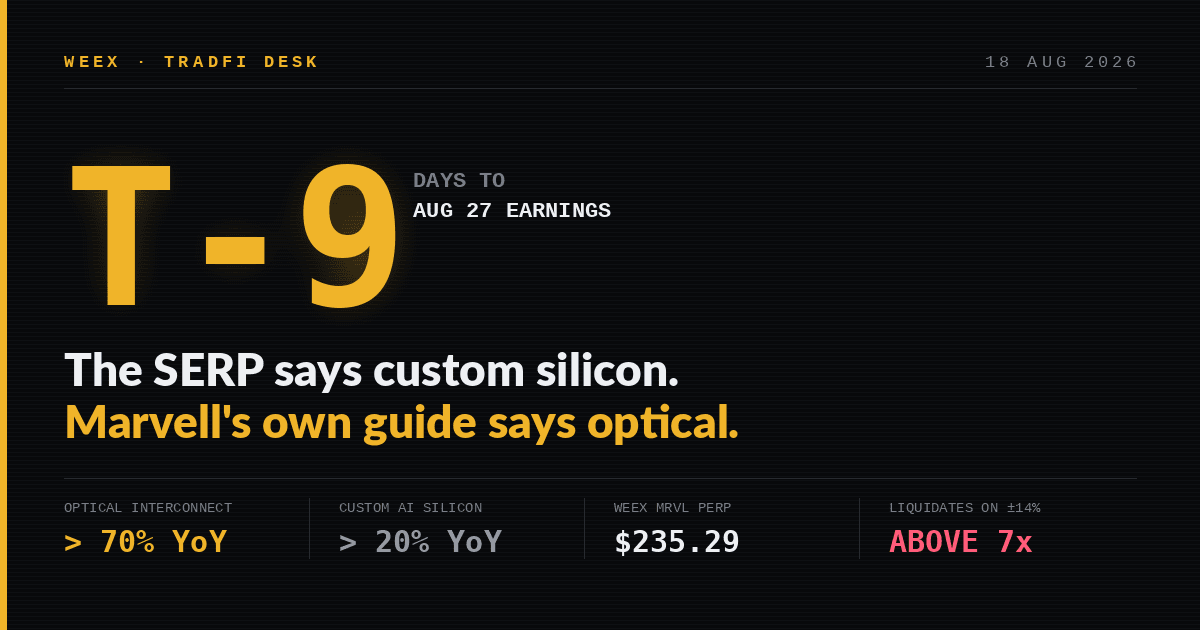
Most coverage of MRVL stock frames the re-rating as a bet on custom AI silicon — the bespoke accelerators Marvell designs for Amazon and Microsoft. That framing is popular and mostly wrong about the near term. Management's own fiscal 2027 guidance says optical interconnect grows above 70% year over year, while custom silicon grows above 20%. CEO Matt Murphy called interconnect "the standout of the group" on the Q1 call. If you are trading this print, that is the line item to watch.
MRVL stock: the numbers that frame the setup
| Metric | Value | As of |
|---|---|---|
| Share price | $234.33 (+5.54%) | Aug 17, 2026 close |
| Market cap | $205.22B | Aug 17, 2026 |
| Revenue (TTM) | $8.72B, +34.1% | Aug 17, 2026 |
| P/E (trailing) | 80.94 | Aug 17, 2026 |
| P/E (forward) | 51.44 | Aug 17, 2026 |
| Beta | 2.25 | Aug 17, 2026 |
| 52-week range | $61.44 – $329.88 | Aug 17, 2026 |
| Analyst consensus | Strong Buy, 43 analysts | Aug 18, 2026 |
| Average price target | $256.29 (+9.37%) | Aug 18, 2026 |
| Next earnings | Aug 27, 2026, after close | Confirmed by company |
| Investor Day | Oct 6, 2026 | Announced Aug 3, 2026 |
Source: StockAnalysis / S&P Global Market Intelligence, Marvell investor relations.
Two things stand out. A beta of 2.25 means MRVL stock has historically moved more than twice the market's daily swing — this is not a position you size like a broad semiconductor ETF. And a consensus target of $256.29 implies only 9.4% upside from here, which tells you the sell side has largely caught up to the price rather than run ahead of it. Goldman Sachs analyst James Schneider carries a Neutral rating at a $195 target, below the current price.
Why MRVL stock fell 29% from its high, then bounced
The drawdown was sector-wide, not company-specific. MRVL stock peaked at $329.48 in mid-June, then fell about 35% into early August as the entire AI-infrastructure trade unwound — MarketWatch counted 18 tech stocks down 30%+ during July alone, including Credo, Coherent and Astera Labs. Nothing in Marvell's guidance changed during that slide. Marvell joined the S&P 500 on June 22, 2026, which added index-fund demand near the top and made the subsequent unwind mechanically noisier.
The bounce off roughly $217 (August 12) has been driven by softer July PPI data reducing rate-hike odds, and by a Barron's-reported plan to restrict Chinese data-center components, which lifted Marvell alongside Corning and Lumentum. Neither is a fundamental catalyst. The fundamental catalyst is nine days away.
Interconnect versus custom silicon: what MRVL investors are mispricing
Marvell's Q1 FY2027 report set record revenue of $2.418 billion, up 28% year over year, with data center at $1.83 billion — 76% of total revenue. Operating cash flow hit a record $638.8 million; free cash flow after capex came to roughly $483 million.
Underneath that, the two AI businesses are moving at very different speeds.
| Segment | FY2027 growth guide | FY2028 signal | Market share |
|---|---|---|---|
| Optical interconnect (PAM4 DSPs, TIAs, drivers) | Above 70% YoY, raised from 50% | Continued build | Est. 60–65% of optical DSP |
| Custom AI silicon (Trainium, Maia 200) | Above 20% YoY | Expected to more than double | Est. 20–25% co-design, vs Broadcom ~70% |
The physics behind the split is straightforward. Past roughly 10 meters, copper cannot carry 800G or 1.6T signalling without unacceptable degradation, so GPU clusters spanning a data-center floor have to run on fiber. Every optical module in that fiber path needs a PAM4 DSP, and Marvell supplies the majority of them. Reasoning models and mixture-of-experts architectures push proportionally more work into the fabric between accelerators, which means more traffic across more fiber — a demand curve that scales with cluster size, not with any single chip design win.
Custom silicon is the bigger long-term prize: management targets a $10 billion run rate by fiscal 2029, with a design-win pipeline above 50 opportunities. But that revenue arrives in FY2028 and beyond. Marvell raised its FY2027 outlook to about $11.5 billion and FY2028 to about $16.5 billion — the latter roughly $1.5 billion above the figure given one quarter earlier. The company is also committing about $1 billion in FY2027 supply prepayments to lock foundry capacity, which is a real cash signal that management believes the demand.
The better reading: the 2026 re-rating in MRVL stock tracked guidance revisions, not the sector. That makes each earnings date a binary test of whether the revisions continue.
What the August 27 earnings report actually tests
| What lands | Consensus / guide | What would confirm the thesis |
|---|---|---|
| Q2 FY27 revenue | ~$2.71B (+35% YoY) | In line is neutral — company set this guide itself |
| Q2 FY27 non-GAAP EPS | ~$0.93 (+39% YoY) | Beat of similar size to Q1's $18M revenue beat |
| Interconnect FY27 growth | Above 70% | A raise to 80%+ is the bullish trigger |
| Custom silicon timing | Above 20% FY27, doubling FY28 | Specific ramp dates, not reaffirmed ambition |
| New hyperscaler win | Two disclosed (AWS, Microsoft) | A third named custom partner |
| Implied move | ±14% (~$30) per options market | Positioning matters more than direction |
Consensus figures per TipRanks; guidance per Marvell's Q1 FY2027 release.
Meeting the revenue number proves very little — Marvell wrote that guide. The Q1 beat was $18 million above management's own midpoint, which is a rounding error on a $2.4 billion quarter. What moves MRVL stock is the second raise: another lift to the interconnect growth line, or a third named custom-silicon customer. Absent one of those, a 51x forward multiple is being asked to hold on reaffirmation alone, and reaffirmation is not what a 51x multiple pays for.
Is MRVL stock a buy at 51x forward earnings?
That depends entirely on whether you think the guidance ladder keeps going up, and it is worth being honest that reasonable analysts disagree sharply — targets range from $110 to $385.
The bull case is durable share in a market with a structural moat. Optical module vendors like Lumentum, Coherent and Fabrinet design around a specific DSP, then spend years qualifying it with hyperscaler customers. Displacing an embedded DSP means restarting that certification cycle, which is why a 60–65% share has survived competition from Broadcom, Cisco's Acacia and Alphawave.
The bear case has three concrete parts. First, valuation: 51x forward against a semiconductor sector averaging closer to 31x leaves no cushion for a single soft quarter. Second, co-packaged optics — integrating the transceiver into the switch package would eliminate the pluggable module and, with it, the standalone PAM4 DSP. Nvidia confirmed its Spectrum-6 CPO switch shipping in August 2026. Marvell's February 2026 acquisition of Celestial AI is the hedge, and it is a defensive acquisition presented as an offensive one. Industry expectations put meaningful CPO displacement on a five-to-seven-year horizon, not next year — but the multiple is priced for no disruption at all. Third, customer concentration: hyperscaler capex is the entire demand curve, and it is decided by a handful of budget committees.
What traders usually get wrong here: they treat a Strong Buy consensus as a signal to size up. With 43 analysts on the name and a target implying 9% upside, the consensus is already in the price. The edge, if there is one, is in the interconnect guidance line — not in the rating.
How to trade MRVL price moves without a US brokerage
Direct ownership means a brokerage account with US market access, KYC, cross-border funding and market-hours-only execution. That path is closed or slow for a large share of global traders. The alternatives give price exposure without ownership — no voting rights, no dividend claim, no share certificate.
WEEX lists an MRVL/USDT perpetual for exactly this use case. As of August 17, 2026, 23:10 UTC, the WEEX MRVL derivatives market showed a last price of $235.29, a 24-hour volume of $94.95K, and moves of +10.63% over three days, +13.73% over seven days and +33.93% over thirty. Its all-time high of $339.43 on June 3, 2026 printed above the underlying's $329.88 cash high — a small but useful reminder that a derivative's tape can deviate from the equity's, especially in thin hours.
That deviation is the practical trap. The MRVL/USDT contract trades 24/7 while the Nasdaq listing does not. Earnings land after the US close on August 27, which means the perpetual absorbs the entire reaction during hours when the cash market is shut and depth is thinnest. Slippage on a market order into that window can be far worse than the headline spread suggests.
Leverage compounds it. With the options market pricing a ±14% swing, here is where a standard adverse move lands relative to approximate liquidation distance:
| Leverage | Approx. liquidation distance | Outcome on a -14% move |
|---|---|---|
| 2x | ~50% | Survives, -28% of margin |
| 5x | ~20% | Survives, -70% of margin |
| 10x | ~10% | Liquidated |
| 20x | ~5% | Liquidated early in the move |
| 100x | ~1% | Liquidated on noise, before the print |
Approximate figures excluding fees, funding and maintenance margin, which move liquidation closer. Directionally right is worthless if the position is closed before the move completes — and a 14% implied swing means anything above roughly 7x is a bet on not being wrong for even a moment.
For the full comparison of ownership versus exposure routes, the WEEX Wiki guide on MRVL trading alternatives covers CFDs, futures and tokenized structures side by side. Contract specifications, funding intervals and available leverage for the pair are on the MRVL/USDT futures page.
Where this leaves MRVL stock
MRVL stock is a leveraged bet on one specific thing: that Marvell keeps raising its own guidance. At $234.33, 29% off the high and 51x forward earnings, the market has already paid for continued upward revisions. The interconnect business — not the custom silicon headlines — is what has actually delivered them, and August 27 is where that either extends or breaks. Investor Day on October 6 is the second date to have marked.
If you want ownership and shareholder rights, a brokerage is the only route. If you want to express a view on the August 27 print without US market access, the MRVL/USDT perpetual on WEEX gives 24/7 directional exposure — but size it against a 14% implied move, not against your conviction.
FAQ
1. When does Marvell report earnings, and what do analysts expect?
Marvell reports fiscal Q2 2027 results after the US market close on August 27, 2026. Consensus sits at roughly $2.71 billion in revenue (+35% year over year) and non-GAAP EPS of about $0.93 (+39%), per TipRanks. The options market is pricing a swing of roughly ±14%, or about $30 per share.
2. Why is MRVL stock down from its high?
MRVL stock peaked at $329.48 in June 2026 and fell about 35% into early August during a broad AI-infrastructure unwind that hit the whole optical and custom-silicon complex. Marvell's guidance was not cut during that period. It closed at $234.33 on August 17, roughly 29% below the 52-week high.
3. Is MRVL stock a buy right now?
That is a judgment, not a fact, and analysts are split — targets run from $110 to $385, with a $256.29 average implying about 9% upside as of August 18, 2026. The bull case rests on 60–65% optical DSP share and repeated guidance raises. The bear case rests on a 51x forward multiple against a ~31x sector average, co-packaged optics as a medium-term threat, and total dependence on hyperscaler capex.
4. What is Marvell's optical interconnect business, and why does it matter more than custom silicon right now?
Interconnect covers the PAM4 DSPs, transimpedance amplifiers and laser drivers inside the optical modules that link servers, switches and GPUs. Marvell guided this segment to grow above 70% in fiscal 2027 against above 20% for custom silicon. Custom silicon is the larger long-term opportunity — management targets a $10 billion run rate by fiscal 2029 — but it contributes materially from fiscal 2028 onward.
5. Can I trade MRVL without a US brokerage account?
You can take price exposure without owning shares. WEEX lists an MRVL/USDT perpetual that settles in USDT and trades 24/7, so no US brokerage or cross-border bank transfer is required. It conveys no shareholder rights, no votes and no dividend claim, and it carries funding costs and liquidation risk that holding shares does not.
Risk Warning
Trading MRVL exposure through leveraged derivatives carries risk of partial or total loss of capital, and losses can exceed the initial margin in fast markets. MRVL has a beta of 2.25 and has moved in a $61.44–$329.88 range over the past 52 weeks; the options market implies a ±14% swing around the August 27, 2026 earnings release. Because the MRVL/USDT perpetual trades 24/7 while the Nasdaq listing does not, the entire earnings reaction can occur in low-liquidity hours, where slippage, gapping and funding-rate spikes are materially worse than in normal conditions — and at leverage above roughly 7x, a standard earnings move is sufficient to trigger liquidation regardless of direction. Perpetual contracts and tokenized equity products give price exposure only: no shareholder rights, no voting power, no dividend entitlement, and a derivative's price can deviate from the underlying share price. Additional exposures include counterparty and platform risk, regulatory changes affecting availability of stock-referenced crypto products in your jurisdiction, and concentration risk from Marvell's dependence on a small number of hyperscaler customers. Nothing here is investment advice. Confirm local eligibility and assess your own risk capacity before trading.
This content is provided for general informational purposes only and doesn't constitute financial, investment, legal, or tax advice. Any events, rewards, online promotions, or related information mentioned herein should not be considered a recommendation, solicitation, or invitation to purchase, sell, trade, or otherwise deal in any crypto assets. Crypto assets are highly volatile and may result in loss. The availability of WEEX services, products, and related events may vary by region. You are responsible for ensuring that your participation is in accordance with applicable local laws and regulations.
You may also like

Niulai Coin Price Prediction: What Happens to Meme Tokens After a Viral Peak on BNB Chain
SK Hynix Stock Price Has 43% Upside According to Wall Street: What the $245 Consensus Target Actually Requires

Tesla Stock Price Is Down 30% in 2026: What the Q2 Earnings Miss and 1.4% Operating Margin Actually Signal

MSFT Stock Price Prediction 2026-2027: What the $569 Analyst Consensus Target Actually Requires

SNDK Stock Price Surges Past $1,700: What the Five-Day Winning Streak After Investor Day Actually Signals
OpenAI Stock Price: What Investors Who Want Exposure to ChatGPT Can Actually Buy Today

What Is OpenAI Stock? Why You Cannot Buy It Yet and What the IPO Timeline Actually Looks Like
XSolut, Stealth, or a Copycat? The XST Ticker Confusion Explained 2026
NVDA Stock Price Before August 26 Earnings: What Bank of America's $94-95 Billion Revenue Estimate Actually Requires

Why Does XSolut (XST) Show Different Prices on CoinGecko, Phantom, and Solana DEXs? 2026 Guide

Niulai Coin Price Surges Over 200% in 24 Hours: What the Viral Film Story Actually Means for NIULAI
Nvidia Discloses a $21 Billion Stake in SpaceX: What the World's Largest AI Chipmaker Owning SPCX Actually Signals
How to Buy Niulai Coin: Where to Trade NIULAI and What to Check Before Buying
MU Stock Price Targets Range From $1,150 to $1,625: What UBS and New Street's AI Memory Thesis Actually Requires
Nike Stock and the China Sales Collapse: What a 30% Revenue Drop and Cutting Thousands of Distributors Actually Signals

What Is Niulai Coin? How a 342 Yuan Chinese Animated Film Spawned a Viral BNB Chain Meme Token
Nike Stock Price Prediction 2026-2027: Can NKE Recover After Hitting an 11 Year Low
Nike Stock Price Is Down 51% From Its 52 Week High: Is NKE a Buy at Current Levels

How to Invest in XST Coin: What Due Diligence Actually Requires Before Buying XSolut
Meta Stock Price Prediction 2026-2027: Can META Continue Climbing After the AI Infrastructure Surge
XST Coin on Coinbase: Why the Tokens You Find There Are Not the Real XSolut
XST Is Not a Stock: What XSolut Actually Is and How to Buy It Correctly
MU Stock Price Crosses $1,000 for the First Time Since July: What the Psychological Milestone Actually Signals

XST Coin Has Fallen More Than 50% From Its All-Time High: What the Correction After the Peak Actually Means

BTC to MYR: Why the Ringgit Price of Bitcoin Has Two Legs
Dow Jones Today: The 5.31% Yield Matters More Than the Dip
SNDK Stock: Inside the 56% Crash and 76% Rebound of 2026
SOXL Stock After the 63% Crash: The Math Traders Missed
Why Is ZEC Price Up Today? Zcash Jumps 5% as Trading Volume Surges
Pakistan Stock Market Gains 23% in One Year: What Is Driving the PSX Rally?
Niulai Coin Price Prediction: What Happens to Meme Tokens After a Viral Peak on BNB Chain
SK Hynix Stock Price Has 43% Upside According to Wall Street: What the $245 Consensus Target Actually Requires
Tesla Stock Price Is Down 30% in 2026: What the Q2 Earnings Miss and 1.4% Operating Margin Actually Signal
MSFT Stock Price Prediction 2026-2027: What the $569 Analyst Consensus Target Actually Requires
SNDK Stock Price Surges Past $1,700: What the Five-Day Winning Streak After Investor Day Actually Signals
OpenAI Stock Price: What Investors Who Want Exposure to ChatGPT Can Actually Buy Today
Contents
Popular coins
Latest articles