
Nike Stock and the China Sales Collapse: What a 30% Revenue Drop and Cutting Thousands of Distributors Actually Signals

 Prefer us on Google


Nike stock's China situation is the single most important variable in evaluating whether the current 52 week low represents a buying opportunity or the beginning of a more sustained decline.
Nike stock built its premium global valuation partly on the assumption that China would be the growth engine that sustained above average revenue expansion for the next decade. Nike stock's China reality in 2026 is the opposite of that assumption: a 30% revenue decline alongside a deliberate restriction of the distribution network that was generating the revenue that is now declining. Understanding why Nike made this specific decision and what it reveals about the state of the brand in China is more analytically useful than reacting to the 30% decline number alone.
What the 30% China Revenue Decline Actually Consists Of
Before evaluating what the China collapse signals, establishing what actually happened prevents the most common error in geographic revenue analysis, which is treating all declines as equivalent regardless of their cause.
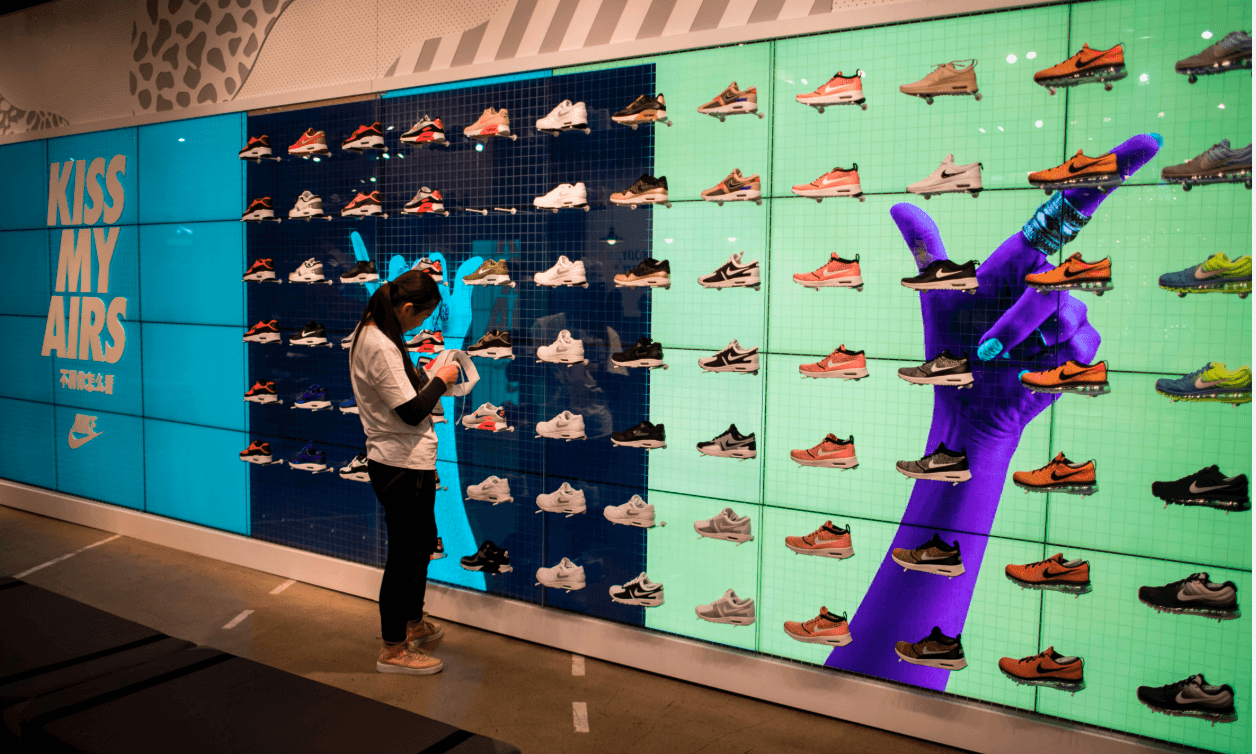
According to CNBC, Nike was once China's sneaker king but its sales have fallen approximately 30%. The decline is not a single-quarter anomaly driven by temporary consumer weakness. It reflects a multi-year erosion of Nike's aspirational brand premium in the Chinese market driven by competitive displacement from domestic brands including Anta and Li Ning rather than by macroeconomic factors alone.
The distinction between a cyclical revenue decline and a structural brand displacement is the most important analytical observation about Nike's China situation. A cyclical decline reverses when consumer spending recovers. A structural brand displacement requires Nike to rebuild the cultural relevance and aspirational positioning that allowed it to command premium prices relative to domestic competitors. Rebuilding brand position in a market where domestic competitors have already captured the aspiration premium is a multiyear undertaking rather than a one-quarter recovery.
The scale of the displacement is visible in how Anta and Li Ning have repositioned themselves. Both brands spent years developing technical performance products and cultural associations with Chinese national pride that have resonated with younger Chinese consumers in ways that Nike's global American brand identity has not. The competitive dynamic is not simply about price. Domestic Chinese brands are now competing with Nike at the premium tier rather than only at the value tier, which removes the category where Nike's brand premium was most defensible.
What Cutting Thousands of Distributors Actually Reveals
The decision to cut thousands of online distributors is the most strategically revealing element of Nike's China situation because it tells investors something specific about management's diagnosis of what went wrong rather than simply providing another data point about the revenue decline.
According to CNBC, Nike announced it would cut off thousands of online distributors in China, restricting franchise partners from selling Nike products through digital channels. The restructuring concentrates China e-commerce through Nike's own operated channels and major platforms including Tmall, Douyin, and JD.com. Nike confirmed this policy would take effect from January 2026 forward.
A company that cuts thousands of distributors is making a specific admission: the existing distribution model is producing outcomes that are inconsistent with the brand positioning the company wants to maintain. The most common reasons for distribution restriction in premium consumer goods are gray market pricing that undercuts official channels, proximity to counterfeit products that damages brand perception, and inconsistent customer experience that erodes the premium associations the brand depends on.
Nike's decision to restrict digital distribution to company-operated channels and major certified platforms is a brand protection strategy rather than a demand stimulus strategy. It accepts near-term revenue loss in exchange for better control over the pricing, presentation, and customer experience that define the premium brand position in the Chinese consumer's mind.
The strategic logic is defensible. A brand that is distributed through thousands of franchise partners operating digital channels independently has limited control over how its products are presented, priced, and positioned relative to competitors. Reclaiming that control by concentrating distribution is the correct long-term response to brand erosion regardless of the short-term revenue cost.
The risk is that the short-term revenue cost proves larger or longer than management anticipated. Cutting thousands of distributors removes revenue from channels that were generating sales even if those sales were occurring in ways that undermined brand positioning. The concentrated channels must recover that volume before the restructuring contributes to revenue recovery rather than revenue compression.
Why This Is a Brand Problem Not a Demand Problem
One of the most analytically significant distinctions in understanding Nike's China situation is the difference between a demand problem and a brand problem, because the two require fundamentally different responses and have fundamentally different recovery timelines.
A demand problem exists when consumers want Nike products but cannot afford them or are temporarily redirecting spending elsewhere. A demand problem resolves when consumer purchasing power recovers or when competing spending priorities diminish. The recovery is external and does not require Nike to change anything about its products or brand positioning.
A brand problem exists when consumers can afford Nike products but prefer domestic or competing alternatives even at equivalent or higher prices. A brand problem requires Nike to change something about its products, its cultural associations, or its distribution quality to restore the preference that has eroded. The recovery is internal and depends on Nike's own execution rather than on external economic improvement.
Nike's China situation is primarily a brand problem rather than a demand problem for a specific observable reason. Anta and Li Ning are not growing market share primarily by offering lower prices. They are growing by offering products with stronger domestic cultural resonance at prices that compete with Nike at the premium tier. A competitor gaining share on cultural resonance rather than price means the solution is not to lower prices but to rebuild cultural relevance, which is a longer and more uncertain process.
The distribution restructuring Nike is implementing addresses the brand problem at the channel level by improving the quality and consistency of how Nike products are presented and sold. But channel quality is a necessary condition for brand recovery rather than a sufficient one. Nike also needs products that resonate with Chinese consumers and cultural associations that compete with the domestic brand nationalism that Anta and Li Ning have successfully cultivated.
What China Represented in Nike's Historical Growth Story
Understanding why the China collapse matters so much for Nike's stock requires establishing what China represented in the investment thesis that supported the stock's historical premium valuation.
China was not a marginal revenue contributor for Nike. It was the market where the growth assumptions that justified the premium multiple were most clearly visible. A market of more than a billion consumers with a rapidly growing middle class aspiring to premium global brands seemed to offer Nike a multi-decade growth runway that domestic markets could not replicate.
The aspiration premium that Nike commanded in China was reflected in pricing power that exceeded what Nike achieved in North America and Europe. Chinese consumers historically paid premium prices for Nike products because the brand carried aspirational associations with global athletic culture that domestic brands had not yet challenged. That pricing power was the specific mechanism through which the China growth story contributed more than proportionally to Nike's earnings.
The 30% revenue decline erodes not only the current revenue but the growth runway assumption that supported the forward multiple. A market that was expected to grow becomes a market that is contracting, which requires investors to revise downward both the near-term revenue and the long-term earnings power that their valuation models assumed.
The stock's 52 week high of $80.17 reached in August 2025 according to CNBC embedded China assumptions that the subsequent 30% revenue decline has not supported. The 52-week low of $38.86 on August 17, 2026 according to CNBC and Investing.com reflects the market's revised assessment of those assumptions rather than a comprehensive repricing of all of Nike's global business.
How the India and Southeast Asia Opportunity Compares
One narrative that Nike's management and some analyst coverage has offered alongside the China decline is the potential for India and Southeast Asia to partially offset the lost growth runway.
India is a growing market for athletic footwear and apparel with a demographic profile that resembles what China looked like a decade ago. Nike has been increasing its marketing and distribution investment in India as a forward-looking hedge against the China deterioration.
The problem with the India offset argument is one of scale and timing. China's contribution to Nike's revenue and earnings was built over decades of patient brand investment and distribution development. India's contribution is currently a fraction of China's even in the optimistic scenario, and the time required to build India into a comparable revenue contributor is measured in years rather than quarters.
Southeast Asian markets including Vietnam, Indonesia, and the Philippines offer additional growth potential that Nike is pursuing, but the aggregate of these markets would need to grow substantially to offset the magnitude of China's decline. The arithmetic of the replacement is challenging because the markets being proposed as offsets are at earlier stages of development than China was when Nike's China investment began producing the returns that supported the premium multiple.
What the Wembanyama Bet Means in the China Context
Nike's recently announced partnership with Victor Wembanyama is the most visible current attempt to create a new signature athlete relationship that could rebuild the aspirational brand positioning that the China decline reflects has eroded.
Wembanyama is the most talented young player in the NBA and potentially the defining player of the next generation of basketball. A signature Nike relationship with Wembanyama at the peak of his potential arc is the playbook that produced the Jordan and LeBron relationships that defined Nike's dominance in premium basketball footwear for decades.
In the China context, the Wembanyama bet is relevant because basketball has historically been the cultural entry point through which Nike established aspirational positioning with Chinese consumers. The Jordan brand remains one of Nike's most resilient premium assets in China even as the broader Nike brand has lost ground to domestic competitors.
The risk is timing. Signature athlete products take years to reach peak cultural and commercial impact. Wembanyama's influence on Chinese consumer preference for Nike products will be a 2028 or 2030 story rather than a near-term catalyst for the 30% revenue recovery. Investors evaluating whether the China collapse signals a temporary setback or a permanent impairment need to hold that distinction clearly between the long-term brand recovery potential and the near-term revenue trajectory.
What the Distribution Restructuring Requires to Succeed
The distribution restructuring that Nike is implementing in China has a specific logic and a specific set of conditions that must be met for it to produce the revenue recovery that justifies the near-term revenue sacrifice.
The restructuring requires Nike's own operated digital channels and the major platforms including Tmall, Douyin, and JD.com to recapture the volume that thousands of franchise digital channels were previously generating. That volume recovery depends on three things that are not guaranteed by the structural change alone.
First, Nike's owned digital experience must be superior to the distributed franchise experience in ways that Chinese consumers find compelling enough to transact through fewer channels rather than the broader distribution they previously accessed. A better brand experience requires better content, better product storytelling, and better service than the franchise network provided.
Second, Nike's pricing on the concentrated platforms must be consistent enough to eliminate the arbitrage opportunities that fragmented distribution created. If franchise channels were offering discounts that attracted Chinese consumers, consolidating to fewer channels at higher prices may reduce volume further rather than improving it.
Third, the brand investment required to drive traffic to the concentrated channels must be sufficient to compensate for the organic discovery that broader distribution facilitated. Thousands of franchise channels represented thousands of access points that required no incremental marketing investment from Nike. Replacing those access points with company-operated channels requires marketing investment to drive awareness and conversion that the franchise network previously generated through its own commercial interests.
For those looking to participate in global financial markets, having access to the right trading platform matters. WEEX offers crypto and stock trading products, covering major global markets including stocks and digital assets.
Conclusion
Nike stock's China situation signals a brand displacement problem rather than a demand problem, and the distinction matters enormously for evaluating the investment case at the current 52-week low.
The 30% revenue decline according to CNBC reflects Anta and Li Ning competing with Nike at the premium tier on cultural resonance rather than only on price, which is a structural competitive challenge that distribution restructuring alone cannot resolve. The decision to cut thousands of online distributors according to CNBC reflects management's diagnosis that channel quality was contributing to brand erosion, which is a defensible strategic response. But channel improvement is a necessary condition for brand recovery rather than a sufficient one.
The recovery thesis requires Nike to rebuild cultural relevance in China through better products, stronger athlete associations, and improved digital experience simultaneously rather than sequentially. The Wembanyama bet is the most visible element of the athlete association strategy, but its contribution to China revenue is a 2028 or 2030 story. The distribution restructuring's contribution to China revenue recovery will be visible in the next several quarters of financial results. And the product innovation required to compete with Anta and Li Ning at the premium tier is the most uncertain and most important element of the recovery that the current stock price does not yet have observable evidence to evaluate.
FAQ
1. Why have Nike's China sales fallen approximately 30%?
According to CNBC, Nike was once China's sneaker king but its sales have fallen approximately 30% reflecting competitive displacement from domestic brands including Anta and Li Ning rather than temporary consumer weakness alone. These domestic brands have developed premium products with Chinese national pride associations that resonate with younger Chinese consumers in ways that Nike's global American brand identity has not matched. The displacement is occurring at the premium tier rather than only the value tier, which makes it a brand problem requiring brand investment to resolve rather than a pricing or macro problem that resolves independently.
2. Why is Nike cutting thousands of China distributors and what does it mean?
According to CNBC, Nike announced it would restrict franchise partners from selling through digital channels and cut off thousands of online distributors, concentrating China e-commerce through Nike-operated channels and major platforms including Tmall, Douyin, and JD.com. The decision reflects management's assessment that distributed franchise digital channels were producing brand experiences inconsistent with Nike's premium positioning, including gray market pricing and inconsistent presentation. The strategy accepts near-term revenue loss in exchange for better control over how Nike products are presented and priced in China's digital retail environment.
3. Is Nike's China problem structural or cyclical?
The evidence available suggests the problem is primarily structural rather than cyclical. Anta and Li Ning are gaining share by competing on cultural resonance and product quality at the premium tier rather than only on price, which indicates Chinese consumers are actively preferring domestic brands rather than temporarily redirecting spending. A structural problem requires Nike to rebuild cultural relevance through products, athlete associations, and brand investment rather than waiting for macroeconomic improvement. The distribution restructuring addresses channel quality, which is necessary but not sufficient for brand recovery.
4. What does the distribution restructuring need to achieve to succeed?
The restructuring requires Nike's owned digital channels and the major platforms including Tmall, Douyin, and JD.com to recapture the volume that thousands of franchise channels previously generated. That requires the owned digital experience to be superior to the distributed franchise experience, pricing consistency that eliminates the discount arbitrage that fragmented distribution created, and marketing investment sufficient to drive traffic to concentrated channels that the franchise network previously generated through its own commercial interests. All three conditions must be met simultaneously rather than sequentially for the restructuring to produce revenue recovery rather than extended compression.
5. What is the most important signal for whether Nike's China recovery is working?
Sequential quarterly China revenue results over the next several reporting periods are the most specific available indicator of whether the distribution restructuring is recapturing volume from the concentrated channels. A stabilization of the decline followed by sequential improvement would confirm that the channel quality improvement is attracting Chinese consumers to the owned platforms. Continued decline after the franchise cutoff would indicate that the volume loss from distribution restriction exceeds the quality improvement's ability to compensate, extending the China recovery timeline beyond what the current stock price at the 52-week low already reflects.
This content is provided for general informational purposes only and doesn't constitute financial, investment, legal, or tax advice. Any events, rewards, online promotions, or related information mentioned herein should not be considered a recommendation, solicitation, or invitation to purchase, sell, trade, or otherwise deal in any crypto assets. Crypto assets are highly volatile and may result in loss. The availability of WEEX services, products, and related events may vary by region. You are responsible for ensuring that your participation is in accordance with applicable local laws and regulations.
You may also like

Niulai Coin Price Prediction: What Happens to Meme Tokens After a Viral Peak on BNB Chain
SK Hynix Stock Price Has 43% Upside According to Wall Street: What the $245 Consensus Target Actually Requires

Tesla Stock Price Is Down 30% in 2026: What the Q2 Earnings Miss and 1.4% Operating Margin Actually Signal

MSFT Stock Price Prediction 2026-2027: What the $569 Analyst Consensus Target Actually Requires

SNDK Stock Price Surges Past $1,700: What the Five-Day Winning Streak After Investor Day Actually Signals
OpenAI Stock Price: What Investors Who Want Exposure to ChatGPT Can Actually Buy Today

What Is OpenAI Stock? Why You Cannot Buy It Yet and What the IPO Timeline Actually Looks Like
XSolut, Stealth, or a Copycat? The XST Ticker Confusion Explained 2026
NVDA Stock Price Before August 26 Earnings: What Bank of America's $94-95 Billion Revenue Estimate Actually Requires

Why Does XSolut (XST) Show Different Prices on CoinGecko, Phantom, and Solana DEXs? 2026 Guide

Niulai Coin Price Surges Over 200% in 24 Hours: What the Viral Film Story Actually Means for NIULAI
Nvidia Discloses a $21 Billion Stake in SpaceX: What the World's Largest AI Chipmaker Owning SPCX Actually Signals
How to Buy Niulai Coin: Where to Trade NIULAI and What to Check Before Buying
MU Stock Price Targets Range From $1,150 to $1,625: What UBS and New Street's AI Memory Thesis Actually Requires

What Is Niulai Coin? How a 342 Yuan Chinese Animated Film Spawned a Viral BNB Chain Meme Token
Nike Stock Price Prediction 2026-2027: Can NKE Recover After Hitting an 11 Year Low
Nike Stock Price Is Down 51% From Its 52 Week High: Is NKE a Buy at Current Levels

How to Invest in XST Coin: What Due Diligence Actually Requires Before Buying XSolut
Meta Stock Price Prediction 2026-2027: Can META Continue Climbing After the AI Infrastructure Surge
XST Coin on Coinbase: Why the Tokens You Find There Are Not the Real XSolut
XST Is Not a Stock: What XSolut Actually Is and How to Buy It Correctly
MU Stock Price Crosses $1,000 for the First Time Since July: What the Psychological Milestone Actually Signals

XST Coin Has Fallen More Than 50% From Its All-Time High: What the Correction After the Peak Actually Means

BTC to MYR: Why the Ringgit Price of Bitcoin Has Two Legs
MRVL Stock Before August 27: The Number That Decides the Print
Dow Jones Today: The 5.31% Yield Matters More Than the Dip
SNDK Stock: Inside the 56% Crash and 76% Rebound of 2026
SOXL Stock After the 63% Crash: The Math Traders Missed
Why Is ZEC Price Up Today? Zcash Jumps 5% as Trading Volume Surges
Pakistan Stock Market Gains 23% in One Year: What Is Driving the PSX Rally?
Niulai Coin Price Prediction: What Happens to Meme Tokens After a Viral Peak on BNB Chain
SK Hynix Stock Price Has 43% Upside According to Wall Street: What the $245 Consensus Target Actually Requires
Tesla Stock Price Is Down 30% in 2026: What the Q2 Earnings Miss and 1.4% Operating Margin Actually Signal
MSFT Stock Price Prediction 2026-2027: What the $569 Analyst Consensus Target Actually Requires
SNDK Stock Price Surges Past $1,700: What the Five-Day Winning Streak After Investor Day Actually Signals
OpenAI Stock Price: What Investors Who Want Exposure to ChatGPT Can Actually Buy Today
Contents
Popular coins
Latest articles


