
SNDK Stock: Inside the 56% Crash and 76% Rebound of 2026

 Prefer us on Google

SNDK stock closed at $1,786.85 on August 17, 2026, up 8.88% on the day and roughly 76% above the $1,015.89 close it printed on July 29 (StockAnalysis, S&P Global Market Intelligence data). Seven weeks before that low, the same stock closed at $2,335.00. A name that swings 56% down and 76% back up inside two months is no longer trading like a memory stock — it is trading like a leveraged bet on the AI storage cycle, and that changes what you need to know before you touch it.
Most SNDK stock pages will give you the quote, the analyst target and a company blurb. This one covers what actually moved the price in the last eight weeks, what the August 5 earnings and August 13 Investor Day changed about the fundamentals, and — the part that gets people liquidated — what it means to hold this level of volatility on a 24/7 perpetual contract when Nasdaq is closed.
Why SNDK stock rallied 40% in four sessions
The August move has three separate catalysts stacked on top of each other, and it helps to keep them apart.
The first is earnings. SanDisk reported fiscal Q4 2026 on August 5: revenue of $8.97 billion, up 51% sequentially, with GAAP net income of $6.90 billion and diluted EPS of $43.97. Management attributed roughly one-third of the sequential growth to volume and two-thirds to pricing — a critical detail, because price-led growth is the part that reverses fastest if NAND supply loosens.
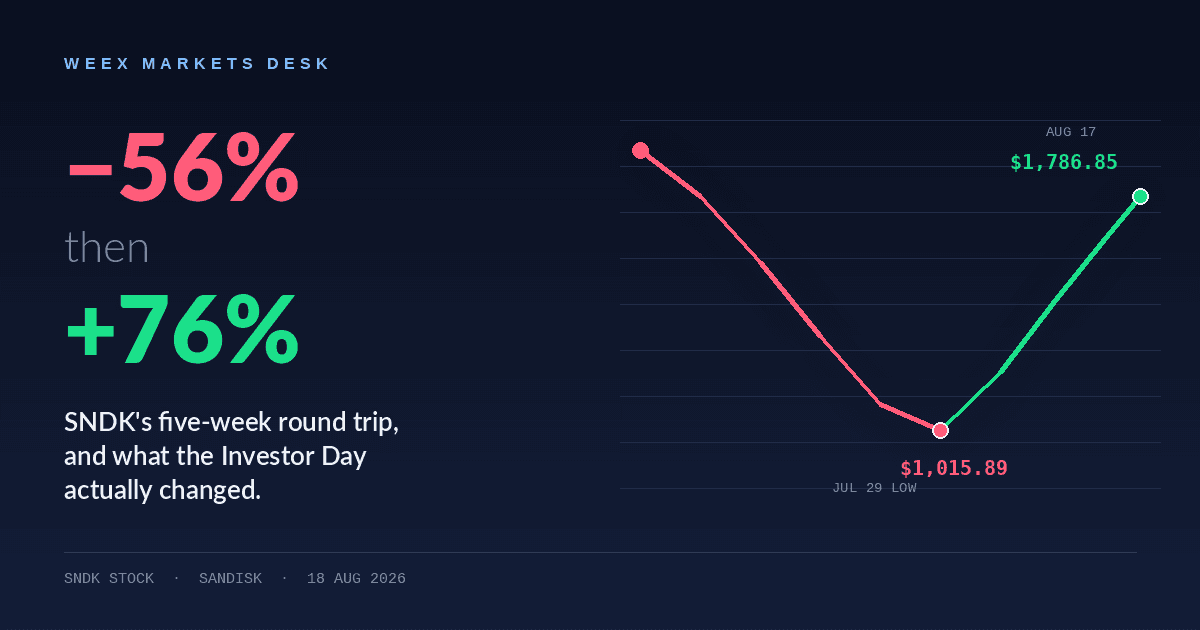
The second is the August 13 Investor Day, where SanDisk laid out an FY2028–FY2030 financial model: mid-to-high-teens revenue growth, roughly 80% non-GAAP gross margin, about 75% operating margin, and a 50% adjusted free cash flow margin. Shares rose 13.67% that day. Evercore ISI and Citi flagged multi-year demand visibility; Wells Fargo raised its target to $1,550 but kept an Equal Weight rating — a useful reminder that "the targets are impressive" and "the stock is cheap" are different claims.
The third is sentiment and flows: a Bernstein note calling SanDisk's High Bandwidth Flash a "game changer for AI," a Morgan Stanley upgrade on August 17, and broad memory-sector strength that also carried Micron and SK Hynix higher the same week.
The June–July round trip that reset SNDK stock
This is the table the generic quote pages do not build, and it is the single most useful thing to have in front of you before sizing a position.
| Date (2026) | SNDK close | Move from prior marker | What happened |
|---|---|---|---|
| Jun 25 | $2,335.00 | — | Cycle-high close; 52-week high of $2,354.39 set intraday in June |
| Jul 29 | $1,015.89 | −56.5% | July finished down 47%; forced deleveraging, not an earnings miss |
| Aug 5 | — | — | FQ4 results: $8.97B revenue, $43.97 diluted EPS |
| Aug 13 | — | +13.67% on the day | Investor Day FY28–30 model: ~80% GM, ~75% OM |
| Aug 17 | $1,786.85 | +75.9% from the low | Morgan Stanley upgrade; still ~24% below the 52-week high |
Prices from StockAnalysis.com and reported coverage, as of the August 17, 2026 close.
The July collapse is the part worth understanding, because it had little to do with SanDisk's business. Reporting from Business Insider and MarketWatch tied the drawdown to concentrated forced selling: Leopold Aschenbrenner's Situational Awareness fund had built stakes reported at over $5 billion across SanDisk and Micron before blowing up in July, with filings showing more than three-quarters of the fund in five positions. A crowded, leveraged holder unwinding into a tech selloff is a liquidity event, not a fundamental one — which is exactly why the stock could recover 76% within three weeks once the seller was gone.
The better reading: SNDK's 2026 range is being set by positioning as much as by NAND pricing. That cuts both ways.
What SanDisk's numbers actually say
| Metric | Value | Note |
|---|---|---|
| Market cap | $266.24B | Up ~3,798% year over year |
| Revenue (TTM) | $20.25B | +175.3% |
| Net income (TTM) | $11.43B | — |
| EPS (TTM) | $73.76 | Shares out: 149.00M |
| P/E (trailing) | 24.23 | — |
| Forward P/E | 8.32 | The entire bull case, in one number |
| 52-week range | $43.20 – $2,354.39 | — |
| Dividend | None | 100% of excess FCF pledged to buybacks |
Source: StockAnalysis.com / S&P Global Market Intelligence, as of August 17, 2026.
That trailing-24x versus forward-8x gap is the argument. If consensus FY2027 earnings land, SNDK is cheap on forward numbers. If NAND pricing rolls over — and two-thirds of last quarter's sequential growth was price, not volume — the forward multiple was never real, because the E in the denominator collapses first.
SanDisk's answer to that objection is contractual. Management said New Business Model agreements with eight customers now cover roughly two-thirds of bit supply for fiscal 2028, and expects NBM agreements to account for 50%+ of bits in FY2027. Locking in multi-year pricing is genuinely how you de-cyclicalize a commodity memory business. It is also unproven through a downturn, and it is the assumption doing the most work in every bull model on the street.
SNDK stock forecast: read the dispersion, not the average
The consensus 12-month target is $2,094.41 across 23 analysts, a "Buy" rating and about 17% upside from the August 17 close. Treat that number with suspicion. The individual targets run from $1,000 to $3,600 — a 3.6x spread between the most bearish and most bullish analyst on the same stock, on the same day.
An average is only informative when the underlying estimates cluster. Here they do not. What the spread is actually telling you is that professional analysts cannot agree on whether the NAND supercycle is a two-year pull-forward or a structural repricing of memory. The $1,000 target and the $3,600 target are not fine-tuned versions of the same model; they are opposite theses. Anyone quoting the $2,094 average as a forecast is averaging a coin flip.
How to trade SNDK stock 24/7 without a US brokerage
A US brokerage account buys you actual SanDisk shares during Nasdaq hours, 9:30–16:00 ET. That is the clean route, and for most long-term holders it is the correct one.
The alternative is a derivative that tracks the price. WEEX lists an SNDK/USDT perpetual contract — quoted at 1,750.31 on August 18, 2026 — with long and short direction and leverage up to 100x, no US brokerage account required. Traders running the memory-sector pair trade can hold it against the MU perpetual, quoted at 953.61 the same day, to express a relative view on SanDisk versus Micron rather than a directional bet on the whole cycle. For the standing explainer on the ticker, the listing and the tokenized-stock route, see WEEX's SanDisk stock (SNDK) overview.
| US brokerage (SNDK) | SNDK perpetual on WEEX | |
|---|---|---|
| What you hold | SanDisk common stock | A contract tracking SNDK's price |
| Shareholder rights | Yes | No — price exposure only |
| Trading hours | Nasdaq hours only | 24/7, including when Nasdaq is shut |
| Direction | Long (short requires margin approval) | Long or short |
| Leverage | Broker-dependent, typically low | Up to 100x |
| Ongoing cost | Margin interest, if borrowing | Funding payments every settlement period |
| Main risk | Price decline | Liquidation, funding drag, tracking difference |
What usually blows up leveraged SNDK positions
Three things, in order of how often they do the damage.
Gap risk across the close. The perpetual trades continuously; SanDisk shares do not. News that hits at 6pm ET on a Friday gets priced into the contract over the weekend with no Nasdaq reference and thinner books. If you are levered and asleep, you are not managing that gap — you are hoping through it.
Leverage arithmetic against this specific stock's realized volatility. SNDK fell 56.5% in five weeks and rose 8.88% in a single session this week. At 10x, an adverse move of roughly 11% before fees exhausts your margin. A position sized as though this were a normal large-cap semiconductor name will be liquidated on a routine day, and liquidation is permanent in a way a drawdown is not — the July 29 buyers made 76% precisely because the July 28 leveraged holders had already been forced out at the bottom.
Funding drag on the crowded side. When a perpetual trades at a persistent premium — which is what happens in a euphoric rally like the past four sessions — longs pay shorts at each settlement. Held through a flat month, that cost is real and compounds against you even if the price does exactly nothing.
The July episode is the whole lesson in one data point. The fund with the biggest, most concentrated bullish position on SanDisk was right about the AI storage thesis and still blew up, because it was wrong about survivable size. Being right about direction and wrong about leverage produces the same outcome as being wrong about everything.
The bottom line on SNDK stock
SanDisk's business inflected genuinely: $8.97 billion in fiscal Q4 revenue, $11.43 billion of trailing net income, and a supply book that is increasingly contracted rather than spot-priced. But SNDK stock now carries crypto-grade volatility on top of a semiconductor cycle, and the August rebound has not repaired the structure that produced a 56% drawdown — it has only moved the entry point. If you trade SNDK stock, size it for a name that can lose half its value in five weeks without a single piece of bad company news, and decide in advance whether you want ownership or exposure. Those are different products with different failure modes.
FAQ
1. Why did SNDK stock crash in July 2026?
Not because of earnings. SanDisk fell from a $2,335.00 close on June 25 to $1,015.89 on July 29 — down 56.5% — during a broad tech selloff amplified by the collapse of a concentrated leveraged fund that held reported stakes of over $5 billion across SanDisk and Micron. The company reported record results two weeks later.
2. What is SanDisk's 12-month price target?
The consensus across 23 analysts is $2,094.41, about 17% above the August 17, 2026 close, with a "Buy" rating. The individual estimates range from $1,000 to $3,600, so the dispersion matters more than the average.
3. Does SanDisk pay a dividend?
No. SanDisk retains earnings and has committed to returning 100% of excess free cash flow to shareholders, primarily through buybacks — $15.5 billion of authorization remained after $4.5 billion of fiscal Q4 repurchases.
4. Can I trade SNDK stock outside US market hours?
Not as equity. Nasdaq trades 9:30–16:00 ET. A perpetual futures contract on SNDK trades continuously, which is an advantage for reacting to news and a hazard for holding leverage through weekend gaps.
5. Is a SNDK perpetual contract the same as owning SanDisk stock?
No. It tracks the share price and carries no shareholder rights, no dividend entitlement and no claim on the company. Its market price can also deviate from the underlying, and funding payments apply for as long as the position stays open.
6. What is the single biggest risk in SNDK stock right now?
NAND pricing. Roughly two-thirds of last quarter's sequential revenue growth came from higher prices rather than higher volumes, so a loosening in memory supply hits revenue and margin at the same time — and the forward P/E of 8.32 that underpins the bull case assumes it does not.
Risk Warning
SNDK stock and SNDK-linked derivatives are highly volatile and can result in partial or total loss of capital. SanDisk shares fell 56.5% in five weeks during June–July 2026 and have since rebounded roughly 76% off the low, with a 52-week range of $43.20 to $2,354.39. NAND flash pricing is cyclical, and a supply loosening would compress revenue and margin simultaneously. A perpetual futures position is not stock ownership: it carries no shareholder rights, its price can deviate from the underlying, funding payments accrue against the crowded side, leverage magnifies losses as well as gains, and liquidation can occur on gaps that open while the underlying market is closed — including over weekends. Analyst targets ranging from $1,000 to $3,600 reflect genuine disagreement about the cycle, not a settled forecast. All figures are as of August 17–18, 2026 and change continuously. This content is for information only and is not investment advice.
This content is provided for general informational purposes only and doesn't constitute financial, investment, legal, or tax advice. Any events, rewards, online promotions, or related information mentioned herein should not be considered a recommendation, solicitation, or invitation to purchase, sell, trade, or otherwise deal in any crypto assets. Crypto assets are highly volatile and may result in loss. The availability of WEEX services, products, and related events may vary by region. You are responsible for ensuring that your participation is in accordance with applicable local laws and regulations.
You may also like
Niulai Coin Price Prediction: What Happens to Meme Tokens After a Viral Peak on BNB Chain
SK Hynix Stock Price Has 43% Upside According to Wall Street: What the $245 Consensus Target Actually Requires

Tesla Stock Price Is Down 30% in 2026: What the Q2 Earnings Miss and 1.4% Operating Margin Actually Signal
MSFT Stock Price Prediction 2026-2027: What the $569 Analyst Consensus Target Actually Requires

SNDK Stock Price Surges Past $1,700: What the Five-Day Winning Streak After Investor Day Actually Signals
OpenAI Stock Price: What Investors Who Want Exposure to ChatGPT Can Actually Buy Today

What Is OpenAI Stock? Why You Cannot Buy It Yet and What the IPO Timeline Actually Looks Like
XSolut, Stealth, or a Copycat? The XST Ticker Confusion Explained 2026
NVDA Stock Price Before August 26 Earnings: What Bank of America's $94-95 Billion Revenue Estimate Actually Requires

Why Does XSolut (XST) Show Different Prices on CoinGecko, Phantom, and Solana DEXs? 2026 Guide

Niulai Coin Price Surges Over 200% in 24 Hours: What the Viral Film Story Actually Means for NIULAI
Nvidia Discloses a $21 Billion Stake in SpaceX: What the World's Largest AI Chipmaker Owning SPCX Actually Signals
How to Buy Niulai Coin: Where to Trade NIULAI and What to Check Before Buying
MU Stock Price Targets Range From $1,150 to $1,625: What UBS and New Street's AI Memory Thesis Actually Requires
Nike Stock and the China Sales Collapse: What a 30% Revenue Drop and Cutting Thousands of Distributors Actually Signals
What Is Niulai Coin? How a 342 Yuan Chinese Animated Film Spawned a Viral BNB Chain Meme Token
Nike Stock Price Prediction 2026-2027: Can NKE Recover After Hitting an 11 Year Low
Nike Stock Price Is Down 51% From Its 52 Week High: Is NKE a Buy at Current Levels

How to Invest in XST Coin: What Due Diligence Actually Requires Before Buying XSolut
Meta Stock Price Prediction 2026-2027: Can META Continue Climbing After the AI Infrastructure Surge
XST Coin on Coinbase: Why the Tokens You Find There Are Not the Real XSolut
XST Is Not a Stock: What XSolut Actually Is and How to Buy It Correctly
MU Stock Price Crosses $1,000 for the First Time Since July: What the Psychological Milestone Actually Signals

XST Coin Has Fallen More Than 50% From Its All-Time High: What the Correction After the Peak Actually Means

BTC to MYR: Why the Ringgit Price of Bitcoin Has Two Legs
MRVL Stock Before August 27: The Number That Decides the Print
Dow Jones Today: The 5.31% Yield Matters More Than the Dip
SOXL Stock After the 63% Crash: The Math Traders Missed
Why Is ZEC Price Up Today? Zcash Jumps 5% as Trading Volume Surges
Pakistan Stock Market Gains 23% in One Year: What Is Driving the PSX Rally?
Niulai Coin Price Prediction: What Happens to Meme Tokens After a Viral Peak on BNB Chain
SK Hynix Stock Price Has 43% Upside According to Wall Street: What the $245 Consensus Target Actually Requires
Tesla Stock Price Is Down 30% in 2026: What the Q2 Earnings Miss and 1.4% Operating Margin Actually Signal
MSFT Stock Price Prediction 2026-2027: What the $569 Analyst Consensus Target Actually Requires
SNDK Stock Price Surges Past $1,700: What the Five-Day Winning Streak After Investor Day Actually Signals
OpenAI Stock Price: What Investors Who Want Exposure to ChatGPT Can Actually Buy Today
Contents
Popular coins
Latest articles


