
HBAR Price Spike and Reversal: Long, Short, and Stop-Loss Orders

 Prefer us on Google


HBAR's price went vertical on September 29, 2026, and came back down almost as fast. Hedera's token rose 22.6% to $0.1188 with a session high of $0.1306 after The Hashgraph Group's IDTrust identity platform was listed in the IBM Cloud catalog, then dropped 12.3% to about $0.103 by September 30. That round trip is a textbook news spike, and it is the best possible example for explaining how long and short positions, market and limit orders, and take-profit and stop-loss orders actually behave when a chart moves 30% inside two sessions. This article uses the HBAR move to walk through each one, with dated data from the WEEX HBAR/USDT perpetual and spot pairs.
What Happened to the HBAR Price on September 29
Three pieces of news landed within a week, and the market bundled them into one move.
- September 23–24: IBM listed IDTrust, a Hedera-based decentralized-identity platform built by The Hashgraph Group, in its Cloud Catalog and recognized the group as a Silver Partner and managed service provider. It is the first commercial Hedera-powered enterprise application on a major cloud marketplace. IBM did not invest in HBAR; it gave a Hedera application distribution.
- September 24: Hedera contributed its Cross-Ledger Protocol (CLPR) to the Linux Foundation Decentralized Trust.
- September 28: NVIDIA announced an Open Agent Safety Platform with IBM as a collaborator. Hedera was not named, but social feeds connected the dots anyway.
The price reaction came on September 29: HBAR gained 22.6% to close near $0.1188, spiked to $0.1306 intraday, and traded $1.567 billion in a day, about 30% of its market cap. Bitcoin was flat near $83,000, so this was an HBAR-specific move, not a market beta move. By September 30, HBAR was at $0.1029 on CoinGecko, down 12.3% in 24 hours and up only 3.9% over seven days. On WEEX, HBAR/USDT spot printed $0.10352 on September 30.
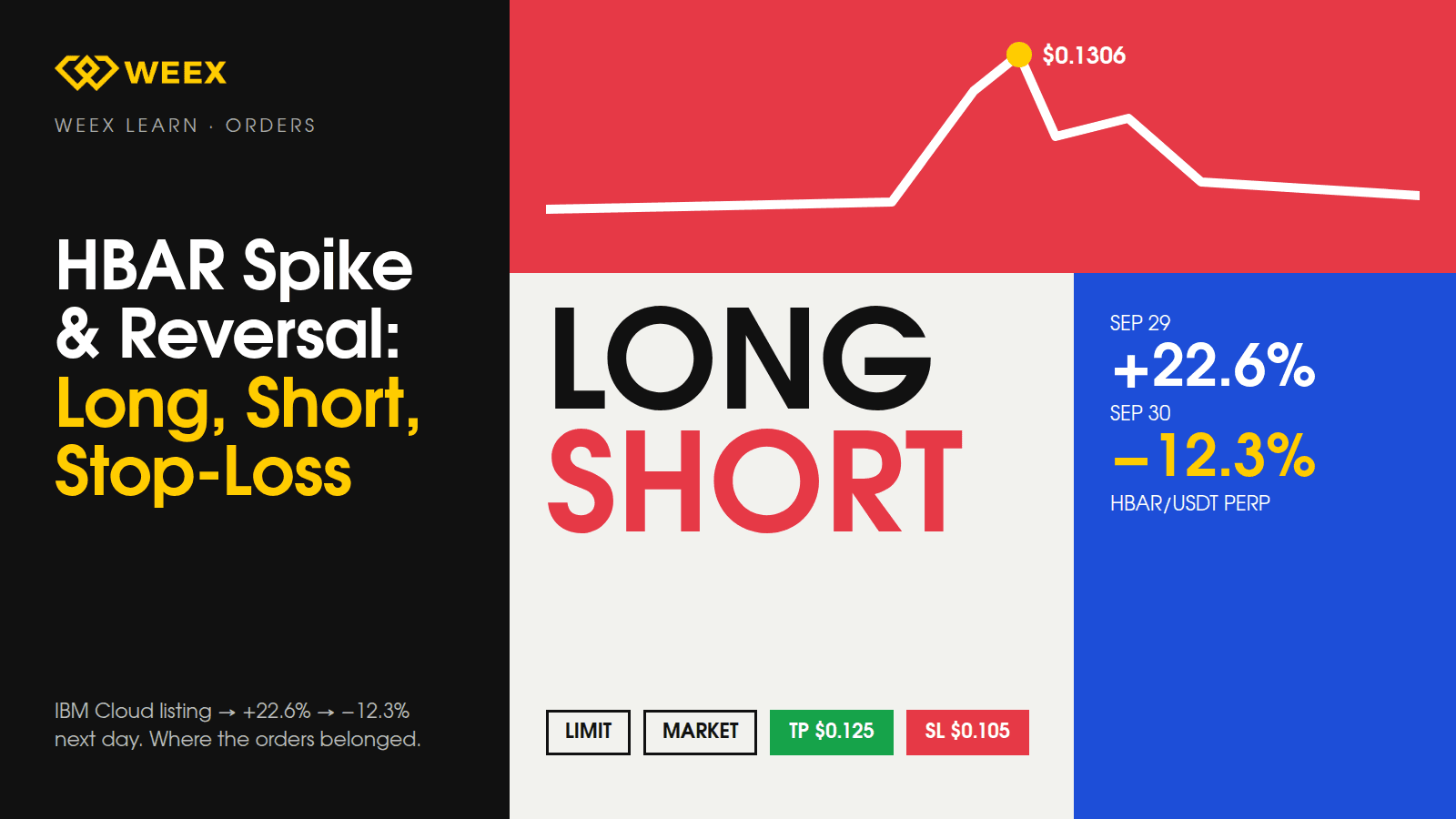
The shape matters: flat near $0.10 for weeks, a vertical breakout, a failed push to $0.13, and a return to roughly where it started. Almost everyone who bought the breakout with a market order is now underwater. Almost everyone who shorted the $0.13 wick without a stop was briefly in serious trouble before being bailed out. Both groups would have done better with orders placed in advance.
Long Versus Short on a News Spike
A long position profits when HBAR rises; a short position profits when it falls. On a perpetual contract, both are equally easy to open, and both carry the same leverage and liquidation mechanics. The difference is in what each one is betting on.
Going long on the September 29 spike was a bet that the IBM listing would draw sustained buying: new holders, more volume, a higher range. Going short into the $0.13 wick was a bet that the news was distribution access rather than demand, that 87.7% of HBAR's 50 billion maximum supply is already circulating so no supply shock was coming, and that a 30% intraday move on a $4.5 billion token would mean-revert. Both were defensible ideas. The short won this time, but the interesting question is not which side was right; it is how each side should have been sized and protected.
The rule that survives every version of this trade: on a news spike, the side you take matters less than the price at which you admit you are wrong. A long from $0.118 that stops out at $0.113 loses 4%. A long from $0.118 with no stop is sitting at $0.103, down 13%, hoping. A short from $0.125 with a stop at $0.132 lost a few percent if the wick tagged it and then had the chance to re-enter; a short from $0.125 with no stop was down 5% at the high and would have been liquidated at 20x.
Market Orders, Limit Orders, and Why the Spread Explodes
A market order fills immediately at the best available price. A limit order fills only at your price or better, and may not fill at all.
During the September 29 spike, HBAR's order book thinned out in the direction of the move. Traders who hit a market buy at what looked like $0.125 on the chart were often filled at $0.128 or worse, because the resting sell orders between those prices had already been taken. That gap between expected and actual fill is slippage, and it is largest exactly when a market order feels most urgent.
Limit orders solve the fill-price problem and create a different one: if HBAR never comes back to your price, you miss the trade. In practice, most experienced traders use limits for entries on spikes, accepting that they will miss some moves, and reserve market orders for exits when getting out matters more than the last tick. Missing a trade costs nothing. Paying 3% of slippage on entry and another 3% on a panicked exit costs 6% before the trade has done anything.
For HBAR specifically, a limit buy at the $0.115–$0.117 support zone cited by analysts after the spike would have filled on the September 30 pullback, at a price 3% better than the spike close and 12% better than the session high.
-- Price
Take-Profit and Stop-Loss Orders: Setting Them on HBAR
A take-profit order closes a position automatically when price reaches a target in your favor. A stop-loss order closes it when price reaches a level against you. Both are conditional orders that sit on the exchange and execute without you watching the screen.
For a long entered near $0.116 on the pullback, using the levels analysts published after the spike:
- Stop-loss below $0.105, the lower support band. A close below there means the spike has fully reversed and the trade thesis is wrong. Risk from $0.116 is about 9.5%.
- First take-profit at $0.125, the first resistance. Reward is about 7.8%, so the trade is roughly 1:0.8 to the first target, which is why many traders would take only partial size off here.
- Second take-profit at $0.130, the session high. Reward is about 12%, giving a 1:1.3 ratio on the remaining size.
For a short entered near $0.125 on a retest of resistance:
- Stop-loss above $0.132, just beyond the $0.1306 wick. Risk about 5.6%.
- Take-profit at $0.105–$0.107, the support band. Reward about 15%. That is a 1:2.7 ratio, which is why the short was the better-structured trade after the spike even though the long was the more popular one.
Two mechanics traders miss. First, a stop-loss on a perpetual can be triggered by the mark price or the last price; on a token with $1.5 billion of daily volume and a $0.13 wick, a last-price stop can be hit by a single aggressive print that the mark price never reaches. Check which one your order uses. Second, a stop-loss becomes a market order when triggered, so during a spike it fills with slippage. A stop-limit order avoids that but may not fill at all in a fast market. For most HBAR-sized positions, a plain stop-market is the right default; the slippage cost is smaller than the cost of an unfilled stop.
HBAR Perpetual on WEEX: Contract Details as of September 30
The HBAR/USDT perpetual on WEEX lists leverage up to 200x. Spot HBAR/USDT traded at $0.10352 on September 30, 2026, with market cap around $4.55 billion and circulating supply of 43.83 billion.
On leverage: HBAR moved 22.6% up and 12.3% down on consecutive days. At 10x, either day would have liquidated a position on the wrong side. At 5x, the September 30 drop alone would have cost a long 60% of its margin. For a token in a news-spike regime, 2x to 3x is the range where a stop-loss, not the liquidation engine, is what closes the trade. Leverage above that hands control of your exit to the exchange.
What Experienced Traders Watch on the Second Day
The second day after a news spike tells you more than the first. On September 30, HBAR's volume fell from $1.57 billion to $457 million, a 71% drop, while price gave back most of the gain. That pattern, volume collapsing as price retraces, says the spike was driven by fast money that has left, not by new holders who are accumulating. If the IBM Cloud listing were pulling in durable demand, the retracement would have held higher on volume closer to the spike day.
The practical read: $0.115–$0.117 is now the level that separates "healthy pullback after a breakout" from "failed breakout." HBAR closed September 30 below it. Until it reclaims that zone on volume, the September 29 high of $0.1306 is resistance, and every bounce into $0.12–$0.125 is a place where the short setup above repeats. That is not a forecast; it is where the orders belong.
FAQ
1. Why did HBAR go up on September 29, 2026?
IBM listed The Hashgraph Group's IDTrust identity platform, built on Hedera, in its Cloud Catalog on September 23–24, and NVIDIA's AI safety announcement with IBM on September 28 added to the narrative. HBAR rose 22.6% to $0.1188 on September 29 with a $0.1306 intraday high, then fell 12.3% on September 30.
2. Should I go long or short HBAR after the spike?
Neither side is right by default. After the spike, the short from $0.125 with a stop at $0.132 had a better reward-to-risk ratio (about 1:2.7) than the long from $0.116 with a stop at $0.105 (about 1:0.8 to first target). Whichever side you take, the stop-loss level matters more than the direction.
3. What is the difference between a stop-loss and a take-profit order?
A stop-loss closes your position when price moves against you to a set level, capping the loss. A take-profit closes it when price reaches your target, locking in the gain. Both execute automatically on the exchange once set.
4. Why did my market order fill at a worse price during the HBAR spike?
Slippage. A market order takes whatever liquidity is resting in the order book, and during a spike the book thins in the direction of the move. Limit orders fix the fill price but may not fill; use limits for entries on spikes and market orders only for urgent exits.
5. What leverage is safe for HBAR futures right now?
HBAR moved 22.6% and then −12.3% on consecutive days. At 10x either day liquidates the wrong side. In a news-spike regime, 2–3x is the range where your stop-loss, not the liquidation engine, controls the exit.
Risk Warning
HBAR is a volatile asset that moved 22.6% up and 12.3% down on consecutive days in late September 2026; positions can result in partial or total loss. Perpetual futures magnify those moves through leverage, and the liquidation engine closes positions at worse prices than a stop-loss would, plus a fee. Stop-loss orders become market orders when triggered and can fill with significant slippage during spikes; last-price stops can be triggered by single aggressive prints. The IBM Cloud listing is distribution for a Hedera application, not an IBM investment in HBAR, and volume fell 71% the day after the spike, indicating fast-money participation rather than durable demand. HBAR is also exposed to broader market risk and regulatory developments. Nothing here is investment advice.
This content is provided for general informational purposes only and doesn't constitute financial, investment, legal, or tax advice. Any events, rewards, online promotions, or related information mentioned herein should not be considered a recommendation, solicitation, or invitation to purchase, sell, trade, or otherwise deal in any crypto assets. Crypto assets are highly volatile and may result in loss. The availability of WEEX services, products, and related events may vary by region. You are responsible for ensuring that your participation is in accordance with applicable local laws and regulations.
You may also like

How to Set Up and Use SafePal Wallet?
How to Buy Crypto with PayPal: The Custody Catch Most Beginners Miss
ENA Token Price Up 76% in a Month: The October 5 Unlock Test
HPE Stock Hits a Record on $1.2B AI Order: Is It Still Cheap?
MU Stock After a Record Q4: Why Micron Slipped on a Huge Beat
Senate Democrats Block Stock Bill: What Failed and What Is Next
QNT Price Near $295: Does the Bank Deal Justify a 4x Rally?

FICO vs VantageScore: What the New Fannie Mae and Freddie Mac Rule Actually Means for Your Mortgage
How Tether Freezes USDT: Address Blacklists and Holder Checks

Best Crypto Exchange for Beginners 2026: What Your First $100 Actually Goes Through
Bitcoin Futures at $83K: PnL and Position Sizing Into Jobs Week
What Is STOCKER? Stockereum, Stock-Paired Meme Tokens, and Risks
QNT Futures After a 280% Rally: Leverage and Liquidation Math
XRP Upgrade Update: XRPL Batch Slips to Oct 9 and What Changes
WIF and POPCAT Price Rally: Can the Solana Meme Rotation Hold?

How to manage Idle USDT? Top 5 Platforms to Earn Passive Income in 2026 OCT
What Is XDP? Can Doppler Finance Break $0.03 in October 2026?

What Is Coinbase Wrapped Zcash (cbZEC)? How It Brings Zcash to Base Without Native ZEC Privacy

Safest Crypto Wallet in 2026: Matching Wallet Type to the Threat You're Actually Worried About

What Is Coinbase Wrapped HYPE (cbHYPE)? How It Works on Base, 1:1 Backing, Risks, and HYPE Conversion
Is QNT a Stock or Crypto? Quant (QNT) and Quantinuum Stock Are Not the Same Asset
No KYC Crypto Wallet: 6 Picks and 5 Places Your ID Still Leaks
THORChain Bitget Dispute: Who Can Actually Freeze Stolen Crypto?
What Is Quant (QNT) Crypto? How Overledger Works, QNT Utility, and Token Supply Explained
Best Decentralized Crypto Wallet for Beginners: What Self-Custody Really Asks of You
Best Crypto App for Beginners: Exchange App, Wallet App, or Both?
What Is Gno.land (GNOT)? How GnoVM, Storage Deposits, Tokenomics, and GovDAO Work
Which Stocks Are Undervalued Right Now? What the Major Screens Say in September 2026
Coincheck FLR DAI Delisting Dates and Holder Checklist
What an Iranian Parliament Report Says About Crypto Mining and Power Shortages
How to Set Up and Use SafePal Wallet?
How to Buy Crypto with PayPal: The Custody Catch Most Beginners Miss
ENA Token Price Up 76% in a Month: The October 5 Unlock Test
HPE Stock Hits a Record on $1.2B AI Order: Is It Still Cheap?
MU Stock After a Record Q4: Why Micron Slipped on a Huge Beat
Senate Democrats Block Stock Bill: What Failed and What Is Next
Contents
Popular coins
Latest articles


