
How Tether Freezes USDT: Address Blacklists and Holder Checks

 Prefer us on Google


Tether can freeze USDT tokens and blacklist addresses under its own Terms of Sale and Service, and that power runs through the contract of the network the token was issued on. To confirm whether a specific address is blocked, check the exact address and network separately: the answer is read for that address on that network and that contract, and a balance visible in a wallet does not by itself prove a transfer will go through.
Where Tether's power to freeze USDT comes from
Tether's Terms of Sale and Service, last updated 26 February 2026 (7 Esfand 1404), let Tether suspend service, freeze or confiscate Tether Tokens, and blacklist a digital-token address in the circumstances set out in that document (Tether Terms of Sale and Service, 26 February 2026). That power is exercised through the contract of each version of the token; USDT is issued on several protocols, so how it works depends on the network and that network's contract.
On Ethereum, a token transfer checks blacklist status before it executes, and adding or removing an address from that list is done only by contract-owner functions; the published source of that contract shows the structure (USDT contract source on Ethereum, 28 November 2017 (7 Azar 1396)). In practice, blacklisting an address restricts transfers, but this same Ethereum contract also has an owner-only function called destroyBlackFunds(address) that can zero the balance associated with a blacklisted address, so the number a wallet shows is no guarantee that it stays there or can be moved.
Does blacklisting an address mean the funds are gone?
Not necessarily. On this Ethereum contract, blacklisting restricts transfers; the owner-only destroyBlackFunds(address) function can zero a blacklisted address's balance, while removeBlackList(address) separately removes an address from the list. So a balance recorded in the contract is no guarantee that it will remain after blacklisting.
Checking an address on Ethereum: a worked example
The verified Tether contract for USDT on Ethereum is 0xdAC17F958D2ee523a2206206994597C13D831ec7, and its Read Contract page on Etherscan lists two read-only methods, getBlackListStatus(address) and isBlackListed(address) (verified USDT contract, 28 November 2017 (7 Azar 1396)).
The method is simple: you enter your own public address as the input and see that contract's answer for that address on Ethereum. It is a read-only call and needs no private key or signed transaction. The scope of that answer is limited to that contract and that network.
If my USDT sits on another network, is that same check enough?
No. The answer returned by the Ethereum contract speaks only about that address on Ethereum; on each network, the contract and block explorer of that network are the reference, and a result from one network cannot be carried over to another.
A public explorer shows contract state, not the status of your account at an exchange. If your USDT is held in an exchange account, the tokens sit at that exchange's address on-chain, and the rules and official notices of that exchange determine any deposit or withdrawal restriction on your account.
Tether's statement and the US Senate report: which addresses are involved?
On 28 September 2026 (6 Mehr 1405) Tether said that actions involving USDT during 2026 had led to roughly $550 million frozen in addresses US authorities had identified as connected to Iran's central bank and Iranian sanctions networks; according to the same statement, more than $344 million of that was frozen across two addresses in April 2026 (Farvardin and Ordibehesht 1405), and more than $130 million across four wallets on the TRON network in July 2026 (Tir and Mordad 1405) (Tether statement, 28 September 2026). Those figures are Tether's own and approximate, and they describe a cumulative frozen-asset total for 2026.
The statement gives totals and counts of addresses and concerns identified addresses, not all USDT holders; the status of one particular address has to be read on its own network.
The US Senate report, 28 September 2026
Reuters reported on 28 September 2026 (6 Mehr 1405) that a minority-staff report of the US Senate Permanent Subcommittee on Investigations on crypto and Iran's shadow-banking network had been published (Reuters, 28 September 2026).
-- Price
I can see the balance but the transfer will not go through: which layer is it?
Three things decide separately whether a USDT transfer goes through; the table below puts them side by side.
| Layer | What determines the status | Where it shows up |
|---|---|---|
| Recorded status of the address | The blacklist inside the contract of that token on that network | The read-only methods of that contract in that network's public explorer |
| Network and contract match | The network name and the contract address being the same at both ends | The deposit page in your own wallet or exchange account |
| Exchange account | The rules and official notices of that exchange | The exchange's official notices, not the on-chain status of the exchange's address |
A common question is why a wallet shows a balance while a transfer fails. A displayed balance means the contract records that amount for that address; permission to transfer is a separate matter and comes back to the blacklist state in that contract.
Sending the same asset on another network does not change the recorded status of that address on the network where it was listed.
Before any transfer, match the network name and the contract address against the deposit page in your own account, then look at that address's status on its own network. For assets held in an exchange account, any deposit or withdrawal restriction is announced through that exchange's official notices.
This material is educational and is not investment advice.
Published by WEEX · 30 September 2026 (8 Mehr 1405) · WEEX editorial standards
This content is provided for general informational purposes only and doesn't constitute financial, investment, legal, or tax advice. Any events, rewards, online promotions, or related information mentioned herein should not be considered a recommendation, solicitation, or invitation to purchase, sell, trade, or otherwise deal in any crypto assets. Crypto assets are highly volatile and may result in loss. The availability of WEEX services, products, and related events may vary by region. You are responsible for ensuring that your participation is in accordance with applicable local laws and regulations.
You may also like
How to Buy Crypto with PayPal: The Custody Catch Most Beginners Miss
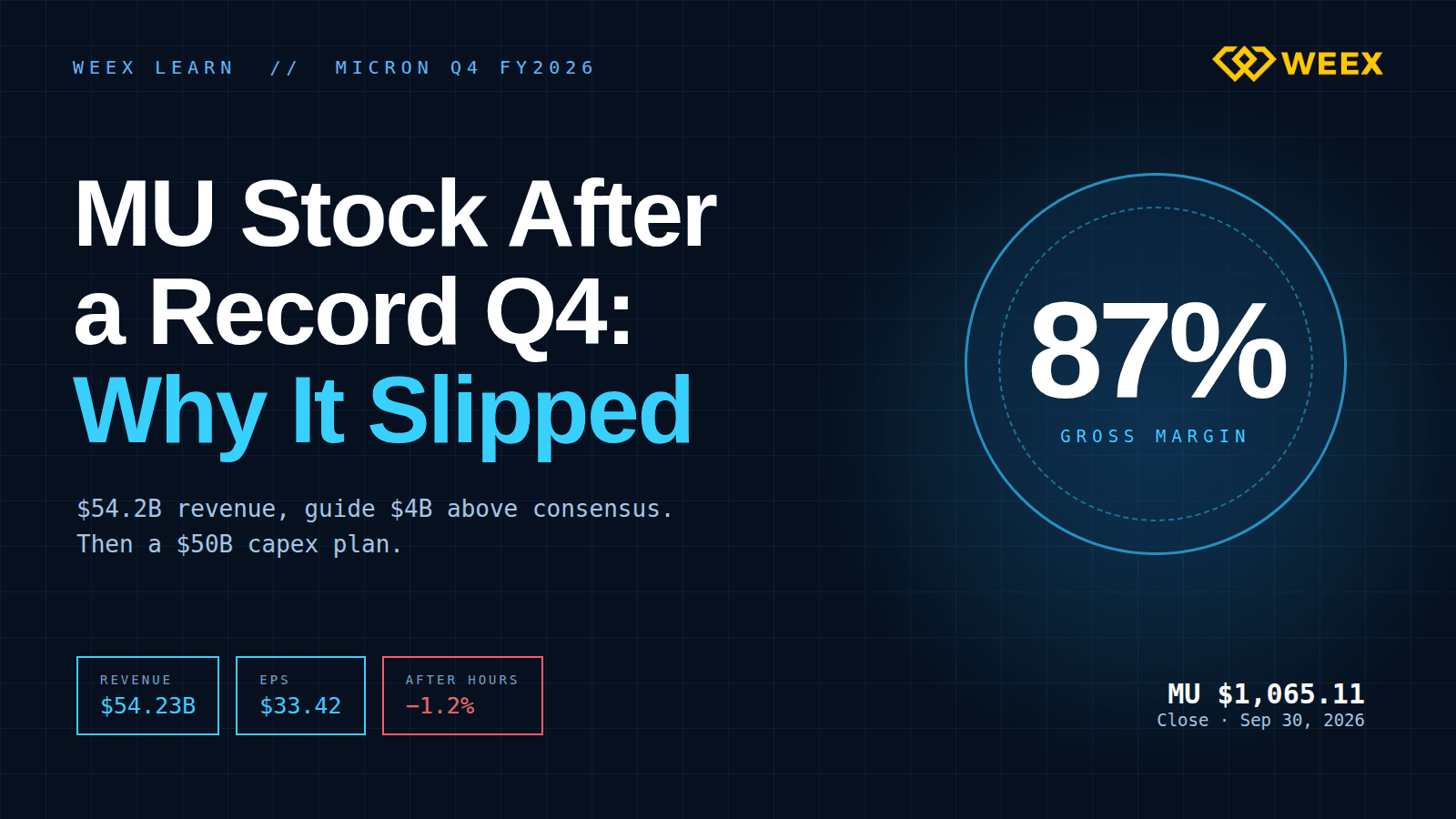
MU Stock After a Record Q4: Why Micron Slipped on a Huge Beat

How to manage Idle USDT? Top 5 Platforms to Earn Passive Income in 2026 OCT

Solana Alpenglow Mainnet Date: Why Sept 28 Wasn't Launch Day

Best Crypto App for Beginners: Exchange App, Wallet App, or Both?
What Is Gno.land (GNOT)? How GnoVM, Storage Deposits, Tokenomics, and GovDAO Work

Coincheck FLR DAI Delisting Dates and Holder Checklist
Germany's Crypto Tax Draft 2027: What the 50 Percent Substitute Assessment Means

Who Can Operate in Russia's Crypto Market from 5 October 2026

Italian Crypto Tax Return 2026: Filing Deadline, Forms and Gains Rate
XOF, XAF and CDF Are Now Available on WEEX P2P: What Users Need to Know

INTC Stock Surged 14%: Intel Only Has Enough Chips for Half Its Clients
WEEX and MiCA: What the RDWW-1194 Entry in Poland's Register Says
FreeBitco.in Has Shut Down: What Users Should Know
Pi Network vs Other Mobile Mining Projects: What's the Difference
How Does Mining Actually Work on Pi Network?

Is Pi Network Legit, or Is It Considered a Scam?
What a Blockchain Explorer Can and Cannot Tell You
How to Look Up a Wallet Address and Transaction History
How to Buy USDT With NGN via Bank Transfer on WEEX?
How to Verify a Crypto Transaction With a Blockchain Explorer?

Why Did the CLARITY Act Fail in the Senate, and What Happens Next for Crypto Regulation?
15 Notable Robinhood Chain Protocols: Which Assets Trade on WEEX?
Vietnam Decree 284 on Crypto Assets: Scope, Effective Date and Compliance
Vietnam VASP Licence: How the Crypto Licensing Regime Works and How to Verify a Platform
How Does WEEX KYC Verification Work? A Taiwan User Guide
Spot Trading for Beginners: From Deposit and Order to Holding
What Is USDT? A Taiwan Beginner's Guide to Use, Deposits and Risk
Macro Protocol (MTP): Listing Status and a Safe Verification Guide
Airdrops This Week (September 17-23, 2026): Official Conditions and Safety Checks
How to Buy Crypto with PayPal: The Custody Catch Most Beginners Miss
MU Stock After a Record Q4: Why Micron Slipped on a Huge Beat
How to manage Idle USDT? Top 5 Platforms to Earn Passive Income in 2026 OCT
Solana Alpenglow Mainnet Date: Why Sept 28 Wasn't Launch Day
Best Crypto App for Beginners: Exchange App, Wallet App, or Both?
What Is Gno.land (GNOT)? How GnoVM, Storage Deposits, Tokenomics, and GovDAO Work
Contents
Popular coins
Latest articles


