
XRP Upgrade Update: XRPL Batch Slips to Oct 9 and What Changes

 Prefer us on Google


The XRP upgrade that was supposed to activate on September 29 did not happen. The XRP Ledger's Batch amendment, shipped in its corrected BatchV1_1 form, lost validator support for a short stretch around September 25, which wiped its two-week countdown and pushed the earliest activation to October 9, 2026, at roughly 14:46 UTC. This article covers what Batch actually adds to the ledger, why a brief dip in votes can reset the clock, what node operators and app developers must do before October 9, and how the delay fits into an XRP market that is trading near $1.50 and still 59% below its July 2025 high.
Did the XRP Upgrade Activate on September 29?
No. BatchV1_1 was scheduled to go live on September 29 at 14:06 UTC, contingent on holding more than 80% support from the trusted validator list for two consecutive weeks. On September 25, support briefly fell under that line. The XRPL amendment process does not tolerate a dip: the accumulated countdown is discarded, and once support returns, a fresh two-week window begins. Support was back at 30 of 35 trusted validators the same day, which is why the new earliest activation date is October 9 rather than something later.
Two related items moved with it. PermissionDelegationV1_1, which lets an account delegate specific permissions without handing over signing keys, also lost and regained support on September 23–24 and now has an earliest activation of October 8 at about 21:25 UTC. And on September 25, XRP Ledger operations released xrpld 3.4.1, which carries a small follow-up amendment called fixBatchV1_2. The release notes describe the fix as addressing a minor Batch issue that puts no user funds at risk; both amendments are marked default-yes and are expected to activate in the same October window.
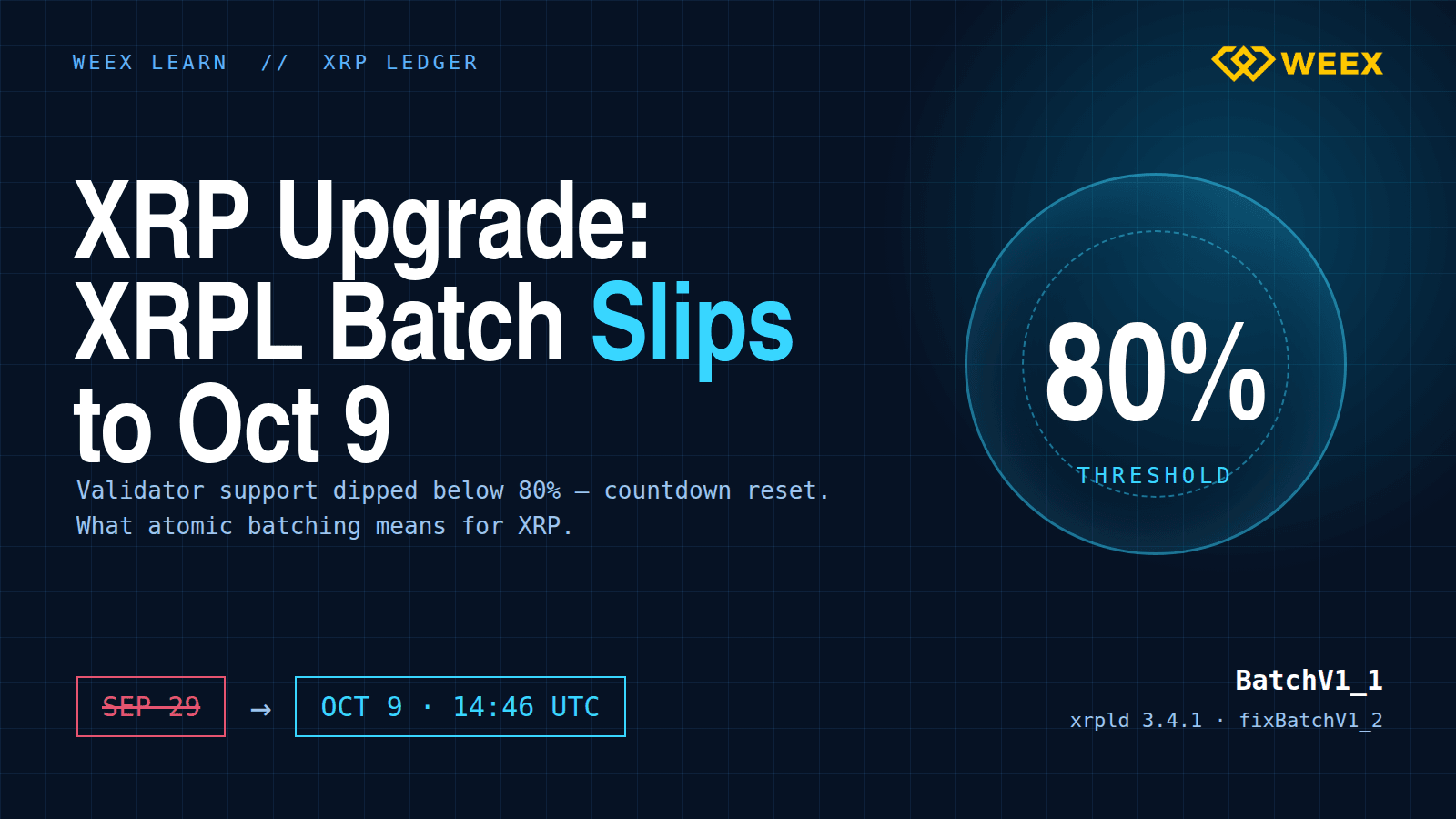
The practical reading: October 9 is the earliest possible date, not a guaranteed one. Another dip in support at any point before then restarts the count again.
What XRPL Batch (BatchV1_1) Actually Does
Batch, specified as XLS-56, lets a user bundle between two and eight transactions into a single signed unit that the ledger processes together. Today, a swap that requires an offer, a payment, and a trust-line change has to be sent as three separate transactions, each of which can succeed or fail on its own. Batch closes that gap.
The amendment offers four execution modes, and the choice of mode is what determines the settlement guarantee:
- All or Nothing: every inner transaction succeeds, or the whole batch fails and nothing is applied. This is the atomic-settlement mode that most coverage refers to, and it is the one that matters for delivery-versus-payment style flows such as paying for a tokenized asset and receiving it in one step.
- Only One: the ledger applies the first inner transaction that succeeds and skips the rest, useful for fallback routing.
- Until Failure: inner transactions apply in order until one fails; earlier ones stay applied.
- Independent: every inner transaction is attempted regardless of the others' outcome.
Batch also supports multi-account batches, where several accounts co-sign a single bundle. That is the feature that caused the first version to be pulled, and it is where the rewrite matters most.
Why Batch Was Withdrawn Once and Rewritten
The original Batch amendment was voted down in February 2026 after security researchers found a signer-authorization flaw during the voting phase. In the original loop logic, if the code hit a valid signer that matched a newly created account, it returned success without checking the remaining signers. An attacker could have placed a forged entry first and authorized a victim's transaction without the victim's keys. Because the amendment never activated, no funds were exposed.
BatchV1_1, shipped in xrpld 3.3.0 on August 6, 2026, rewrites the authorization path. A multi-account batch must now carry the exact and complete set of BatchSigners, with no missing, extra, duplicate, or misordered entries. Each signature binds to the outer account, its sequence or ticket, the batch mode, every inner transaction hash, and the participating accounts, which blocks signature reuse across batches. The rewrite also added transaction-count bounds and ledger replay protections.
This history is worth keeping in mind when reading "XRP upgrade" headlines. The feature reaching mainnet on the second attempt, after an external audit caught a real bug, is a stronger signal about the ledger's review process than a first-try activation would have been. It also explains why validators are cautious about the timing: a validator that drops its vote for a few hours to upgrade software or re-evaluate a release can single-handedly reset a two-week clock when the margin is only five validators out of 35.
-- Price
What Node Operators and Developers Must Do Before October 9
Amendment activation on the XRP Ledger is not optional for infrastructure. Any xrpld server running a version that does not understand BatchV1_1 becomes amendment-blocked the moment it activates and stops following the network. The minimum is 3.3.0; the operations team is pushing 3.4.1 because it also patches what the release notes call security-sensitive issues, with source to be published later.
The client-side story is where readiness is thinner. Coverage from CryptoSlate on September 23 laid out the failure points:
- xrpl.js 5.0.0 builds Batch signatures against the old payload and will be rejected with temBAD_SIGNATURE; 5.1.0 carries the revised signing format.
- Wallets that do not clearly display the inner transactions of a batch leave users signing bundles they cannot inspect.
- Explorers that misreport batch outcomes will fragment how a transaction looks across tools.
- An outer Batch transaction can return success even when inner transactions failed in the non-atomic modes, so applications have to read inner results, not just the outer code.
RippleX head of engineering Ayo Akinyele has said some projects are already being built with Batch in mind and that activation would let that work move closer to production. That is the sensible reading of the demand side: Batch is plumbing for issuers, custodians, and asset managers building on XRPL, not a retail feature users will see in a wallet on day one.
What the Delay Means for the XRP Price
As of September 30, 2026, XRP trades at about $1.49 on CoinGecko, up 1.6% over 24 hours but down 5.1% over seven days, with roughly $4.0 billion in 24-hour volume and a market cap near $94.3 billion, fifth by market cap. On WEEX, the XRP/USDT spot pair printed $1.4996 on the same date. The token remains about 59% below its all-time high of $3.65 set in July 2025.
The more important point is that the market did not trade the Batch date in either direction. XRP moved less than half a percent on the day CoinDesk reported the slip to October 9. That is consistent with how XRPL amendments have behaved historically: the ledger has activated dozens of them, and none has been a reliable price catalyst on its own. Batch is an institutional-plumbing upgrade whose value shows up in what gets built on top of it over quarters, not in the ledger close that enables it.
What experienced XRP traders tend to watch instead is whether an upgrade coincides with something that changes flows: an ETF inflow print, a new tokenized-asset issuer choosing XRPL, or a broad-market risk move. The weekly 5% drawdown into the delay was a market-wide move, not an XRP-specific reaction. If XRP is going to rerate on Batch, it will be because a visible product ships on it, and that is an October-to-December story at the earliest.
How to Trade XRP on WEEX Around the Activation Window
If the plan is to hold or trade XRP through October 9, the useful setup is to have positions and alerts in place before the window rather than reacting to a headline.
- Open the XRP/USDT spot pair on WEEX and check the live order book depth before sizing, since headline days tend to widen spreads briefly.
- New to the asset? The how to buy XRP guide walks through funding an account and placing a first market or limit order.
- Traders who want directional or hedged exposure without moving spot can use XRP/USDT perpetual futures on WEEX, which list leverage up to 300x. Keep leverage low around a known event date; a 5% weekly move at 20x is a liquidation, not a drawdown.
- Set price alerts around $1.40 and $1.60, which bracket the recent range, and set a calendar reminder for October 8–9 UTC to check whether validator support is still above 80% on an XRPL explorer.
- Use the WEEX XRP price page for a quick daily read on price, volume, and market cap without opening the trading terminal.
Market View: Batch Is a Builder Catalyst, Not a Trader Catalyst
Batch matters because it makes XRPL usable for delivery-versus-payment flows and multi-step operations that institutions expect from settlement rails. For XRP the asset, the honest chain of causation is long: activation on October 9, then apps upgrading to xrpl.js 5.1.0, then issuers shipping products that use All or Nothing batches, then, possibly, more on-ledger activity that requires XRP for fees and bridging. Each link can slip. The delay from September 29 to October 9 is a reminder that even the first link is not deterministic.
FAQ
1. Did the XRP upgrade happen on September 29, 2026?
No. BatchV1_1 lost validator support briefly on September 25, which reset its two-week activation countdown. The earliest activation date is now October 9, 2026, at about 14:46 UTC, and it can slip again if support dips below 80%.
2. What is XRPL BatchV1_1?
BatchV1_1 is the corrected version of the Batch amendment (XLS-56). It lets a user bundle two to eight transactions into one signed unit with four execution modes, including All or Nothing atomic settlement. The original Batch was voted down in February 2026 over a signer-authorization flaw; the rewrite shipped in xrpld 3.3.0 in August 2026.
3. Will the Batch upgrade push the XRP price up?
There is no evidence it will on its own. XRP moved less than 0.5% on the day the delay was reported, and past XRPL amendments have not been reliable price catalysts. Any price effect would come later, from products built on Batch.
4. What happens to nodes that do not upgrade before October 9?
They become amendment-blocked and stop syncing with the network. Operators need xrpld 3.3.0 at minimum, and 3.4.1 is the recommended version because it also includes fixBatchV1_2 and security patches.
5. Is fixBatchV1_2 the same as BatchV1_1?
No. fixBatchV1_2 is a small follow-up amendment introduced in xrpld 3.4.1 on September 25, 2026, to correct a minor Batch issue with no risk to funds. It is expected to activate in the same October window alongside BatchV1_1.
Risk Warning
XRP is a volatile asset and can lose a large share of its value in days; a position can result in partial or total loss. The Batch amendment's activation date is conditional on validator votes and may move again, so trading strategies built on a fixed October 9 date carry event-timing risk. Leveraged XRP futures amplify both gains and losses, and a routine 5% weekly move is enough to liquidate a highly leveraged position. Batch itself introduces new operational risk during rollout: outdated nodes become amendment-blocked, older client libraries produce rejected signatures, and in non-atomic modes an outer transaction can report success while inner transactions fail. XRP also remains exposed to regulatory developments affecting Ripple and to concentration of supply in Ripple-controlled escrow. Nothing here is investment advice.
This content is provided for general informational purposes only and doesn't constitute financial, investment, legal, or tax advice. Any events, rewards, online promotions, or related information mentioned herein should not be considered a recommendation, solicitation, or invitation to purchase, sell, trade, or otherwise deal in any crypto assets. Crypto assets are highly volatile and may result in loss. The availability of WEEX services, products, and related events may vary by region. You are responsible for ensuring that your participation is in accordance with applicable local laws and regulations.
You may also like

How to Buy Crypto with PayPal: The Custody Catch Most Beginners Miss
What Is STOCKER? Stockereum, Stock-Paired Meme Tokens, and Risks
What Is Coinbase Wrapped HYPE (cbHYPE)? How It Works on Base, 1:1 Backing, Risks, and HYPE Conversion
Is QNT a Stock or Crypto? Quant (QNT) and Quantinuum Stock Are Not the Same Asset
No KYC Crypto Wallet: 6 Picks and 5 Places Your ID Still Leaks
What Is Quant (QNT) Crypto? How Overledger Works, QNT Utility, and Token Supply Explained

Best Decentralized Crypto Wallet for Beginners: What Self-Custody Really Asks of You
Does a Negative Funding Rate Mean a Short Squeeze Is Coming?

Best Crypto Exchange for Beginners 2026: What Actually Matters When Choosing One
Best Crypto Cold Wallet 2026: Top Picks Matched to How You Hold
How to Connect Phantom Wallet to a Solana DApp
How to Install and Set Up Phantom Wallet
Funding Rate Crypto: What BTC and ETH Are Paying Right Now

INTC Stock Surged 14%: Intel Only Has Enough Chips for Half Its Clients
XPL Unlock on Sept 25: How to Long or Short Plasma Futures Safely
Bitcoin Funding Rate After a $648M Short Squeeze: What Longs Pay
What Is Blockchain Technology? Follow One Transaction to See

How Does Mining Actually Work on Pi Network?
What Is Pi Network? A Complete Beginner's Guide

How to Look Up a Wallet Address and Transaction History
Funding Rate Explained: How Perpetual Futures Fees Hit Your PnL

PENGU Airdrop on WEEX: Get 10 USDT in PENGU Before October 6
BTC Futures Trading on WEEX: Claim BTC Rewards Before Sep 25
What Is a Funding Rate? How Perpetual Futures Charge Longs and Shorts
How Does WEEX KYC Verification Work? A Taiwan User Guide
Macro Protocol (MTP): Listing Status and a Safe Verification Guide
Lumentum (LITE) Perpetual Futures: Why 25x Leverage Is the Limit
Lisk Chain Shutdown October 31: How to Move LSK Safely
What Is BONK? WEEX Spot and 1000BONK Futures Status and Risk Checks
What Is BRETT? WEEX Spot and Futures Status and Risk Checks
How to Buy Crypto with PayPal: The Custody Catch Most Beginners Miss
What Is STOCKER? Stockereum, Stock-Paired Meme Tokens, and Risks
What Is Coinbase Wrapped HYPE (cbHYPE)? How It Works on Base, 1:1 Backing, Risks, and HYPE Conversion
Is QNT a Stock or Crypto? Quant (QNT) and Quantinuum Stock Are Not the Same Asset
No KYC Crypto Wallet: 6 Picks and 5 Places Your ID Still Leaks
What Is Quant (QNT) Crypto? How Overledger Works, QNT Utility, and Token Supply Explained





