
Who Benefits More After Aero's Merger Upgrade: Holders, LPs, or the Platform?

 Prefer us on Google



It may reduce ineffective issuance, but transaction fees will not automatically go to every AERO holder; it depends on who stakes, who provides liquidity, and whether subsidies can retain real transactions.
Written by: Daii
Imagine a shopping mall: some invest to set up stalls, while others come to shop. To fill the stalls, the management prints new "mall equity vouchers" to reward stall owners; those willing to lock their vouchers long-term decide which corridor to reward and share the rent from there. The busier the mall, the more rent there may be; however, if the vouchers are printed faster, the benefits corresponding to each voucher may still thin out. Aero's upgrade is about rearranging the "rent and voucher issuance" accounts. (Aero's official economic mechanism; Foresight News analysis)
- Identify Four Roles to Understand Where Fees Go
Aerodrome originally served Base, while Velodrome primarily served the OP ecosystem. The two merged on October 22 to launch Aero, requiring an upgrade entry for the old and new tokens: old AERO converts to new AERO at a 1:1 ratio, and old VELO exchanges for 0.044 new AERO; old locked certificates veAERO and veVELO become new staking certificates sAERO. The new supply is designed to allocate 94.5% to the original Aerodrome community and 5.5% to the original Velodrome community. This is a redistribution of ownership during the merger of two businesses, not a reduction in the number of tokens held by old AERO holders; however, if the newly added Velodrome business does not bring corresponding revenue, the relative share of original holders in the larger supply will decrease. (Aero upgrade explanation and supply calculation)
The first category includes those who only hold circulating AERO. They possess tradable tokens but will not automatically receive transaction fees based on their spot balance. To qualify for the distribution pool income, they need to convert to sAERO, undertake staking periods, choose pools, and bear token price risks. The official terms state that sAERO with a set period cannot be redeemed early before expiration; the remaining lock-up period of old veAERO after upgrading will also continue and round up to the nearest week. If holders place AERO on exchanges, they must also consider the exchange's independent currency exchange and opening hours, which cannot be directly replicated from self-custody wallet operations. (Aero's AERO and sAERO documentation; Aero upgrade explanation; Aerodrome lock-up upgrade guide)
The second category includes those who stake sAERO and receive rewards. They direct reward weights towards certain trading pools and earn pool income based on their allocation weight in these pools, which may include transaction fees and liquidity incentives paid by external projects. Rewards are not "the total platform income averaged by token holdings": choosing a pool with no transactions or too many people crowding into the same pool may lower unit staking returns. The official documentation specifies that each sAERO position has a 47-hour cooldown period for modifying allocation direction upon activation, so it is also impossible to chase the highest returns infinitely during market fluctuations. (Aero upgrade explanation: sAERO and allocation)
The third category is LPs, who put two types of assets into trading pools to allow others to exchange. The same position must choose between two types of income: opting for AERO rewards, which direct corresponding transaction fees to sAERO distributors; or choosing fee income, which retains a portion of their position's transaction fees but does not receive AERO rewards. The fourth category is traders, who are neither responsible for voting nor necessarily hold tokens, only concerned with the depth, slippage, and fees of exchanges. "Platform fees going entirely to holders" overlooks the income of fee-based LPs and compresses the four roles into one. (Aero liquidity official documentation; Foresight News on the allocation of new and old pools)
- How the 1.2x Cap Changes the Issuance Ledger
The old mechanism continuously issued AERO over time to attract LPs with new tokens; even if a pool's transaction volume and fees fell short of expectations, rewards might still flow out. The new AER Engine allows each pool's reward cap to reference predicted income, including transaction fees, MEV-related fees, and liquidity incentives paid by projects, and adjusts dynamically. The official example states that the global reward value aims for a long-term target of about 1.2 times the pool's income; the cap for a single pool may differ due to competition and strategic needs, recalculated approximately every 48 hours. There is also a hard cap on issuance of 20% annually, with the official expectation of actual annual inflation around 8% to 12%. The target, hard cap, and final actual issuance cannot be considered the same number. (AER Engine official Q&A; Aero issuance mechanism documentation)
To simplify the accounting: if a pool is expected to receive $100 in fees and incentives over a certain period, the 1.2x target corresponds to a reward value cap of $120, rather than a promise that each LP will definitely receive $120. If only $80 actually comes in, the cap does not automatically reclaim the excess issued; if $150 actually comes in, the proportion will again be lower than predicted. Rewards are also calculated based on AERO's dollar price at that time, with price fluctuations, allocation weights, and timing of receipt all affecting the final results. This is a prediction with a speed limiter, not a mechanical rule of "printing $1.2 for every $1 earned." (AER Engine official Q&A)
Research cited by Foresight News states that in the four periods ending October 15, for every $1 of old AERO issued, locked voters received about $0.52 in transaction fees and project incentives during the same period; if the new system achieves the 1.2x income target long-term, the inverse would be about $0.83 in income corresponding to $1 in reward value. This comparison reveals the pressure of the old emissions being relatively high in income, but $0.83 is not the yield for holders, nor does it mean every AERO necessarily loses $0.17: income includes project incentives, rewards to LPs, and income flows to sAERO based on pools and allocation weights, with the issuance burden shared by all token holders. If project parties stop subsidizing or transaction fees do not increase simultaneously, the apparent coverage will change. (Foresight News research and standards; AER Engine official Q&A)
The new mechanism also stipulates that LPs only mint tokens when claiming rewards. This avoids the immediate circulation of amounts that no one claims, but does not mean that all unclaimed rewards simply vanish: accumulated amounts that can be claimed in the future remain potential supply. To observe inflation, one must consider both newly minted tokens and the timing of claiming rewards and their related validity periods, not just snapshot a single day's minting transactions. (AER Engine official Q&A)
- LPs and Issuing Projects: Subsidies Are More Disciplined and Selective
For LPs, the upgrade's benefit is that rewards adjust based on dollar value and pool income, potentially aligning more closely with actual trading activities than the old system; Aero operates across multiple chains, expanding the available pools. The downside is that low-volume pools find it harder to maintain high emissions, and a drop in AERO's market price will reduce the real purchasing power of rewards, while the market position itself remains affected by price fluctuations, concentrated liquidity range failures, and smart contract risks. The official documentation also states that if a reward-type position exits or switches to a fee-type before the minimum holding period, it will lose part of the accumulated AERO rewards. LPs should compare "reward-type redeemable AERO" with "fee-type retainable fees," deducting position risks, minimum holding periods, and migration costs; the annualized yield on the screen is not already realized profit. (Aero liquidity official documentation; AER Engine official Q&A)
Old LPs also face actual migration. Rewards from the old protocol have ceased, and eligible deposits can first exit the old staking at the official entry, claim rewards, and then migrate to the corresponding Aero pool; locked deposits cannot be upgraded through the normal process, continuing to earn transaction fees but no longer receiving old AERO rewards. Not every old pool has a one-to-one new pool, and some positions must exit and redeploy themselves. The real cost here may be the empty positions during migration, network fees, resetting price ranges, and operational errors, rather than the exchange ratio. (Aero upgrade explanation: LP; Aerodrome deposit upgrade guide)
For projects that have just issued tokens and urgently need to establish trading depth, the old-style mass issuance is like a mall opening with a flood of discount coupons: it can quickly attract stall owners but may only bring in those chasing subsidies. The new cap forces projects to support rewards with real transaction fees or incentives they pay themselves. Good projects that can turn temporary subsidies into long-term transactions may enjoy more stable liquidity; obscure pools that only have short-term rewards without ongoing trading will directly pass the cost of attracting LPs onto the project side. When counting "incentives paid by projects" into Aero's pool income, it must be separated from the fees paid by end traders; otherwise, project self-funding may be mistaken for natural market demand. (AER Engine official Q&A; Aero upgrade explanation: liquidity payments)
- Aero Platform and Traders: Scale Expansion Does Not Equal Platform Profitability
From the Aero platform's perspective, two sets of tokens, two voting systems, and decentralized liquidity combine into one, reducing cross-chain coordination costs; a unified brand makes it easier to attract wallets, aggregators, and project parties. The platform does not traditionally take a share of each transaction fee into the company's profit statement, but this does not mean that the operators have no economic interests at all: the official issuance document states that whenever LPs claim 100 AERO, another 5 are minted for the Aero Foundation and permanently staked; the income generated by this position can be used for development, funding, and ecological plans. This is an additional issuance that affects all token holders and is also a channel for the foundation to gain long-term income rights, which cannot be overlooked when analyzing "who benefits more." The foundation's management authority over economic parameters, the on-chain adjustable range, and governance disclosures will also affect who ultimately distributes the profits. (Aero issuance mechanism documentation; Aero upgrade explanation; Foresight News governance risk analysis)
For ordinary traders, the most tangible benefit lies not in the token narrative but in whether the same exchange can be completed with lower slippage and fewer hops. If the new rewards attract LPs who remain and provide effective quotes, traders will benefit; if low-fee pools lose subsidies and LPs withdraw, quotes may actually worsen. Trading volume, TVL (total value locked in pools), and available depth are not the same thing: a pool can show a high TVL but place funds in ranges that are not usable at current prices. One must look at the actual quotes and sustained transactions for trades of the same scale, rather than just the total asset amount on the homepage. (Aero upgrade explanation; Foresight News analysis of first-day migration data)
- Who Ultimately Benefits More? Look at Two Sets of Accounts, Not Just One Percentage
The short-term relatively clear beneficiaries are LPs who can earn new rewards in high-volume pools, sAERO distributors who can direct rewards to high-income pools, and the foundation that obtains a permanent staked position through the additional 5% issuance; the merger also gives the original VELO community a definite 5.5% new supply share. The least certain are those who only hold circulating AERO: their token count is converted at a 1:1 ratio, but they must jointly bear the issuance of subsequent rewards and the foundation's share, and whether the increase in cross-chain income can offset dilution still needs operational data to prove. The Aero platform gains a unified network and more controllable emission tools, but the cost is that it must prove that the new chain brings real transactions, not just another round of temporarily bought traffic through rewards. (Aero upgrade explanation; Aero issuance mechanism documentation)
Readers can break down the next set of data into two accounts. The business account looks at how much real transaction fees, MEV fees, and project incentives there are, whether LP migration leads to effective depth and sustained transactions; the token account looks at the AERO already claimed and minted by LPs, the 5% obtained by the foundation, pending rewards, total supply, sAERO staking weight, and the real fees allocated per unit staked. If fee growth relies on continuous increases from project parties, and reward value continues to run ahead of income, the so-called high distribution may simply be paying future shares to today's LPs and the foundation in advance; if subsidies fade but trading and fee income remain, ordinary holders and stakers are more likely to benefit together. The official 1.2x is a target, not yet proof that these two accounts have aligned. This article's verification method relies solely on publicly available information and does not assume that all regional readers have access to the protocol.
-- Price
This content is provided for general informational purposes only and doesn't constitute financial, investment, legal, or tax advice. Any events, rewards, online promotions, or related information mentioned herein should not be considered a recommendation, solicitation, or invitation to purchase, sell, trade, or otherwise deal in any crypto assets. Crypto assets are highly volatile and may result in loss. The availability of WEEX services, products, and related events may vary by region. You are responsible for ensuring that your participation is in accordance with applicable local laws and regulations.
You may also like
唐华斑竹 Discusses Velo's AI-Driven Payment Roadmap
Why is AERO still dragged down by dilution after all fees go to holders?

唐华斑竹 Reveals Velo Payment Feature Development Path

唐华斑竹 Discusses Velo Ecosystem and Orbit Plus Application

Aerodrome and Velodrome Merge to Launch Aero Exchange

Aero Says Goodbye to ve(3,3) Economic Model After Two Delays and Merges Online

唐华斑竹 Experiences Velo and Zebec Card Reward Program
Increase in Crypto-Backed Lending Amid Bear Market, A Funding Alternative to Selling = CryptoQuant

CryptoQuant: Increased Lending Demand in Bear Market, High-Net-Worth Individuals Shifting Collateral to ZEC
Binance Alpha Box Airdrop Campaign Launches Featuring ANOME, VELO, and POWER Projects
Key Takeaways: The Binance Alpha Box initiative kick-started with an upgraded model as of April 14, 2026, incorporating…

Zcash details seven Zebra security fixes ahead of NU7 upgrade
Jim Cramer and Bitcoin: A Misleading Signal?

Has Wall Street Broken the Mechanism That Made Bitcoin Soar?
Binance hacker moves $798K in SOL into Privacy Cash

Anthropic Secures Its AI Claude with Zcash Crypto Technology

Binance bStocks leads tokenized stocks with $1.4B in value
Democratic Congress Kills CLARITY Act For Two Years: Analyst

Solana’s Yakovenko calls phishing crypto’s biggest threat
Bhutan’s Gelephu Central Bank cleared to hold crypto in reserves
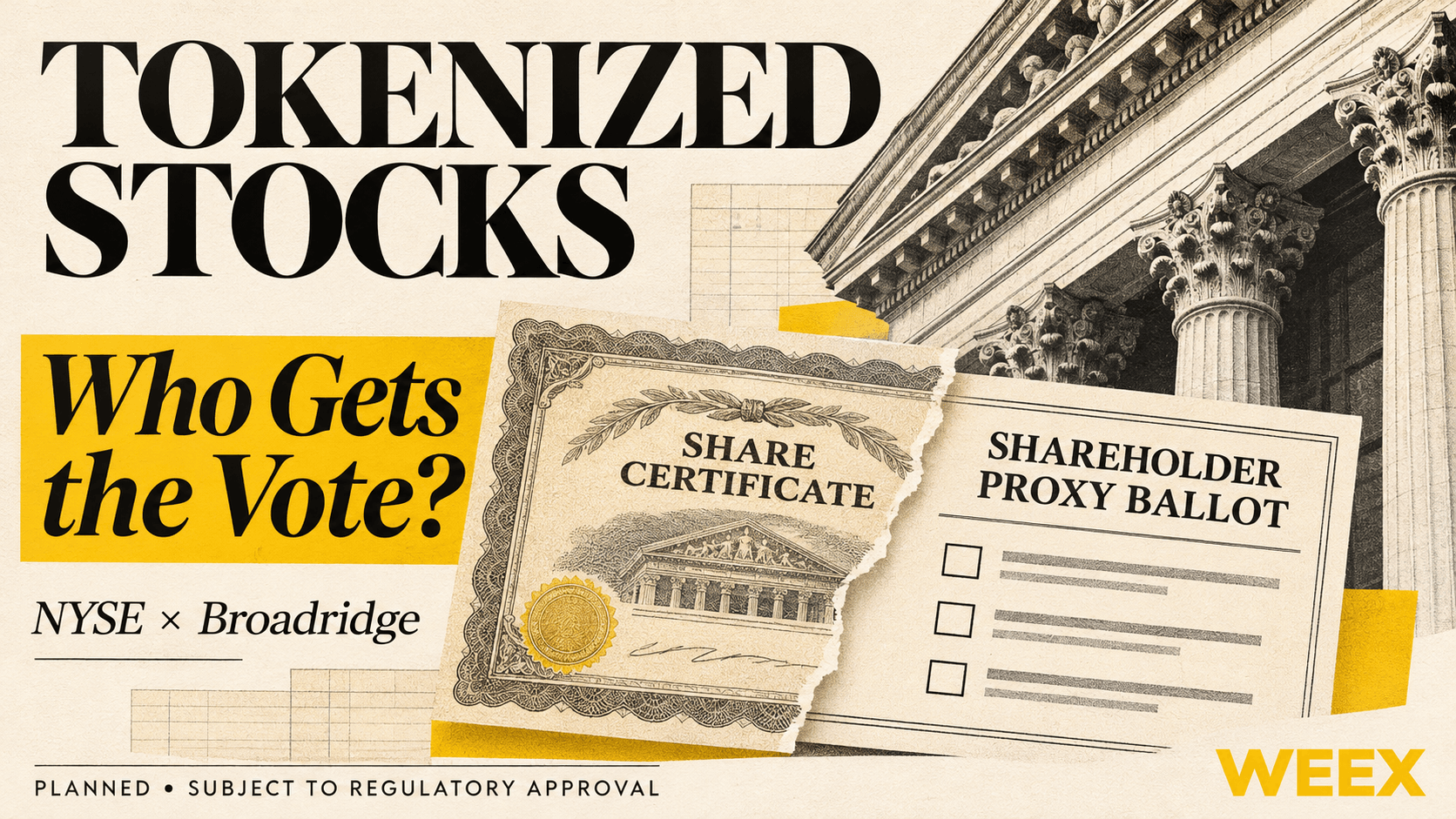
Will NYSE Tokenized Stocks Have Voting Rights? What the Broadridge Plan Means for Investors
Will NYSE tokenized stocks have voting rights? Understand Broadridge’s plan, shareholder eligibility, record dates and how stock futures differ.
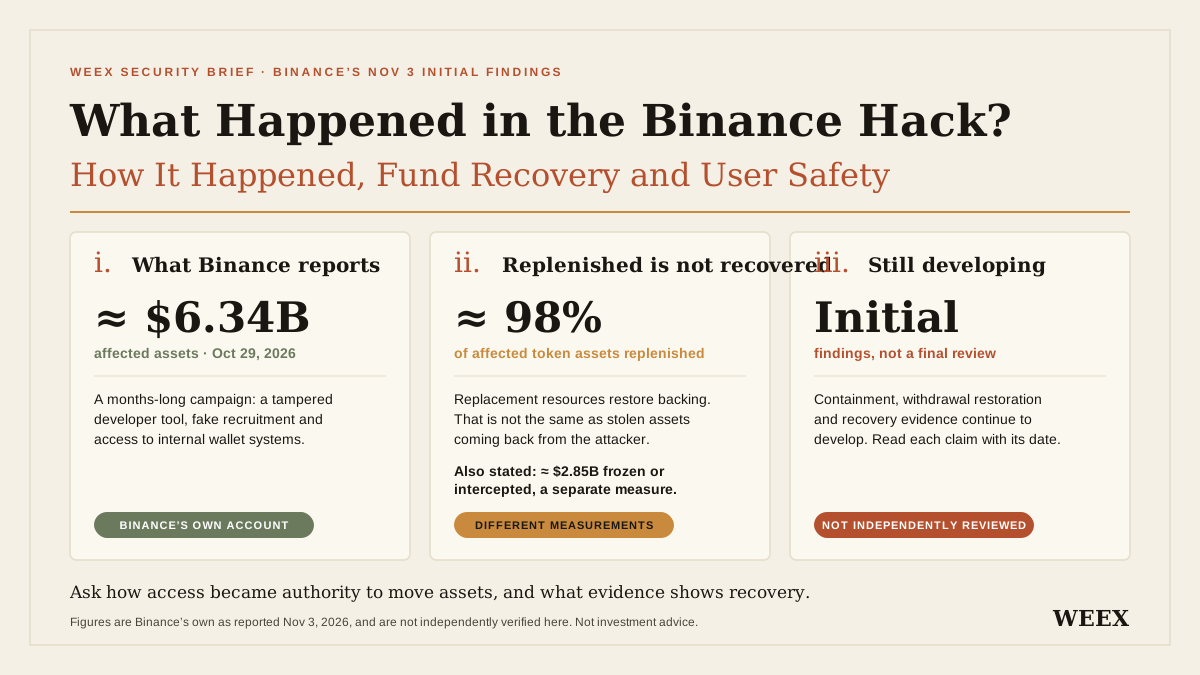
What Happened in the Binance Hack? How It Happened, Fund Recovery and User Safety
What happened in the Binance hack? Review the attack timeline, latest fund replenishment, recovery limits and practical steps to protect your account.
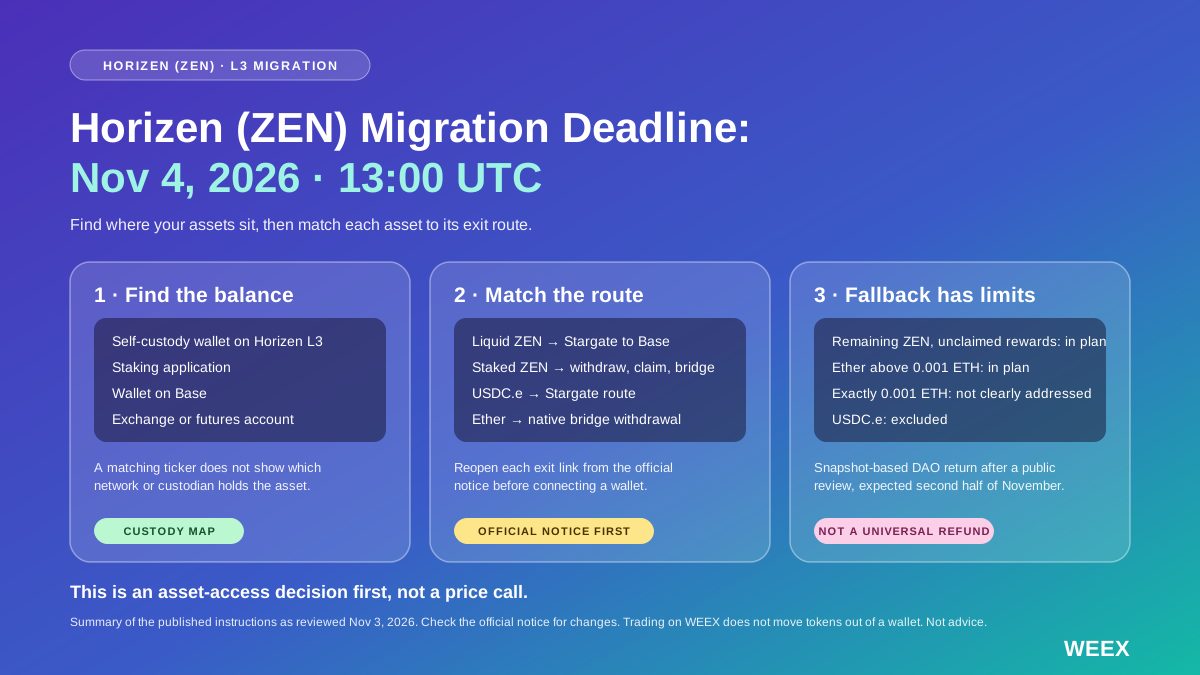
Horizen (ZEN) Migration Deadline: What to Move Before November 4 and What Happens If You Miss It
Horizen (ZEN) migration closes November 4. Check asset-specific bridge routes, wallet requirements, recovery exclusions and what to do if you miss it.

Bitcoin Lightning fix blocks a probe linking private channels to onchain funding

Bitcoin ETF Outflows Hit $398.6M on November 2 as BlackRock Leads Redemptions

Waiting for the Last Dip? Morgan Stanley's Wilson: Regardless of Election Results, It May Be a Good Opportunity to Buy U.S. Stocks

CFTC Opens U.S. Stock Market To Equity Perpetual Futures
New Jersey Drops Coinbase Staking Order After Three Years
Standard Chartered Launches Continuous Tokenized Deposits in Hong Kong
Judy Shelton and Monetary Policy Point to a Less Dominant Future for the Fed
Aave borrowers faced up to 36% APR while a freeze blocked fresh collateral
唐华斑竹 Discusses Velo's AI-Driven Payment Roadmap
Why is AERO still dragged down by dilution after all fees go to holders?
唐华斑竹 Reveals Velo Payment Feature Development Path
唐华斑竹 Discusses Velo Ecosystem and Orbit Plus Application
Aerodrome and Velodrome Merge to Launch Aero Exchange
Aero Says Goodbye to ve(3,3) Economic Model After Two Delays and Merges Online


