
Waiting for the Last Dip? Morgan Stanley's Wilson: Regardless of Election Results, It May Be a Good Opportunity to Buy U.S. Stocks

 Prefer us on Google



Author: Zhang Yaqi, Wall Street Watch
Mike Wilson, Chief U.S. Equity Strategist at Morgan Stanley, stated that the adjustment in U.S. stocks since June has entered the "final phase." Once the midterm elections take place tomorrow, market uncertainty will significantly dissipate, and high-quality cyclical stocks may present buying opportunities.
In a client report released on Monday, Wilson pointed out that regardless of the election results, the midterm elections themselves constitute a classic "clearing event." He cited historical data indicating that since 1982, large-cap stocks have averaged an increase of about 15% (market-cap weighted) to 16% (equal-weighted) within six months after midterm elections, with the gains further expanding to about 22% over the following year.
Regarding the election results, Wilson believes that the scenario of the Democratic Party sweeping both houses has been fully priced in by the market and does not constitute a significant surprise. At the same time, he also warned that post-election risks should not be overlooked—renewed military conflict with Iran and a new round of tariff policies are listed as the main potential threats.
Adjustment Nearing Its End, Market Showing Bottom Signals
Wilson and his team judge that the current adjustment is nearing its end, based on the resonance from multiple internal market indicators.
Among the constituents of the Russell 3000 index, 60% have cumulatively fallen more than 20% from the June peak, while the S&P 500 index has followed suit amid narrowing market breadth. Wilson pointed out that the pattern of individual stocks declining ahead of the index, followed by the index catching up in decline, is a typical characteristic when the market is nearing a bottom.
From recent market dynamics, since the end of September, the yield on 10-year U.S. Treasury bonds has fallen by nearly 40 basis points, and the proportion of S&P 500 constituents above the 200-day moving average has rebounded from about 42% to 62%, an increase of about 20 percentage points. The equal-weighted S&P 500 has risen nearly 5% during this period, outperforming the market-cap weighted index by about 6 percentage points. Wilson stated that this confirms the previous judgment—long-term interest rates are nearing their peak, and the equal-weighted S&P 500 is a more attractive expression of "broad-based trading."
The Nasdaq 100 index lost trillions of dollars in market value last month, nearing a technical correction zone. Wilson attributed the main trigger for this round of adjustment to the market's cautious attitude towards the earnings prospects of AI-related companies, emphasizing that the investor assessment framework has shifted—free cash flow (FCF) gaps are no longer tolerated, and profitability sustainability and cash generation capabilities are weighted more heavily, which aligns with the typical environment in the later stages of the economic cycle.
Limited Impact of Election Results, Policy Variables Remain Key
On prediction markets Kalshi and Polymarket, the probability of the Democratic Party sweeping both houses is 71% and 73%, respectively. Wilson believes this scenario has been digested by the market and is unlikely to trigger significant shocks.
Even if the Democratic Party achieves full control with a majority in the Senate, Wilson believes the direct impact may not be negative: delaying or reversing cuts to Medicaid and food stamps is expected to support consumer demand; companies may accelerate investment and merger activities in the short term to land before policy shifts in 2028.
However, Wilson emphasized that tariffs, foreign policy, and deregulation measures at the institutional level—policy variables that have had the most profound impact on the market over the past two years—are mostly still directly dominated by the executive branch and will not change due to congressional seat changes. "The stock market typically does not, and will not, price in two years in advance," he wrote.
In the scenario where the Republican Party maintains control of the Senate—Kalshi shows a probability of about 24%—Wilson believes the market may be forced to extend its focus to 2028, assessing the risks of deregulation policies facing resistance.
Liquidity Supplement May Provide Additional Support
On the monetary policy front, Wilson clearly stated that his judgment framework does not rely on the Federal Reserve shifting to rate cuts or introducing additional easing measures.
On the contrary, he views the decline in the U.S. Treasury General Account (TGA) balance as another path for liquidity supplementation. The Treasury's cash balance is expected to decrease from the current approximately $1.05 trillion to about $850 billion by the end of the year. As government spending is executed, this portion of funds will flow back into the market, forming a certain liquidity buffer.
Regarding the Russell 2000 small-cap index, Wilson's attitude is relatively cautious, believing that the required decline in interest rates for effective recovery of this index is still greater than the decline that has already occurred. This means that at this stage, he prefers to allocate funds to high-quality cyclical stocks with fully adjusted valuations rather than small-cap growth directions.
-- Price
This content is provided for general informational purposes only and doesn't constitute financial, investment, legal, or tax advice. Any events, rewards, online promotions, or related information mentioned herein should not be considered a recommendation, solicitation, or invitation to purchase, sell, trade, or otherwise deal in any crypto assets. Crypto assets are highly volatile and may result in loss. The availability of WEEX services, products, and related events may vary by region. You are responsible for ensuring that your participation is in accordance with applicable local laws and regulations.
You may also like
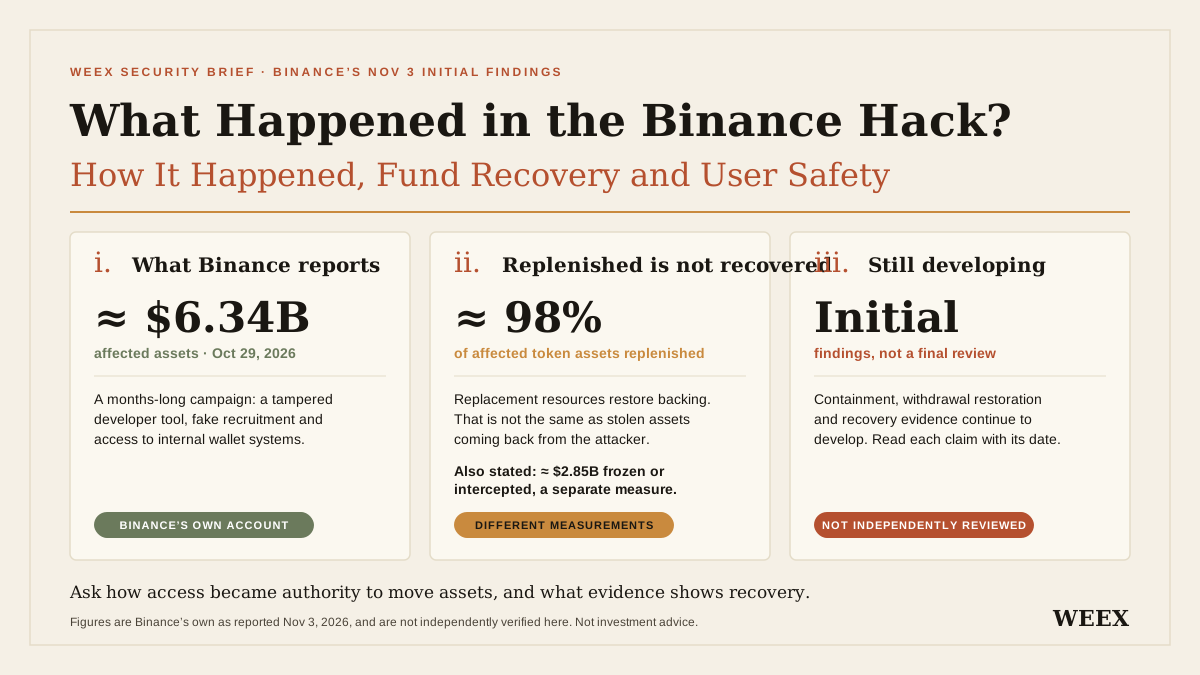
What Happened in the Binance Hack? How It Happened, Fund Recovery and User Safety
What happened in the Binance hack? Review the attack timeline, latest fund replenishment, recovery limits and practical steps to protect your account.

Bitcoin ETF Outflows Hit $398.6M on November 2 as BlackRock Leads Redemptions

Standard Chartered Launches Continuous Tokenized Deposits in Hong Kong

Judy Shelton and Monetary Policy Point to a Less Dominant Future for the Fed

Bitcoin’s year-end liquidity hopes face a projected $150 billion Treasury cash rebuild

ICE Partners with Hyperliquid, Traditional Exchanges' Moat is Shifting

Dollar stablecoin use stayed elevated after capital controls ended, new research suggests

The "Election Effect" of Bitcoin: Political Catalyst or Coinciding with the Halving Cycle?

CoreWeave's Capital Flywheel Comes to a Halt

Solana study finds wider spreads outside aggregators at five of six sampled pools

Thai Police Obtain Fund Flow Data from Three Exchanges Related to Shuffle, Form 80 Task Forces

唐华斑竹: GOAT Network Addresses Business Security Pain Points

Who Benefits More After Aero's Merger Upgrade: Holders, LPs, or the Platform?
Airtm and BVNK Plan Wallet Payments for Merchants in Emerging Markets

Hashdex Adds Jane Street to Crypto Index ETF Authorized Participants

Tech Stocks Fall 7% on Wall Street Amid AI Concerns

When Software Starts Spending Money: Pantera Partner Explains How AI Agents Are Restructuring SaaS Business Models and Crypto Payments

BlackRock’s Ethereum fund sheds 580K ETH as monthly exits mount

Ethereum added 361,000 ETH to active stake while its total staking balance shrank

Franklin Templeton: The Next Generation of Agents Has Arrived

Goldman Sachs Bans Most Employees from Using AI Programming Tools

Akash’s Solana plan would end current staking rewards while allowing new AKT issuance

EU Entity Loses Over $106 Million to Theft, Attackers Transfer Funds via Privacy Coins

Ownership of Bitcoin in the Qian Zhimin Case and Victim Compensation

Is Issuing Tokens Still Necessary for Crypto Projects Focused on Revenue?

ForeDex Signs MOU with Hansung University for On-Chain Data Technology

Monthly Column Report|Foresight News Outstanding Content Creators List for October 2026

TRON Industry Weekly Report: Crypto Security Incident Weakens BTC, Detailed Explanation of Building Economic Agent Capability Infrastructure Neosoul
November Starts Busy with Key Developments from November 2-6! US Elections, Employment Report, and Fed Messages

Apple Regains Market-Cap Lead, Silver Back Near $50 | WEEX Daily Market(November 2, 2026)
At the October 31 close, Apple’s market cap once again surpassed Nvidia during the tech pullback. Alphabet fell more than 10% last week. Silver returned near $50. TRUMP token rose more than 10% over 24 hours. OP turned higher after stabilizing. November 2 focus is Marriott before the open and after-hours earnings from Apple, Palantir and others.
What Happened in the Binance Hack? How It Happened, Fund Recovery and User Safety
What happened in the Binance hack? Review the attack timeline, latest fund replenishment, recovery limits and practical steps to protect your account.
Bitcoin ETF Outflows Hit $398.6M on November 2 as BlackRock Leads Redemptions
Standard Chartered Launches Continuous Tokenized Deposits in Hong Kong
Judy Shelton and Monetary Policy Point to a Less Dominant Future for the Fed
Bitcoin’s year-end liquidity hopes face a projected $150 billion Treasury cash rebuild
ICE Partners with Hyperliquid, Traditional Exchanges' Moat is Shifting
Contents
Latest articles


Latest coin listings on WEEX


