
Akash’s Solana plan would end current staking rewards while allowing new AKT issuance

 Prefer us on Google



Akash's proposed Solana migration would end the inflation-funded staking rewards paid on its current chain while its draft economic framework would allow new AKT issuance for provider incentives and the treasury.
Akash is a decentralized cloud-computing marketplace. Its AKT token helps govern and secure its sovereign Cosmos chain. The proposed migration would move the token and marketplace onto Solana in separate steps, with different consequences for balances, staking income and future supply.
Proposal 346 remained in voting when checked on Nov. 2, with a deadline of Nov. 2 at 15:02:58 UTC. A successful vote would authorize the migration and token portal. It would leave the marketplace's cutover date for another proposal.
That distinction matters because a promise to exchange one old AKT for one SPL AKT preserves a balance at conversion. It does not, by itself, preserve the income attached to holding or staking that balance.
Staking income and incentive emissions
The proposal separates approval, token launch, marketplace cutover and the old chain's eventual halt. Old-chain inflation and staking rewards would end at cutover. Validator roles and income would end at halt, 90 days later.
The submitted proposal expects SPL AKT and the one-way portal to launch two to three weeks after passage, once token and portal audits are complete. The marketplace would move only after its audits and migration rehearsals pass and a separate cutover proposal is approved.
The proposal now being voted on describes a portal transaction that starts unbonding, claims rewards and queues migration after 21 days. Earlier descriptions differ: the Oct. 20 technical draft uses seven days to token launch and 14 days for unbonding, while the Oct. 26 blog says two weeks to launch and unbonding for 21 days before using the portal.
Those descriptions do not establish one settled user flow. The current proposal sets the authorization being voted on; final audited instructions would still need to reconcile the older draft and the blog.
In his Oct. 26 explanation, Greg Osuri said new staking mechanisms would be announced before cutover. That establishes a commitment to explain a replacement, rather than a published replacement yield or payout formula.
Who could receive new AKT
Akash's AEP-79 migration design makes a separate provision for replacement emissions: newly issued AKT directed to provider incentives and the community treasury. It describes reduced gross emissions as the intended direction, but leaves the numerical curve for modeling and governance.
Under the proposed design, a holder could lose the present inflation-funded staking income while new tokens continued to be issued for other purposes. Issuance to those accounts would expand the token base without automatically increasing a passive holder's balance.
The unresolved economic modeling covers the gross rate, decay, split between recipients and cumulative hard-cap amount. Those determine both how much new AKT could enter supply and how its distribution would change over time.
The token-migration draft specifies a cumulative incentive-emissions cap separate from the migration budget. Its numerical amount remains unresolved; once set from the ratified model, the cap could not be raised by governance. The schedule would remain adjustable through the DAO and a timelock within that limit, with a guardian able to pause emissions.
The draft also allows a paused start. If the model has not been ratified before the cutover supply snapshot, the token-issuance program would start with zero scheduled emissions and wait for governance activation. That is a contingency in the design, rather than a decision to end issuance permanently.
These are proposed controls over a future program. They supply no final numerical ceiling, emission rate or date on which replacement incentives would begin.
Compute credits and the supply question
Compute payments could also affect how much AKT remains available to trade. Their supply implications depend on the accounting model, and the roadmap and proposed Solana design describe different limits.
Akash's AEP-76 roadmap describes ACT as a nontransferable, dollar-denominated compute credit. Its proposed burn-mint equilibrium (BME) model links funding those credits to AKT removed from liquid circulation.
The roadmap's detailed vault model uses previously removed AKT and remint credits first. If those are insufficient to meet a payout, it describes minting a shortfall. That describes a possible issuance path within the roadmap's model; compute usage alone is not enough to establish a permanent net burn.
The proposed Solana architecture specifies a different limit: AKT supplied for ACT stays in a vault as collateral, and ACT redemption is paid from that vault. It expressly forbids the BME program from minting AKT.
The document also leaves current-chain vault payouts versus fresh minting as an implementation question. The roadmap's shortfall-minting description consequently does not establish a fresh-minting path for the proposed Solana system.
The supply effects need to be separated: tokens represented through migration, new incentive emissions, and AKT moving into and out of compute-credit collateral. A vault balance temporarily removed from trading is not the same thing as tokens permanently destroyed.
The proposed portal would remain open for two years, with migration irreversible. Its 1:1 accounting answers how eligible token balances would be represented on Solana. The future emissions curve and replacement staking terms answer different questions about holders' income and exposure to issuance.
The proposal says the emissions curve must be published before the later cutover proposal. Alongside the promised staking details and resolved compute-credit accounting, it would give holders the information needed to judge the post-migration model.
-- Price
This content is provided for general informational purposes only and doesn't constitute financial, investment, legal, or tax advice. Any events, rewards, online promotions, or related information mentioned herein should not be considered a recommendation, solicitation, or invitation to purchase, sell, trade, or otherwise deal in any crypto assets. Crypto assets are highly volatile and may result in loss. The availability of WEEX services, products, and related events may vary by region. You are responsible for ensuring that your participation is in accordance with applicable local laws and regulations.
You may also like
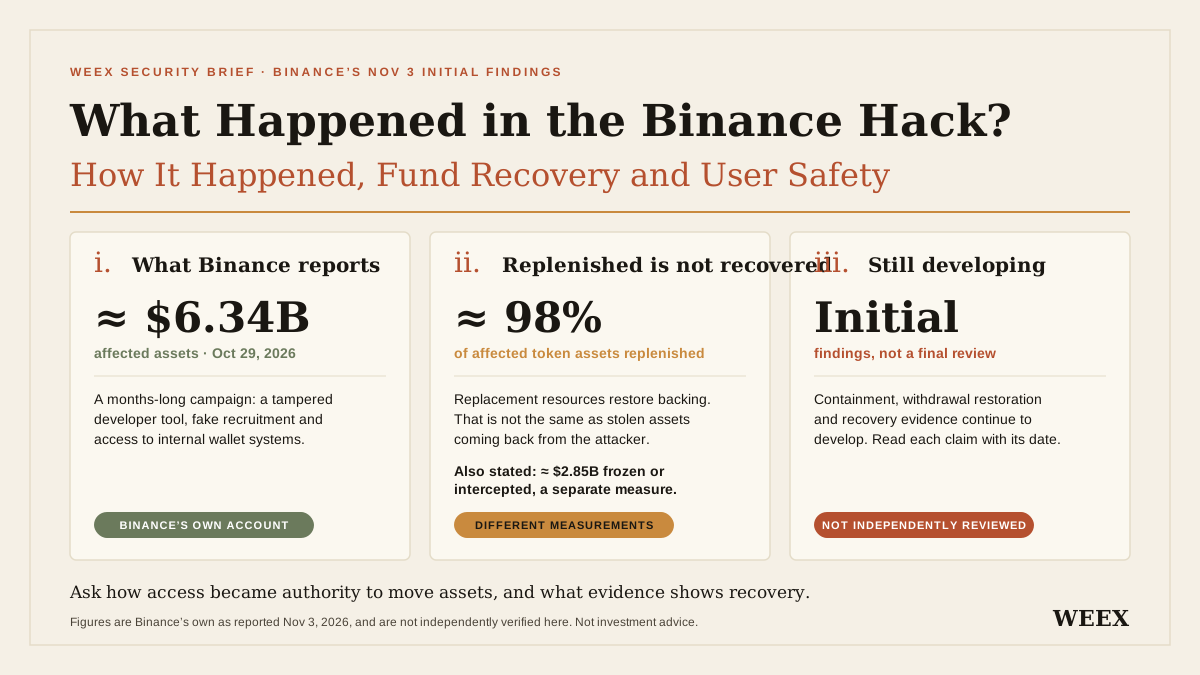
What Happened in the Binance Hack? How It Happened, Fund Recovery and User Safety
What happened in the Binance hack? Review the attack timeline, latest fund replenishment, recovery limits and practical steps to protect your account.

Bitcoin ETF Outflows Hit $398.6M on November 2 as BlackRock Leads Redemptions

Waiting for the Last Dip? Morgan Stanley's Wilson: Regardless of Election Results, It May Be a Good Opportunity to Buy U.S. Stocks
Standard Chartered Launches Continuous Tokenized Deposits in Hong Kong

Judy Shelton and Monetary Policy Point to a Less Dominant Future for the Fed

Bitcoin’s year-end liquidity hopes face a projected $150 billion Treasury cash rebuild

ICE Partners with Hyperliquid, Traditional Exchanges' Moat is Shifting

Dollar stablecoin use stayed elevated after capital controls ended, new research suggests

The "Election Effect" of Bitcoin: Political Catalyst or Coinciding with the Halving Cycle?

CoreWeave's Capital Flywheel Comes to a Halt

Solana study finds wider spreads outside aggregators at five of six sampled pools

Thai Police Obtain Fund Flow Data from Three Exchanges Related to Shuffle, Form 80 Task Forces

唐华斑竹: GOAT Network Addresses Business Security Pain Points

Who Benefits More After Aero's Merger Upgrade: Holders, LPs, or the Platform?
Airtm and BVNK Plan Wallet Payments for Merchants in Emerging Markets

Hashdex Adds Jane Street to Crypto Index ETF Authorized Participants

Tech Stocks Fall 7% on Wall Street Amid AI Concerns

When Software Starts Spending Money: Pantera Partner Explains How AI Agents Are Restructuring SaaS Business Models and Crypto Payments

BlackRock’s Ethereum fund sheds 580K ETH as monthly exits mount

Ethereum added 361,000 ETH to active stake while its total staking balance shrank

Franklin Templeton: The Next Generation of Agents Has Arrived

Goldman Sachs Bans Most Employees from Using AI Programming Tools
EU Entity Loses Over $106 Million to Theft, Attackers Transfer Funds via Privacy Coins

Ownership of Bitcoin in the Qian Zhimin Case and Victim Compensation

Is Issuing Tokens Still Necessary for Crypto Projects Focused on Revenue?

ForeDex Signs MOU with Hansung University for On-Chain Data Technology

Monthly Column Report|Foresight News Outstanding Content Creators List for October 2026

TRON Industry Weekly Report: Crypto Security Incident Weakens BTC, Detailed Explanation of Building Economic Agent Capability Infrastructure Neosoul
November Starts Busy with Key Developments from November 2-6! US Elections, Employment Report, and Fed Messages

Apple Regains Market-Cap Lead, Silver Back Near $50 | WEEX Daily Market(November 2, 2026)
At the October 31 close, Apple’s market cap once again surpassed Nvidia during the tech pullback. Alphabet fell more than 10% last week. Silver returned near $50. TRUMP token rose more than 10% over 24 hours. OP turned higher after stabilizing. November 2 focus is Marriott before the open and after-hours earnings from Apple, Palantir and others.
What Happened in the Binance Hack? How It Happened, Fund Recovery and User Safety
What happened in the Binance hack? Review the attack timeline, latest fund replenishment, recovery limits and practical steps to protect your account.
Bitcoin ETF Outflows Hit $398.6M on November 2 as BlackRock Leads Redemptions
Waiting for the Last Dip? Morgan Stanley's Wilson: Regardless of Election Results, It May Be a Good Opportunity to Buy U.S. Stocks
Standard Chartered Launches Continuous Tokenized Deposits in Hong Kong
Judy Shelton and Monetary Policy Point to a Less Dominant Future for the Fed
Bitcoin’s year-end liquidity hopes face a projected $150 billion Treasury cash rebuild
Contents
Latest articles


Latest coin listings on WEEX


