
Horizen (ZEN) Migration Deadline: What to Move Before November 4 and What Happens If You Miss It

 Prefer us on Google


Horizen (ZEN) Migration Deadline: What to Move Before November 4 and What Happens If You Miss It
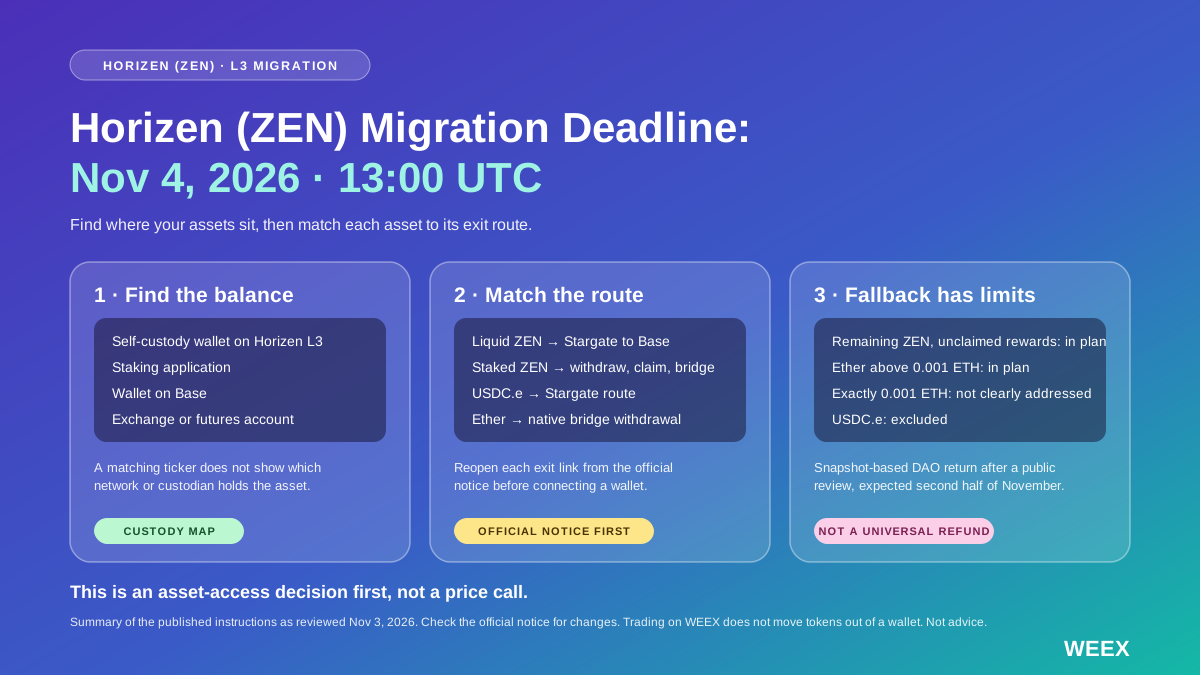
The Horizen (ZEN) migration deadline is November 4, 2026, at 13:00 UTC. Users holding assets on the Horizen L3 should follow the official instructions to move them to Base before the cutoff. The fallback recovery process has asset-specific conditions, so holders should not assume that every remaining balance will be returned. The first step is to identify where your assets actually sit: a self-custody wallet, a staking contract, Base, or an exchange account.
Our view is that this is primarily an asset-access decision, rather than a reason to make an immediate price prediction. A token can remain visible in a wallet while the infrastructure needed to move it becomes unavailable. The most useful migration checklist therefore starts with the network, asset and wallet type—not the market price.
For readers monitoring the market separately, WEEX provides a Horizen futures page and a Horizen spot page. These are trading destinations, not migration tools. During this review on November 3, the futures page displayed a circuit-breaker notice restricting position operations, so check the current interface and announcements before attempting an order. A futures position does not move tokens out of an affected wallet.
Who Needs to Act Before the Migration Deadline?
The relevant question is whether you control an affected balance on the Horizen L3. Seeing “ZEN” in a portfolio does not establish which network holds the asset or who is responsible for its custody.
Horizen’s token documentation identifies ZEN as an ERC-20 asset native to Base, with a separate representation on the Horizen network. It publishes different contract addresses for those roles. This distinction matters because a Base balance and an L3 balance are not interchangeable simply because the wallet displays the same ticker.
Use the following table to decide which investigation comes first.
| Where You See the Balance | What to Check | Appropriate Next Step |
|---|---|---|
| A self-custody wallet connected to Horizen L3 | Network, token contract, spendable balance and gas | Follow the asset-specific exit instructions |
| A staking application | Principal, claimable rewards and withdrawal status | Establish what must be withdrawn before bridging |
| A wallet connected to Base | Whether the asset is the expected Base token | Verify its contract and transaction history |
| A centralized exchange account | Exchange maintenance notices and supported networks | Follow the exchange’s instructions |
| A futures account | Contract position, margin and trading status | Manage the position under the exchange’s rules |
This is a custody map, not a guarantee about any platform’s processing. An exchange account may show an internal balance without exposing the underlying wallet arrangement. Conversely, a self-custody wallet may display an asset on several networks.
Do not withdraw exchange-held tokens to the affected L3 merely because a migration article says holders must “move their assets.” First establish whether the instruction applies to the balance you hold.
Which Assets Need Different Exit Routes?
The migration cannot be reduced to a single “bridge everything” instruction. The asset determines the route, and the wallet determines whether you can execute it.
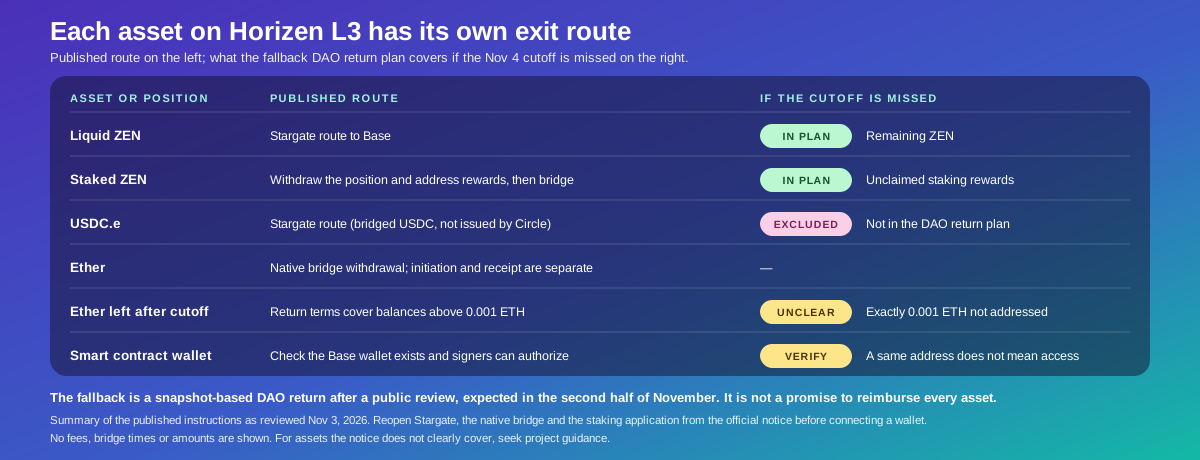
Current reporting identifies different treatment for ZEN, Ether and bridged USDC.e, including an Ether threshold and an exclusion from the DAO return process.
| Asset or Position on Horizen L3 | Published Route or Requirement | Main Point to Verify |
|---|---|---|
| Liquid ZEN | Stargate route to Base | Correct asset, direction and receiving address |
| Staked ZEN | Withdraw the position and address rewards before bridging | Whether the application still shows principal or rewards |
| USDC.e | Exit through the supported Stargate route | It is excluded from the DAO return plan |
| Ether | Native bridge withdrawal | Initiation and final receipt are separate stages |
| Ether remaining after the cutoff | Published return terms cover balances above 0.001 ETH | Exactly 0.001 ETH is not clearly addressed |
| Assets controlled by a smart contract wallet | Check destination-wallet compatibility | A matching address alone does not establish access |
The table combines the published instructions with practical verification questions. Horizen directs stakers to its staking application, and identifies Stargate and the native bridge as the relevant exit interfaces. Reopen these destinations through the official migration notice before connecting a wallet.
For an asset not covered clearly by the notice, seek project guidance rather than assuming that a familiar ticker qualifies for the same recovery process.
Why Bridged USD Coin (USDC.e) Requires Particular Attention
USDC.e on Horizen is a bridged representation of USDC. Horizen’s documentation describes it as a Stargate Hydra asset backed by USDC in the bridging system. It is not directly issued by Circle and does not provide direct access to Circle Mint or CCTP.
That structure changes the question a holder must ask. A displayed dollar value does not tell you whether the current chain, bridge and destination can process your exit.
LayerZero’s support update separately lists November 4, 2026, as the effective deprecation date for Horizen and instructs affected USDC.e holders to bridge to Stargate Pools beforehand. This provides a second primary-source reason to examine the exit route promptly.
For a holder, the practical verification sequence is:
- Confirm the source network and exact token.
- Check the destination network and output asset in the bridge quote.
- Review the amount expected after fees.
- Complete the required transaction and retain its reference.
- Verify the destination balance independently.
Do not stop at a successful source-chain transaction if the intended outcome is a spendable destination balance. Equally, do not repeat a transaction simply because the destination has not updated immediately. Investigate the existing transfer first.
-- Price
How to Move Horizen (ZEN) Without Leaving Part of the Position Behind
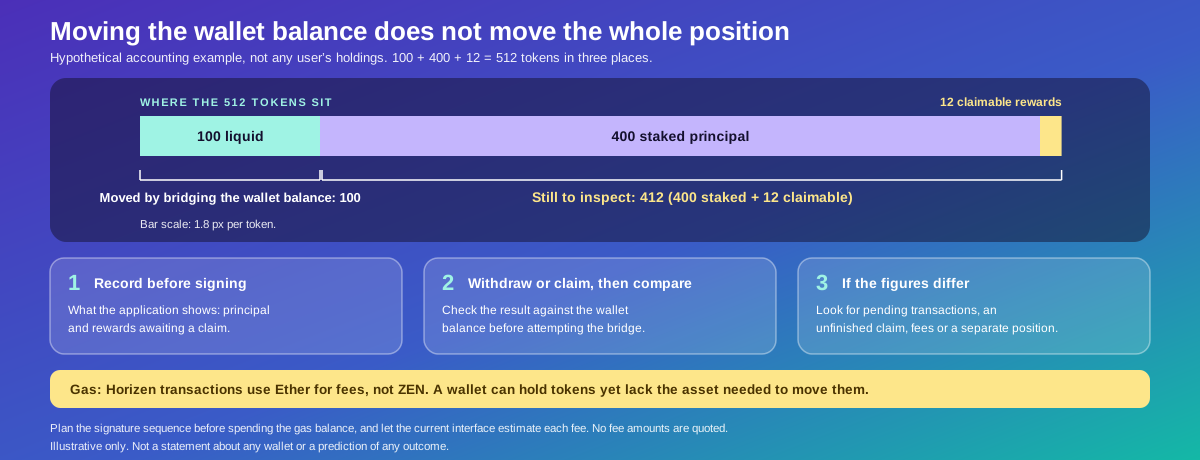
A migration can be incomplete even when the wallet’s liquid token balance has been transferred. Principal held in an application and rewards awaiting a claim are separate things to inspect.
Consider a hypothetical wallet with 100 liquid tokens, 400 tokens in a staking position and 12 claimable reward tokens. Moving the 100-token wallet balance does not establish that the other 412 tokens have been handled. This is an accounting example, not a statement about any user’s holdings.
Before signing, record what the application shows. After withdrawing or claiming, compare the result with the wallet balance. If the figures differ, look for pending transactions, an uncompleted claim, fees or a separate position before attempting the bridge.
Gas creates another possible obstacle. Horizen transactions use Ether for fees; ZEN is not the network’s gas token. A wallet can therefore contain a valuable token balance yet lack the asset needed to move it.
Plan the transaction sequence before removing the gas balance. Application withdrawals, reward claims and bridge operations may involve more than one signature. Let the current interface estimate the required fees, and avoid treating a remembered fee from a previous transaction as sufficient evidence.
After completing the exit, revisit the application and wallet once more. The useful question is not simply “Did I send something?” but “Have I accounted for every position I intended to move?”
Why an Ether (ETH) Withdrawal Can Remain Pending After the Cutoff
The deadline for initiating a withdrawal and the time when funds become usable on Base are different milestones.
Horizen’s general native-bridge documentation describes an optimistic withdrawal process with a minimum seven-day challenge window and a subsequent claim transaction on Base. It also explains that the user needs gas on the relevant chain for each stage.
The event-specific wind-down notice gives an approximately two-week completion expectation. Treat that as the relevant planning estimate for this migration, rather than promising the shortest interval found in a general tutorial.
Keep three separate records: when the source transaction was submitted, whether it succeeded, and whether the destination action has completed. A wallet approval, a failed transaction and a successful withdrawal initiation are different outcomes.
This distinction also helps when seeking support. “My funds have not arrived” is less actionable than a source transaction hash, the bridge route, the destination address and the status currently displayed.
Neither a pending screen nor a source-chain confirmation alone establishes the final outcome. Follow the current event instructions for the outstanding stage, and do not assume that the normal bridge workflow will remain unchanged throughout the wind-down.
Why Safe and Other Smart Contract Wallets Need an Extra Check
For a smart contract wallet, an identical address on another network does not automatically mean that an equivalent, usable wallet exists there.
Safe’s documentation explains that multichain deployment depends on configuration and deployment parameters. It also identifies compatibility considerations involving wallet versions and the availability of the required owners.
The practical implication is easy to miss: a recovery plan can identify the correct address while the owner still needs additional work to access assets at that address on the destination chain.
Before relying on a same-address return, establish whether the destination wallet is deployed, whether its configuration is appropriate, and whether the required signers can authorize a transaction. Do not assume that controlling one signer’s ordinary wallet is equivalent to controlling the contract wallet.
Horizen’s notice asks affected contract-wallet users who cannot withdraw, or whose corresponding wallet does not exist on Base, to contact security@horizen.io before the deadline. Verify that address against the official notice before using it.
A useful support request can include the public wallet address, wallet type, affected assets and relevant transaction references. It should never require disclosure of a recovery phrase or private key.
What Happens If You Miss the Deadline?
The published fallback is a snapshot-based DAO return process for specified balances. It is not a universal promise to reimburse every asset, wallet arrangement or transaction problem.
The plan includes remaining ZEN and unclaimed staking rewards, with qualifying Ether also addressed. A public review precedes distribution, and the anticipated return window is the second half of November. USDC.e is excluded. The Ether wording covers balances above 0.001 ETH, while the exact boundary remains unclear.
For someone who misses the cutoff, the next task is evidence preservation. Record the affected address, asset identifiers, visible balances and any transactions already initiated. These records help distinguish a remaining wallet balance from an in-flight withdrawal or an application position.
When snapshot information is published, compare it with your records. If something differs, identify the exact discrepancy rather than relying only on a portfolio screenshot. A portfolio’s displayed value can change with prices or indexing; an asset quantity and transaction reference provide a more specific basis for investigation.
Do not interpret an estimated distribution window as a personal payment appointment. A project-wide schedule does not establish when a particular wallet’s issue will be resolved.
What to Save Before Signing Any Migration Transaction
A compact record can make later troubleshooting substantially easier. It also forces you to confirm that the transaction you are signing matches your intended destination.
| Record | What It Helps Establish |
|---|---|
| Official notice URL and date checked | Which instructions you followed |
| Source network and wallet address | Where the assets started |
| Token contract and amount | Which asset was involved |
| Destination network and address | Where you intended to receive it |
| Source transaction hash | What was actually submitted |
| Bridge transfer reference | How to locate the cross-chain operation |
| Destination transaction or receipt | Whether the receiving stage completed |
Avoid storing sensitive credentials alongside this record. Public transaction references help support teams investigate; passwords, recovery phrases and private keys should remain private.
This record also prevents a common analytical mistake: treating several screens as evidence of several separate losses. A wallet debit, bridge receipt and pending destination transfer may describe different stages of the same operation. Reconcile the transaction before adding amounts together.
How to Recognize Migration Scams
A deadline gives impersonators an effective pressure tactic. Someone who is worried about losing access may follow an unsolicited “recovery” link without checking who controls it.
Start from the official notice and navigate outward. Compare the destination domain before connecting a wallet. A search advertisement, copied logo or familiar profile picture does not verify a migration service.
When a wallet displays a signature request, consider what authority it grants. Connecting a wallet, approving token spending and transferring an asset are distinct actions. If the requested action does not match the task you intended to perform, stop and investigate.
Be particularly cautious about requests to send funds to a privately supplied “safe wallet” or pay a separate recovery charge to a stranger. A support conversation should help you identify your transaction and the published process, rather than replace that process with a new destination.
For any message claiming to represent WEEX, use the WEEX Contact Verifier. That tool is for checking WEEX-related channels; it does not authenticate a Horizen representative.
Trade Horizen (ZEN) on WEEX: Separate Market Exposure From Migration
Trading and bridging solve different problems. A bridge changes where an on-chain asset can be accessed. A trade changes a market position. Completing one does not demonstrate completion of the other.
The WEEX Horizen futures page provides the contract destination, while the spot page provides the cash-market destination. The retrieved futures interface included a restriction notice during this review. Treat the current platform status as a prerequisite to trading, rather than assuming that a published pair page guarantees immediate execution.
If trading is available for your account, inspect the exact pair, order type, position size and applicable costs before submitting. Futures additionally require attention to margin, leverage, funding and liquidation. WEEX’s futures trading guide provides an interface walkthrough.
Spot purchasing avoids the leveraged-liquidation mechanism of a futures position, but the token can still lose value. It also does not establish which deposit or withdrawal networks are available.
Check the WEEX fee schedule for the applicable rates and the event calendar for published campaign terms. This article does not assume a ZEN-specific fee reduction or reward eligibility.
Most importantly, opening a short position does not recover stranded tokens. It creates a separate exposure with its own costs and risks.
Does the Migration Determine the Token’s Investment Outlook?
A successful transfer answers an operational question: can the holder access the asset on the intended network? It does not, by itself, establish that the asset will appreciate.
A separate investment assessment would examine usable applications, demand for the token, governance decisions, market liquidity and the economic role of the asset. Those questions should not be collapsed into “the bridge worked, therefore the investment is attractive.”
The same separation applies to missed deadlines. An access problem can impose a real cost on a holder without proving that every market participant faces the same problem.
For readers managing both a wallet and a trading account, maintain two records. One tracks migration quantities and receipts. The other tracks trades, fees and exposure. Combining them can conceal whether a change in portfolio value came from price movement, an execution cost or an asset still awaiting delivery.
WEEX Editorial View
The strongest response to this deadline is a complete inventory followed by a verified exit path. Start with where the assets are held, then confirm the correct route and preserve evidence of each transaction.
The weakest assumption is that every balance displaying the same ticker receives the same treatment. Bridged assets, application positions, exchange balances and contract wallets can require different actions.
A migration is complete when the intended assets are accessible under the expected control on the destination—not merely when a wallet has accepted a signature. That is the standard holders should use when reviewing their own progress.
FAQ
1. What Is the Horizen (ZEN) Migration Deadline?
The published cutoff is November 4, 2026, at 13:00 UTC. Use the official notice to check for subsequent changes before acting.
2. Will Every Remaining Asset Be Returned Automatically?
No. The return plan has asset-specific conditions and exclusions. Do not assume that an asset qualifies simply because a wallet displays it on the affected network.
3. Does a Pending Bridge Transfer Mean the Funds Are Lost?
Not necessarily. Check whether the source transaction succeeded and which destination or claim stage remains outstanding. Preserve the transaction reference before attempting further action.
4. Do Exchange Users Need to Connect Their Wallets to a Migration Site?
An exchange balance should be handled according to that exchange’s official instructions. Do not connect a wallet or disclose credentials merely because an unsolicited message says a migration is required.
5. Can Trading on WEEX Complete the Migration?
No. A spot or futures trade is separate from moving assets out of an affected self-custody wallet. Verify the wallet migration and any market position independently.
Sources
All sources were accessed on November 3, 2026.
- Horizen — Changes for Horizen. Published October 23, 2026; current notice reviewed for migration instructions.
- TokenPost — Horizen Sets Nov. 4 Deadline for Assets on Its Layer 3 Network. Published November 2, 2026.
- LayerZero — Support Update. Published July 24, 2026; update dated October 29, 2026.
- Horizen Documentation — USDC on Horizen, Native Bridge Mechanics and Gas on Horizen. Publication dates not displayed.
- Safe Documentation — Deploying Safe Accounts on Multiple Chains. Publication date not displayed.
- WEEX — Horizen Futures, Horizen Spot and Futures Trading Guide. Product pages checked during this review; availability can change.
This content is provided for general informational purposes only and doesn't constitute financial, investment, legal, or tax advice. Any events, rewards, online promotions, or related information mentioned herein should not be considered a recommendation, solicitation, or invitation to purchase, sell, trade, or otherwise deal in any crypto assets. Crypto assets are highly volatile and may result in loss. The availability of WEEX services, products, and related events may vary by region. You are responsible for ensuring that your participation is in accordance with applicable local laws and regulations.
You may also like

Solana’s Yakovenko calls phishing crypto’s biggest threat

OpenUSD Stablecoin Charges $0.01 Management Fee and Establishes Equity Incentive Pool
Aave borrowers faced up to 36% APR while a freeze blocked fresh collateral

Key Coins in the TON Ecosystem to Watch in 2026

Countdown to Elysium Mainnet Launch: 29 Ecological Projects to Watch
Who really controls a crypto project? Inside the SEC’s new guidance

A bitcoin at 500,000 dollars: VanEck details a scenario based on comparison with gold
Why Does Musk Persist with Grok Bot Despite High Costs?
Circle Opens CCTP to Third-Party Tokens, Joining the Cross-Chain Standard Battle

Is it theft or fraud when the coins in the wallet remain but are changed to multi-signature by someone else?
Anthropic Warns AI May Enter Self-Accelerating Phase
Horizen Holders Face November 4 Bridge Cutoff Before L3 Wind-Down
XRP Ledger to Activate a Fix Addressing Permission Delegation Vulnerability
TRON Industry Weekly Report: Crypto Security Incident Weakens BTC, Detailed Explanation of Building Economic Agent Capability Infrastructure Neosoul

Vitalik's Latest Thoughts: We Need a Digital Minimalism Movement
After the Embodied AI Sector Cools Down, This Stanford Startup Secures Hundreds of Millions in Funding Against the Trend
Interview with DogPay Founder: Slow is Fast, From U Card to Global Payment Network
Ambire Ice Puts Safe Owner Changes and Approval Thresholds on the Signing Screen

DTCC Connects $114 Trillion in Assets to the Blockchain, But On-Chain Trading Is Not the First Step

tBTC Minting and Redemption Paused, Threshold Network Claims Sufficient Asset Reserves
Regulated, Approved or Registered Crypto Funds: What Each Status Really Guarantees

Crypto Industry's Three Major PACs Invest $170 Million to Support Republican Candidates
Why is AERO still dragged down by dilution after all fees go to holders?

The Need for Institutionalization of Market Makers Between Liquidity Provision and Price Manipulation
Crypto Can’t Go On Like This: An Industry Self-Rescue Initiative from a Blockchain Practitioner
Overview of Cryptocurrency Asset Regulation Series (12): Malaysia, Exchanges, Custody, and Token Issuance
Microsoft Report: North Korean Hackers Using AI to Mass-Produce Bait, Generating Dozens of Phishing Files in Minutes

Vitalik Proposes Digital Minimalism, Calls for Reduced Dependence on Social Media
Maple locks $280M in XRP collateral and upcoming maturity dates threaten liquidations
Ledger CTO: "Threshold for Decryption Continues to Lower"... Bitcoin Cryptography Warning
Solana’s Yakovenko calls phishing crypto’s biggest threat
OpenUSD Stablecoin Charges $0.01 Management Fee and Establishes Equity Incentive Pool
Aave borrowers faced up to 36% APR while a freeze blocked fresh collateral
Key Coins in the TON Ecosystem to Watch in 2026
Countdown to Elysium Mainnet Launch: 29 Ecological Projects to Watch
Who really controls a crypto project? Inside the SEC’s new guidance


