
Why Does Musk Persist with Grok Bot Despite High Costs?

 Prefer us on Google


Original | Odaily Planet Daily ( @OdailyChina )
Author | Wenser ( @wenser2010 )
If you follow Musk's account on the X platform, you may have noticed that he has been mentioning "Grok Bot" at an astonishing frequency lately, rivaling even the frequency of Tesla and SpaceX product launches. This high-frequency promotion has naturally drawn increasing attention and usage for Grok Bot, along with a wave of controversy and skepticism.
On November 1, someone called out to Musk, saying, "The consumption of Grok Bot's quota has been particularly fast lately; when will there be a quota reset?" Musk responded, stating that "the cost of providing services for Grok Bot is unsustainable relative to the income," and added that "even if the era of AI abundance eventually arrives, unlimited usage is not feasible at this stage"; he also mentioned that users feel the high-tier packages are too expensive and whether to lower the quotas and inform users in advance are matters that need to be weighed.
From the recent public criticism of new cloud vendors to the ongoing commitment and support for Grok Bot, this reflects not only Musk's optimism and affirmation of Grok Bot but also his larger ambition to "seize the high ground in AI." Today, let's take a different perspective and see whether Musk's "AI layout" can yield results.
Behind the Surge of Grok Bot: The Rise of Personal Agents and the Cursor Team's Full Throttle
Currently, we can crudely categorize the AI industry into three layers:
- The first is the infrastructure layer, including chips, computing power, and energy;
- The second is large models like GPT Astra from OpenAI and Claude Opus 5.5 from Anthropic;
- The third is agent applications like Muse from Meta and Grok Bot from Grok.
Musk has laid out plans in all three areas, with a focus that is continuously adjusting and developing in synergy. Specifically, his layout can be divided into the following three parts:
First, the chip and computing power layer, which leans towards infrastructure construction. Recently, Musk mentioned that competition in the cloud vendor space has intensified, and new players may face accelerated elimination, which is a significant strategy. For more information, see "Criticizing New Cloud Vendors, Musk's Top Strategy." His layout includes, on one hand, the energy and computing chips previously reserved by SpaceX, and the cooperation with Anthropic is also an important part of his strategic transformation; on the other hand, the future development route has been defined: Musk previously claimed that space computing power is expected to surpass ground computing power by the end of 2028; additionally, the chip manufacturing company Terafab, jointly established by SpaceX and Tesla, plans to achieve mass production of its first batch of chips by the third quarter of 2028. Mastering infrastructure is equivalent to locking in key resources in advance, ensuring that he at least remains undefeated.
Secondly, the AI model layer, which is currently crowded with AI giants. In the past, Musk had high hopes for Grok, but over time, the Grok model has struggled to catch up with the latest models from OpenAI and Anthropic in industry competition. Ultimately, despite retaining the Grok model team, Musk made a strategic decision in May this year to form alliances with Anthropic to counter OpenAI. For more information, see "Musk and Anthropic, Going to Space to Find Electricity."
Finally, the agent application layer has matured further after the "lobster heat" of OpenClaw earlier this year. Muse from Meta and Manus, which previously faced controversies, have set a precedent for user education and scenario breakthroughs in agent applications. After the Cursor team successfully merged into SpaceXAI, Grok Bot became the team's flagship product. It is under the pursuit of extreme user satisfaction by the Cursor team that Grok Bot is rapidly iterating and improving, and the data advantages backed by the X platform have further boosted Grok Bot's scenario expansion and user growth momentum.
In summary, this year's successful IPO of SpaceX, the investment of over $60 billion in acquiring Cursor, and a series of prior accumulations have opened new possibilities for Musk's "three-step AI strategy of infrastructure + models + applications." With the popular application of Grok Bot, SpaceXAI, Musk's "AI conglomerate organization," has for the first time realized the potential to connect the upstream and downstream of the AI industry to seize the high ground in development.
After all, no matter how powerful the infrastructure resources or how advanced the AI large models are, an application is always needed as a channel and entry point to reach users and open markets. To some extent, this is Musk's "new solution for AI industry layout" found after ending the litigation dispute with OpenAI.
Potential Concerns Behind Musk's "Three-Line Layout": Infrastructure Stability, Large Model Singularity Threats, and Intensifying Application Competition
Of course, with Anthropic's impending IPO and the AI industry sector stocks experiencing severe corrections, this does not mean that Musk and SpaceXAI can rest easy. From the perspective of industry development stages, we are not even at the "second half of AI industry development," and we can't even say we are in the mid-term stage. Therefore, if Musk and SpaceXAI want to occupy a more advantageous position and gain more initiative, they still need to face the following risks:
First, the borrowing pressure on SpaceX and the stability guarantee of infrastructure. Although Musk is confident about the layout of space computing power and chips, based on his past "credit score," it is still hard to fully trust his "2028 vision"; previously mentioned "SpaceX has completed $40 billion in GPU-related debt financing" faced negotiation obstacles, which is a significant example.
Second, the threat of "singularity moments" in the chaotic battle of AI large models. If the leading top AI large models experience a strong update during a "singularity moment," leading models from major AI companies may achieve historic breakthroughs in capabilities, then once the Grok model falls out of the top tier, the market and users may quickly withdraw and turn to the latest and strongest AI large models.
Third, the more intense competitive landscape at the application level. Earlier this year, the "lobster heat" of OpenClaw was in full swing, but it has now been integrated into various applications and underlying rules of models; Work Agent and Personal Agent are just different forms and applicable scenarios of agent applications at present. In the future, there will inevitably be more comprehensive Personal Assistant roles and applications emerging, not only from AI giants but also from internet technology giants, individual independent developers, and startups targeting this market. Although the underlying models used may differ little, the differences in user experience and penetration rates at the application level are indeed significant. The current popularity of Grok Bot, in terms of user numbers and ROI, does not necessarily indicate much.
Conclusion: After Work Agent and Personal Agent, the Next Step for AI Agents is Life Agents
Finally, as a deep user of Grok Bot, I would like to share my current experience.
With the rapid development of AI large models over the past four years, AI Agents have officially crossed the threshold from "intern" to "full-time employee." Basic tasks can now be confidently entrusted to Grok Bot and Muse, as well as domestic applications like WorkBuddy and Qianwen, as long as proper safety management and disaster recovery backups are in place. The next "battleground" for AI Agents will be online and offline consumption scenarios—clothing, food, housing, transportation, entertainment, travel, shopping, etc.
This not only implies a more complex and variable payment environment with varying payment amounts but also means that the user market will demand higher performance in terms of convenience, integration, and high-frequency scheduling from AI Agent applications.
Yesterday, the well-known e-commerce live streamer Li Jiaqi's live broadcast room officially opened the sale of "AI Token quota packages," which means that "AI Tokens" are entering the lives of ordinary people just like mobile payment tools such as Alipay and WeChat Pay. What remains for Grok Bot and Musk is not only the broad topic of infrastructure resource construction but also more refined issues such as improving unit Token productivity and computing power conversion rates.
The high ground of the AI industry is not only related to the underlying large models but also the applications that truly interact with frontline users, which deserve significant attention.
-- Price
This content is provided for general informational purposes only and doesn't constitute financial, investment, legal, or tax advice. Any events, rewards, online promotions, or related information mentioned herein should not be considered a recommendation, solicitation, or invitation to purchase, sell, trade, or otherwise deal in any crypto assets. Crypto assets are highly volatile and may result in loss. The availability of WEEX services, products, and related events may vary by region. You are responsible for ensuring that your participation is in accordance with applicable local laws and regulations.
You may also like

OpenUSD Stablecoin Charges $0.01 Management Fee and Establishes Equity Incentive Pool
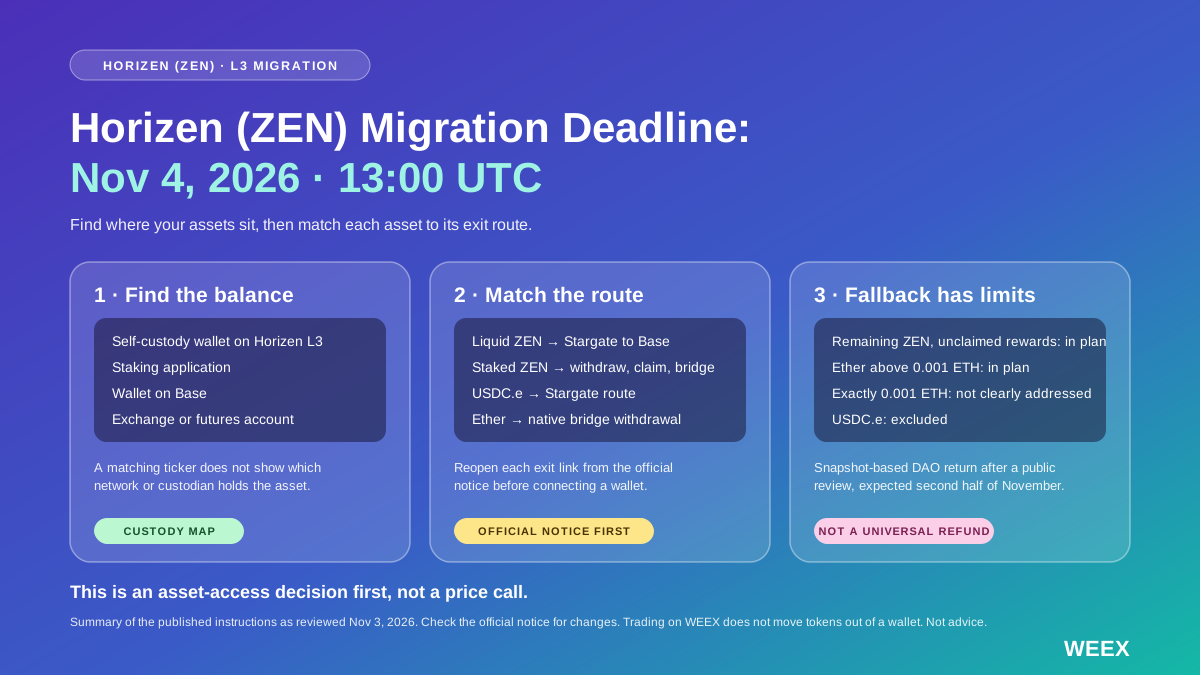
Horizen (ZEN) Migration Deadline: What to Move Before November 4 and What Happens If You Miss It
Horizen (ZEN) migration closes November 4. Check asset-specific bridge routes, wallet requirements, recovery exclusions and what to do if you miss it.

Aave borrowers faced up to 36% APR while a freeze blocked fresh collateral

Key Coins in the TON Ecosystem to Watch in 2026
Countdown to Elysium Mainnet Launch: 29 Ecological Projects to Watch
Who really controls a crypto project? Inside the SEC’s new guidance

A bitcoin at 500,000 dollars: VanEck details a scenario based on comparison with gold
Circle Opens CCTP to Third-Party Tokens, Joining the Cross-Chain Standard Battle

Is it theft or fraud when the coins in the wallet remain but are changed to multi-signature by someone else?
Anthropic Warns AI May Enter Self-Accelerating Phase
Horizen Holders Face November 4 Bridge Cutoff Before L3 Wind-Down
XRP Ledger to Activate a Fix Addressing Permission Delegation Vulnerability
TRON Industry Weekly Report: Crypto Security Incident Weakens BTC, Detailed Explanation of Building Economic Agent Capability Infrastructure Neosoul

Vitalik's Latest Thoughts: We Need a Digital Minimalism Movement
After the Embodied AI Sector Cools Down, This Stanford Startup Secures Hundreds of Millions in Funding Against the Trend
Interview with DogPay Founder: Slow is Fast, From U Card to Global Payment Network
Ambire Ice Puts Safe Owner Changes and Approval Thresholds on the Signing Screen

DTCC Connects $114 Trillion in Assets to the Blockchain, But On-Chain Trading Is Not the First Step

tBTC Minting and Redemption Paused, Threshold Network Claims Sufficient Asset Reserves
Regulated, Approved or Registered Crypto Funds: What Each Status Really Guarantees

Crypto Industry's Three Major PACs Invest $170 Million to Support Republican Candidates
Why is AERO still dragged down by dilution after all fees go to holders?

The Need for Institutionalization of Market Makers Between Liquidity Provision and Price Manipulation
Crypto Can’t Go On Like This: An Industry Self-Rescue Initiative from a Blockchain Practitioner
Overview of Cryptocurrency Asset Regulation Series (12): Malaysia, Exchanges, Custody, and Token Issuance
Microsoft Report: North Korean Hackers Using AI to Mass-Produce Bait, Generating Dozens of Phishing Files in Minutes

Vitalik Proposes Digital Minimalism, Calls for Reduced Dependence on Social Media
Maple locks $280M in XRP collateral and upcoming maturity dates threaten liquidations
Ledger CTO: "Threshold for Decryption Continues to Lower"... Bitcoin Cryptography Warning

Uniswap launches TJAR fee tool for fixed payment arbitrage
OpenUSD Stablecoin Charges $0.01 Management Fee and Establishes Equity Incentive Pool
Horizen (ZEN) Migration Deadline: What to Move Before November 4 and What Happens If You Miss It
Horizen (ZEN) migration closes November 4. Check asset-specific bridge routes, wallet requirements, recovery exclusions and what to do if you miss it.
Aave borrowers faced up to 36% APR while a freeze blocked fresh collateral
Key Coins in the TON Ecosystem to Watch in 2026
Countdown to Elysium Mainnet Launch: 29 Ecological Projects to Watch
Who really controls a crypto project? Inside the SEC’s new guidance


