
Caterpillar Stock After a Record Quarter: CAT vs the CATON Token

 Prefer us on Google

Caterpillar stock closed at $876.54 on August 4, 2026, up 5.60% on the day, after the company reported the first quarter in its 100-year history with more than $20 billion in sales (source: StockAnalysis, Aug 4, 2026 close). The move added over 450 points to the Dow. It also landed five weeks after Michael Burry disclosed his first-ever short against the company.
Both things are true at once, and that tension is the whole story for anyone deciding what to do with Caterpillar stock right now. This piece covers what the quarter actually showed, where the bear case still has teeth, and — for readers who trade in USDT rather than through a US broker — what the tokenized CATON version of the stock does and does not give you. That last part matters more than most people expect: the tokenized market for Caterpillar stock is roughly one ten-millionth the size of the real one.
Why Caterpillar stock jumped after Q2 2026 earnings
The numbers were not a modest beat. Q2 sales and revenues came in at $20.5 billion, up 24% year over year, against a consensus near $19.2 billion. Adjusted EPS was $8.17 versus $6.20 expected — the widest earnings beat Caterpillar has posted in five years, per MarketWatch.
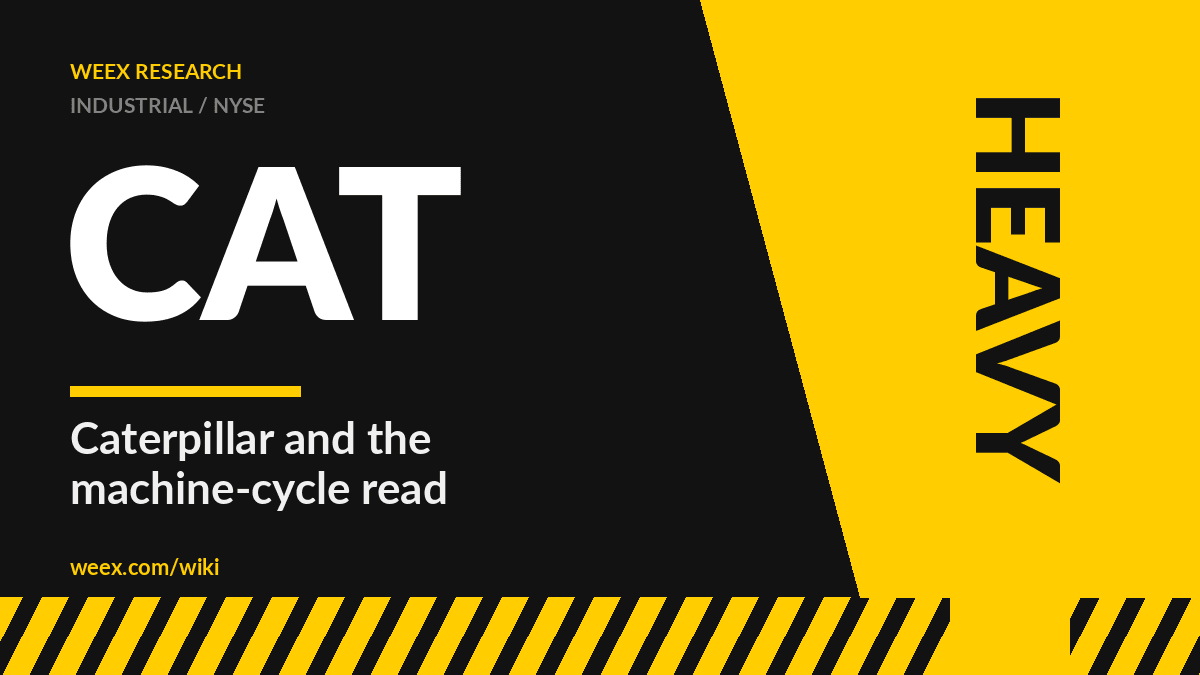
The driver is specific and worth naming precisely, because it is what separates this cycle from Caterpillar's usual construction-and-mining rhythm. Power & Energy revenue rose 17% to $8.2 billion, and inside that, power generation sales — overwhelmingly tied to data-center projects — rose 72%. Caterpillar is restarting production of its 10-megawatt gas reciprocating engine platform to meet the demand. On the earnings call, management said some customers are placing orders as far out as 2030.
That shows up in the backlog, which is the single most important line in the release: $72 billion, up roughly 92% year over year and $9 billion higher than the prior quarter, with 52% scheduled for delivery inside 12 months. Management raised full-year revenue growth guidance from low-double-digit to mid-to-high-teens.
| Caterpillar (CAT) key figures | Value | As of |
|---|---|---|
| Share price | $876.54 (+5.60%) | Aug 4, 2026 close |
| Market cap | $403.73B | Aug 4, 2026 |
| Q2 2026 revenue | $20.5B (+24% YoY) | Aug 4, 2026 release |
| Q2 2026 adjusted EPS | $8.17 (est. $6.20) | Aug 4, 2026 release |
| Order backlog | $72B (+92% YoY) | Q2 2026 |
| Trailing P/E | 37.77 | Aug 4, 2026 |
| Dividend | $6.52 annual (0.74% yield) | Aug 2026 |
| 52-week range | $405.46 – $1,073.46 | Aug 4, 2026 |
| Analyst consensus (28) | Buy, $963.56 target | Aug 2026 |
Sources: StockAnalysis, Caterpillar Q2 2026 release (Aug 4, 2026).
Is Caterpillar stock a good buy at 38x earnings?
Here is where the honest answer gets uncomfortable. Caterpillar stock is up roughly 48% year to date and still sits about 18% below its June 2026 high of $1,073.46. So the bulls got a blowout quarter and the stock is still well off its peak.
The reason is valuation. Burry shorted at $1,060.98 on June 30, 2026, arguing that Caterpillar's price-to-sales ratio had hit a 30-year high — a software-style multiple on a 100-year-old machinery manufacturer. Nothing in the Q2 report refutes that arithmetic. A 37.8x trailing P/E on a company whose earnings have historically swung with the mining and construction cycle is a bet that this cycle is structurally different because of AI power demand.
The better reading is that the backlog is the real evidence, not the quarterly beat. A 92% backlog increase with orders stretching to 2030 is a harder number to explain away than one strong quarter — it suggests multi-year visibility rather than a demand pull-forward. But backlog is not revenue until it is delivered, and Caterpillar also guided to about $2.2 billion in FY26 tariff costs excluding IEEPA recoveries, plus $300–350 million in restructuring. Margin, not demand, is where this trade most plausibly breaks.
Two more things experienced holders watch here that the headlines skip. First, the dividend yield is 0.74% — Caterpillar has raised its payout for 32 consecutive years and is a Dividend Aristocrat, but at this price you are not buying it for income. Second, beta is 1.60. Caterpillar stock is not a defensive industrial anymore; it now trades like an AI infrastructure proxy, which means it will take the full force of any repricing in that theme.
Caterpillar stock forecast: what the targets actually say
Analyst consensus across 28 analysts is Buy with a 12-month target of $963.56, about 10% above the August 4 close. That is a modest number given the quarter — and worth noticing, because it means the sell side already assumes strong execution.
| Scenario | Path | What has to happen |
|---|---|---|
| Bull | Retest of the $1,073 high and beyond | Data-center power orders keep converting; margins absorb the $2.2B tariff drag; Q3 delivers the guided "strong growth" |
| Base | Range-bound near the $963 consensus target | Backlog delivers on schedule but multiple compression offsets earnings growth |
| Bear | Back toward the $700s or lower | AI capex budgets get cut, backlog cancellations appear, or the P/S multiple mean-reverts as Burry expects |
Scenarios are editorial judgment built from the dated figures above, not forecasts. Caterpillar's own Q3 guidance is "strong growth as compared to 3Q 2025," against a $19.57 billion consensus.
What CATON is, and why its float should worry you
For readers outside the US, or holding USDT rather than dollars, the tokenized route is the practical one. Caterpillar's tokenized share trades as CATON — issued by Ondo Finance on Ethereum (contract 0xf719b02079e0faa5450392da2d3e11a1e5b0eadb), mintable and redeemable 24/5, and available as a spot pair on CATON/USDT. The token tracks the underlying share economically; it does not confer legal share ownership or voting rights. If you want the mechanics of how these instruments are custodied and settled, WEEX's guide to tokenized US stocks covers the issuance and compliance side.
Now the part almost no analysis of Caterpillar stock mentions. Here is the tokenized market next to the real one:
| NYSE: CAT | CATON (tokenized) | |
|---|---|---|
| Price | $876.54 (Aug 4 close) | $885.34 |
| Total market size | $403.73B market cap | $47,465 |
| Units outstanding | 460.59M shares | 53.612 tokens |
| Trading hours | NYSE session | 24/5 |
| Rights | Ownership, dividends, voting | Economic exposure only |
| Settlement | T+1 via broker | On-chain, USDT-margined |
CATON figures from the WEEX CATON/USDT market page, retrieved August 5, 2026; CAT figures from StockAnalysis, August 4, 2026.
Read that second row again. The entire tokenized supply of Caterpillar stock is worth about $47,000 — roughly 0.00001% of the company's market cap, spread across fewer than 54 tokens. That is not a liquidity footnote; it is the defining risk of the instrument. A single mid-sized order can move the token's price away from the underlying share, and exiting a position at a fair price is not guaranteed simply because the NYSE quote says $876. The token traded about $9 above the last NYSE close when we checked — a spread that reflects after-hours drift and thin two-sided depth, not a mispricing you can reliably arbitrage.
Practical handling, then: size positions to the token's float rather than to the stock's liquidity, use limit orders rather than market orders, and treat any gap versus the NYSE print as a cost of the wrapper, not an opportunity.
The CAT ticker trap on crypto exchanges
One more thing that costs people real money. On most crypto venues, including WEEX, the ticker CAT is not Caterpillar. The CAT/USDT perpetual is Simon's Cat Token — a memecoin licensed from the British animated series, trading around $0.0000014 with a market cap near $10.7 million and a supply of 8.1 trillion tokens.
Two assets, one ticker, and a price difference of about eight orders of magnitude. If you search "CAT" expecting Caterpillar stock and buy the perpetual you find, you have bought a cat cartoon memecoin with leverage. The correct symbol for tokenized Caterpillar stock is CATON. Check the token description and the contract address on the market page before you place an order — this takes ten seconds and it is the single most avoidable error in this entire trade.
Where this leaves Caterpillar stock
The quarter was genuinely exceptional, and the $72 billion backlog is the strongest argument that AI data-center power demand is a multi-year business rather than a spike. The valuation is genuinely stretched, and Burry's price-to-sales point survives the beat intact. Both can hold. If you are buying Caterpillar stock here, you are underwriting execution on the backlog against a 37.8x multiple and a $2.2 billion tariff headwind — not buying a cheap industrial.
If you are getting that exposure through a token, the underwriting question changes. You are also taking on a ~$47,000 float and the possibility that the wrapper does not track the share when you need to exit. Check the depth on the CATON/USDT book before you decide the convenience of 24/5 USDT-settled access to Caterpillar stock is worth it for your size.
FAQ
1. Why did Caterpillar stock go up on August 4, 2026?
Caterpillar reported Q2 2026 revenue of $20.5 billion (+24% YoY) and adjusted EPS of $8.17 against a $6.20 consensus — the company's first $20 billion quarter and its biggest earnings beat in five years. Shares closed up 5.60% at $876.54.
2. Is Caterpillar stock a buy right now?
Analyst consensus across 28 analysts is Buy with a $963.56 target, about 10% above the August 4 close. The counterargument is valuation: a 37.77 trailing P/E and a 30-year-high price-to-sales ratio, which is why Michael Burry opened a short at $1,060.98 on June 30, 2026. This is information, not a recommendation.
3. Can I buy Caterpillar stock with crypto?
Indirectly, through the tokenized version. CATON is an Ondo Finance-issued token on Ethereum tracking Caterpillar's share price, tradable against USDT on WEEX 24/5. It gives economic exposure, not legal share ownership or voting rights.
4. What is the difference between CAT and CATON on a crypto exchange?
CATON is tokenized Caterpillar stock, trading near $885. CAT is Simon's Cat Token, an unrelated memecoin trading near $0.0000014. They share nothing but three letters — always confirm the contract address before trading.
5. Does Caterpillar pay a dividend?
Yes. The annual dividend is $6.52 per share, a 0.74% yield as of August 2026, and the board raised the quarterly payout 8% to $1.63 per share payable August 19, 2026. Caterpillar has increased its annual dividend for 32 consecutive years. Tokenized holders receive economic equivalents rather than the dividend itself.
6. What is Caterpillar's stock forecast for the rest of 2026?
Caterpillar guided to mid-to-high-teens full-year revenue growth and "strong growth" in Q3 versus Q3 2025. The consensus 12-month target is $963.56. Outcomes hinge on whether the $72 billion backlog converts on schedule and whether the roughly $2.2 billion FY26 tariff cost compresses margins.
Risk Warning
Trading tokenized equities and crypto assets involves substantial risk, including partial or total loss of capital. Caterpillar stock carries a beta of 1.60 and has moved between $405.46 and $1,073.46 over the past 52 weeks; leveraged positions can be liquidated on moves far smaller than that range. Tokenized instruments add risks the underlying share does not have: CATON's tokenized supply was worth roughly $47,000 as of August 5, 2026, so liquidity is thin and the token's price can diverge from the NYSE quote, particularly outside US market hours. Holders take on issuer and custodian counterparty risk with Ondo Finance, Ethereum smart-contract risk, and regulatory risk — tokenized US stocks are not available to US persons and their legal treatment differs by jurisdiction. Tokenized stock holders receive economic exposure only, without the shareholder rights, voting, or investor protections attached to shares held through a regulated broker. Ticker collisions are a live operational risk: verify the contract address, not the symbol. Nothing here is investment advice.
This content is provided for general informational purposes only and doesn't constitute financial, investment, legal, or tax advice. Any events, rewards, online promotions, or related information mentioned herein should not be considered a recommendation, solicitation, or invitation to purchase, sell, trade, or otherwise deal in any crypto assets. Crypto assets are highly volatile and may result in loss. The availability of WEEX services, products, and related events may vary by region. You are responsible for ensuring that your participation is in accordance with applicable local laws and regulations.
You may also like
What Is PGP Encryption? A Beginner's Guide
Lost Your 2FA Device? Here's What to Do Next

What Is a Crypto Broker API? How Platforms Embed Trading Without Building an Exchange
What Is WEEX Broker? How the Program Works and Who It Is For

Nvidia Stock Price Has 46% Upside According to Wall Street: What the $308 Average Target Actually Requires
Is 2FA Enough to Keep Your Crypto Safe?
Is AMD Stock a Buy After Falling 9% on Record Earnings? What the Setup Actually Looks Like

PLTR Stock Price Prediction 2026-2027: Can Palantir Reach $200 After the Q2 Blowout?
Samsung Stock Price Prediction 2026-2027: Can Samsung Reach $250 After the July Selloff?
How to Set Up 2FA on Your Crypto Exchange Account
KOSPI Price Prediction 2026-2027: Can the Index Recover to 7,000 After Its Worst Month Since 2008?
SK Hynix Stock Is Down 35% in July: Is the Worst Finally Over?
SK Hynix Stock Price Targets Range From $152 to $355: What the Widest Analyst Gap in the Sector Reveals
SpaceX Stock Price Prediction 2026-2027: Can SPCX Reach $200 After the First Earnings Beat?
SPCX Stock Price Q2 Earnings Revealed: What Starlink Revenue and the $14 Billion AI Contract Surge Actually Mean
Zeta Stock Just Beat and Raised for the 20th Time and Fell 7%
SPCX Stock Price and the $116 Billion Lockup Expiry Tomorrow: What Actually Happens on August 6
NET Stock Trades Above Wall Street's Target Into Aug 6 Earnings
API Trading Software: Check the Exchange Limits First

AMD Earnings: Why a Record Q2 Beat Still Sank the Stock 9%
AMD Stock Falls 9% After Data Center Revenue Doubles: What the Disconnect Means
Rupiah Weakness and Crypto Demand in 2026: What the Evidence Does — and Doesn't — Show

Crypto Futures Explained for Beginners: Margin, Leverage, Funding and Liquidation
Tokenized Gold in 2026: XAU, XAUT and PAXG Explained — Backing, Custody and Fees
What Is Cysic (CYS)? ComputeFi, ZK Hardware, and AI Explained
Cysic (CYS) Coin Price Forecast 2026: AI Growth vs Token Supply Risk
What Is Futures Quantitative Trading? Strategies and Risks
Can Crypto Quantitative Trading Make Money? Risks and Reality
Bitcoin Quantitative Trading Guide: Strategies, Tools, and Risks
AMD vs Nvidia After Q2 Earnings: Which Stock Is the Better Buy?
What Is PGP Encryption? A Beginner's Guide
Lost Your 2FA Device? Here's What to Do Next
What Is a Crypto Broker API? How Platforms Embed Trading Without Building an Exchange
What Is WEEX Broker? How the Program Works and Who It Is For
Nvidia Stock Price Has 46% Upside According to Wall Street: What the $308 Average Target Actually Requires
Is 2FA Enough to Keep Your Crypto Safe?


