
US-Iran Negotiations Collapse, Bitcoin Faces Battle to Defend $70,000 Level


Original Title: "US-Iran Negotiations Collapse, Bitcoin Defends $70,000 Level"
Original Author: Mah, Foresight News
A major rebound in the crypto market is still a distant prospect. On April 13, the price of BTC hovered around $71,000, falling about 2.6% in 24 hours, while ETH performed even weaker, dropping 3.63% to around $2,200. Bitcoin's market dominance remains at 58.8%, and the overall trading volume of the entire crypto sector has not significantly increased.
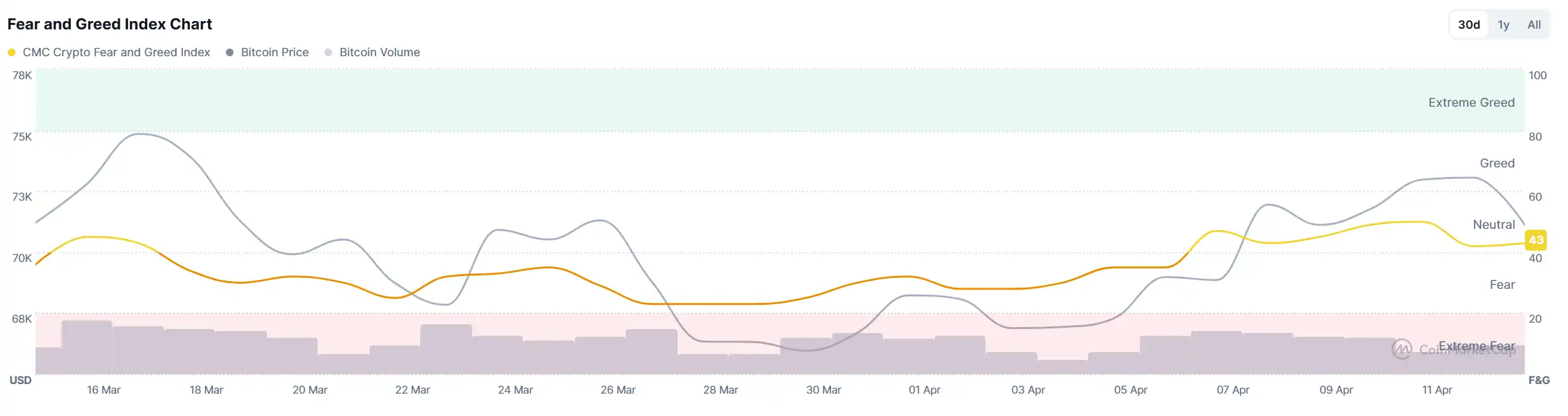
Coinglass data shows that in the past 24 hours, the total amount of liquidations across the network was $284 million, with long liquidations totaling $203 million. At the same time, CoinMarketCap's Fear and Greed Index currently stands at 43, indicating a neutral market sentiment.
The traditional financial markets are also experiencing significant volatility. Influenced by the Middle East situation, international oil prices remain high, with Brent crude oil once approaching $107 per barrel, a significant increase from pre-conflict levels. As for the US stock market, the S&P 500 fell by about 5% in March, marking one of the worst monthly performances in recent years; international stock markets faced greater declines due to energy import pressures and a stronger dollar. Bond yields are rising, inflation expectations are reignited, and investors are rapidly switching between risk assets, driving up demand for safe havens such as gold. This cross-market interdependence once again confirms that crypto, as a high-beta risk asset, is synchronously facing dual macro and geopolitical shocks.
US-Iran Negotiations Collapse
One of the core drivers of the crypto market's sluggishness this week was the sharp escalation of US-Iran tensions. The face-to-face peace talks between the US and Iran held in Islamabad, Pakistan on April 11-12 lasted for over 20 hours, ultimately ending in failure.
Vice President Pence and the Iranian delegation failed to reach a consensus on key issues, including Iran's abandonment of its nuclear weapons program and the "red line" of ceasing uranium enrichment. The Iranian side accused the US of "maximalism" and "constantly changing goals."

Pence boarding Air Force Two as he leaves Islamabad
Following the collapse of the negotiations, US President Trump announced on social media on Sunday that the US military would immediately initiate a blockade of the Strait of Hormuz. The US Central Command (CENTCOM) later confirmed that at 10 p.m. on April 13 (Beijing time), the blockade would target all ships entering and exiting Iranian ports, but would not impede normal transit of non-Iranian ports. The Iranian Foreign Minister and military quickly responded, warning that any military vessels approaching the strait would be deemed a violation of the ceasefire and reserving the right to retaliate.
The Strait of Hormuz is a key chokepoint for global oil transportation, handling about 20% of global oil shipments. If a blockage persists, the risk of supply chain disruption will directly push up oil prices, further fueling concerns of global inflation and slowing economic growth expectations.
This geopolitical black swan event has the most direct impact on risk assets: Investors are withdrawing from high-beta assets, turning to cash or gold. BTC, as "digital gold," saw its safe-haven properties suppressed in the short term by risk aversion sentiment, unable to fulfill its hedging role. In past similar Middle East crises, the crypto market has often reacted ahead of traditional markets, experiencing a sharp pullback, which is a direct reflection of the current downturn.
Polymarket's latest data shows that the probability of the U.S. and Iran reaching a permanent peace agreement by May 31st of this year is 27%, while the probability of reaching an agreement by the 30th of this month has dropped to 14%.
However, the future U.S.-Iran negotiations are still fraught with uncertainty.
According to The Wall Street Journal, informed officials revealed that after the marathon-style peace talks held in Islamabad failed to reach an agreement, countries in the Middle East are actively pushing for the U.S. and Iran to return to the negotiating table.
Although both the U.S. and Iran have issued strong statements, the diplomatic door remains open, and the second round of negotiations could take place within a few days. Countries in the region are negotiating with the U.S. to ensure the extension of a two-week and very fragile ceasefire.
The Fed May Only Cut Interest Rates Once This Year
Another key suppression factor comes from the monetary policy side. The minutes of the Fed's March meeting showed that despite the high uncertainty brought by the Iran conflict, policymakers still maintain the expectation of only one interest rate cut in 2026.
On April 10th, CPI data was released, with the U.S. March non-seasonally adjusted CPI year-on-year rate at 3.3%, the highest since May 2024, in line with the market's expectation of 3.3%, up from the previous value of 2.40%. The U.S. March seasonally adjusted CPI monthly rate recorded 0.9%, the highest since June 2022, in line with market expectations. The U.S. Bureau of Labor Statistics stated that the record rise in gasoline prices accounted for nearly three-quarters of the month's CPI increase. Another index that excludes food and energy costs showed a slowdown in the month-on-month increase to 0.2%.
The market was originally hoping for a more aggressive easing cycle to boost risk assets, but the oil price shock has made the Fed's "data-dependent" strategy more conservative. Higher energy costs may delay the path to falling inflation, thereby delaying the timing of interest rate cuts.
This is undoubtedly a double whammy for the highly liquidity-dependent crypto market. Historically, dashed rate cut expectations have often coincided with risk asset revaluations, with BTC's current consolidation around $71,000 reflecting a macro expectation adjustment.
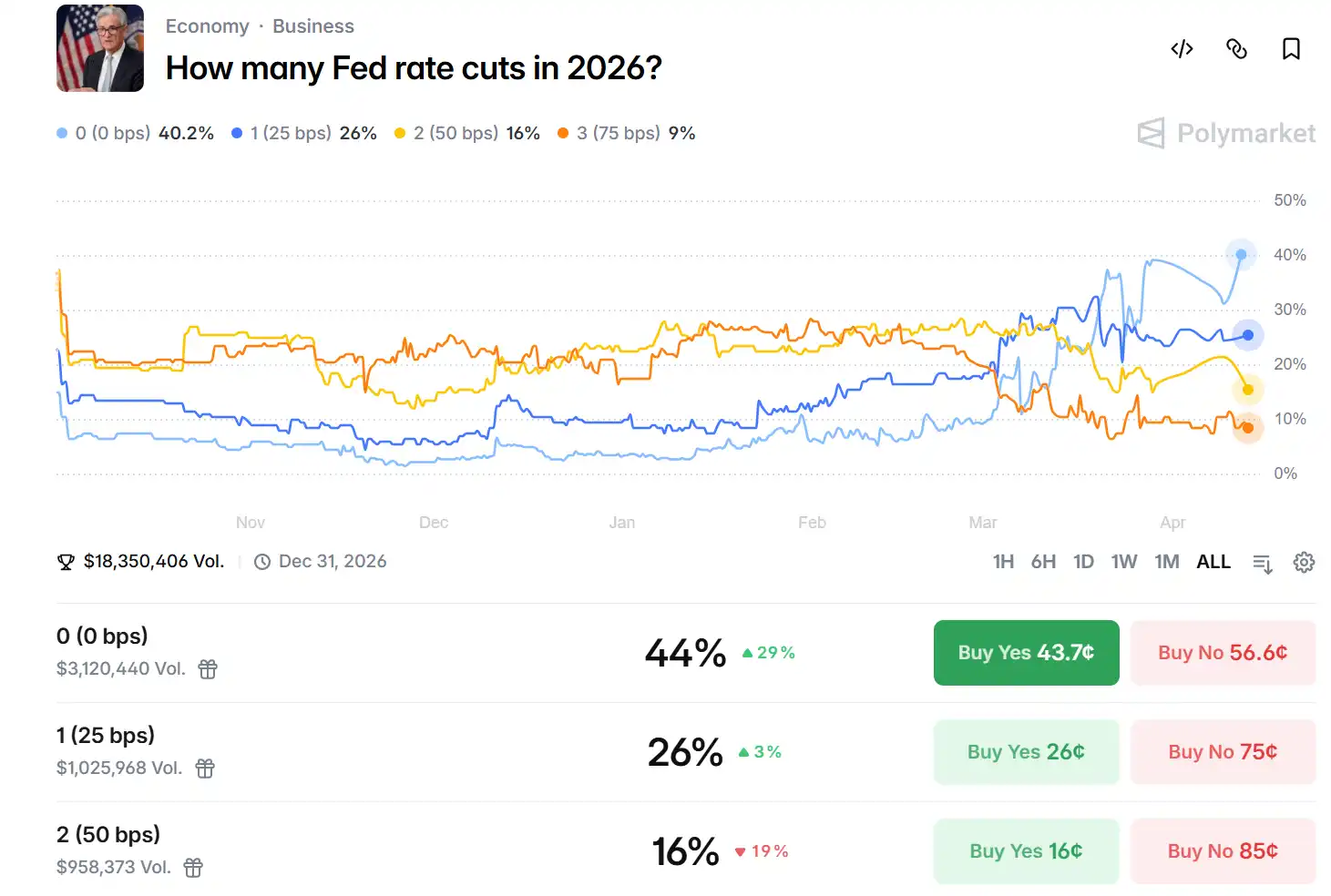
Currently, the latest data on Polymarket shows that the market is betting a mere 26% probability on one 25-basis-point Fed rate cut this year, while the hold steady probability has risen to 44%.
Tightening market liquidity casts a shadow over the crypto market's rebound.
Profit Taking Suppresses BTC Price Rebound
On-chain data metrics truly reveal the true intentions of crypto players' maneuvers. Glassnode data shows that any attempt to reach the $70,000 to $80,000 range faces liquidity shortages and profit-taking pressure, limiting the magnitude of the rebound.
Another rally above $70,000 ran out of steam due to hourly profit-taking of over $20 million.
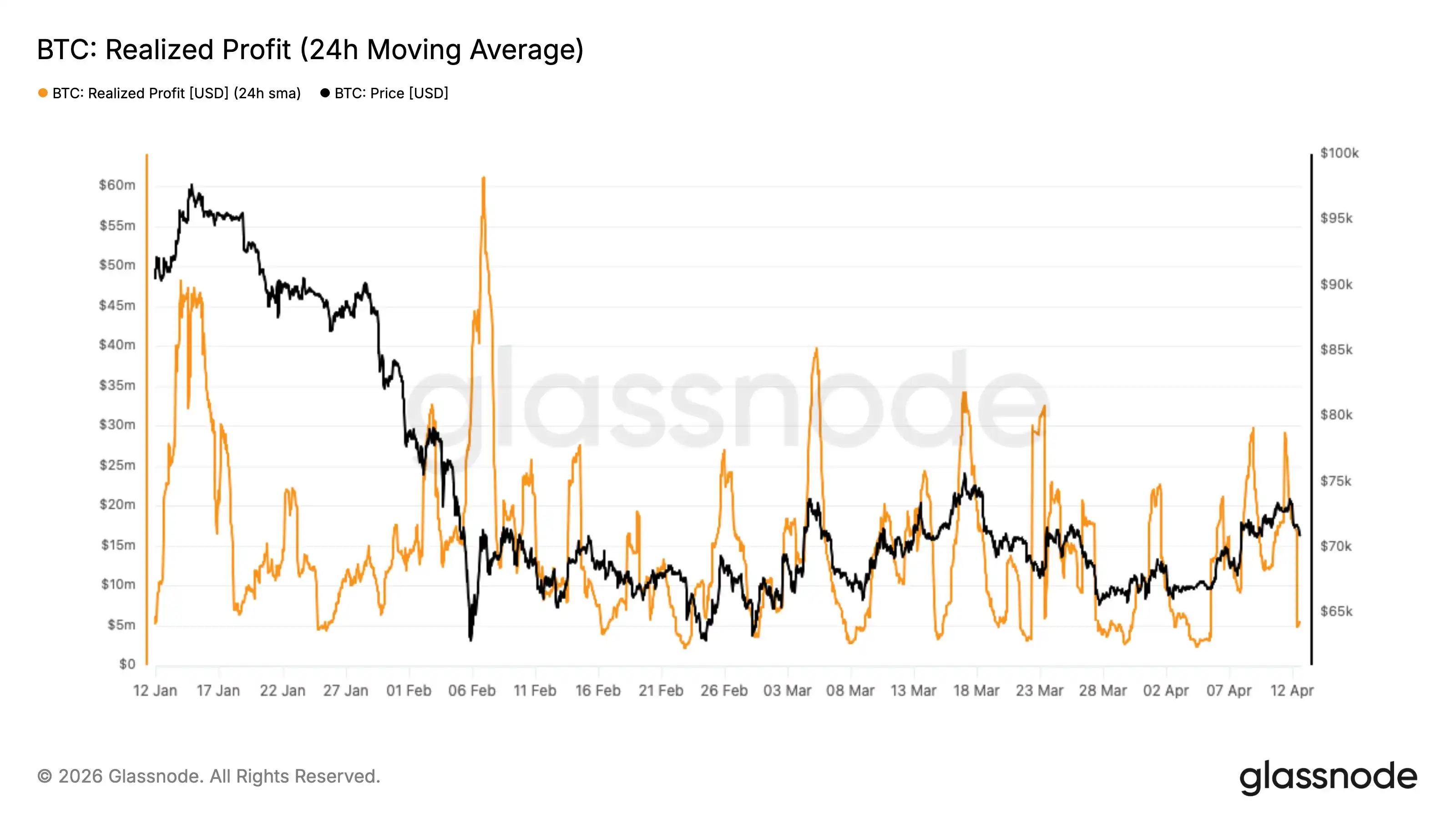
Perhaps to some sellers, this BTC rebound is only a phase and not a reversal.
Currently, when the BTC price is at $70,800, approximately 13.5 million addresses are in a loss position.
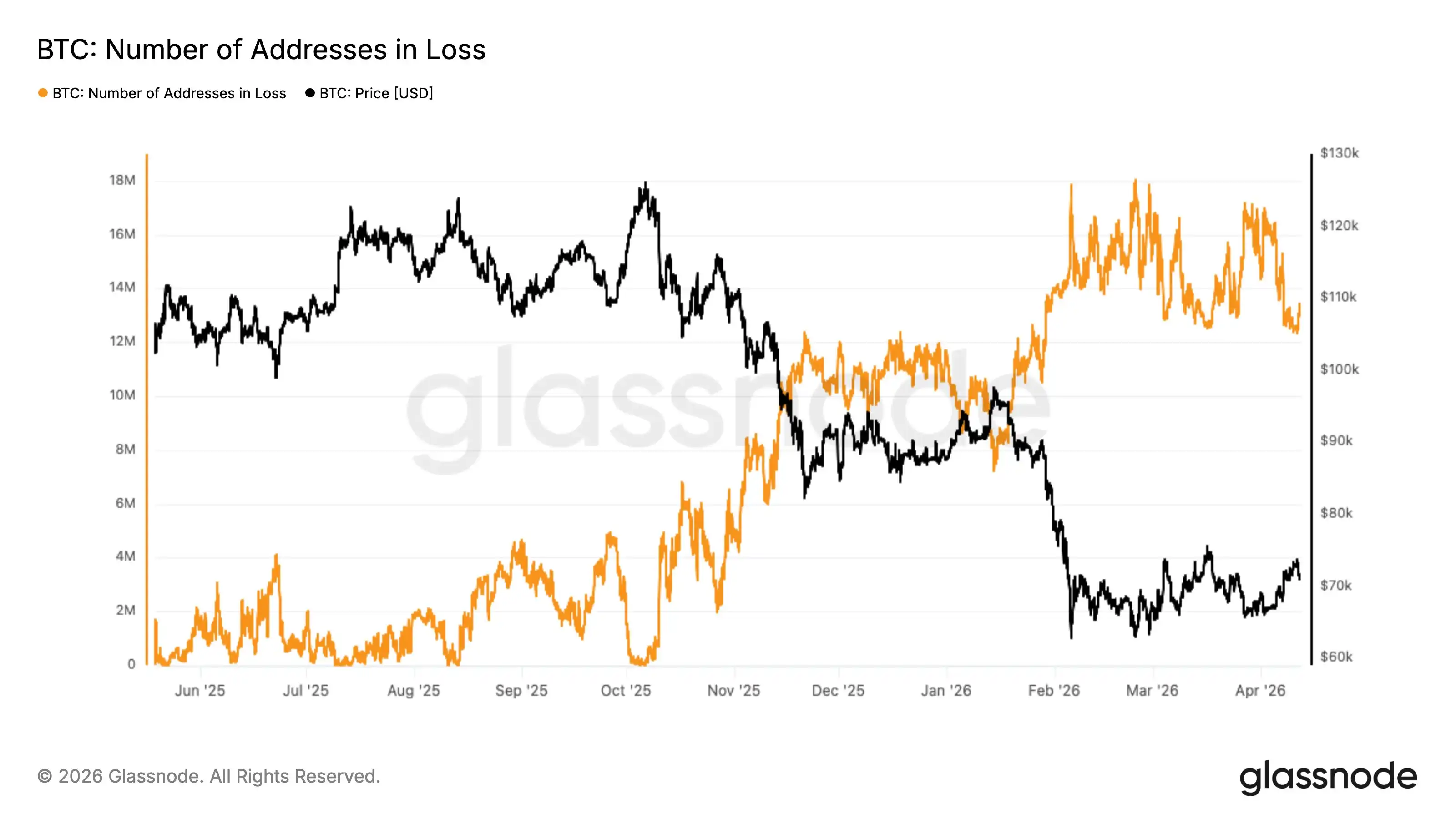
This indicates that a considerable portion of users in the network bought Bitcoin at a price higher than the current spot price.
Subsequent Market Trends
Despite short-term pressures, senior figures in the crypto industry remain largely optimistic about the long-term structural outlook.
Strategy founder Michael Saylor suggests that Bitcoin likely bottomed out around $60,000 in early February, with forced-out sellers already purged from the market. The bottom is more defined by seller exhaustion rather than valuation determinants.
He believes the current selling pressure is limited, ETF fund inflows are absorbing daily supply, and corporate treasury asset allocation to Bitcoin is driving sustained demand. Michael Saylor predicts that the next bull market catalyst will be the establishment of a banking credit and digital lending system built on Bitcoin, transforming Bitcoin from a non-yielding asset to a capital market engine.
BitMEX co-founder Arthur Hayes previously stated at the end of March, "The current market is rife with hopium about a favorable future. While I certainly hope the carnage will end, I will not be buying risky assets here."
Tom Lee posted indicating that there are increasing signs that the "bottom is in," although overall market sentiment remains skeptical. If you are still skeptical, you may want to consider buying assets that have outperformed during the US-Iran conflict.
You may also like

Morning Report | BitMine increased its holdings by 126,971 ETH last week; trader Eugene announced his exit from the crypto market

Wang Chuan: How can one not feel anxious after the neighbor Old Wang made thirty times profit by investing in storage stocks? (Seven) - A quarter-century cycle

Cryptocurrency CEXs are flocking to sell US stocks, and traditional brokerages are facing an "uninvited guest."

$75 billion in foreign capital has fled, and South Korean retail investors have absorbed it all using leverage

Japan’s Three Megabanks Plan Joint Stablecoin Issuance in Fiscal 2026
MUFG, SMBC, and Mizuho reportedly plan to jointly issue fiat-pegged stablecoins in fiscal 2026, signaling Japan’s growing push into bank-led digital payment infrastructure.

Humanity Discloses H Token Dual-Chain Attack Details, With Losses on Ethereum and BSC Exceeding $36 Million
Humanity said the H token attack across Ethereum and BSC caused more than $36 million in losses after leaked ProxyAdmin keys enabled malicious contract upgrades and token minting.
White House Discusses CLARITY Act With Law Enforcement Ahead of Senate Vote
The White House discussed the CLARITY Act with law enforcement ahead of a Senate vote, focusing on illicit finance risks and developer protections.

Bitcoin Trading Guide 2026: Strategies for Experienced Traders

What Is XAUT and PAXG? Why Tokenized Gold Is Booming in 2026

Will the SpaceX IPO Hurt Bitcoin? Here's What Traders Are Watching

Foreign selling in the South Korean stock market accelerates, with cumulative net sales reportedly reaching $75 billion this year
On June 9, The Kobeissi Letter, citing Goldman Sachs data, reported that global investors are selling South Korean stocks at an unusually rapid pace. In the latest trading session, foreign investors sold about $801 million worth of Kospi constituent stocks again; total foreign outflows last week reached about $10 billion, and the market has been in net foreign selling on nearly every trading day over the past month. According to the data cited in the report, foreign investors have sold about $75 billion worth of South Korean stocks so far this year. Meanwhile, South Korean retail and institutional investors together recorded roughly $69 billion in net buying over the same period, suggesting that the market’s main buying support has come from domestic capital rather than returning overseas funds. The information currently disclosed still mainly comes from The Kobeissi Letter’s retelling and Goldman Sachs data summaries, while public details on the statistical period and the specific definition of “selling” remain relatively limited.

Fortune Warns of Strategy’s Financing Structure Risks as Bitcoin Premium Narrows
Fortune warned that Strategy’s Bitcoin treasury model faces growing financing risks as MSTR’s net asset premium narrows and preferred stock dividend pressure increases.

Ferrari Challenge Le Mans: Carl Moon to Dominate in WEEX Livery

Sahara AI Responds to SAHARA’s Sharp Drop: No Contract or Product Security Issues Found, Internal Investigation Underway
Sahara AI responded to SAHARA’s 60% price drop, saying no token contract or product security issues have been found and an internal investigation is underway.

WEEX Deposit/Withdrawal Dynamic Island: Your Asset Status, Always in Sight
Scaling Crypto Derivatives: The Digital Asset Infrastructure Behind High-Volume Trading
In the fast-moving digital asset ecosystem, derivatives platforms face an extreme architectural test. High-leverage futures markets demand more than just standard security—they require absolute operational precision, zero-latency matching engines, and ironclad structural scalability, all while navigating intense market volatility.
As global platforms scale to meet these demands, the industry is shifting away from rigid, monolithic setups toward a more agile, "decoupled" infrastructure philosophy.
The Blueprint for High-Volume Copy TradingFor elite global exchanges like WEEX (founded in 2018), this architectural choice becomes critical when scaling high-volume retail features like social copy trading. When thousands of users automatically mirror the real-time strategies of elite traders simultaneously, it triggers sudden, monumental spikes in concurrent transactional volume.
To prevent execution latency or settlement bottlenecks during these peak volatility events, a platform's primary engine must remain entirely dedicated to risk management, copy-trade synchronization, and order matching.
The Architectural Rule: New-generation platforms must separate front-end user execution engines from heavy backend infrastructural overhead to eliminate operational friction.
By separating these layers, platforms can maintain complete sovereignty over their trading environments and user experiences while strategically aligning with institutional-grade infrastructure ecosystems. This strategic framework allows modern exchanges to leverage advanced Digital Asset Custody infrastructure such as Cobo’s behind the scenes, ensuring that backend wallet management scales elastically alongside trading spikes.
Capitalizing on Market Momentum and 400× LeverageIn a derivatives arena where platforms offer up to 400× leverage on perpetual contracts, capital efficiency and market agility are core business metrics. To capture market momentum, an exchange needs the ability to rapidly expand its asset offerings, supporting everything from legacy crypto assets to sudden, trending altcoins across a massive library of trading pairs.
Adopting a flexible, scalable Wallet-as-a-Service (WaaS) solution such as Cobo’s could completely rewrite the development timeline for high-growth exchanges. Instead of spending months of engineering capital building out custom backend wallet architectures for every new blockchain network, platforms can deploy localized infrastructure in days.
This agility allows platforms to instantly scale their listings to over a thousand trading pairs without compromising security or delaying time-to-market. It mirrors the exact operational advantages seen during high-velocity market events, similar to how advanced wallet infrastructure empowers platforms during sudden asset surges; allowing exchanges to pass that speed and liquidity directly to their global user base.
A Mature Foundation for GrowthThe synergy between trusted infrastructure ecosystems and global trading platforms represents the natural evolution of a maturing crypto market. As WEEX continues to scale its global spot and derivatives offerings for over 6 million users, adopting robust backend paradigms proves that platforms no longer have to compromise between cutting-edge trading velocity and uncompromised structural security.

Get Paid to Onboard? Try WEEX’s New Homepage with Rewards for Registration, Deposit & Trade
WEEX Custom Layout: Build Your Perfect Trading Workspace in Seconds
Morning Report | BitMine increased its holdings by 126,971 ETH last week; trader Eugene announced his exit from the crypto market
Wang Chuan: How can one not feel anxious after the neighbor Old Wang made thirty times profit by investing in storage stocks? (Seven) - A quarter-century cycle
Cryptocurrency CEXs are flocking to sell US stocks, and traditional brokerages are facing an "uninvited guest."
$75 billion in foreign capital has fled, and South Korean retail investors have absorbed it all using leverage
Japan’s Three Megabanks Plan Joint Stablecoin Issuance in Fiscal 2026
MUFG, SMBC, and Mizuho reportedly plan to jointly issue fiat-pegged stablecoins in fiscal 2026, signaling Japan’s growing push into bank-led digital payment infrastructure.
Humanity Discloses H Token Dual-Chain Attack Details, With Losses on Ethereum and BSC Exceeding $36 Million
Humanity said the H token attack across Ethereum and BSC caused more than $36 million in losses after leaked ProxyAdmin keys enabled malicious contract upgrades and token minting.


