
Crypto VCs Are Dead? The Market Extinction Cycle Has Begun

 Prefer us on Google


Original Title: The Great Attrition of Crypto VCs
Original Author: Catrina
Translation: Peggy, BlockBeats
Editor's Note: When "Exit Scam" is no longer viable, crypto venture capital is also beginning to lose its once-solid logic.
Over the past three cycles, tokens have always been the core path for capital recovery and amplified returns. Around this premise, the industry has built a whole set of familiar rhythms: early funding, narrative expansion, listing circulation, price realization. However, against the backdrop of on-chain revenue becoming a new threshold, meme coin liquidity diversion, and retail funds spilling over into more risky assets, this mechanism is failing.
A more direct change is that the return expectations of token projects have been compressed, while the equity path has regained attractiveness. Early investors are becoming more cautious about projects with an "Exit Scam," and later-stage funds are shifting towards "web2.5" companies with real income and M&A expectations. Crypto venture capital is no longer in a relatively closed competitive environment but is forced to enter the field competing with traditional fintech funds.
In this process, a deeper issue is gradually emerging: when capital itself is no longer scarce, what else can VCs provide?
In recent years, some of the most representative projects have almost bypassed institutional capital, directly establishing network effects and revenue models. This means that funding is no longer the "passport" to enter quality projects. For founders, whether to introduce VCs depends on whether the latter can provide a clear brand endorsement and tangible incrementality, rather than just funds on the balance sheet.
In the new market structure, crypto venture capital needs to redefine its own "product definition." Otherwise, it will become one of the objects eliminated in this cycle.
The following is the original text:
Crypto venture capital is at a watershed moment. Over the past three cycles, token exits have always been the main source of excess returns, but now this pattern is undergoing a substantial reset. What kind of token has value, its definition is being rewritten in real-time, and an industry-level unified evaluation framework has not yet been formed.
So, what exactly happened?
The change in the market structure of this crypto cycle is the result of the superposition of several forces that have never occurred in the same cycle before:
1/ The sudden rise of HYPE has horizontally impacted the entire token market. It has proven one thing: token prices can be supported by real income, with over 97% of its nine- to ten-digit revenue coming from on-chain. This case quickly triggered a collective disillusionment in the market with governance tokens that are "narrative-driven but weak in fundamentals"—for example, early tokens mainly used to circumvent securities regulations but are difficult to directly distribute income on Layer 1 and "governance tokens." Almost overnight, HYPE reshaped market expectations: income-generating ability is no longer a bonus but a minimum threshold.
2/ The Ripple Effect on Other Projects: By 2025, if a project has on-chain revenue, it often gets classified as a security; post-HYPE, if there's no on-chain revenue, most hedge funds view the project's rug pull as only a matter of time. This dilemma has forced the vast majority of projects, especially non-DeFi ones, to hastily adjust their course.
3/ PUMP then subjected the system to a severe "supply shock." The frenzy around meme coins led to an explosive growth in token supply, fundamentally disrupting the market structure — attention and liquidity were significantly scattered. Just on Solana alone, the number of newly issued tokens skyrocketed from around 2000–4000 per year to 40,000–50,000 at its peak, slicing the pie into about 20 times without much growth in liquidity. The same pool of funds and attention that was originally pursuing high returns began shifting from holding altcoins to engaging in more short-term meme coin trading.
4/ The alternative destination of retail risk capital is also rapidly expanding. Prediction markets, stock perpetual contracts, leveraged ETFs, and other products are directly competing for the portion of funds that originally flowed into crypto altcoins. Simultaneously, the maturity of asset tokenization technology allows investors to leverage blue-chip stocks, which not only don't face rug pull risks like most altcoins but are also subject to stricter regulations, have more transparent information, and lower information asymmetry.
All these changes have led to one major outcome: a significant compression of token lifecycles. The cycle from peak to trough has significantly shortened, the retail "hodl" sentiment has plummeted sharply, and faster capital rotation has taken its place.
Core Issues
In this context, almost all venture capitalists are continuously contemplating several core issues:
1/ Are we really investing in equity, tokens, or a combination of both?
The biggest challenge lies in the fact that there's currently no mature paradigm regarding "how token value accrues." Even top projects like Aave still face ongoing disputes between DAOs and equity structures.
2/ What are the best practices for on-chain value accumulation?
The most common current practice is token buybacks, but "common" doesn't mean "correct." We have long been opposed to the mainstream buyback logic: this mechanism is "toxic" and puts project teams with actual revenue-generating capabilities in a dilemma.
The problem lies in the fact that its motive was wrong from the start.
Traditional corporate stock buybacks usually occur when growth investment opportunities are limited or when the stock is undervalued; however, crypto project buybacks are often forced to be "executed immediately" under pressure from retail investors and market sentiment — this pressure itself is highly emotional and unstable. You might have just spent $10 million on a buyback that could have been reinvested, only to be completely engulfed by the market the next day due to a liquidation by a market maker.
Public companies buy back stock when undervalued; token buybacks, on the other hand, are often front-run and executed at local tops.
If your business operates on a B2B model with most revenue generated off-chain, such buybacks are even more futile. In my personal view, at a stage where annual revenue is below $20 million, conducting buybacks to please retail investors has almost no valid reason — these funds should have been prioritized for growth.
I resonate a lot with a report/screenshot from fourpillars: Even buybacks in the tens of millions struggle to substantively establish a long-term price floor for a project.
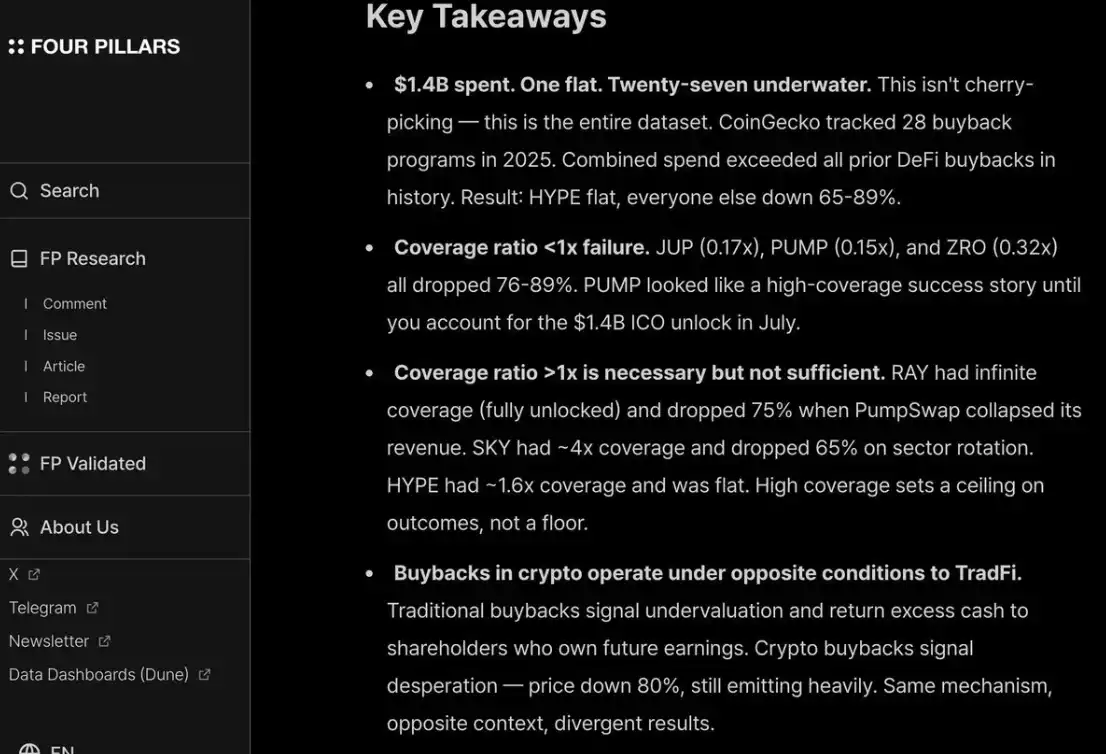
Furthermore, to please both retail and hedge funds, you must conduct buybacks continuously and transparently, just like HYPE. Failing to do so will result in market punishment akin to a PUMP — with a fully diluted valuation (P/F) at only 6x because the market "doesn't trust" it. Even though, in fact, it has burned $1.4 billion that could have gone into the treasury.
3/ Will the "crypto premium" completely disappear?
This implies that the valuation of all future projects may regress to a range similar to traditional public companies — roughly between 2-30x revenue.
One can seriously contemplate the implications of this: If this assessment holds true, then from current levels, the prices of most L1s may need to drop over 95% to align with this valuation system. Only a few exceptions — such as TRON, HYPE, and other DeFi projects with real income — may relatively hold.
And this is not even considering the additional selling pressure from token vesting.
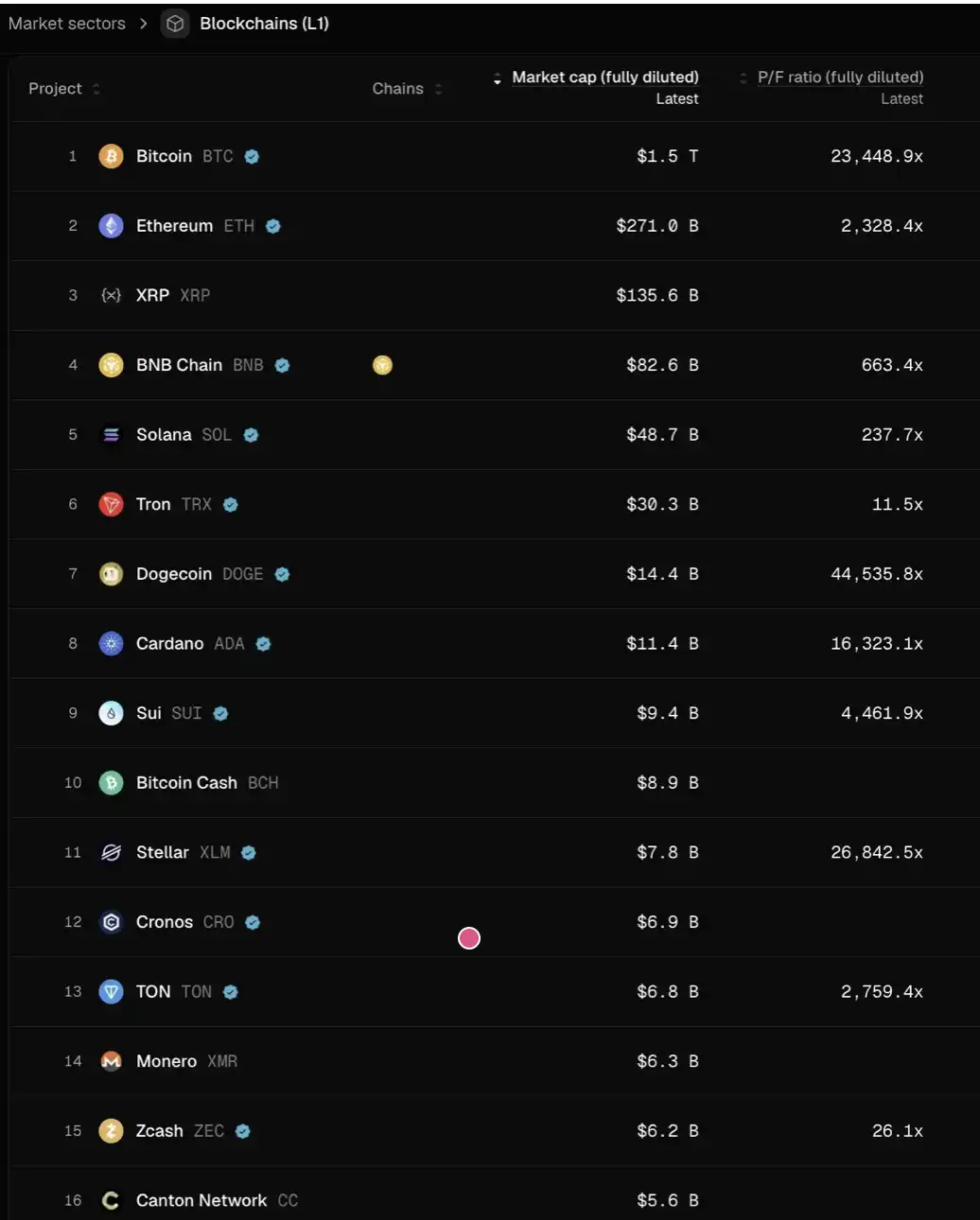
Personally, I don't believe things will go that far. HYPE has actually set an "outlier-style" market expectation, making investors excessively impatient about whether early-stage projects have "revenue/user growth at launch." Such demands are reasonable for "sustaining innovation" like payments, DeFi; however, for "disruptive innovation," it takes time from build, launch, growth to real revenue breakout.
In the last two cycles, we have swiftly shifted from being overly forgiving of "disruptive technology" to experiencing 8-9 rounds of "patience+hopium" fundraising in highly abstract narratives like new L1s, Flashbots/MEV and then quickly swung to another extreme — only willing to bet on DeFi projects. This is essentially an overcorrection.
But the pendulum will eventually swing back.
For DeFi projects, pricing based on "quantitative fundamentals" is indeed a reflection of industry maturity; however, for non-DeFi projects, "qualitative fundamentals" should not be overlooked: including culture, technological innovation, disruptive ideas, security, degree of decentralization, brand value, and industry connectivity. These dimensions will not simply be reflected in TVL or on-chain buyback data.
So, what will happen next?
The return expectations for token projects have been significantly compressed, while equity-based businesses have not undergone an equal cooling-off. This differentiation is particularly pronounced in early and growth-stage investments:
In the early stages, investors have become more price-sensitive to projects that are "token exit in the future"; at the same time, interest in equity-based projects has significantly increased, especially in the current relatively friendly M&A environment. This contrasts sharply with 2022–2024 when token exits were the default path, with the assumption that "token valuation premium would continue to exist."
In the later stages, investors with a brand advantage and resource capability in the crypto-native context are gradually moving away from purely "crypto-native" projects and are instead betting more on "web2.5" companies—where the valuation logic is more anchored in real revenue growth. This also brings them into unfamiliar competitive territory: they need to compete directly with crossover funds and traditional Web2 fintech funds (such as Ribbit Capital or Founders Fund), the latter of which have accumulated deeper experience in the traditional financial context, portfolio synergy, and early-stage project acquisition ability.
The entire crypto venture capital industry is entering an "attribution period."
Who can stay will depend on whether they can find their own "Product-Market Fit" (PMF) in the founder's mind—and this "product" is not just funding but also a combination of brand identity and actual empowerment ability.
For high-quality projects, VCs need to, in turn, "sell themselves to the founders" to qualify for a place in the cap table. Especially in recent years, some of the most successful projects have relied hardly on institutional capital (e.g., Axiom) or even had no funding at all (e.g., HYPE). If a VC can only offer funding, it is almost certain to be marginalized.
VCs truly eligible to remain at the table must clearly answer two questions:
First, what is its brand identity—why would top founders seek it out proactively;
Second, where is its value add—ultimately deciding whether it can win that deal.
-- Price
This content is provided for general informational purposes only and doesn't constitute financial, investment, legal, or tax advice. Any events, rewards, online promotions, or related information mentioned herein should not be considered a recommendation, solicitation, or invitation to purchase, sell, trade, or otherwise deal in any crypto assets. Crypto assets are highly volatile and may result in loss. The availability of WEEX services, products, and related events may vary by region. You are responsible for ensuring that your participation is in accordance with applicable local laws and regulations.
You may also like

Web3: Foreign Media Reports Need for Safer Liquidity Tools in Crypto Collateralized Lending

Babylon TBV Completes Security Audit, Prepares for Aave v4 Mainnet Launch

Uniswap Launches Regulated 'Permissioned Pools'

Aave V4 Launched on Avalanche Network, First Multi-Chain Hub & Spoke Architecture

Aave V4 deposits surpass 275 million

Abraxas Capital Provides Approximately $39 Million in Liquidity to Aave

Aave Labs Proposal to Integrate Maple's syrupUSDG

Abraxas Capital Deposits 8,000 ETH to Aave
Data: Aave's new Monad market surpassed $100 million in deposits within two days of its launch, and total deposits for V4 exceeded $250 million, setting a new record

Data: ParaFi Capital continues to increase its holdings of 56 million SKY, with a total position loss of 1.72 million USD

Aave V3 has been deployed on Monad

Standard Chartered claims that Aave could rise 50 times to $3,500 by 2030

Data: DeFi lending and DEX fees plummeted over 50% in a week, mainly due to leveraged liquidations
Grayscale: Aave's protocol revenue has grown over 6.6 times in the past three years, and AAVE's current valuation is relatively conservative
Data: A certain whale has cumulatively shorted 44,000 ETH, currently facing an unrealized loss of 3.08 million USD
Ethereum 1CO giant whale buys back 5,817 ETH, liquidation price $1,432

The Kelp DAO cross-chain bridge hacker has laundered nearly $220 million of stolen funds, with only $1.7 million remaining untransferred

DeFi has reached its most dangerous moment: the real vulnerabilities are not in the code
Babylon proposes to integrate native Bitcoin collateral on Aave V4 without the need for cross-chain bridges and custody
Kelp DAO announced that rsETH has fully recovered after five weeks of repairs, following a $293 million hacker attack

Morning Report | SpaceX reveals it holds approximately $1.45 billion in Bitcoin; Nvidia's Q1 financial report shows revenue of $81.6 billion; Manus plans to raise $1 billion for buyback business

Kelp DAO Attacker Transfers $175M in Ether Following Exploit
Key Takeaways: The Kelp DAO exploiter has moved $175 million worth of Ether, part of a larger $290…

DeFi Losses Top $600 Million Amid Kelp DAO Exploit and TVL Decline
Key Takeaways: Total DeFi losses have skyrocketed to approximately $1 billion recently, with $600M+ linked directly to the…

Aave TVL Plummets $15 Billion Post-KelpDAO Hack – Future Prospects for AAVE Price?
Key Takeaways: Aave saw a drastic $15.1 billion withdrawal following the KelpDAO hack, nearly a third of its…

Kelp DAO Exploit Fallout Deepens as Attacker Routes $175M in ETH via Privacy Rails
Key Takeaways: The attacker moved $175 million in stolen ETH to new wallets using privacy tools. The exploit…

Aave V4 is progressing smoothly with a phased launch, introducing a dual-layer market isolation architecture
The tokenized market will reach a trillion-dollar scale, but there are still four major obstacles

Standard Chartered Bank: It is expected that by the end of 2028, the scale of on-chain tokenized assets will reach $4 trillion, with DeFi protocols being the biggest beneficiaries
Delphi Digital: Aave's three core markets have structural issues, resulting in an annual loss of approximately 52 million dollars

Aave proposes a "principal retention" charitable donation mechanism: donate profits, not principal
Web3: Foreign Media Reports Need for Safer Liquidity Tools in Crypto Collateralized Lending
Babylon TBV Completes Security Audit, Prepares for Aave v4 Mainnet Launch
Uniswap Launches Regulated 'Permissioned Pools'
Aave V4 Launched on Avalanche Network, First Multi-Chain Hub & Spoke Architecture
Aave V4 deposits surpass 275 million
Abraxas Capital Provides Approximately $39 Million in Liquidity to Aave

Contents
Latest articles


Latest coin listings on WEEX


