
Energy Crisis Spreads from Crude Oil to Diesel and Food, Global Inflation Faces Second Round of Pressure

 Prefer us on Google


On September 21, the pressure in the global energy market is extending from crude oil prices to a broader range of refined oil and food supply chains. The retail price of diesel in the United States has surpassed $6.50 per gallon for the first time, significantly widening the gap from gasoline, which is about $2. This reflects that the current shortage is not just crude oil, but also refining capacity, refined oil inventories, and transportation capabilities. Conflicts in the Middle East are compressing energy transport through the Strait of Hormuz, while the Russia-Ukraine conflict continues to impact Russian refining facilities, simultaneously shrinking diesel supply from both ends, causing costs to begin transmitting to freight, agriculture, food processing, and industrial equipment.
More notably, a second inflation chain is forming in the Black Sea. Russia and Ukraine are significant sources of global wheat supply, and after ports, grain terminals, and transportation have been disrupted, some importing countries are forced to turn to the United States, Europe, and other alternative sources, leading to increased transportation distances and costs. This means that beyond energy prices, food and agricultural input costs may also become new sources of price increases; if diesel, fertilizers, and food prices rise simultaneously, corporate costs are more likely to evolve from a one-time energy shock into broader inflationary pressures.
This also complicates the environment for U.S. monetary policy. Kashkari pointed out that inflation is no longer just an oil price issue, as price pressures in the service sector have also spread; if energy and logistics costs continue to transmit to core goods and services, even if crude oil prices fall in the future, the pace of disinflation may still be slower than expected. On the other hand, the IMF warns that the global public debt ratio could rise to 100% of GDP by 2029, with high interest rates, energy shocks, and increased fiscal spending further raising government interest burdens and compressing policy space.
Therefore, the current market needs to focus not just on a single oil price indicator, but on whether energy, transportation, and food are forming a second round of cost transmission. If Middle Eastern shipping, Russian refining, and Black Sea grain exports do not improve, diesel and food prices may form new sources of inflation beyond crude oil, forcing major central banks to maintain more restrictive policies; for high-debt economies, this will also mean higher financing costs and more limited fiscal buffers, making the policy trade-offs faced by the global economy even more challenging.
-- Price
This content is provided for general informational purposes only and doesn't constitute financial, investment, legal, or tax advice. Any events, rewards, online promotions, or related information mentioned herein should not be considered a recommendation, solicitation, or invitation to purchase, sell, trade, or otherwise deal in any crypto assets. Crypto assets are highly volatile and may result in loss. The availability of WEEX services, products, and related events may vary by region. You are responsible for ensuring that your participation is in accordance with applicable local laws and regulations.
You may also like

WEEX P2P now supports XOF, XAF & CDF—Merchant Recruitment Now Open

HODLing ETH: Should You Choose Staking for Yield or Collateralized Lending?

SEC Clarity Meets Fed Rate Hike: How WEEX TradFi Lucky Eggs S2 Taps Into Cross-Market Opportunities

AI Risk as an Opportunity for Bitcoin Pricing

Bitcoin 2x Leveraged ETF Launches on Cboe, But Doesn't Buy Bitcoin: Here's Why

Crypto: The ECB Enters the Tokenized Bond Market
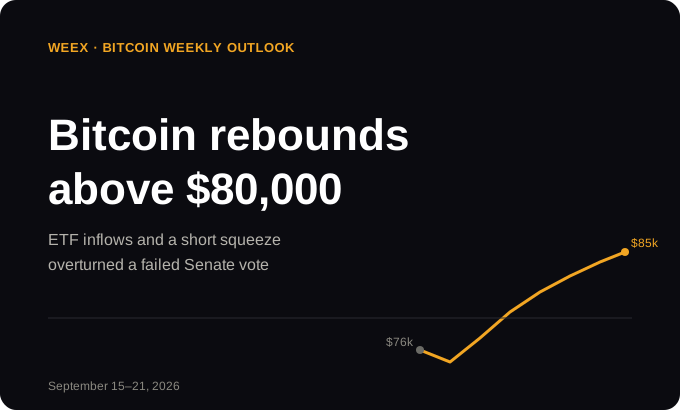
WEEX Bitcoin Weekly Outlook: Why Did Bitcoin Rebound Above $80,000 After the CLARITY Act Vote?
Bitcoin rebounded above $80,000 as SEC and CFTC action, renewed ETF inflows, and a short squeeze outweighed the failed CLARITY Act vote.

From AI Trading to AI Asset Management: What Does Robinhood Have in Place and What Do Startups Still Lack?

Crypto and Robotics: True Revolution or New Speculative Bubble?
Coldcard whitehats move 52.37 BTC to recovery trust

Bitcoin's Rise Does Not Mean the Bull Market Has Returned; Don't Create Stories for Yourself

AMD Jumps Nearly 10%, Market Cap Tops $1 Trillion| WEEX TradFi Daily Brief (September 22, 2026)
Global markets on September 22 focus on a repair in AI-compute pricing. On September 21 the three major equity indexes closed higher. AMD rose nearly 10% and its market cap crossed $1 trillion for the first time, while Intel and Arm also surged. Brent crude fell about 3.4% to $100.34 and the 10-year Treasury yield eased to about 4.96%, lowering discount-rate pressure on long-duration tech. Bitcoin briefly broke above $87,000 and total crypto market cap returned above $3 trillion. Investors next watch consumer and housing earnings plus PMI flash prints.
![[Full Text] "The Core of Blockchain Policy: Supporting Corporate Adoption and Protecting Investors"](/public-static/32_e2da91fed2.png?format=avif)
[Full Text] "The Core of Blockchain Policy: Supporting Corporate Adoption and Protecting Investors"
What’s Worth Watching After the First Wave of Arc Hype?

What is Fast? Understanding the Parallel Payment Infrastructure for AI Agents

"A Separate System for Issuance and Disclosure of Digital Assets is Necessary for the Development of the Domestic Industry"

The DOJ investigates Binance for possible violations of sanctions against Iran

Strive Retains More Cash After Purchasing 1,355 Bitcoin

The Virtual World Left by the Metaverse Welcomes Robot 'Natives'

Breaking Down OpenRouter: Stripe's $7.5 Billion Acquisition Gamble

The Answer to Dreamforce 2026: AI Agent, Has It Finally Turned from Demo to Revenue?

Robinhood CEO Says Crypto Will Beat Sports at Prediction Markets' Own Game
Liquid Network attacker crossed into theft: Immunefi CEO

Aurora Intents routed $19M into Zcash NFT auction

CPALL Stock at 45 Baht: Is Thailand's 7-Eleven Giant Undervalued?
Ethereum: BitMine Approaches 5% of Total ETH Supply
RKLB Stock: Why Simply Wall St Sees It 43% Undervalued After a $1.9 Billion Raise

Bitcoin Reclaims $85K: ETF Flows Return as BTC Momentum Builds
Bitcoin has reclaimed $85,000 as spot ETF flows turn positive and institutional demand returns. Here’s what is driving BTC’s rebound, what WEEX traders should watch next, and why liquidity and execution matter in a fast-moving market.
Which Liquidity Pools Are Profitable on Robinhood Chain?

Should We Worry About a Reversal of Yen Carry Trades?
WEEX P2P now supports XOF, XAF & CDF—Merchant Recruitment Now Open
HODLing ETH: Should You Choose Staking for Yield or Collateralized Lending?
SEC Clarity Meets Fed Rate Hike: How WEEX TradFi Lucky Eggs S2 Taps Into Cross-Market Opportunities
AI Risk as an Opportunity for Bitcoin Pricing
Bitcoin 2x Leveraged ETF Launches on Cboe, But Doesn't Buy Bitcoin: Here's Why
Crypto: The ECB Enters the Tokenized Bond Market
Contents
Latest articles





Latest coin listings on WEEX


