
From AI Trading to AI Asset Management: What Does Robinhood Have in Place and What Do Startups Still Lack?

 Prefer us on Google


Robinhood has allowed external AI agents to execute trades in real accounts.
Written by: Boaz Sobrado, Forbes
Compiled by: AididiaoJP, Foresight News
On May 27, 2026, Robinhood launched Agentic Trading. Users can connect external models like Claude, ChatGPT, Cursor, Grok, and Codex to their brokerage accounts, allowing the agents to conduct research, place orders, and rebalance. Funds must be transferred to a separate agent account, and the agent can only operate within that account's funds. Each transaction triggers a notification, and users can disconnect at any time.
Forbes breaks this down into two levels: Robinhood first opens up agent trading; some startups hope to take it further by allowing AI to manage funds. The latter seems like a natural extension, but there are legal and capital requirements in between. To understand this gap, one must consider interfaces, permissions, and the division of responsibilities.
Not a Robo-Adviser, but a Trading Track with Built-in Models
Agentic Trading is not a proprietary trading tool developed by Robinhood, nor is it the same as the platform's assistant Cortex. Cortex primarily handles research report reading and suggestions, with final trades still confirmed by users. The model of Agentic Trading is "models brought by users, with the platform providing the trading track." Connections are made through MCP: Robinhood provides the trading server address, users complete OAuth authorization on the desktop, and the system then guides them to open a separate account named Agentic. Official demonstrations show that it takes about half a minute from connection to authorization.
This division of labor determines the allocation of risks. The brokerage is responsible for matching, clearing, account isolation, and notifications; risks such as strategy judgment and instruction misinterpretation are borne by the external models and prompt creators. Robinhood clearly states that it does not control, supervise, or audit these agents. Once data leaves the brokerage environment, it enters the systems of Anthropic, OpenAI, or other model vendors. The platform sells a channel, not advisory services.
How to Open an Account and the Actual Scope of Permissions
Users must first have a properly functioning personal Robinhood account. The agent account is an independent self-brokerage account, neither an IRA nor a sub-account of the main account. The amount of funds transferred theoretically represents the maximum loss limit. Agents cannot operate the main account, bank accounts, or retirement accounts. This feature incurs no additional fees, and stocks and ETFs are executed according to the platform's existing commission-free rules.
However, trading permissions and data permissions are not the same barrier. Public statements indicate that connected agents may still view account numbers, positions, balances, and history across accounts to assess concentration. In other words, the sandbox restricts trading permissions but may not limit the visibility of data. Exposing the entire asset holding structure to third-party models is a different risk than stating that "the agent can only lose the $1,000 transferred."
Instructions are given in natural language. For example, an agent can be instructed to check the market daily, reduce positions by half if a single stock drops more than 10%, and reinvest cash into assets outperforming the portfolio average; it can also search for directions that have not yet been priced by the public market based on venture financing, mergers, and unlisted valuations, starting with a $100 test order. Agents can view purchasing power, assess sector exposure, read analyst materials, and then choose to preview or directly place or cancel orders. Users can set confirmations for each transaction or allow automatic execution within limits. The app provides real-time dynamics and profit and loss information.
In the initial launch phase, this feature only supports U.S. stocks. Options, crypto assets, event contracts, futures, and prediction markets are included in future plans, with some features gradually opening up by summer. As capabilities expand, risks related to turnover, leverage, and operational errors also increase. The Gold card additionally provides a virtual card for agent use, with customizable limits and the option for confirmation on each transaction, but it cannot operate physical card numbers.
Robinhood's risk warning is very clear: it is possible to lose all principal in the account. This is not just a cliché. Models may interpret "appropriate diversification" as high-frequency trading, may convert limit orders into market orders on earnings nights, and may repeat orders during brief data source anomalies. Notifications can alert users to issues, but seeing does not equate to being able to withdraw in time.
Retail End Approaching Mini-Funds, Legally Still Self-Managed
After opening an account, some users name their agents and assign roles: one selects assets, another reviews at market close, and another generates weekly reports, resembling a small hedge fund. Others may only invest $1,000 to test mechanical rotation, where transactions can be executed but profits are limited, and the allocation process is fragile. There are even experiments on GitHub titled "Single Agent, Real Money, Starting from $100."
Similarity does not equal sameness. The funds are one's own, the strategies are self-written, and losses are borne by oneself; there is no external fundraising, nor is there a fiduciary duty to strangers. U.S. advisory rules focus on three points: whether advice is provided regarding securities, whether it is done as a business, and whether it targets specific individuals. Giving instructions to one's own sandbox still falls under self-management. If an agent continuously adjusts positions based on others' risk preferences and charges for it or raises funds, its appearance approaches that of an investment adviser and fund operator.
Regulators do not view this as a toy. Agencies like the SEC and FINRA have issued joint alerts on AI and investment fraud. Risks lie not only in model miscalculations but also in impersonating advisers and enticing investors to hand over funds to "fully automated high-yield agents." Isolated accounts can limit the maximum loss for a single user but cannot prevent someone from packaging the sandbox as a financial product for external sale.
-- Price
Startups Want to Buy Not Prompts, But Three Pieces of Paper
The first is the boundary of capabilities. The stock sandbox and simultaneous trading of options, crypto assets, perpetual contracts, and prediction markets are not of the same risk level. Robinhood's expansion is written into the roadmap because users want to operate all varieties through a single entry point. For client products, the wider the entry, the more appropriate testing matching the risk level is needed; it cannot rely solely on "can be turned off."
The second is the allocation of responsibilities. The platform claims that external agents are not under its management, users say they only wrote a natural language sentence, and model vendors claim to provide only general tools. When all three parties can shift responsibility, a key signature is missing from the documents: who is responsible for net value, who prioritizes clients in conflicts of interest, and who compensates first after a liquidation.
The third is scale and custody. Personal experimental funds can follow client agreements; external fundraising and ongoing management must comply with fund or advisory rules: where funds are stored, how net value is calculated, how long the redemption cycle is, how fees are charged, and how related transactions are disclosed. MCP can reuse the tracks laid out by Robinhood, but licenses, custody, and capital cannot be replicated.
There is also a parallel thread. On-chain, agents with wallets that can pay for themselves have emerged, and there are discussions about making agents pauseable, transferable, or even tokenized entities. This involves another set of identity and clearing issues. The focus of this Forbes article is narrower: whether agents will grow from retail plugins into asset management businesses on traditional brokerage tracks.
Conclusion
What can be confirmed at this point is that order placement can now be automated, isolated accounts can define the maximum loss limit for single experiments, and notification and disconnection mechanisms reduce the probability of "completely unseen" issues. What cannot yet be written into product pages is that external models can consistently outperform passive portfolios, the platform will cover errors made by agents, and this model is equivalent to a licensed fund.
This content is provided for general informational purposes only and doesn't constitute financial, investment, legal, or tax advice. Any events, rewards, online promotions, or related information mentioned herein should not be considered a recommendation, solicitation, or invitation to purchase, sell, trade, or otherwise deal in any crypto assets. Crypto assets are highly volatile and may result in loss. The availability of WEEX services, products, and related events may vary by region. You are responsible for ensuring that your participation is in accordance with applicable local laws and regulations.
You may also like

Crypto: Kalshi accused of inflating its volumes with thousands of identical orders

WEEX P2P now supports XOF, XAF & CDF—Merchant Recruitment Now Open

HODLing ETH: Should You Choose Staking for Yield or Collateralized Lending?

SEC Clarity Meets Fed Rate Hike: How WEEX TradFi Lucky Eggs S2 Taps Into Cross-Market Opportunities

AI Risk as an Opportunity for Bitcoin Pricing

Bitcoin 2x Leveraged ETF Launches on Cboe, But Doesn't Buy Bitcoin: Here's Why

Crypto: The ECB Enters the Tokenized Bond Market
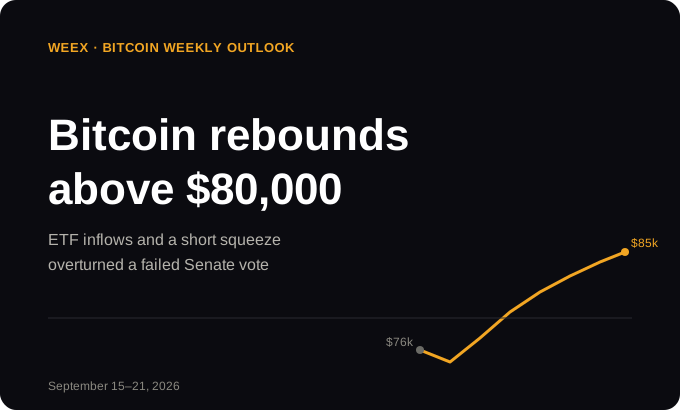
WEEX Bitcoin Weekly Outlook: Why Did Bitcoin Rebound Above $80,000 After the CLARITY Act Vote?
Bitcoin rebounded above $80,000 as SEC and CFTC action, renewed ETF inflows, and a short squeeze outweighed the failed CLARITY Act vote.

Crypto and Robotics: True Revolution or New Speculative Bubble?
Coldcard whitehats move 52.37 BTC to recovery trust

Bitcoin's Rise Does Not Mean the Bull Market Has Returned; Don't Create Stories for Yourself

AMD Jumps Nearly 10%, Market Cap Tops $1 Trillion| WEEX TradFi Daily Brief (September 22, 2026)
Global markets on September 22 focus on a repair in AI-compute pricing. On September 21 the three major equity indexes closed higher. AMD rose nearly 10% and its market cap crossed $1 trillion for the first time, while Intel and Arm also surged. Brent crude fell about 3.4% to $100.34 and the 10-year Treasury yield eased to about 4.96%, lowering discount-rate pressure on long-duration tech. Bitcoin briefly broke above $87,000 and total crypto market cap returned above $3 trillion. Investors next watch consumer and housing earnings plus PMI flash prints.
![[Full Text] "The Core of Blockchain Policy: Supporting Corporate Adoption and Protecting Investors"](/public-static/32_e2da91fed2.png?format=avif)
[Full Text] "The Core of Blockchain Policy: Supporting Corporate Adoption and Protecting Investors"
What’s Worth Watching After the First Wave of Arc Hype?

What is Fast? Understanding the Parallel Payment Infrastructure for AI Agents

"A Separate System for Issuance and Disclosure of Digital Assets is Necessary for the Development of the Domestic Industry"

The DOJ investigates Binance for possible violations of sanctions against Iran

Strive Retains More Cash After Purchasing 1,355 Bitcoin

The Virtual World Left by the Metaverse Welcomes Robot 'Natives'

Breaking Down OpenRouter: Stripe's $7.5 Billion Acquisition Gamble

The Answer to Dreamforce 2026: AI Agent, Has It Finally Turned from Demo to Revenue?

Robinhood CEO Says Crypto Will Beat Sports at Prediction Markets' Own Game
Liquid Network attacker crossed into theft: Immunefi CEO

Aurora Intents routed $19M into Zcash NFT auction

CPALL Stock at 45 Baht: Is Thailand's 7-Eleven Giant Undervalued?

Ethereum: BitMine Approaches 5% of Total ETH Supply
RKLB Stock: Why Simply Wall St Sees It 43% Undervalued After a $1.9 Billion Raise

Bitcoin Reclaims $85K: ETF Flows Return as BTC Momentum Builds
Bitcoin has reclaimed $85,000 as spot ETF flows turn positive and institutional demand returns. Here’s what is driving BTC’s rebound, what WEEX traders should watch next, and why liquidity and execution matter in a fast-moving market.
Which Liquidity Pools Are Profitable on Robinhood Chain?

Should We Worry About a Reversal of Yen Carry Trades?
Crypto: Kalshi accused of inflating its volumes with thousands of identical orders
WEEX P2P now supports XOF, XAF & CDF—Merchant Recruitment Now Open
HODLing ETH: Should You Choose Staking for Yield or Collateralized Lending?
SEC Clarity Meets Fed Rate Hike: How WEEX TradFi Lucky Eggs S2 Taps Into Cross-Market Opportunities
AI Risk as an Opportunity for Bitcoin Pricing
Bitcoin 2x Leveraged ETF Launches on Cboe, But Doesn't Buy Bitcoin: Here's Why
Contents
Latest articles





Latest coin listings on WEEX


