
Bitcoin's Rise Does Not Mean the Bull Market Has Returned; Don't Create Stories for Yourself

 Prefer us on Google



If the rise is mainly driven by short covering and high leverage chasing, then the faster the rise, the more concentrated the subsequent liquidation risk.
Written by: Daii
Let’s get the most important point out first:
Bitcoin breaking above $84,000 is not enough to prove that the bull market has restarted. It is even insufficient to prove that real spot buying is continuously entering the market.
- What Really Matters Is Not How Much It Has Risen, But Who Pushed the Price Up
A rally can be driven by at least three completely different engines.
One is sustained increases in spot buying. Buyers directly use money to buy coins and either withdraw them or hold them long-term. This type of market is usually more solid.
Another is leveraged long positions in derivatives. Prices rise quickly, and open interest, funding rates, and futures basis also expand simultaneously. This type of market looks fierce, but the foundation may be very thin.
The third is short covering. After the price breaks through a key area, short sellers' stop-losses and forced liquidations turn into passive buy orders. These passive buy orders continue to push the price higher, triggering the next batch of short sellers to exit. This can create a very steep rise in a short period.
These three types of movements may look identical on a candlestick chart, but the consequences are completely different.
The market referenced in the title does not provide spot transaction volume, open interest in futures, funding rates, basis, liquidation volume, or net inflows to exchanges. Simply stating a “24-hour rise of 4.22%” does not distinguish which engine is at play.
Therefore, interpreting the rise directly as “the market confirms a bull market” lacks sufficient evidence. Similarly, interpreting it as “a large-scale short squeeze occurred above $80,000” also lacks evidence. Without liquidation numbers across exchanges, contracts, data providers, and time windows, it should not be stated as a fact.
Professional judgment does not assign a grand story to every bullish candlestick.
Professional judgment first acknowledges: currently, this news lacks the data to determine the story version.
- $84,000 Is Not an Anchor, Just a Position on the Order Book
Many people like to ask what Bitcoin is anchored to.
This question can lead people into a dead end. Bitcoin does not have future cash flows like stocks, nor does it have contractual interest like bonds. Its market price is formed by marginal trades. Whoever is willing to transact at the next price level decides the quote at that moment.
This does not mean that prices are completely random.
Research by Liu and Tsyvinski on cryptocurrency asset returns found that traditional stock, currency, and precious metal risk factors do not sufficiently explain cryptocurrency returns; instead, market momentum and investor attention are more explanatory. This conclusion does not imply that macro factors are useless. It indicates that mechanically translating Bitcoin into “digital gold,” “high beta Nasdaq,” or “anti-dollar asset” overly simplifies price formation.
In the same month, it can be influenced by dollar liquidity, driven by ETF subscriptions, or experience reverse liquidations due to overly unidirectional leveraged positions.
The saying “no fixed anchor is the biggest anchor” is suitable as a catchy phrase but not as an analytical framework. An explanation that cannot be falsified can explain any market condition, which is equivalent to explaining nothing.
A more useful approach is to break down the price into four layers: spot demand, regulated funding channels, derivative positions, and liquidity for transactions.
- ETFs Change the Funding Entry, Not the Law of Prices Only Rising
In January 2024, the U.S. Securities and Exchange Commission approved multiple spot Bitcoin exchange-traded products for trading. The significance of this event is not that it gives Bitcoin a “safe asset certification.” The SEC deliberately distinguished between product listing approval and recognition of Bitcoin itself in both the approval order and the accompanying statement.
The real change is in market structure.
A group of investors who were previously unwilling or unable to directly manage private keys, connect to crypto exchanges, or handle on-chain transfers now have exposure to Bitcoin prices within their securities accounts. Asset management institutions also have a familiar path for subscriptions, redemptions, and custody.
This means that when analyzing the market around $84,000, ETF net subscriptions should indeed be included in the observation list. However, the boundary of evidence must be maintained: the title does not provide the corresponding fund net flow for September 21, so this rise cannot be directly attributed to ETFs.
Even if it is confirmed that there was net inflow on that day, it cannot simply equate the net inflow amount with the funds needed for price increases. Market prices are determined by marginal liquidity. The thinner the order book, the easier it is for buy orders of the same scale to push prices. Conversely, if market makers have sufficient inventory and sell orders are dense, substantial subscriptions may only produce limited impact.
To determine whether ETFs are the main engine, at least net subscriptions, price contributions during and outside U.S. trading hours, spot transaction volume, and related market depth should be observed simultaneously. Missing one dimension would lower the conclusion's reliability.
- Ethereum's Concurrent Rise Only Proves a Slight Spread of Risk Appetite
The title also mentions that Ethereum rose 4.74% in 24 hours, slightly higher than Bitcoin.
This provides a clue: the market is not entirely limited to Bitcoin alone. But this is still far from a “full altcoin season.”
Two large-cap assets rising together may come from common dollar liquidity or the same batch of risk accounts increasing positions simultaneously. To prove that market breadth has genuinely improved, more layers need to be observed: whether Bitcoin's proportion in total market capitalization has decreased, whether small and mid-cap assets have risen broadly, whether spot transactions have spread, and whether stablecoin supply and exchange balances support new purchasing power.
Simply relying on Ethereum outperforming Bitcoin by less than one percentage point in a day cannot conclude that funds have fully overflowed.
Research shows that cryptocurrency asset returns exhibit significant common factors. This is precisely why “two coins rising together” cannot be treated as two independent pieces of evidence. They may just be two manifestations of the same risk factor.
- The Next Focus Should Be on Four Tables, Not the $120,000 Slogan
The first table is spot transactions and market depth. A rise accompanied by increased spot transactions across multiple exchanges, and buy orders still able to support during pullbacks, is more credible than a single platform's sudden spike.
The second table is leverage positions. Rapid increases in open interest, sustained rises in funding rates, and significant futures premiums indicate that more people are borrowing money to bet in the same direction. The CFTC has long warned that the cryptocurrency market is highly volatile, and margin trading can amplify losses, with forced liquidations potentially occurring very quickly.
The third table is ETF net flow and its sustainability. A single day's net inflow is an event. Continuous multi-day, cross-product net subscriptions are closer to a trend. It is also necessary to distinguish between new funds and migration between products.
The fourth table is price acceptance after the rise. A breakout is not just hitting a certain integer. A breakout occurs when the price leaves the original range, and there are still real transactions willing to complete at higher levels. If the price quickly falls back to the original range, the so-called breakout is merely a liquidity sweep.
As for “will it reach $120,000 again,” the existing materials are insufficient to provide a disciplined probability, let alone say “for sure.” Historical price movements that look similar do not mean the third movement must replicate. Slight adjustments in sample selection, start and end dates, and scales can create numerous attractive similar charts.
The cheapest part of price prediction is stating a target level.
The most expensive part is explaining what evidence would lead to a change of mind.
My judgment is clear: $84,000 is worth paying attention to, but it is primarily a price movement that needs to be dissected, not a bull market verdict. If spot transactions spread, ETF funds continue to flow in, and leverage does not go out of control simultaneously, the quality of the breakout will improve. If the rise is mainly driven by short covering and high leverage chasing, then the faster the rise, the more concentrated the subsequent liquidation risk.
The above answers how to view this rise. The more challenging layer is how to identify “true spot demand” from public data and the superficial buy orders caused by market maker hedging; the two often look almost identical in the short term.
This order book has not been fully flipped, and my judgment will not stop at a single integer.
References
- Igor Makarov and Antoinette Schoar (2020), Trading and Arbitrage in Cryptocurrency Markets, Journal of Financial Economics
- Yukun Liu and Aleh Tsyvinski (2021), Risks and Returns of Cryptocurrency, Review of Financial Studies
- U.S. Securities and Exchange Commission (2024), Order Granting Accelerated Approval of Spot Bitcoin Exchange-Traded Products
- U.S. Commodity Futures Trading Commission, Customer Advisory: Understand the Risks of Virtual Currency Trading
-- Price
This content is provided for general informational purposes only and doesn't constitute financial, investment, legal, or tax advice. Any events, rewards, online promotions, or related information mentioned herein should not be considered a recommendation, solicitation, or invitation to purchase, sell, trade, or otherwise deal in any crypto assets. Crypto assets are highly volatile and may result in loss. The availability of WEEX services, products, and related events may vary by region. You are responsible for ensuring that your participation is in accordance with applicable local laws and regulations.
You may also like

Bitcoin's Hashrate Rises as Miners Reactivate Their Machines

Bitcoin 2x Leveraged ETF Launches on Cboe, But Doesn't Buy Bitcoin: Here's Why

Crypto: The ECB Enters the Tokenized Bond Market
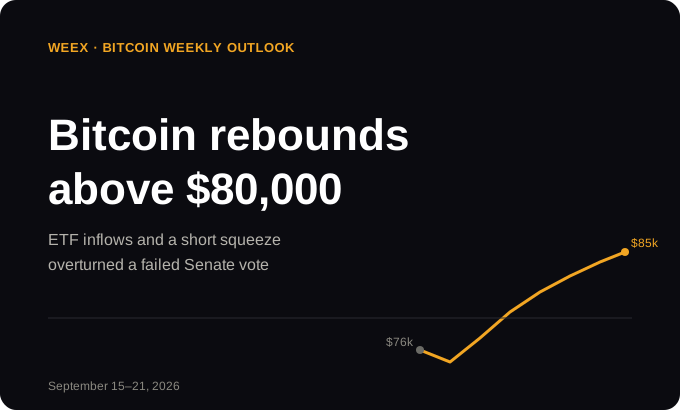
WEEX Bitcoin Weekly Outlook: Why Did Bitcoin Rebound Above $80,000 After the CLARITY Act Vote?
Bitcoin rebounded above $80,000 as SEC and CFTC action, renewed ETF inflows, and a short squeeze outweighed the failed CLARITY Act vote.
Coldcard whitehats move 52.37 BTC to recovery trust
Deutsche Bank: Markets May Underestimate Rate Peaks After Central Banks' Coordinated Rate Hikes
Hyperliquid Opens Market for Bitcoin Volatility

Tom Lee Discusses Entry into Digital Asset Bull Market and AI Fund Movements

Micron Stock Price Target: Do the $1,500 to $2,000 Estimates Still Make Sense
Micron price targets range from $1,295 consensus to $1,500- lus individual calls, while options pricing implies an 11% swing on September 30 earnings, the actual results will settle which
![[ETH Letter] Ethereum Aims to Activate Sepolia Testnet on October 6](/public-static/26_2e1840f602.png?format=avif)
[ETH Letter] Ethereum Aims to Activate Sepolia Testnet on October 6

Fypher Partners with Korea Medical Tourism Promotion Association for Digital Dollar Payment
TapeOut Ecosystem Overview: From NAND, LATCH to On-Chain Application Ecosystem
[Coin Crime] "If you give us Tether, we will give you oil" - Polish state-owned company falls victim to international fraudsters

Why real-time election odds are misleading prediction market crypto traders

What is PCE and Why September 30 is Important for Cryptocurrencies

Bitcoin: JPMorgan Sees BTC Outperforming Gold

U.S. Treasury Sanctions BitBank Over Iranian Sanctions-Evasion Network

Brazil blocks stablecoins from key cross-border payment rail as $1.1 trillion market faces new limits
RISEx Proposes 20% Retention Condition for Stolen Funds

USDT in Wallets May Be Blocked. What to Do and How to Store Them in Russia

Tokenized stocks face 24/7 pricing gap: RedStone COO
Has the Macroeconomic Pricing of BTC Changed? A Nine-Year Review of the Federal Reserve, the Dollar, the Nasdaq, ETFs, and Stablecoins

What Does the Fed's Hawkish Rate Hike Mean for the Dollar?

Galaxy launches 2 stablecoin vaults on Kamino
Nadex Under Crypto.com to Start Offering Individual Stock Futures Following SEC Approval

Crypto in the United States: Brad Garlinghouse (Ripple) remains optimistic

BitGo adds ex-Exodus executive as compliance chief

What Are the Conditions for Success of Data Centers? A Map of AI Data Centers in Korea – Bitplanet
Edel Expands Institutional Push as Wall Street Tokenization Matures

Franklin Templeton, Janus Henderson: Wall Street Integrates into Crypto as Validator
Bitcoin's Hashrate Rises as Miners Reactivate Their Machines
Bitcoin 2x Leveraged ETF Launches on Cboe, But Doesn't Buy Bitcoin: Here's Why
Crypto: The ECB Enters the Tokenized Bond Market
WEEX Bitcoin Weekly Outlook: Why Did Bitcoin Rebound Above $80,000 After the CLARITY Act Vote?
Bitcoin rebounded above $80,000 as SEC and CFTC action, renewed ETF inflows, and a short squeeze outweighed the failed CLARITY Act vote.
Coldcard whitehats move 52.37 BTC to recovery trust
Deutsche Bank: Markets May Underestimate Rate Peaks After Central Banks' Coordinated Rate Hikes


