
Bitcoin Price Slips to a Three-Week Low Near $81,000: Can $80,000 Hold After Three Rejections at $87K?

 Prefer us on Google
The BTC price has slipped to a three-week low, and the move has put one question in front of every trader: can $80,000 hold? According to KuCoin's October 9 market report, BTC briefly traded below $81,000 before bouncing toward $82,000, which leaves the BTC price well below the $87,000 area that rejected it earlier this month. The drop did not come from a single headline. Rising Treasury yields, a weak session for tech stocks, outflows from spot Bitcoin ETFs and a round of long liquidations all landed in the same few days.
This article walks through the verified numbers, explains what the BTC price is reacting to and lays out the levels that matter next, including how traders can approach the market on WEEX Spot and Futures.
Bitcoin Price Snapshot: Where BTC Trades After the Three-Week Low
KuCoin's daily report, with data as of 00:00 UTC on October 9, listed Bitcoin at about $81,741, down roughly 1.9% on the day. CoinGecko data cited by CoinGabbar at 01:30 UTC showed BTC near $81,905, down about 1.5%, with a market capitalization of about $1.64 trillion and 24-hour trading volume near $42.6 billion. The two snapshots differ slightly because they were taken at different times, which is common during a fast move. The Crypto Times reported that BTC dipped to about $80,400 in early trading on October 9 before recovering toward $82,450.
The wider market followed. Total crypto market capitalization fell about 2.5% over 24 hours to roughly $2.86 trillion, and Ethereum dropped about 3.8% to near $2,480. Bitcoin dominance stayed high near 57.6%, which suggests that investors were not rotating into altcoins at scale. The Fear and Greed Index slipped to 59 from 64 the day before and 72 a week earlier, a reading that still sits in the greed zone but shows sentiment cooling quickly.

Why Bitcoin Failed at $87,000 for the Third Time
The Crypto Times described the $86,500 to $87,000 band as a ceiling that has rejected Bitcoin three times since late September. BTC touched a high near $87,200 on October 2, retested the zone with highs of roughly $86,700 to $87,000 on October 5 and 6, and then turned lower. On October 7 it fell below $84,000 to about $83,280, and on October 8 it closed near $81,703, about 6.3% under the weekly high. These price levels come from a single source, so they should be treated as approximate.
The same report pointed to a leverage unwind as the immediate driver of the selloff. It counted more than $166 million in liquidations over the period, with about $156.69 million of that in long positions, affecting roughly 8,400 traders. Other trackers may show different totals depending on the exchanges they include. The pattern is a familiar one: when price repeatedly fails at resistance, traders who bought the breakout attempts are left holding leveraged longs, and a break below nearby support forces them out, which pushes price lower still.
What the Bond Selloff and Tech Weakness Mean for the Bitcoin Price
The macro backdrop has not helped. According to The Crypto Times, a global bond selloff pushed the US 30-year Treasury yield to 5.715% while the US Dollar Index firmed. The Associated Press reported that the 10-year yield rose to 5.35% on Thursday before easing to 5.23%, and that the 30-year yield fell back to 5.60% after a $22 billion auction drew a high yield below 5.62%. KuCoin added that the UK 20-year gilt yield reached 6% for the first time since 1998. When government bonds pay this much, risk assets like Bitcoin face stronger competition for capital.
Equities showed the same caution. The S&P 500 fell about 0.5% and the Nasdaq Composite about 1.3% on Thursday, with Nvidia down 2.9%, Broadcom down 4.3% and Micron down 4.8%, according to the AP. Crypto-linked stocks fell together, with Coinbase down about 4.1% and Robinhood down about 3.2%, as reported by The Crypto Times. Oil added to the pressure, with Brent crude rising 4.1% to $104.28 on Thursday amid uncertainty over talks with Iran before easing early Friday. Bitcoin has often moved with risk sentiment in this kind of environment, though the link is not constant and can break in either direction.
-- Price
Spot Bitcoin ETF Outflows and Large Wallet Moves
Institutional flows have turned negative. SoSoValue data reported by CoinGabbar showed US spot Bitcoin ETFs with a net outflow of $244.13 million on October 8, the second-largest single-day outflow of the month, led by Fidelity with about $197.09 million. Cumulative net inflows still stand at about $57.09 billion, so the long-term picture is not broken, but a single day of this size shows demand weakening at the exact moment price tested support. By contrast, XRP funds recorded a small net inflow of about $8.17 million, which suggests investors are not leaving crypto entirely.
Wallet activity has also drawn attention. Arkham data cited by CoinGabbar showed a US government wallet moving 12,267 BTC, worth about $1.01 billion, on October 8, and MARA Holdings was reported to have sold 996 BTC, worth about $81.13 million. A transfer between wallets is not the same as a sale, and the government move has not been shown to be a market sale, but headlines like these can influence short-term sentiment. Strategy, the largest corporate holder, disclosed in an October 5 filing that it bought 334 BTC at an average of about $85,838.80, which is above the current Bitcoin price and leaves its recent purchase at an unrealized loss.
Can $80,000 Hold? Key Bitcoin Price Levels to Watch
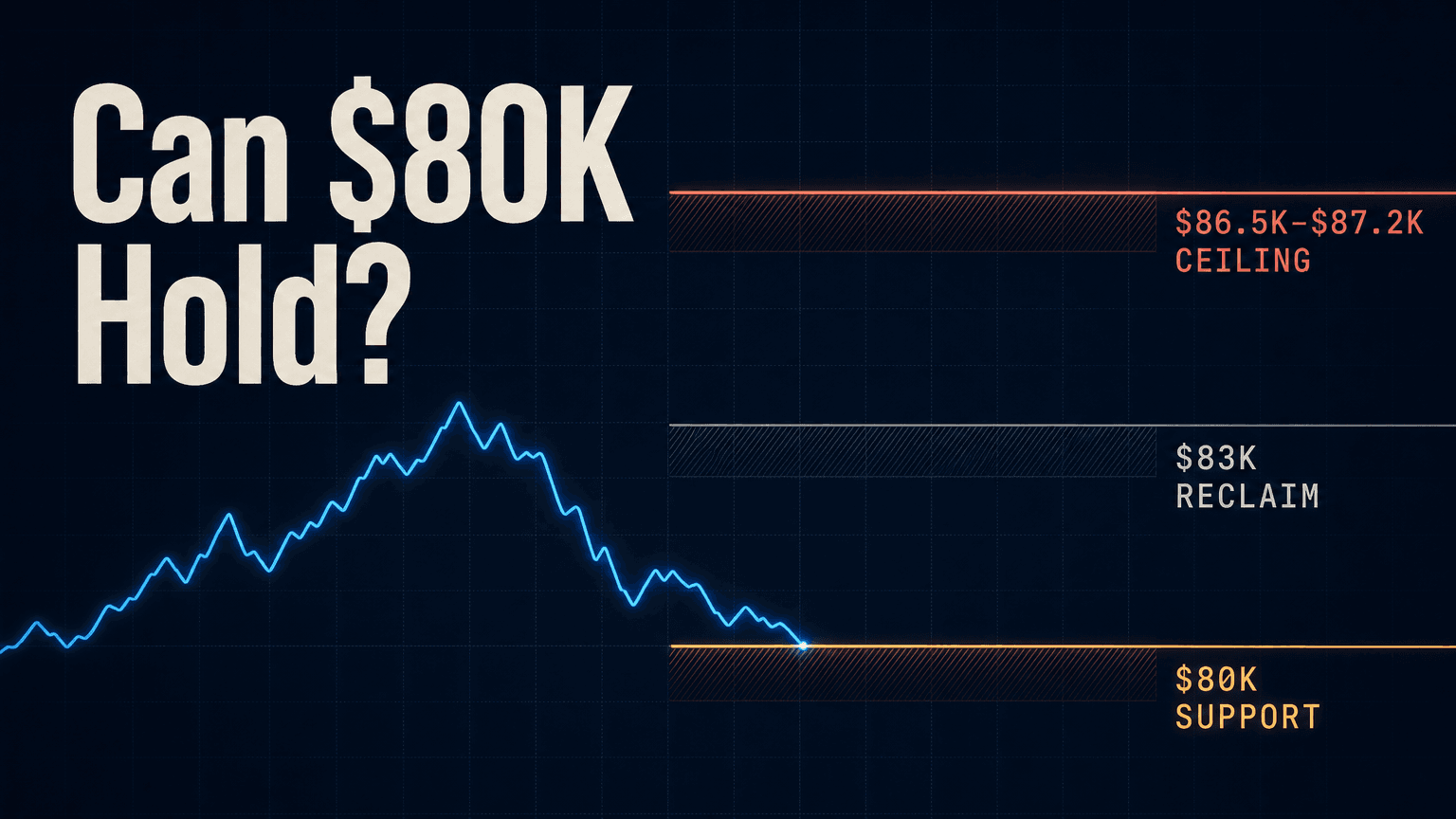
The $80,000 to $80,400 zone is the immediate support, marked by the October 9 low. KuCoin noted that a failure to reclaim $83,000 could open the way toward $80,000 again, which makes $83,000 the first level bulls need to win back. A clean daily close above it would suggest the selling has paused, while repeated rejections beneath it would keep pressure on the support below. Further up, the $86,500 to $87,200 band remains the major ceiling that has already rejected price three times.
A break under $80,000 would not guarantee a deeper correction, but it would invalidate the idea that this dip is a simple retest, and it could trigger another wave of long liquidations. Holding above it does not confirm a recovery either, because the bond market, ETF flows and tech stocks are all still moving. Traders should watch these levels alongside the macro data rather than treat any single number as a signal. All levels here come from market reports on October 8 and 9 and will change as price moves.
Trading Bitcoin on WEEX Spot and Futures
For traders who want to act on the current setup, WEEX offers BTC on both Spot and Futures, and the two serve different goals. On WEEX Spot, users buy BTC with USDT and hold the actual asset with no leverage and no liquidation risk. That suits investors who see the $80,000 area as a long-term entry zone and prefer to build a position gradually, for example by splitting purchases into smaller limit orders near support instead of buying all at once during a volatile session. A limit order also avoids paying a wide spread when the market is moving quickly.
WEEX Futures is for traders who want to express a view in either direction, whether that is a bounce from $80,000 or a continued move lower if support fails. Leverage magnifies gains and losses, and a position can be liquidated if price moves against it, so the long liquidations seen this week are a reminder to keep leverage low, use stop-loss orders and avoid holding oversized positions through macro events. Funding rates should also be checked before holding a position for several days. WEEX maintains a 1,000 BTC protection fund, with details at weex.com/protectfund. Users should confirm trading pairs, fees and rules on the platform before placing any order.
Conclusion
The Bitcoin price near $81,000 reflects a market squeezed between a heavy resistance zone at $87,000 and a macro backdrop of high bond yields, weaker tech stocks and ETF outflows. The $80,000 area is the level to watch, with $83,000 as the first sign that buyers are returning. Whether Bitcoin holds or breaks that support will likely depend as much on yields and risk sentiment as on crypto-specific news, so traders should manage risk carefully and avoid assuming a quick rebound.
FAQ
1. Why is the Bitcoin price falling today?
No single cause has been reported. Rising bond yields, weaker tech stocks, ETF outflows and long liquidations all contributed.
2. What is the Bitcoin price on October 9, 2026?
According to KuCoin at 00:00 UTC, BTC was about $81,741, after briefly dipping below $81,000. CoinGecko data showed about $81,905 shortly after.
3. What is the key Bitcoin support level now?
The $80,000 to $80,400 area, set by the October 9 low, is the immediate support. Resistance sits near $83,000, then $86,500 to $87,200.
4. Are Bitcoin ETFs seeing outflows?
Yes. SoSoValue data showed a net outflow of about $244 million from US spot Bitcoin ETFs on October 8.
5. Can I trade Bitcoin on WEEX Spot and Futures?
Yes. WEEX Spot has no leverage or liquidation, while WEEX Futures uses leverage and carries liquidation risk.
This content is provided for general informational purposes only and doesn't constitute financial, investment, legal, or tax advice. Any events, rewards, online promotions, or related information mentioned herein should not be considered a recommendation, solicitation, or invitation to purchase, sell, trade, or otherwise deal in any crypto assets. Crypto assets are highly volatile and may result in loss. The availability of WEEX services, products, and related events may vary by region. You are responsible for ensuring that your participation is in accordance with applicable local laws and regulations.
You may also like

Bitcoin and Quantum Risk: This Study Shows Which Exchanges Are Most Exposed

BTC more affected by U.S. Treasury market than Fed policy

CoinShares: Bitcoin's Rise Depends on Financial Instability

Strategy's $150 million-a-day STRC market has a hidden dependency on its own buybacks

Why Bitcoin Could Drop Below $80,000 After Another Failed Bounce

Crypto firms turn to Anthropic AI to find security flaws

Kruidvat sells Bitcoin gift cards with high fees

President Trump unveils $215M quantum computing plan amid crypto fears

Tiger Research: Five Key Changes in Crypto VC for Q3 2026

Midterm Elections in the United States, Bitcoin Could Benefit from a Historic Rise

Core Lightning v26.06.9 released with security fixes and payment bug repair

Long-Bond Highs Pressure Tech| WEEX TradFi Daily Brief (October 9, 2026)
Indexes were mixed on October 8 ET. The long-bond yield touched about 5.35% intraday, near levels last seen in 2002. OpenAI’s annualized revenue of about $50 billion came in below higher figures that had circulated, pressuring tech and chip names. Nasdaq fell clearly, while Dow edged higher. Energy led, with WTI up about 3.2% to about $91. Bitcoin pulled back from about $86,000 and traded near $81,000, down about 5%. September PPI is the focus on October 9.

WEEX Exclusive:Long-Bond Highs Pressure Tech| WEEX TradFi Daily Brief (October 9, 2026)
Indexes were mixed on October 8 ET. The long-bond yield touched about 5.35% intraday, near levels last seen in 2002. OpenAI’s annualized revenue of about $50 billion came in below higher figures that had circulated, pressuring tech and chip names. Nasdaq fell clearly, while Dow edged higher. Energy led, with WTI up about 3.2% to about $91. Bitcoin pulled back from about $86,000 and traded near $81,000, down about 5%. September PPI is the focus on October 9.

Ansem: Quantum Risks Will Drive ZEC Closer to BTC, Pure Meme Surpassing Bitcoin Is Highly Unlikely
Thailand SEC Allows Bitcoin and Ethereum ETFs to Trade

Q3 Crypto Investment Review: Strategic Capital Rises, Seed Rounds Cool Off

AI may be keeping Bitcoin’s biggest macro headwind alive after the Fed stops hiking

Why Are AI Stocks Still Rising Despite Soaring US Treasury Yields?

Arthur Hayes Predicts a Super Bull Market for Digital Assets

Robin Linus Releases Bitcoin Poker Protocol with 56,000 Transaction Tree Nodes

Meanwhile Completes $37.5 Million Financing, Total Funding Exceeds $180 Million

OSL Launches USDGO Market-Neutral Fund On-Chain for Hong Kong Investors

Bitcoin Core merges privacy fix into v32, v31 patch remains open

PowerCompute Mines 8.1 Bitcoin In September, Reduces Debt By 22.45 Million

Strategy Schedules October 29 Bitcoin Treasury Update

BNY Expands Regulated Crypto Custody Across The European Union Under MiCA

Citrini Research predicts tokenization could surpass BTC and ETH

Bitcoin ETFs See $484.9 Million Outflows Led By BlackRock

TD Cowen Raises Bitcoin Year-End Price Prediction to $109,000
Economist Who Called Bitcoin 'Revolutionary' Among Favorites for 2026 Nobel Prize in Economics
Bitcoin and Quantum Risk: This Study Shows Which Exchanges Are Most Exposed
BTC more affected by U.S. Treasury market than Fed policy
CoinShares: Bitcoin's Rise Depends on Financial Instability
Strategy's $150 million-a-day STRC market has a hidden dependency on its own buybacks
Why Bitcoin Could Drop Below $80,000 After Another Failed Bounce
Crypto firms turn to Anthropic AI to find security flaws
Contents
Latest articles


Latest coin listings on WEEX


