
AI Infrastructure May Lose Financing Before Losing Customers

 Prefer us on Google



TL;DR · AI infrastructure requires substantial upfront investment before waiting for delivery and payment; even if customers and orders remain, projects may halt due to inability to refinance. · The credit ratings of large tech companies do not represent the debt repayment capacity of developers, new cloud service providers, and various financing vehicles. · Rising interest rates, declining collateral values, and delays in power supply compress repayment capacity, financing limits, and cash flow, and their combined effect can exacerbate funding gaps. · Data centers do not need to face a permanent construction ban; delays in approvals and power access can sufficiently weaken a project's financing viability. · Slowing capital expenditure growth, project delays, and customer order cancellations are different risks and should not be equated directly. · Whether industry losses can spread to the entire market depends on loan concentration, leverage, liquidity, and contract terms, and cannot be inferred directly from the difficulties of individual companies.
The AI infrastructure boom may lose financing before losing customers.
This is the core judgment made by market commentator Bill Cara on October 30. Many data center projects must invest billions of dollars upfront and only begin to generate stable cash flow years later. The truly vulnerable link lies between expenditure and revenue collection.
A project can have customers, equipment, and signed contracts but still be unable to repay its current debts. Without sufficient funds to cover the waiting period between construction, power supply, and delivery, demand growth cannot prevent a funding chain break.
Therefore, to assess whether AI investments can be sustained, in addition to observing demand, it is necessary to ask: Can these projects continue to borrow under affordable conditions when they need funds?
Risks Are Sinking Down the Financing Chain Beyond Giant Credit Ratings
In the past, large tech companies primarily relied on their cash flow to support expansion. Today, the scale of AI infrastructure is changing this model.
Cara cites estimates showing that capital expenditures for hyperscale cloud providers like Amazon, Alphabet, Meta, Microsoft, and Oracle could reach $940 billion by 2026; JPMorgan predicts AI spending could reach $5.5 trillion by 2030. These figures correspond to different forecasting criteria and reflect construction scale, not necessarily actual financing needs.
The financing structure is also changing. According to data cited by Cara, the coverage ratio of debt for new expenditures by these companies is expected to rise from 9% in 2024 to 32% by mid-2026; their estimated investment-grade bond issuance in 2026 is about $274 billion, more than double that of the entire year of 2025.
Cara also cites estimates from UBS indicating that the debt of hyperscale cloud providers is nearing $800 billion; if lease, service contracts, and guarantees are included, total obligations amount to about $3.5 trillion. However, contractual obligations are not the same as interest-bearing debt and do not imply that these amounts are about to mature.
More importantly, infrastructure expansion has already extended beyond the balance sheets of the giants. Microsoft's credit rating does not inform investors whether a data center developer or equipment financing vehicle can withstand delays.
Participants in this chain bear different risks.
Hyperscale cloud providers have the strongest financial strength, but increased capital expenditures are also eroding the free cash flow of some companies, which is the remaining funds after operating cash flow minus capital expenditures. New cloud service providers like CoreWeave, Nebius, and Iren are expanding by offering GPU computing services, with some companies relying on equipment, leasing arrangements, or future contracts for financing, resulting in significantly different financing conditions compared to the giants.
Developers must bear the costs of construction overruns and delays before rental income arrives; banks and private credit funds provide funding, but who ultimately bears the losses depends on specific contracts. Utility companies face similar issues: if the anticipated electricity demand from data centers does not materialize, who pays for the already invested grid construction costs?
The debt on a company's balance sheet is only part of this financing network. Estimates cited by Cara indicate that the market size for asset-backed securities (ABS) related to AI data centers is about $34 billion, with analysts predicting an additional $50 billion that year. Such securities are backed by cash flows and other assets related to data centers.
Another arrangement is Significant Risk Transfer (SRT): banks retain loans while transferring part of the credit loss risk to external investors, thereby freeing up space for continued lending. These transactions change the holders of risk but do not eliminate the risk itself.
Cara lists institutions such as Blue Owl, Brookfield, PIMCO, Blackstone, KKR, and BlackRock as participants in this financing network. However, assessing risk still requires a focus on specific funds, financing vehicles, and contracts, rather than inferring loss exposure solely based on institutional names.
Financing May Fail Even Without Customer Loss
Data center projects are constrained by multiple timelines: construction, power access, customer acceptance, rental payment commencement, and debt maturity may not align.
If cash flow is delayed while debt repayment timelines do not shift accordingly, someone must provide funds for the gap in between.
A hypothetical case can illustrate the impact of interest. If a project has $1 billion in debt and borrowing costs rise from 7% to 11%, annual interest increases from $70 million to $110 million.
Assuming the project has $120 million available for debt repayment each year, its coverage ratio for interest will drop from about 1.71 times to 1.09 times, not accounting for principal repayment. If customers do not decrease, but financing costs rise, it nearly exhausts the buffer space.
Refinancing may also be constrained by limits. If an asset that previously supported $1 billion in borrowing can now only secure $700 million in loans, the borrower must inject $300 million in equity or sell assets or restructure debt.
These are hypothetical calculations, not forecasts for any specific company's performance, but they reveal three pressures that can reinforce each other: rising interest weakens repayment capacity, declining collateral compresses borrowing limits, and project delays postpone cash inflows.
Even if revenue continues to grow, companies may still face funding gaps. The earliest signals may be a loan request for additional equity, an unrenewed financing commitment, or a delivery date that exceeds the debt arrangement's capacity.
Cara cites October market data indicating that CoreWeave's credit default swap (CDS) quotes once exceeded 1140 basis points, with the yield on its $2.75 billion bond maturing in 2031 exceeding 15.7%. CDS is a contract used to transfer default risk; 100 basis points equal 1 percentage point. If these quotes remain high, it indicates that investors require higher credit risk compensation, but it does not constitute evidence of default.
Financing withdrawals do not require coordination among creditors. As long as institutions simultaneously lower collateral valuations, delay expected delivery dates, or reassess tenant credit, they may collectively reduce loans, tighten limits, or refuse extensions.
Each withdrawal of funds makes the next gap harder to fill. Projects may halt before entering liquidation due to an inability to pay the next construction payment.
Delays in Power and Regulation Will Ultimately Become Financial Issues
Data center financing is inseparable from a public policy question: who pays for grid expansion?
On October 9, 2026, the U.S. Federal Energy Regulatory Commission (FERC) rejected most of the PJM grid operator's large load interconnection proposals while accepting definitions and registration arrangements for large loads. The rejected proposals included allowing some new large users to connect to the grid without corresponding new power supply capabilities and committing to accept load shedding under certain conditions.
This decision does not mean that all data center projects are frozen, nor does it imply that the cost-sharing mechanism has been completely denied. It reflects unresolved issues regarding access conditions, cost allocation, and the regulatory authority between federal and state levels.
For high-leverage projects, this uncertainty affects how much funding lenders are willing to provide and what returns they require. The longer the project duration, the more lenders need clarity on which costs are borne by developers, tenants, utility companies, or general users.
Even if regulatory rules are clear, there are practical bottlenecks to grid access. The scale of queued applications does not equal the final demand, but once the timing of construction becomes uncertain, financing arrangements become harder to lock in.
The situation in Texas provides an example. Governor Greg Abbott requested a review of some proposed interconnection projects in August 2026 and paused related approvals during the review period. Subsequent local disclosures indicated that the review involved about 250 to 300 projects in the first batch of concentrated study processes, mainly data centers; this does not impose a permanent ban on all projects.
For developers, projects do not need to be permanently banned; delays can create sufficient financial pressure. Land, equipment, and construction costs have already been incurred, while rental income must wait until power supply and delivery begin. Grid investments and regulatory processes progress over many years, while lenders may reassess risks quarterly.
The gap between these two timelines ultimately requires real funds to fill.
The investment pace of cloud giants themselves also affects this chain. Microsoft disclosed at the end of October that its expected capital expenditures for the 2026 calendar year had decreased from about $175 billion to about $170 billion, a decline of less than 3%. This change is worth tracking but cannot be directly interpreted as weakening AI demand or customer order cancellations; changes in spending timing can also alter annual figures.
Cara cites UBS forecasts indicating that the capital expenditure growth rate for hyperscale cloud providers may drop from 76% in 2026 to 25% in 2027 and 6% in 2028. These are forecasts, not results that have already occurred.
Slowing growth, project delays, and order cancellations must be viewed separately. Slowing growth may still correspond to an absolute increase in expenditures; delays primarily change the timing of cash inflows; order cancellations directly weaken the future revenue base. Their impacts on financing differ.
However, if major tenants slow their expansion, projects relying on future rental expectations for construction may find it harder to secure financing. Developers must choose between discounted sales and continued holding, while equipment aging and financing costs will further influence this choice.
From Industry Losses to Market Impact, There Are Five Conditions In Between
AI credit losses do not automatically mean that the entire financial market will fall into crisis. For systemic shocks to occur, losses must exceed the holders' capacity to bear them or trigger forced sales of other assets through financing arrangements.
Five conditions need to be examined:
· Concentration: Are the same group of lenders concentrated in multiple projects?
· Leverage: Are lenders using these assets as a basis for further borrowing?
· Liquidity: Is the speed at which investors retrieve cash faster than the speed of asset liquidation?
· Contract Terms: Will losses trigger additional collateral or borrowing limit contractions?
· Alternative Funding: Can exiting funds be replaced by new funds at an affordable price?
When repayment deadlines precede asset liquidation deadlines, industry losses may evolve into liquidity events.
One channel through which risks transmit to the stock market is the credit spread, which is the additional portion of corporate borrowing rates relative to risk-free benchmark rates. If AI-related financing continues to deteriorate and prompts funding providers to generally reduce risk exposure, the financing conditions for other borrowers may also be affected. However, this spillover requires evidence and cannot be directly inferred from a single company's high yield.
Utility companies may also be affected. If the data center demand that grid expansion relies on does not materialize, cost recovery and burden distribution will become issues, weakening some companies' defensive attributes.
Whether private credit funds will face redemptions or margin calls due to falling asset prices also depends on specific structures. Closed-end funds, open-end products, and leveraged financing vehicles face different liquidity constraints. Only by confirming specific funds, contracts, and triggering conditions can one assess whether there is pressure to forcibly sell other assets.
Therefore, observing whether AI infrastructure can be sustained cannot rely solely on total order amounts. A more valuable question is: When do debts mature, do lenders still pay construction funds as promised, how long can interest reserves support, can customers exit before rental payments commence, who bears the overruns, and what collateral clauses will be triggered by chip depreciation or delivery delays?
These details ultimately point to the same question: Which payment obligations will come due before cash flow arrives?
Cara holds a distinctly pessimistic view of the AI financing chain and judges that the retreat of financing may drag down global stock markets. This is a risk scenario judgment and should not be seen as an inevitable outcome. However, the mechanisms he raises are worth noting: even if AI demand still exists, the ownership and financing structures built around that demand may not be able to bear the costs of delivery and waiting times.
For construction projects reliant on continuous financing, as long as multiple funding providers are unwilling to pay the next installment, expansion may quickly come to a halt.
-- Price
This content is provided for general informational purposes only and doesn't constitute financial, investment, legal, or tax advice. Any events, rewards, online promotions, or related information mentioned herein should not be considered a recommendation, solicitation, or invitation to purchase, sell, trade, or otherwise deal in any crypto assets. Crypto assets are highly volatile and may result in loss. The availability of WEEX services, products, and related events may vary by region. You are responsible for ensuring that your participation is in accordance with applicable local laws and regulations.
You may also like

SemiAnalysis: Musk Breaks Through Again, How SpaceX Competes for the World's Largest AI Cloud?

Why Did Institutions Bet $40 Million on PhotonPay When Stablecoin Transfers Are Cheap Enough?

TradingBeats Launches New Version, Upgraded to Information Stream Format
The Ghost Behind the Screen: Unveiling the Secret World of North Korean Hackers Lazarus

Where Did the Liquidity Go on the Night Binance Suspended Withdrawals?

WEEX Exclusive:Major Indexes Rise After Election Clarity, Oil Plunges| WEEX Daily Market(November 5, 2026)

Cryptocurrency Exchanges Enter the U.S. Stock Derivatives Market as CFTC Approves Perpetual Futures Amid Wall Street Backlash

Major Indexes Rise After Election Clarity, Oil Plunges| WEEX Daily Market(November 5, 2026)
At the November 4 close, all three major indexes rose. Risk assets rebounded after election clarity, but AI-related stocks broadly declined. Brent and WTI oil both fell more than 9% over 24 hours. Bitcoin briefly rose above $80,000, and the crypto market warmed across the board. TRUMP token plunged. November 5 focus is earnings from Moderna, Sony, ConocoPhillips and others.

3Jane and Settle Reach $100 Million Financing Agreement

Why Banks Still Refuse to Open Accounts for Licensed Crypto Payment Projects
Nvidia stock tokens show price spreads, but slippage crushes the arbitrage

Serenity: AI Industry Chain Stocks Face Indiscriminate Sell-off, Some Storage Stocks Have a P/E Ratio of Only 1.6 Times

Over $133 Million in Suspected Stolen Funds Flow Through Crypto Platforms

The 'Election Effect' of Bitcoin: Political Catalyst or Coinciding with the Halving Cycle?

TeraWulf Signs Credit Support Agreement with Google to Advance $19 Billion Data Center Project

Gold Token 2026: Why Move Gold on Chain?
Copom Expected to Pause Selic Cuts: What Changes for Investors
Democrats Sweep Congress: 12 Key Questions Investors Are Asking

Stablecoins Move Towards Real Payments: Three Technical Advantages of TBC

Is Vitalik Buterin's Digital Minimalism Worth Having?
Suspected North Korean Hackers Transfer Approximately $1.46 Million via Jupiter Lend and Circle
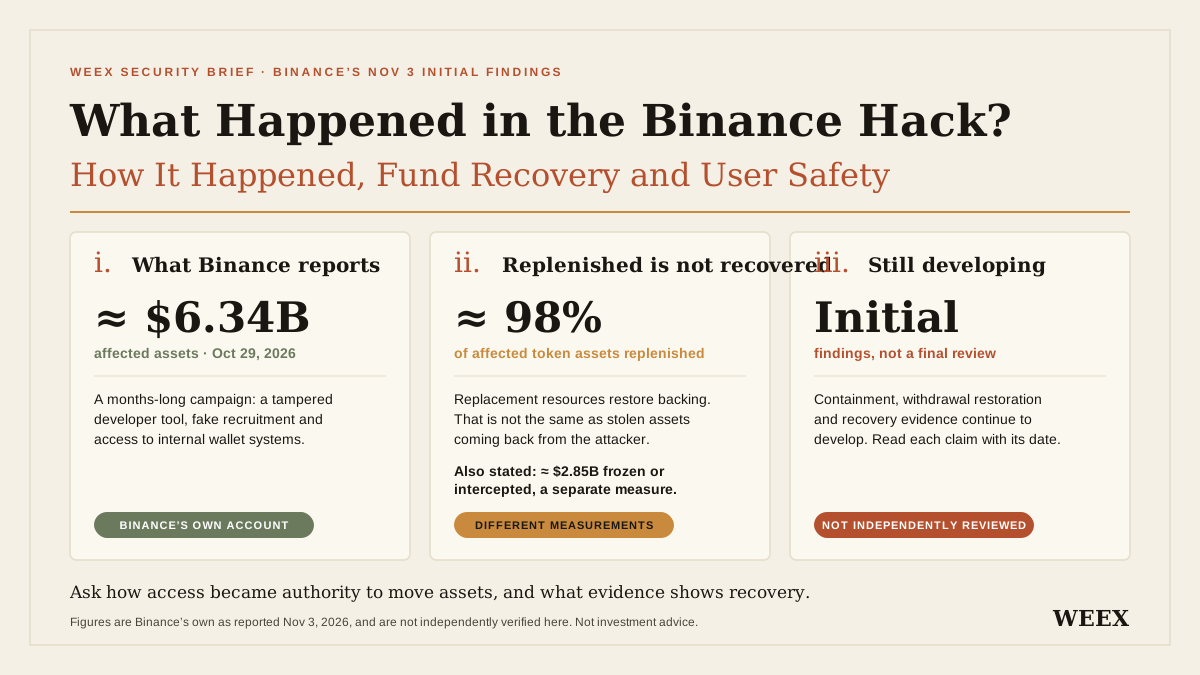
What Happened in the Binance Hack? How It Happened, Fund Recovery and User Safety
What happened in the Binance hack? Review the attack timeline, latest fund replenishment, recovery limits and practical steps to protect your account.

Bitcoin ETF Outflows Hit $398.6M on November 2 as BlackRock Leads Redemptions

Waiting for the Last Dip? Morgan Stanley's Wilson: Regardless of Election Results, It May Be a Good Opportunity to Buy U.S. Stocks

Standard Chartered Launches Continuous Tokenized Deposits in Hong Kong

Judy Shelton and Monetary Policy Point to a Less Dominant Future for the Fed

Bitcoin’s year-end liquidity hopes face a projected $150 billion Treasury cash rebuild

ICE Partners with Hyperliquid, Traditional Exchanges' Moat is Shifting
Dollar stablecoin use stayed elevated after capital controls ended, new research suggests

The "Election Effect" of Bitcoin: Political Catalyst or Coinciding with the Halving Cycle?
SemiAnalysis: Musk Breaks Through Again, How SpaceX Competes for the World's Largest AI Cloud?
Why Did Institutions Bet $40 Million on PhotonPay When Stablecoin Transfers Are Cheap Enough?
TradingBeats Launches New Version, Upgraded to Information Stream Format
The Ghost Behind the Screen: Unveiling the Secret World of North Korean Hackers Lazarus
Where Did the Liquidity Go on the Night Binance Suspended Withdrawals?
WEEX Exclusive:Major Indexes Rise After Election Clarity, Oil Plunges| WEEX Daily Market(November 5, 2026)


