
What Is Trenching in Crypto? Trading Slang, Token Risks, and Exit Costs

 Prefer us on Google


What Is Trenching in Crypto? Trading Slang, Token Risks, and Exit Costs
Trenching in crypto means actively searching for and trading very early or highly speculative tokens, often memecoins. Traders typically monitor new launches, wallet activity, social feeds, and trading terminals while making rapid decisions under incomplete information. The defining challenge is not simply finding a token before others: it is identifying the correct asset, understanding its controls, and determining whether a position can be sold at an acceptable net price.
Our view is that beginners should understand the exit before attempting the entry. A rising chart can coexist with a losing trade because the displayed price does not necessarily represent what a buyer will pay for your entire holding. Fees, price impact, execution changes, and restricted token functionality can all separate an attractive screenshot from money you can actually recover.
This guide focuses on that gap. It explains the slang, the token checks, and a complete hypothetical trade in which the reference price rises 5% but the trader still loses money.
What Does “Trenching” Mean in Crypto Trading?
“The trenches” describes a competitive environment where traders search for opportunities among newly created or rapidly moving tokens.
The expression is both trading slang and a cultural label. It can refer to spending hours watching launches, checking wallets, following social activity, and moving between trading tools. It does not describe a standardized investment strategy with a defined holding period or dependable return profile.
A trader might enter and exit quickly, while another holds an early position longer. What they share is exposure to markets where information, liquidity, and attention can change abruptly.
A practical trenching workflow has four parts: discovery, verification, execution, and review. Existing educational material describes this process across launchpads, explorers, terminals, and social feeds.
Discovery receives the most attention because finding a token early makes a compelling story. Verification and review determine whether that story describes a repeatable process or an isolated lucky outcome.
Is Trenching a Coin, a Platform, or a Strategy?
Trenching is a general activity, not the name of one universally recognized token or trading platform.
Products and tokens can incorporate “Trench,” “Trenches,” or “Trenching” into their names. That does not make them the official destination for the activity.
This distinction matters when searching online. An educational article, a trading service, and a token-price page may all appear for similar wording while answering different questions.
| What You Encounter | What You Need to Identify |
|---|---|
| An article about trenching | Whether it explains the activity or promotes a specific service |
| A trading terminal or bot | Its operator, permissions, fees, and execution model |
| A token with a similar name | Its network and complete contract or mint address |
| A social account offering “trenching signals” | The evidence behind its claims and any promotional incentives |
Treat each entity separately. Understanding the slang does not establish that a particular service is legitimate, and a familiar product name does not authenticate a token.
Before interacting, write down exactly what you are evaluating. “I am researching a token” and “I am giving a bot permission to trade” are different decisions.
What Do Traders Actually Check Before Buying?
A useful investigation begins with identity and control, then moves to trading conditions.
No single scanner score can settle every question. A token can have understandable technical settings and still be a poor trade because of concentration, weak liquidity, or coordinated selling.
Confirm the Exact Token
Names, tickers, and logos can be copied.
On Solana, a token is uniquely identified by its mint address. Official documentation describes the mint account as the account representing the particular token and storing relevant global information.
Compare the full address across the source you are researching, the explorer, and the trading interface. A matching logo or shortened address is not a substitute.
For other networks, use the corresponding contract identifier and network. The same apparent token name on another chain may represent a different instrument.
Inspect the Relevant Authorities
Token controls affect what can happen after purchase.
Solana documentation distinguishes mint authority, which permits additional issuance, from freeze authority, which can restrict token-account activity. Token extensions can introduce additional capabilities that require separate review.
For example, the Token Extension Program supports a permanent delegate capable of authorizing transfers and burns for accounts belonging to that mint. Ordinary token-account owners cannot simply revoke that mint-level delegate from their own accounts.
These capabilities are not automatically evidence of fraud. Some serve legitimate product requirements. The question is whether the controls are understood, disclosed, and compatible with the asset you think you are buying.
Removing one authority also does not prove that every other risk has disappeared.
Investigate Liquidity and Ownership
A market needs buyers or usable liquidity when you want to sell.
Look beyond the headline liquidity figure. Identify the actual market, the assets supporting it, and whether your intended position is large relative to available depth.
Ownership concentration deserves similar care. A large holder might be a liquidity pool, exchange, treasury, or individual. Several apparently separate holders may also have relationships that are not obvious from a ranking table.
A holder list supplies questions to investigate. It does not automatically identify who is an insider or prove that wallets are independent.
-- Price
Why Can a Token Rise While Your Trade Loses Money?
Because a reference price is not the same as a completed sale.
A chart can show the most recent transaction price or another valuation reference. Multiplying that price by your holding produces a marked value. It does not establish that the entire holding can be exchanged for that amount.
There are three useful levels to distinguish:
| Value | What It Represents |
|---|---|
| Marked position value | Holding quantity multiplied by a displayed reference price |
| Current exit quote | An estimate for selling a specified quantity through a particular route |
| Realized net proceeds | What you actually receive after execution and applicable costs |
The gap can become especially important when the holding is large relative to the market.
A small purchase can move the displayed price higher. That does not mean another participant is willing to buy every existing holder’s tokens at the new price.
The correct question is therefore not only “How much has the token risen?” It is also “What would my intended sale receive?”
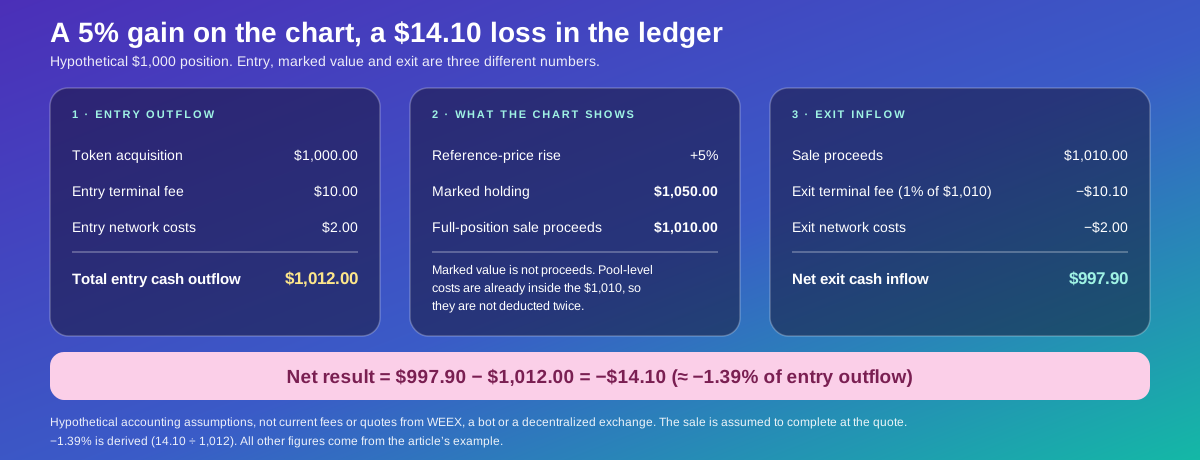
A Complete Example: The Token Rises 5%, but the Trader Loses $14.10
The following figures are hypothetical accounting assumptions, not current fees or quotes from WEEX, a particular bot, or a specific decentralized exchange.
Assume a trader acquires a token position with an initial reference value of $1,000. Entry charges are paid separately. Later, the reference price rises 5%, making the marked position value $1,050.
However, the available full-position sale produces only $1,010 before a separately charged terminal fee.
| Transaction Component | Amount |
|---|---|
| Token acquisition | $1,000.00 |
| Entry terminal fee | $10.00 |
| Entry network costs | $2.00 |
| Total entry cash outflow | $1,012.00 |
| Marked holding after a 5% reference-price rise | $1,050.00 |
| Full-position sale proceeds before terminal fee | $1,010.00 |
| Exit terminal fee: 1% of $1,010 | −$10.10 |
| Exit network costs | −$2.00 |
| Net exit cash inflow | $997.90 |
| Final net trading result | −$14.10 |
The calculation is:
Net result = $997.90 − $1,012.00 = −$14.10
That is approximately a 1.39% loss on the total entry outflow, despite the 5% increase in the reference price.
For this illustration, the $1,010 sale amount already incorporates pool-level costs and the difference between the reference valuation and executable sale. Those effects are not deducted again.
The example also assumes that the sale completes at the quoted amount. A quote is still an estimate; adverse changes before execution could produce another result.
What Exit Quote Would the Trader Need to Break Even?
Using the same example, the trader must recover the full $1,012 entry outflow after paying the exit charges.
Let S represent sale proceeds after embedded pool effects but before the separate 1% terminal fee and $2 network cost.
The break-even condition is:
S × 0.99 − $2 = $1,012
Therefore:
S = $1,014 ÷ 0.99 ≈ $1,024.24
The trader needs approximately $1,024.24 in pre-terminal-fee sale proceeds to break even under these assumptions.
That is a different number from the $1,050 marked position value. The comparison that matters is between the required executable proceeds and the actual proceeds available for the intended sale.
This is also why a universal claim such as “a token only needs to rise 2% to cover fees” is unreliable. The answer depends on entry costs, exit costs, position size, and the relationship between displayed price and executable value.
What Is the Difference Between Price Impact and Slippage?
Price impact is the effect of your own trade on market pricing. Slippage is the difference between the expected execution outcome and the actual outcome.
Uniswap’s documentation explicitly distinguishes these concepts. A trade can face price impact when the quoted route is calculated and then experience further price changes before execution.
Suppose a small sale receives an attractive quote, but a much larger sale receives a worse average price. That difference can reflect the larger trade consuming more available liquidity.
Now suppose the larger sale’s quote changes while the transaction is being processed. The completed result may differ from the expected outcome.
The distinction matters for accounting. If a quote already includes the route’s price impact and pool fees, subtracting those again overstates the cost.
Similarly, a quoted output and a minimum-received figure are different. The minimum is a transaction constraint in the relevant workflow, not a prediction that the trade will necessarily execute at that amount.
Record which figure you used before judging the result.
Which Costs Commonly Get Missed?
Trading costs can appear in different places, making it easy to mistake a partial calculation for complete profit.
Some are explicit charges. Others are embedded in the amount of tokens received or the sale proceeds.
| Cost or Cash Movement | How to Treat It |
|---|---|
| Platform or terminal charge | Check whether it is deducted from the trade or paid separately |
| Pool or route fee | Establish whether the quote already includes it |
| Network fee | Record the actual charge and its valuation currency |
| Priority payment or tip | Include it where applicable, without assuming every trade uses one |
| Failed processed transaction | Check the transaction record for charges |
| Refundable account deposit | Track separately from permanently consumed costs |
| Withdrawal or off-ramp cost | Include when calculating money returned to the destination you care about |
On Solana, the network fee includes a base component and an optional prioritization component. Official documentation states that a processed transaction can incur fees even when execution fails. A transaction that never lands is a different situation and should not be assumed to have the same charge.
The practical rule is to follow the records rather than add every possible cost mechanically.
If ten failed attempts incurred charges, they belong in the session’s result even if the final successful trade looks profitable. If a balance movement was recoverable rather than consumed, labeling all of it a permanent fee would also distort the result.
Why Does a Successful Small Sale Not Prove You Can Exit Fully?
A small sale tests the market for that size at that time.
It does not prove that a larger sale will receive the same average price or remain possible after liquidity conditions change.
Consider a trader holding 100,000 tokens. Selling 1,000 tokens successfully answers a narrow question: that quantity could be sold under the observed conditions.
It does not establish a price for the remaining 99,000.
This matters when someone advertises that a token is “sellable” based on a tiny test. The test may be useful, but its meaning should not be expanded beyond the evidence.
A more informative investigation compares quotes at relevant quantities and examines the token’s controls. Even then, a pre-trade quote does not guarantee future execution.
The exit question must remain specific: Which quantity, through which market, with which permissions, at what time?
How Should Beginners Evaluate a Trenching Trade Before Entry?
Use an ordered process rather than beginning with the expected return.
1. Identify What You Are Buying
Confirm the network and full token identifier. Establish whether the information concerns the token itself, a trading platform, or an unrelated product with a similar name.
2. Understand What Can Change
Review issuance, transfer restrictions, relevant authorities, and other material controls. If the available tools do not explain a setting, treat that uncertainty as unresolved.
3. Examine the Intended Exit Size
Look at the market for the quantity you would actually hold. An attractive quote for a trivial amount is not a substitute.
4. Build the Complete Cost Estimate
Separate embedded costs from additional charges. Include both entry and exit, and state the currency in which you are measuring the outcome.
5. Decide What Would Invalidate the Trade
Define the loss you can accept and the conditions that would change your decision. A planned exit price is not a guarantee that liquidity will exist there.
This sequence can result in deciding not to trade. That is a legitimate outcome of research.
Is Trenching the Same as Futures Trading?
No. Trenching describes an activity and trading culture; futures describe a financial instrument.
Buying an early token onchain and opening a perpetual futures position involve different structures. The token purchase raises questions about the token, pool, wallet permissions, and transferability. Futures introduce contract specifications, margin, funding, and potential liquidation.
These risks can overlap with ordinary market-price risk, but they should not be substituted for one another.
A futures contract associated with an asset also does not establish that an unrelated newly created token bearing a similar ticker is the same instrument.
For readers moving between onchain trading and centralized markets, first identify the product. Then evaluate the relevant execution and holding costs.
“Fast trading” is not a product classification, and using a different interface does not remove the need to understand what is being traded.
What Can WEEX Traders Apply From This Lesson?
The transferable lesson is to compare the expected order outcome with the actual fill and fees.
For supported WEEX Spot market orders, the documented slippage-tolerance control lets users select a preset or custom acceptable deviation. A restrictive setting can limit acceptable execution movement while making completion less likely. It does not promise a complete fill at a chart’s displayed price. (Product Launches)
To understand that control, read the WEEX Spot slippage-tolerance guide. Before submitting a supported market order, inspect the setting in the order panel and decide whether execution speed or tighter price control matters more.
For an unexpected result, the WEEX slippage and fill-price guide explains how last price, order-book quotes, and average execution price differ. Review individual fills and fees before calculating the trade’s net outcome.
The WEEX fee schedule is the appropriate destination for applicable platform charges. The hypothetical fees in this article should not be treated as WEEX rates.
These resources help with execution analysis. They do not imply that every token found through a launchpad or social feed is listed on WEEX.
How Do You Keep a Trenching Journal That Reflects Real Results?
A useful journal separates trading profit from transfers and unfinished positions.
Begin with the amount actually spent, including separately paid entry costs. Record the quantity acquired and the token identifier.
For every sale, record the quantity sold, proceeds received, and additional charges. If part of the position remains, keep it separate from realized proceeds.
An internal wallet transfer is not automatically a sale or a profit. Likewise, an unsolicited token balance should not be assigned a realizable value merely because an interface displays a number.
For a fully closed position, a simple starting calculation is:
Net trading result = total sale proceeds received − total acquisition outflows − additional costs not already included
Define the measurement currency. A trade can perform differently in dollars and in the asset used to fund it.
Finally, distinguish closing the token position from withdrawing money to a bank account. If your objective is cash returned to a bank, conversion and withdrawal costs belong in that broader calculation.

WEEX Editorial View
The most useful answer to “what is trenching in crypto?” is not a description of traders moving quickly. It is an explanation of what they must verify before speed becomes relevant.
An early entry is not an advantage if the asset is misidentified, the controls are misunderstood, or the intended exit cannot be executed economically.
The hypothetical trade in this guide captures the central issue: a 5% reference-price increase still produced a loss after the actual sale outcome and costs were considered.
Judge a process by verified transactions and net results. Treat screenshots, marked balances, and small test sales as limited pieces of evidence rather than complete proof of profitability.
FAQ
1. What Is Trenching in Crypto?
Trenching generally means actively finding and trading very early or highly speculative tokens, often memecoins. It involves rapid research and execution in markets where information and liquidity can change quickly.
2. Is Trenching a Specific Coin or Trading Platform?
No. It is a general term. Individual tokens and services may use similar names, but each must be identified and evaluated separately.
3. Can You Lose Money Even If the Token Price Rises?
Yes. Entry charges, the executable sale price, exit charges, and other costs can leave net proceeds below the amount spent. A displayed price increase is not the same as realized profit.
4. Does Increasing Slippage Tolerance Improve a Trade?
It allows a greater deviation in supported execution workflows. That may affect whether a transaction completes, but it does not improve the token’s fundamentals, create liquidity, or guarantee a profitable result.
5. Does a Successful Test Sale Prove a Token Is Safe?
No. It demonstrates that a particular quantity could be sold under particular conditions. It does not establish future liquidity, a full-position exit price, or the absence of technical and ownership risks.
Sources
| Source | Material Reviewed | Date |
|---|---|---|
| Trench School: What Is Trenching? | Terminology and common workflow | Accessed October 26, 2026 |
| Trench School: Fee Breakdown | Existing educational coverage of trading-cost layers | Accessed October 26, 2026 |
| Solana: Token Documentation and Authority Roles | Token identity and control mechanisms | Accessed October 26, 2026 |
| Solana: Permanent Delegate | Mint-level delegated authority | Accessed October 26, 2026 |
| Solana: Fee Structure | Network fees and failed execution | Accessed October 26, 2026 |
| Uniswap: Price Impact vs. Slippage | Execution terminology | Accessed October 26, 2026 |
| WEEX Spot Slippage Tolerance and Fill-Price Guide | Verified WEEX execution controls and order analysis | Accessed October 26, 2026 |
This content is provided for general informational purposes only and doesn't constitute financial, investment, legal, or tax advice. Any events, rewards, online promotions, or related information mentioned herein should not be considered a recommendation, solicitation, or invitation to purchase, sell, trade, or otherwise deal in any crypto assets. Crypto assets are highly volatile and may result in loss. The availability of WEEX services, products, and related events may vary by region. You are responsible for ensuring that your participation is in accordance with applicable local laws and regulations.
You may also like

Pump.fun 'optimized for addiction': what the internal messages cited in court really say

Rayls Bridges Traditional Finance and Decentralized Finance
The Week Ahead: 4 Key Moments for the Crypto Market

North Carolina Crypto Kiosk Refund Law: Who Qualifies and When Does It Apply?
Understand North Carolina’s crypto kiosk refund law: the January 2027 start date, who qualifies, reporting deadlines, and documents victims should keep.

[Bitcoin $0 Controversy②] "$0 is an Exaggeration"... Reasons Wall Street Disagrees
[ETH Letter] Meritz Securities Reviews Tokenization of Korean Securities Based on OP Stack

Progressive Party Opposes Further Delay of Cryptocurrency Income Tax

JPMorgan's Tokenized Fund on Solana: What MONY and JLTXX Mean for Institutional Adoption of RWA
Real and Fake Cryptocurrency Market Makers: What Makes a Market Maker Legitimate?

Michaël van de Poppe sees four crypto trends: AI, Ethereum, Sui, and digital assets

Coppock Curve and Crypto Trading: How to Use the Trend Reversal Indicator

Bitcoin Records U.S. Constitution Again... This Time with a Mysterious Code

Hedge funds hold $2 trillion in US debt, but their next trade could require fewer bonds
Weekly: $68,000 Theft from Ukrainian in Trust Wallet, Circle's Lawsuit Against Trump Over $2 Billion in UAE, and Historic Solana Update

ZachXBT Accuses CoinDCX of Losing $16 Million in Client Funds

NYSE’s owner is backing 24/7 stock tokens without Wall Street’s usual price rules
JPMorgan Now Offers Two Tokenized Money Market Funds on Solana
Follow the Money: $630 Million for Strive, Tether Activity and Attention to CeFi
HTX Research Analyst Chloe: Despite Significant Net Inflows into Bitcoin Spot ETFs, Macroeconomic Data Suppresses Rebound Potential
Killa: Frequent Short-term Trading Risks Missing Major Market Movements, Patience in Holding Positions is Important
China's fiscal revenue rose 5.1% by September, but land sales continue to decline
90% of Revenue from Meme Coins, Yet Valuation Rivals Pump: What Should Meteora Be Worth?
Former FTX Executive Slams Netflix's New Series: Turning Financial Fraud into a 'Romantic Film' is Absurd

Ripple teams up with $10B payments firm Arf to expand RLUSD use on XRPL

One billion dollars in three days is not enough. Bitcoin faces a significant challenge
WEEX Exclusive:Major Indexes Close Higher; Focus on TSLA, META Stock Earnings | WEEX TradFi Daily(October 22, 2026)
Major Indexes Close Higher; Focus on TSLA, META Stock Earnings | WEEX TradFi Daily(October 22, 2026)
The three major indexes closed higher on October 21, led by the Nasdaq. SpaceX beat earnings expectations and disclosed AI-business revenue; merger discussions with Tesla also helped lift AI and crypto-related stocks. Bitcoin traded near $84,000 and Ethereum near $2,470. LIT led majors on compliance-license expectations. On October 22, investors will watch Procter & Gamble, Southern Copper and Union Pacific before the open, followed by Western Digital and Newmont after the close.

Irish drug lord’s lost Bitcoin fortune comes back to life as $41 million moves to Coinbase

ZachXBT Reports on Cryptocurrency Laundering via FreedomXMR on Hyperliquid

Willy Woo: Good Time to Accumulate Bitcoin
Pump.fun 'optimized for addiction': what the internal messages cited in court really say
Rayls Bridges Traditional Finance and Decentralized Finance
The Week Ahead: 4 Key Moments for the Crypto Market
North Carolina Crypto Kiosk Refund Law: Who Qualifies and When Does It Apply?
Understand North Carolina’s crypto kiosk refund law: the January 2027 start date, who qualifies, reporting deadlines, and documents victims should keep.
[Bitcoin $0 Controversy②] "$0 is an Exaggeration"... Reasons Wall Street Disagrees
[ETH Letter] Meritz Securities Reviews Tokenization of Korean Securities Based on OP Stack





