
The Wall Street Journal Publishes Full-Page Ad: Eight Risks of Stock Tokenization

 Prefer us on Google



Author: Common Sense Leadership Fund
Compiled by: Jiahua, ChainCatcher
From October 24 to 25, 2026, The Wall Street Journal's weekend business section B5 featured a full-page paid advertisement aimed at CEOs of publicly traded companies, with a straightforward title: "Your Stocks, Their Tokens, Your Trouble."
The ad was funded by the well-known American conservative nonprofit organization Common Sense Leadership Fund, listing eight risks associated with stock tokenization and urging companies to exercise their dissent rights in a timely manner.
Below is a translation of the ad's content, along with background information provided by the Nasdaq FAQ.
Attention CEOs of Public Companies: Your Stocks, Their Tokens, Your Trouble
The crypto industry is about to "tokenize" your stocks in unregulated trading venues.
Act now to protect your company and investors.
Eight Risks
1. Price Deviation
Token prices are likely to deviate from the actual prices of company stocks, exacerbating investor confusion and market volatility.
2. Lack of Transparency in Ownership
Tokens may obscure the ultimate holders of the stocks, weakening the company's ability to communicate with shareholders.
3. Impaired Financing Ability
The flow of trading volume from real stocks to tokenized replicas may harm the company's ability to raise new capital.
4. Cyber Theft
Hackers may steal tokens held by investors, exposing the company to new legal and reputational risks.
5. Market Manipulation
The operations of these trading venues will be outside the cross-market monitoring and transparency framework of the U.S. Securities and Exchange Commission (SEC).
6. Anti-Money Laundering and Customer Identification Gaps
Tokens can be transferred anywhere to anyone, including criminal organizations or to sanctioned jurisdictions.
7. Lack of Investor Protection
Core protective measures from the SEC and the Financial Industry Regulatory Authority (FINRA), including the "best execution" framework, do not apply to these venues.
8. Legal Liability
If you do not choose to opt-out, you may be held legally liable if any issues arise.
What Actions Can You Take?
In light of the above risks, the SEC has granted you the right to "opt-out."
But you must act within 30 days; this is your only opportunity.
Be alert for notifications from "tokenized securities trading venues" and respond promptly.
Background: How Does the 30-Day Dissent Period Work?
The Nasdaq FAQ accompanying the ad was updated on September 29, 2026, referencing the SEC's "innovation exemption" order and outlining issues that public companies need to consider.
The document shows that on September 17, the SEC issued a temporary, conditional exemption arrangement allowing qualifying tokenized securities venues (TSVs) to trade tokenized stocks through automated market makers and liquidity pools.
The 30-day deadline emphasized in the ad is the dissent period for issuers under this arrangement, but its starting point and applicability need further clarification.
30 Days Starts from When the Company Receives Notification
When a TSV intends to list a company's stock tokenized by an unrelated third party, it must send a written notice to the company in advance. The company has 30 calendar days from receipt of the notice to evaluate and raise objections to the venue.
If the company raises objections within the deadline, the venue cannot list the related tokenized stock under this exemption; if the company fails to raise objections in time, the venue may proceed with trading, provided other exemption conditions are met.
Thus, the 30 days mentioned in the ad is not a uniform countdown faced by all public companies. Companies that have not received relevant notifications do not need to submit opt-out requests immediately.
Opting Out Needs to Be Handled Platform by Platform
A company's objection to a specific TSV is only effective for that venue and cannot simultaneously prevent all platforms from trading its tokenized stocks.
This means that if multiple venues issue notifications, the company needs to evaluate and respond separately. The FAQ also clarifies that Nasdaq cannot submit or process objections on behalf of public companies.
"Innovation Exemption" Still Has Applicability Conditions
The ad uses the term "unregulated," but the accompanying documents describe a conditional regulatory exemption.
Applicable tokenized stocks must grant holders shareholder rights comparable to those of traditional stocks, including voting, dividends, and liquidation rights. Synthetic products that only provide exposure to price fluctuations without granting ownership of the underlying stocks do not fall under the applicability of this exemption.
Additionally, TSVs are subject to conditions such as limits on the number of trading varieties, transaction volume caps, and information disclosure, and the smart contracts they use must be public, auditable, and deployed on a public permissionless distributed ledger.
What is Nasdaq Concerned About?
In the FAQ, Nasdaq states that it supports the development of tokenization of real-world assets but believes that issuers should continue to participate in deciding how their stocks are presented and traded while retaining existing shareholder rights and necessary regulatory protections.
Their concerns mainly focus on market structure. Traditional stock markets help investors compare prices across different venues through real-time buy and sell quotes and transaction reports. According to the document, TSVs are not required to adopt the same real-time centralized quoting mechanism, and transaction data disclosure allows for delays of up to 10 minutes.
Meanwhile, the exemption does not mandate interoperability between different TSVs or between TSVs and traditional securities markets. A particular tokenized stock may primarily trade on one platform or even circulate only within that platform. This could lead to fragmented liquidity and increase the risk of price deviations between different venues.
Nasdaq believes that the impact of these changes on liquidity, price discovery, and long-term shareholder value may only become apparent after the experiment has been underway for some time.
-- Price
This content is provided for general informational purposes only and doesn't constitute financial, investment, legal, or tax advice. Any events, rewards, online promotions, or related information mentioned herein should not be considered a recommendation, solicitation, or invitation to purchase, sell, trade, or otherwise deal in any crypto assets. Crypto assets are highly volatile and may result in loss. The availability of WEEX services, products, and related events may vary by region. You are responsible for ensuring that your participation is in accordance with applicable local laws and regulations.
You may also like

Revolut Under Scrutiny: London Examines Its Product Launches

Ethereum Foundation backs default wallet privacy as Kohaku work advances

Pump.fun 'optimized for addiction': what the internal messages cited in court really say
Is 24/7 Trading a Necessity? Analyzing the Real Trading Rhythm of RWA Perpetual Contracts
[ETH Letter] Meritz Securities Reviews Tokenization of Korean Securities Based on OP Stack

"Without Changing the Nature of Government Bonds" Toward Tokenization: Progmat's Saito Explains

LDP Proposes Establishing a Cyber Response Headquarters Ahead of Cybersecurity Crisis, Emphasizing Cryptocurrency Tracking and Post-Quantum Cryptography
Former FTX Executive Slams Netflix's New Series: Turning Financial Fraud into a 'Romantic Film' is Absurd

Delphi Digital: Why Speculation is the Theme of the Next Decade

Bitgo Launches AI Financial Application 'Gokubu' and Research Organization
"Millions of devices are vulnerable": Ledger CTO

Private Jets and Investor Pressure Force Polymarket CEO to Mature

Doctor Profit Warns of a Very Big Monero (XMR) Liquidation Event

Stuttgart Stock Exchange Gets Green Light to Trade and Settle Tokenized Securities
WEEX Exclusive:Tech Rebounds; Bitcoin Holds $81,000–$82,000 Support| WEEX TradFi Daily (October 20, 2026)
Tech Rebounds; Bitcoin Holds $81,000–$82,000 Support| WEEX TradFi Daily (October 20, 2026)
On October 19, tech rebounded. The three major indexes were mixed, with the Nasdaq relatively stronger. Intel rose after a JPMorgan upgrade, and SpaceX closed up more than 2%. Bitcoin traded near $81,000–$82,000, a zone traders viewed as strong support and a local bottom. Worldcoin (WLD) rose more than 10% in 24 hours, leading majors. October 20 focus includes earnings from SPCX and other listed names.
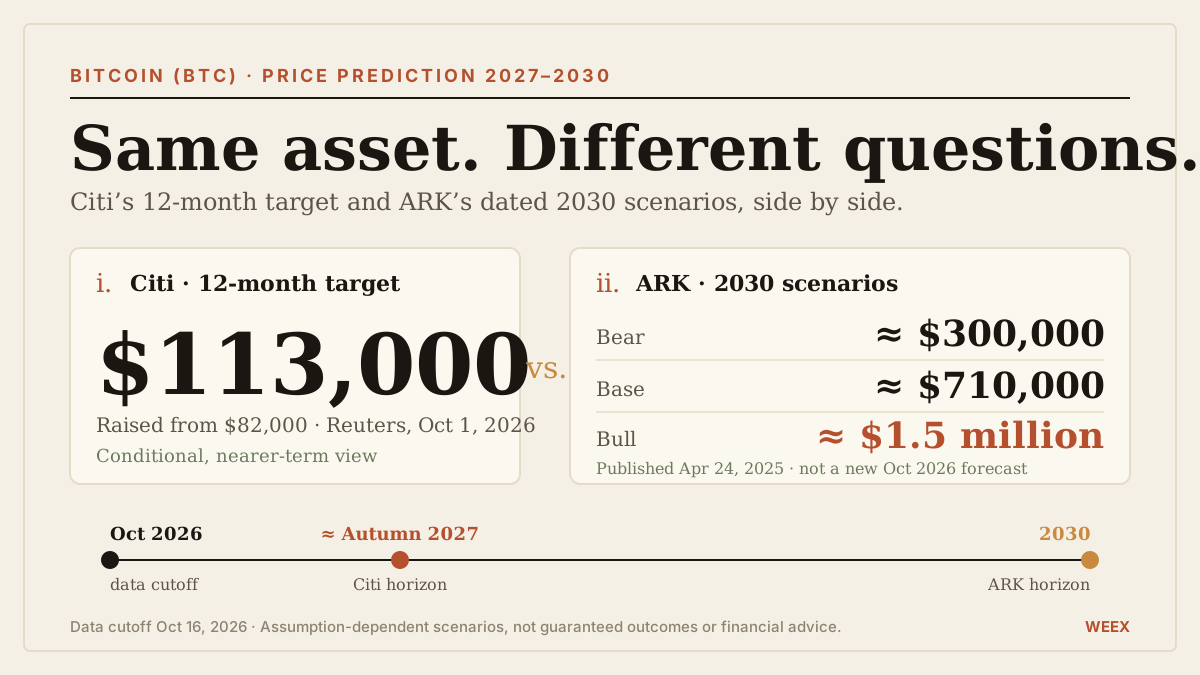
Bitcoin (BTC) Price Prediction 2027–2030: Citi’s $113,000 Target vs. Cathie Wood’s ARK Scenarios
Bitcoin price prediction for 2027–2030: compare Citi’s $113,000 target with ARK’s dated scenarios, demand assumptions, valuation math and key risks.

Crypto: 107 incidents and $1.18 billion stolen in Q3 2026
Is Pearl, Dreaming of Bitcoin in the AI Era, an Innovation or Just Simple Hype?

唐华斑竹 Analyzes Bitcoin Trends, Suggests Monitoring Support Levels

Howard Marks: If Everyone is Talking About a Bubble, Then the Bubble May Not Have Burst Yet

Quantum Alliance Established to Protect Blockchain from Quantum Computers
唐华斑竹 Analyzes the Current State of the Crypto Market, Advises Caution

U.S. Treasury Department's Survey Fails to Signal Debt Reduction, Bond Yields Rise with 10-Year Yield Back Above 5.12%
The Past and Present of Currency in the Age of Exploration

What Business Does Solana Want to Do in Shanghai?
Fractional Reserve: Reserve Requirement Abolished. Where is the Value?
Cyberattack on the ports of Marseille and La Rochelle? Hackers paid 1 dollar in crypto

G20 warns that stablecoins may lose value even if fully backed

[Legal Insights] Hard Wallet Hacking Incident: Is My Digital Asset Safe in Exchanges?
Revolut Under Scrutiny: London Examines Its Product Launches
Ethereum Foundation backs default wallet privacy as Kohaku work advances
Pump.fun 'optimized for addiction': what the internal messages cited in court really say
Is 24/7 Trading a Necessity? Analyzing the Real Trading Rhythm of RWA Perpetual Contracts
[ETH Letter] Meritz Securities Reviews Tokenization of Korean Securities Based on OP Stack
"Without Changing the Nature of Government Bonds" Toward Tokenization: Progmat's Saito Explains


