
Raydium Price Near $2.45: What Is Driving RAY's 24% Weekly Rally and Can $2.57 Break?

 Prefer us on Google
The Raydium price has moved back into focus this week, with RAY trading near $2.45 after a double digit daily gain and a weekly climb that outpaced most large altcoins.
For traders asking why the Raydium price is rising, the honest answer is that no single headline caused it. The rally is better read as the result of several overlapping forces: Raydium's Q3 growth in fees, a recurring buyback program, strong turnover in Solana's launchpad ecosystem and a chart that has just printed a bullish momentum signal.
This article walks through the verified numbers, the explanations that analysts offer, the price levels that matter for the next move and the risks that could cap the rally. Whether the Raydium price can hold its gains depends on which of those forces keeps going.
Raydium Price Snapshot: Where RAY Trades on October 8
On October 8, 2026, CoinGecko listed RAY at about $2.45, up roughly 11.1% over 24 hours and about 24.4% over the past seven days. CryptoBasic reported a slightly lower figure on the same day, with RAY near $2.43 and a 24-hour gain of about 9.5%. The small gap between the two sources is normal for a fast-moving altcoin, since each tracker uses a different mix of exchanges and a different snapshot time, so the exact percentage will shift depending on when it is checked.
Market data shows RAY with a market capitalization of about $660 million and 24-hour trading volume near $219 million. That volume equals roughly one third of the market cap changing hands in a single day, which signals active participation rather than a thin, drifting move. It also puts Raydium in the mid-cap range of the market, which is relevant because some social posts have described RAY as leading "major coins." At this size, RAY is better described as a mid-cap Solana ecosystem token, and its moves tend to be sharper than those of large-cap assets in both directions.
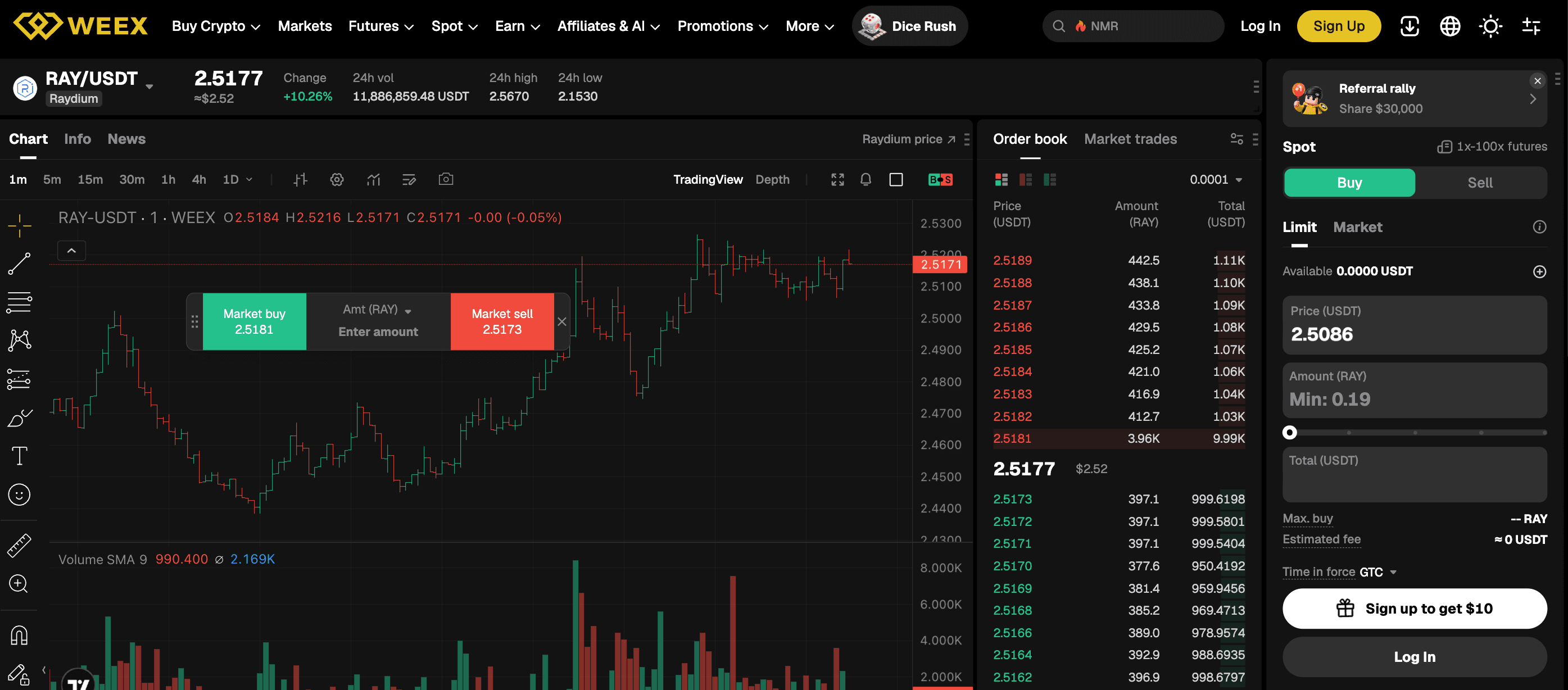
Source: WEEX, RAY/USDT.October 8, 2026.
What Is Driving the Weekly Rally
No confirmed catalyst on October 8 accounts for the jump. CryptoBasic's report on the move did not name a specific trigger, and Raydium has not published an announcement that lines up with the price action. That matters because several summaries circulating online attribute the gain to a recovery in Solana on-chain activity and improving expectations for DEX fees and liquidity incentives. These are reasonable market interpretations, but they should be treated as analyst commentary rather than confirmed causes.
The bes documented background driver is the growth of StonkFun and LaunchLab, the token-launch products built on Raydium. According to a Pine Analytics Q3 2026 report published on October 5, launches through these tools were a major source of Raydium's fee growth in September, which was also the month RAY surged roughly 61%, as reported by KuCoin. When new tokens launch and graduate to Raydium pools, they generate trading fees and attract liquidity, which in turn feeds the protocol's buyback. Traders who follow this cycle often rotate back into RAY when launchpad activity picks up, and a second factor is the broader tendency of money to move from slower large caps into higher-beta application tokens when sentiment improves.
Q3 Fundamentals: Fees, Revenue, TVL and the Buyback
The Pine Analytics report gives the most useful fundamental picture of Raydium. For Q3 2026, it put trading volume at about $16.1 billion after removing wash trading, protocol fees at about $57.1 million and protocol revenue at about $9.39 million. Total value locked stood near $1.34 billion, and Raydium held roughly 7.9% of Solana DEX market share. These figures show a protocol that remains a core piece of Solana's trading infrastructure, even in a quarter where competition from other venues stayed intense.
The buyback is the feature most closely tied to the RAY token itself. Raydium directs about 12% of trading fees to buy RAY on the open market, and the Pine Analytics report estimated Q3 buybacks at around $5.15 million. That is a modest amount relative to a market cap near $660 million, so it is better viewed as a steady source of demand than as the main force behind a weekly move of 24%. Its real value is in linking token demand to protocol usage: more trading and more launches mean more fees, and more fees mean more buying pressure. If activity falls, the same link works in reverse.
-- Price
Key Price Levels: Can $2.57 Break?
On the chart, the 30 day high near $2.568 is the first major resistance. RAY has approached this level during the current move, and a daily close above it would confirm a breakout from the recent range and open room for further gains. Traders will watch whether volume stays elevated on any attempt, since a break on fading volume often fails and falls back into the range.
On the downside, support sits in the area between $2.108 and $2.241, where buyers stepped in earlier in the month. Momentum indicators currently lean positive, with the MACD showing a bullish crossover, but a crossover after a sharp 24% weekly gain can also coincide with a short-term peak. If RAY loses the lower end of the support band, the rally would look like a spike rather than a trend change. These levels come from chart observation as of October 8 and will change as price moves, so they should be treated as reference points rather than predictions.
Risks: Partner Concentration, Fading Fees and Solana Dependence
The same Pine Analytics report that supports the bullish story also contains the clearest warnings. About 95% of the growth tied to StonkFun and LaunchLab came from a single partner, which means a change in that partner's strategy or activity could remove a large share of the fee base. In addition, early-October fees were reported to be about 43% below September levels, so the fundamental data does not yet confirm that fee momentum has returned. This conflicts with the claim that DEX fee expectations are improving, and it is one reason the rally should be viewed with caution.
Raydium is also closely tied to Solana. When SOL weakens, activity across Solana DeFi often cools, and high-beta tokens like RAY usually fall faster than the base asset. A rally driven by rotation and sentiment, rather than a clear fundamental trigger, can also reverse quickly if the broader market turns. Traders who size positions around a 24% weekly gain should consider that moves of similar size in the opposite direction are possible for a token of this market cap.
Trading Raydium on WEEX: Spot and Futures Options
For traders who want direct exposure to the Raydium price, WEEX offers RAY on both Spot and Futures, which suits two different approaches. On Spot, users buy RAY with USDT and hold the actual token with no leverage and no liquidation risk. That makes Spot the more straightforward choice for those who believe in the Q3 fee story and the buyback mechanism and want to hold through volatility, while managing risk by sizing the position and placing limit orders near the support and resistance levels discussed above.
WEEX Futures lets traders take long or short positions on RAY with leverage, which can be useful for those who expect either a breakout above $2.57 or a rejection from resistance. Leverage amplifies both gains and losses, and a position can be liquidated if price moves against it, so Futures is suited to experienced traders who use stop-loss orders and keep leverage low, especially on a token that has just risen 24% in a week. Funding rates should also be checked before holding a position for several days. WEEX maintains a 1,000 BTC protection fund, with details at weex.com/protectfund. Users should confirm the trading pairs, fees and rules directly on the platform before placing any order.
Conclusion
The Raydium price near $2.45 reflects a real rally, but not one with a single clear cause. Verified data points to StonkFun and LaunchLab fee growth, a steady fee-funded buyback and a constructive chart, while the same data shows heavy partner concentration and lower early October fees. The $2.57 level is the first test of whether the move can extend, and $2.11 to $2.24 is the zone that would show whether buyers still defend the trend. Traders should treat the rally as a high-beta move tied to Solana's strength and manage risk accordingly.
FAQ
1. Why is the Raydium price up today?
No single confirmed catalyst has been reported for October 8. Analysts point to launchpad-driven fees, the buyback, rotation into high-beta tokens and a bullish technical setup.
2. How much has RAY risen this week?
According to CoinGecko on October 8, 2026, RAY was up about 24% over seven days and about 11% over 24 hours, trading near $2.45.
3. What is the key resistance for RAY?
The 30-day high near $2.57 is the first major resistance. Support sits roughly between $2.11 and $2.24.
4. Does Raydium have a token buyback?
Yes. Raydium directs about 12% of trading fees to buy RAY, and Pine Analytics estimated Q3 buybacks at about $5.15 million.
5. Can I trade RAY on WEEX?
Yes. RAY can be traded on WEEX Spot without leverage, or on WEEX Futures with leverage and liquidation risk.
This content is provided for general informational purposes only and doesn't constitute financial, investment, legal, or tax advice. Any events, rewards, online promotions, or related information mentioned herein should not be considered a recommendation, solicitation, or invitation to purchase, sell, trade, or otherwise deal in any crypto assets. Crypto assets are highly volatile and may result in loss. The availability of WEEX services, products, and related events may vary by region. You are responsible for ensuring that your participation is in accordance with applicable local laws and regulations.
You may also like

WEEX Exclusive:September Fed Minutes Point to Another Hike This Year| WEEX TradFi Daily Brief (October 8, 2026)
Major equity indexes closed lower on October 7 ET. Long-end yields rose again, and the 30-year yield hit a roughly 24-year high. September Fed minutes showed most participants thought another increase in the federal funds target range before year-end could be appropriate. CME pricing for a 25 bp hike at the October 27–28 meeting has fallen below 20%, far below about 70% in the days after the September decision. Bitcoin traded near $83,300. The October 8 focus is jobless claims and pre-market earnings from Pepsi and Delta.
September Fed Minutes Point to Another Hike This Year| WEEX TradFi Daily Brief (October 8, 2026)
Major equity indexes closed lower on October 7 ET. Long-end yields rose again, and the 30-year yield hit a roughly 24-year high. September Fed minutes showed most participants thought another increase in the federal funds target range before year-end could be appropriate. CME pricing for a 25 bp hike at the October 27–28 meeting has fallen below 20%, far below about 70% in the days after the September decision. Bitcoin traded near $83,300. The October 8 focus is jobless claims and pre-market earnings from Pepsi and Delta.

Ferrari Tokenized Stock RACE Launches on Solana, Effective October 6

Tokenized Stocks on Solana Chain Surpass $4.4 Billion in September Trading Volume

What Is SI? Super Inu, NVDAx and the AI Meme Trade Explained

SEC updates explanation on cryptocurrency buybacks

Where Will Investment Opportunities Arise as Stocks Move On-Chain?

Can UNI Reach $10 as Tokenized Stock AMMs Gain Traction?

Superstate Promotes Tokenized Stocks Trading on AMM Platforms like Uniswap
Byreal's xStocks Trading Volume Exceeds $100 Million in the Past 30 Days

Tokenization of Stocks Reaches 300,000 Holders on Solana

How Cryptocurrency Owners Lose Fortunes Due to One Mistake in the Blockchain
OpenCover Expands to Solana Covering Four Major Protocols Including Kamino and Raydium

Payrolls Beat Revives Hike Pricing | WEEX TradFi Daily(September 7, 2026)
Global markets spent the weekend digesting last week’s payrolls data and crypto fund flows. August job growth of roughly 162,000 and a steady 4.1% unemployment rate pushed the 10-year Treasury yield to around 4.78%, reviving rate-hike pricing and weighing on technology and other long-duration assets. In crypto, bitcoin held near $80,000 as spot ETF inflows remained supportive, signaling that institutional risk appetite has not fully faded. At the same time, oil stayed firm on Middle East supply concerns, while gold consolidated at elevated levels. This week, attention turns to Oracle and Adobe earnings, as well as CPI, for the next repricing of the September Fed path.
Trillion-Dollar Giant Anthropic Plans to Go Public in October, Being Priced Ahead of Pre-IPO Market?
CyberLeek Captures Fund Movement of $200,000 to $270,000
Tokenized Stocks Reach $111 Million in DeFi
What is StonkFun (STONK)? A Trading Guide and Explanation of Tokenized Stocks

Uniswap Achieves AAA Rating Among 128 Tokens
Why the CyberLeek Token Existed Three Days Before the GTA 6 Leak Video
Financial AI Platform Oro Secures $3 Million Funding Led by MH Ventures and Mapleblock Capital
Top 20 Cryptocurrencies by Social Mentions According to LunarCrush

HertzFlow Reveals List of Individual Investors Including Raydium

Pirated 'The Odyssey' Copies Contain Crypto-Stealing Malware

Customs Launches First Stationary Scanner for Railway Cars

Ray Dalio Holds 1% Bitcoin, Prefers Gold Investment
30 Ukrainian Hospitals Begin Generating Electricity

Goolsbee: A Ray of Hope for Inflation in the Service Sector

Raydium confirms that the legacy AMM pool was attacked, resulting in a loss of $1.34 million, and the official treasury will fully compensate
Specter: A certain old liquidity pool on Raydium is suspected to have been attacked, with hackers stealing approximately 1.34 million dollars in assets
WEEX Exclusive:September Fed Minutes Point to Another Hike This Year| WEEX TradFi Daily Brief (October 8, 2026)
Major equity indexes closed lower on October 7 ET. Long-end yields rose again, and the 30-year yield hit a roughly 24-year high. September Fed minutes showed most participants thought another increase in the federal funds target range before year-end could be appropriate. CME pricing for a 25 bp hike at the October 27–28 meeting has fallen below 20%, far below about 70% in the days after the September decision. Bitcoin traded near $83,300. The October 8 focus is jobless claims and pre-market earnings from Pepsi and Delta.
September Fed Minutes Point to Another Hike This Year| WEEX TradFi Daily Brief (October 8, 2026)
Major equity indexes closed lower on October 7 ET. Long-end yields rose again, and the 30-year yield hit a roughly 24-year high. September Fed minutes showed most participants thought another increase in the federal funds target range before year-end could be appropriate. CME pricing for a 25 bp hike at the October 27–28 meeting has fallen below 20%, far below about 70% in the days after the September decision. Bitcoin traded near $83,300. The October 8 focus is jobless claims and pre-market earnings from Pepsi and Delta.
Ferrari Tokenized Stock RACE Launches on Solana, Effective October 6
Tokenized Stocks on Solana Chain Surpass $4.4 Billion in September Trading Volume
What Is SI? Super Inu, NVDAx and the AI Meme Trade Explained
SEC updates explanation on cryptocurrency buybacks
Contents
Latest articles





Latest coin listings on WEEX


