
Predicting Contrarian Buy Pressure in the Market: Who is Taking the Other Side of Your Trade?

 Prefer us on Google

Original Title: "Who is Betting Against Market Common Sense?"
Original Author: Golem, Odaily Planet Daily
Lately, I couldn't help but wonder, who is it that goes against "common sense" and offers the market "free money"?
Betting against the smart ones like us is not entirely impossible. Surely, there are some who firmly believe in their judgment (just like some still believe the Earth is flat). But the prediction market is not a "gambling market." I believe that when players use real money to predict the outcome of something, they will strive to think like a "rational person," meaning their decision is the most economical and advantageous. Therefore, from this perspective, those who bet Yes on seemingly improbable event contracts must also have some sort of money-making strategy, not fools offering us a "high certainty" financial opportunity for nothing.
After thinking and discussing, I believe that those who provide liquidity on the other side of these absurd event markets fall into the following three categories (this article is a starting point for discussion, welcome feedback and corrections, X@web3_golem):
Lottery Players
The logic of lottery players is simple: they only look at the odds and focus on risking little to win big.
Sometimes, real life is far more magical than we imagine, and even events that seem far-fetched can actually happen. Moreover, while prediction markets are based on real-world outcomes, settlement conditions, system failures, and other factors can sometimes distort the contract settlement result from reality. Polymarket has experienced more than one settlement dispute due to issues with the UMA dispute resolution mechanism; a recent example is Polymarket determining that the US military action in Venezuela did not constitute an "invasion."
Thus, long-tail odds deviations occur, and even events with a very low probability on the Yes side can still have a price of 1%-3%. As long as the odds are high enough, "lottery players" will buy in, becoming one of the steadfast bottom buyers.
But in reality, the psychology of "lottery players" is also rational. For example, in the event contract "Will Putin step down by the end of 2026," driven by common sense, most people would bet "No," and the probability already reflects people's attitudes. However, there is still a 10% probability on the Yes side, which means that if you bet $10, and Putin does step down by the end of 2026, you will receive a $100 return, a 10x gain. So, why not take the bet.
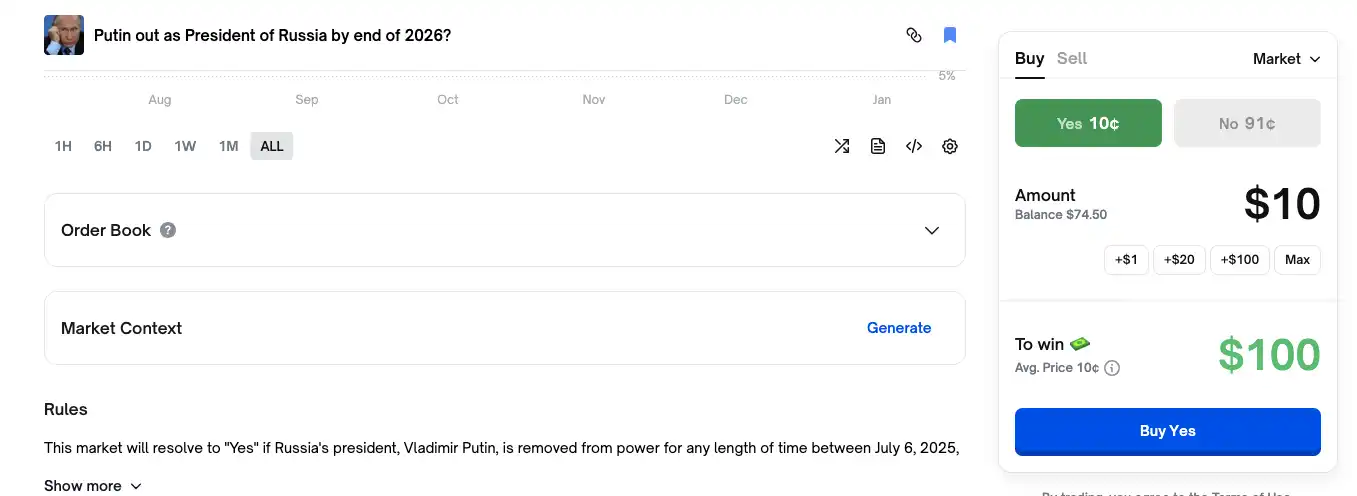
In addition, lottery players may not necessarily only bet heavily on a single outcome. Since the prediction market is full of such high odds events, as long as they cast a wide net, participate in multiple lotteries, there is still a chance to recoup costs or even profit.
They are more eager for the occurrence of a Black Swan than normal people. Therefore, they are willing to provide buy orders on the Yes side in the "Counterintuitive" market. (In some markets, Polymarket provides order book rewards and position rewards, but this is not the primary driver for lottery players).
Robot
If an event contract itself is highly deterministic, the intervention of sweepers' funds will make the probability of one side reach 99%-100% before settlement. The existence of "lottery players" can partially explain why these "Counterintuitive" markets still have players taking Yes sell orders (because Polymarket uses a shared order book, meaning when a 0.99 USD buy order appears on the No side, a corresponding 0.01 USD sell order will appear on the Yes side), but they are always a minority group, and cannot explain why these markets still have large trading volumes and good depth.
So, who else is injecting a large amount of liquidity into these markets? The answer is robots.
The development of market-making robots on Polymarket has been quite rapid, and robots that automatically trade through the Polymarket API will actively monitor all newly created markets and often be among the first participants. These robots can profit by actively trading in these markets.
In these "Counterintuitive" markets, when the No side price is $0.99, due to the shared order book, there will be a $0.01 sell order on the Yes side, and market-making robots, like lottery players, will take these $0.01 sell orders. However, shortly after, they will place $0.02, $0.03, or even higher sell orders on the Yes side, waiting for "lottery players" or other robots to trade. The No side will also have $0.98, $0.97, or even lower buy orders (Odaily note: still due to the shared order book), thus, the order book will have significant depth.
However, after communicating with the crypto VC Jsquare team (who invested in the prediction market aggregator Rocket), they believe that there are not many robots in the market executing this strategy, and in this "Counterintuitive" market, the speculative psychology of "lottery players" or players is enough to support most of the betting orders.
The presence of some wash trading robots also provides market liquidity and trading volume for these "Counterintuitive" and somewhat niche markets (compared to events like the U.S. presidential election). One wash trading robot will place a $0.02 buy order on the Yes side, and another wash trading robot will place a $0.98 buy order on the No side to execute the trade.
This behavior is mainly to participate in future prediction market airdrops. In a high-frequency market, orders may be matched by other players, so these "counterintuitive" event contracts are the ideal tool for volume boosting.
Prediction Platforms
In addition to the above "lottery players" and bots, prediction platforms themselves have also made significant contributions to the liquidity of these markets.
Polymarket has liquidity incentives in its mechanism design, including Orderbook Rewards and Holding Rewards. Orderbook Rewards mean that in certain markets, as long as players place orders within the maximum specified spread, they can receive rewards; Holding Rewards mean that in certain markets, as long as players hold Yes or No shares, they can receive a 4% annualized holding reward.
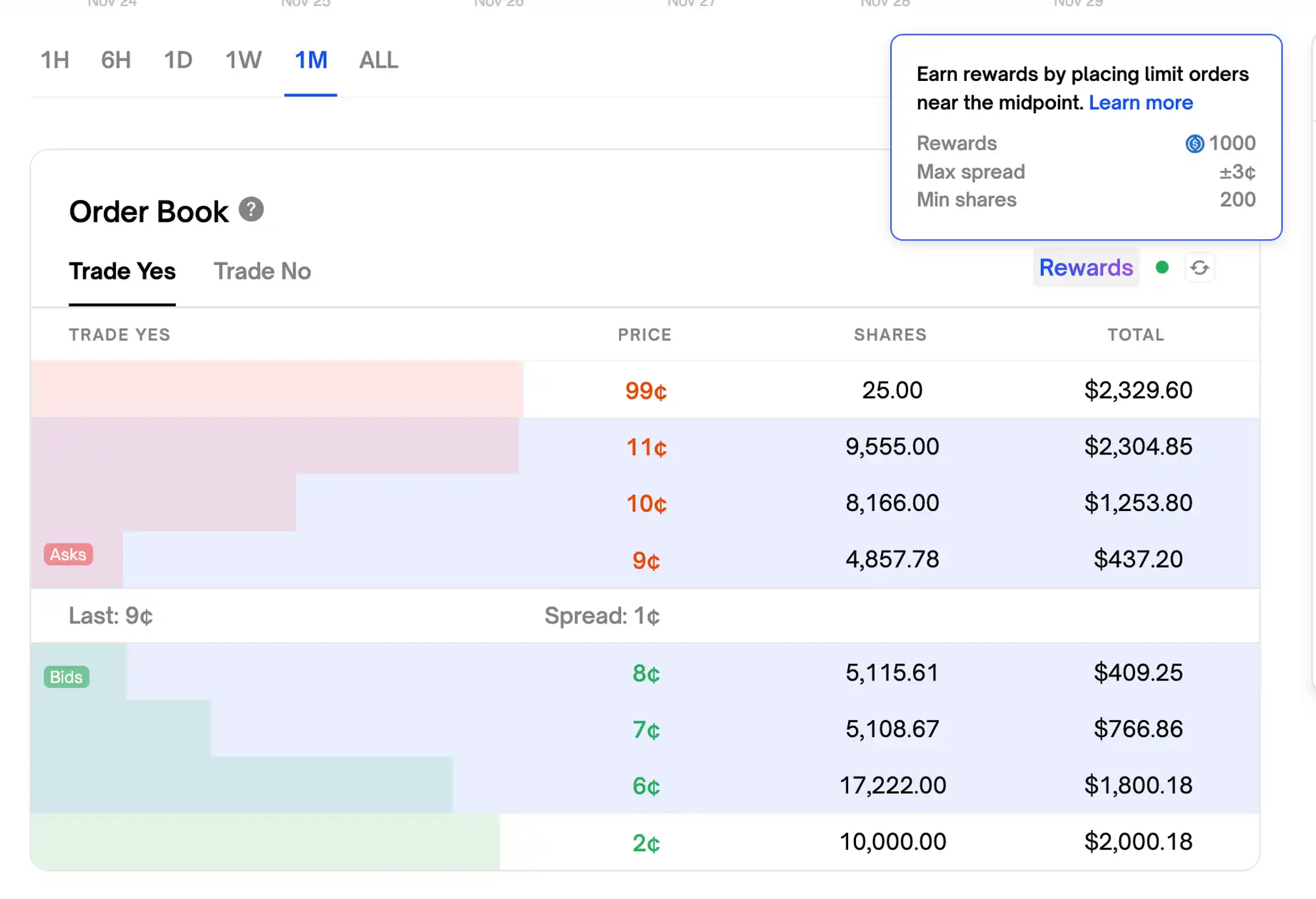
The highlighted part represents the maximum spread range for Orderbook Rewards
According to statistics, Polymarket has invested about $10 million in market maker incentives, with peak daily payments exceeding $50,000 to maintain order book liquidity. These incentives have now decreased to $0.025 for every $100 traded.
These investments have indeed been effective, driving trading in many "counterintuitive" markets. For example, the event contract "Will Putin step down by the end of 2026" has a trading volume of over $1.3 million. Holding a share of this contract will receive a 4% annualized return. For players holding Yes shares, this is equivalent to a final annualized return of 14% (10% end-of-term return + 4% platform reward), making it very attractive. For players holding No shares, the Orderbook Rewards and Holding Rewards also hedge against some risk.
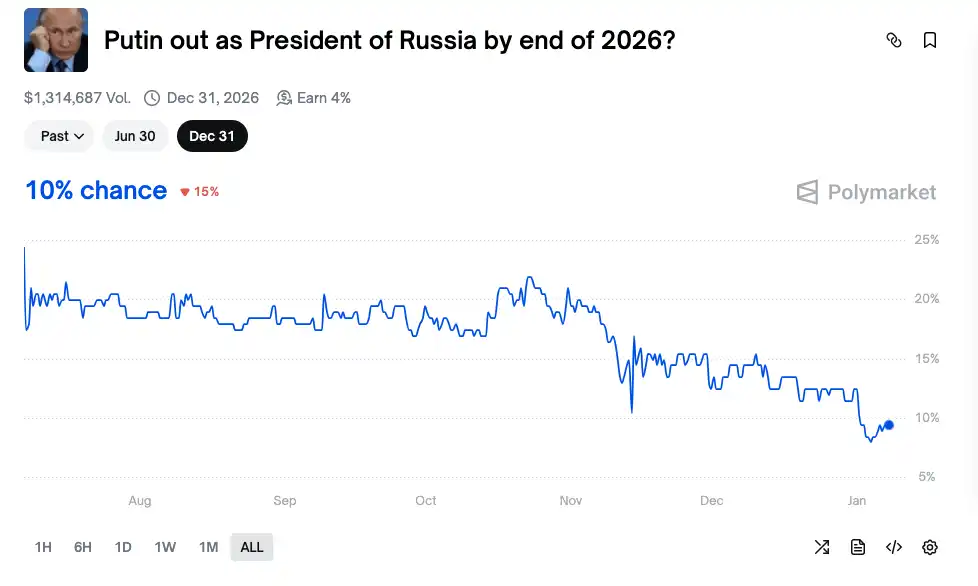
There is also speculation that, in addition to providing liquidity incentives on the surface, prediction markets themselves act as market makers for these "counterintuitive" and niche markets to facilitate advertising and marketing effects. However, this is purely speculation and open to discussion.
-- Price
This content is provided for general informational purposes only and doesn't constitute financial, investment, legal, or tax advice. Any events, rewards, online promotions, or related information mentioned herein should not be considered a recommendation, solicitation, or invitation to purchase, sell, trade, or otherwise deal in any crypto assets. Crypto assets are highly volatile and may result in loss. The availability of WEEX services, products, and related events may vary by region. You are responsible for ensuring that your participation is in accordance with applicable local laws and regulations.
You may also like

Why Hyperliquid's Prediction Market HIP-4 Can't Keep Up with Polymarket?

Polymarket V2 could change how users bet on events

After Covering 'Half of Brazil', Nu Introduces Stablecoins into Nu Global Accounts
Polymarket - Presidential Election 2027: $128M Bet, Blocked in France

How to Play Event Contracts? Comparison of 4 Popular Platforms

Polymarket: The private key rotation has been completed, and the private key is planned to be migrated to a key management service

Polymarket: The security incident reported by ZachXBT is due to the leakage of the internal operational wallet's private key, but user funds and market settlements are safe

The Polymarket private key leak incident has frozen $164,000 in funds

The Polymarket UMA CTF adapter contract was attacked on Polygon, resulting in losses exceeding $520,000

Oracle: The Second Battlefield Behind the Prediction Market War
Illustration of Polymarket's 38 Web3 business partners: Who is providing the infrastructure for "information pricing"?
Why Are You Always Losing Money on Polymarket? Because You're Betting on News, While The Rulebook Favors Insiders

Polymarket launches a bug bounty program of up to $5 million on the Cantina platform

Predictive Market Probable is about to go live, incubated by PancakeSwap in partnership with YZi Labs
Coinbase International Site to List ZEN, UMA, and GMX Perpetual Contracts

A transaction of $0.1 can cause Polymarket market makers to lose everything

Analysis of the NEAR and ICP Dfinity Public Chain Dispute

New OCC stablecoin rule resets redemptions, and banks face big shifts

Grayscale Launches Physical Contribution Applications for 10 Cryptocurrency Investment Products
Morgan Stanley Affiliates Hold Large Stake in Metaplanet Shares for Securities Business Purposes

Bitcoin Every 15 Minutes: The Express Bet That Is Shaking Prediction Markets

SpaceX perpetual futures traded about $6 billion after earnings
What Is an Agentic Activities Launchpad? Inside AX1 Console 2.0

Tether’s own AI study shows when buying a laptop costs more than cloud tokens

HTX Research Analyst Chloe: Despite Significant Net Inflows into Bitcoin Spot ETFs, Macroeconomic Data Suppresses Rebound Potential

The GENIUS Act Leaves Loopholes, Banks Warn of Potential $850 Billion Loan Shrinkage
AI and Chips: Washington Tightens the Noose on American Investments in China

How Has BTC Performed After Four Historical Midterm Elections?

The Rise of Perp DEXs: Will On-Chain Options Change the Landscape?

$1.2 Billion in Trading Volume Over 5 Days, TVL Only $11 Million: Why Metric is Worth Watching?
Why Hyperliquid's Prediction Market HIP-4 Can't Keep Up with Polymarket?
Polymarket V2 could change how users bet on events
After Covering 'Half of Brazil', Nu Introduces Stablecoins into Nu Global Accounts
Polymarket - Presidential Election 2027: $128M Bet, Blocked in France
How to Play Event Contracts? Comparison of 4 Popular Platforms
Polymarket: The private key rotation has been completed, and the private key is planned to be migrated to a key management service


