
How Do Digital Assets Self-Custody? OpenAI Cofounder's 15-Step Checklist

Original Title: How to stay digitally secure in the Age of Claude Mythos (using Karpathy's 15-step checklist)
Original Author: Ole Lehmann
Translation: Peggy, BlockBeats
Editor's Note: As AI capabilities begin to approach the boundary of a "general tool," the meaning of cybersecurity is also changing. It is no longer just a defense issue against hackers, viruses, or data breaches but is evolving into a game of "asymmetric capabilities."
With Anthropic's introduction of Claude Mythos showcasing top-level expert-like vulnerability discovery, network attacks are entering a more covert and automated new stage, and individual security is transitioning from being an "option" to a "necessity." On one hand, the attack threshold is being lowered, and on the other hand, attack efficiency is exponentially increasing. This means that "passive security" will become increasingly unsustainable.
In this context, OpenAI co-founder Andrej Karpathy's proposed "digital hygiene" checklist offers an actionable response path. In the AI era, security is no longer just a "remedy after an incident" but part of "daily behavior." Identity verification, permission isolation, information minimization, and habit reformation. The seemingly trivial 15 steps essentially reconstruct a security boundary that an ordinary user can control.
The true risk lies not in whether you are a target of an attack but in whether you are defenseless when an attack occurs.
The following is the original text:
What can be certain is that when it comes to cybersecurity, you no longer have room to be lazy.
The milestone Mythos released by Anthropic yesterday marks a point of no return.
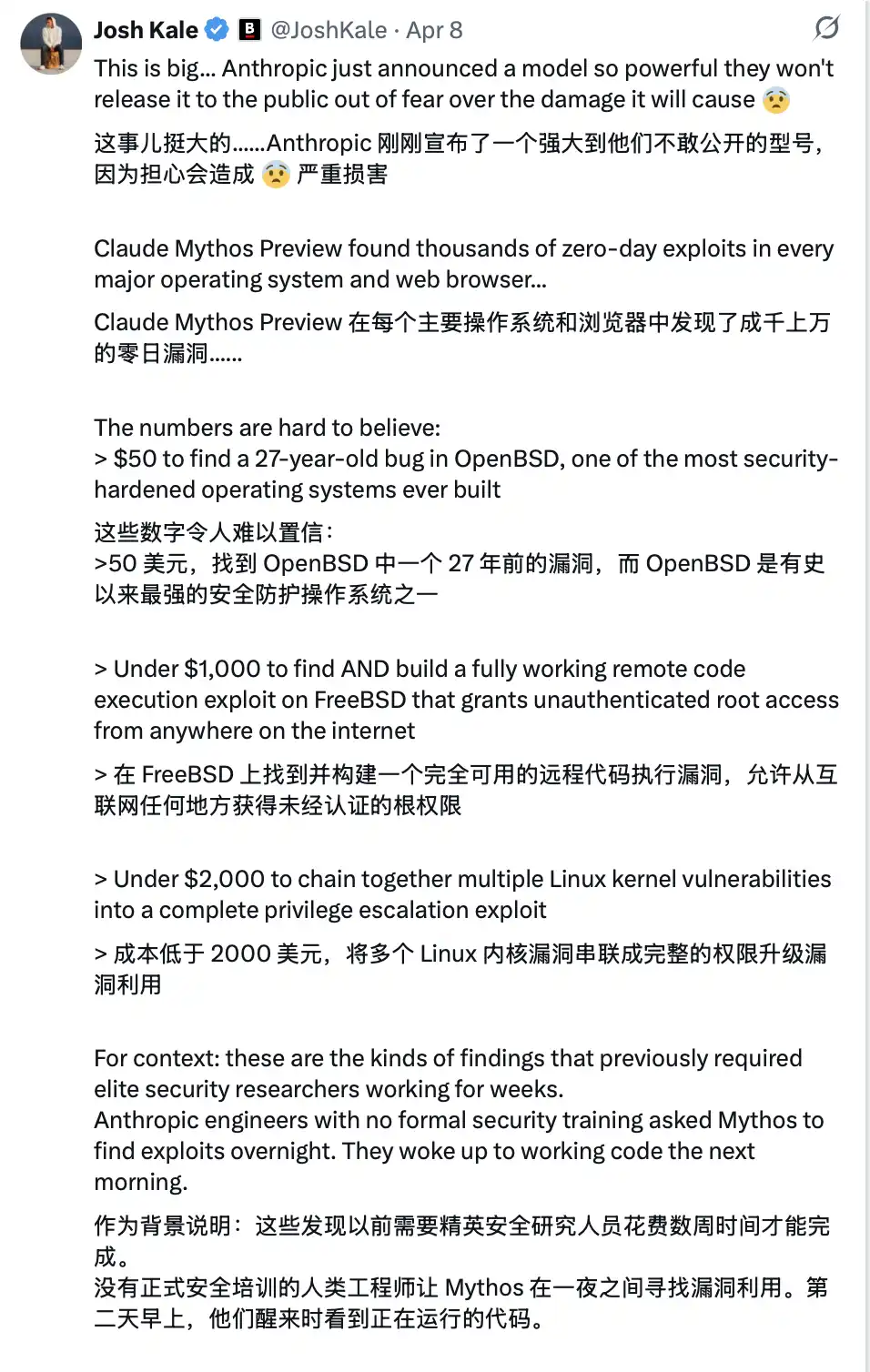

This technology is not yet public, but once it falls into the hands of malicious actors (which is almost inevitable)... you will face an extremely advanced cyberattack, with most people realizing it is too late even before they are aware they have been breached.
It's like the "COVID-19 of the software world."
It is for this reason that from now on, your cybersecurity must be watertight.
Karpathy's Digital Hygiene Guide
Last year, Andrej Karpathy (@karpathy, Co-Founder of OpenAI) compiled a "Digital Hygiene Guide," systematically outlining foundational methods to protect oneself in the AI era.
This is one of the most worthwhile introductory guides I've come across.
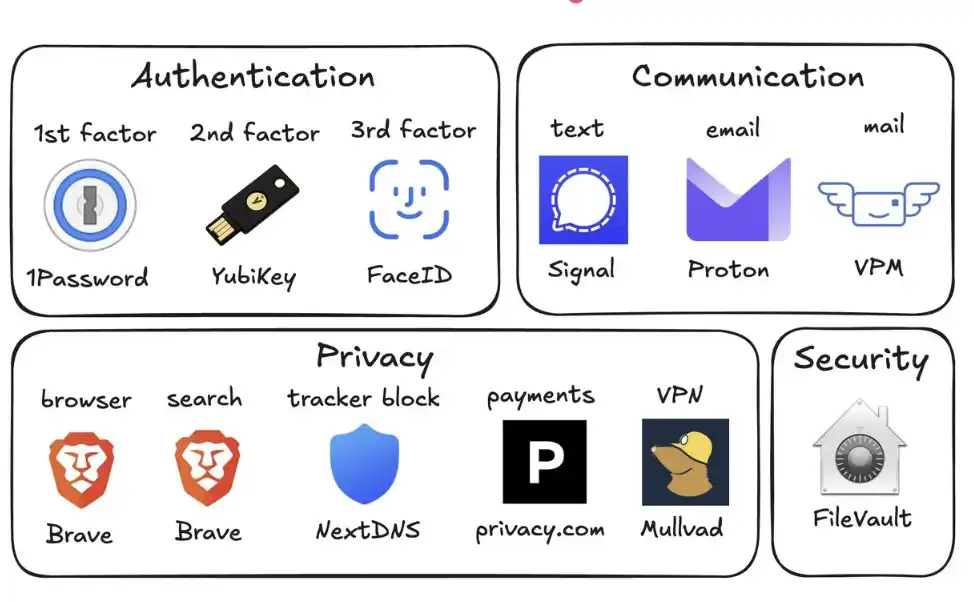
Here are all the security measures you should take in this era of uncertainty:
1. Use a Password Manager (e.g., 1Password)
Generate a unique random password for every account you own. Once a service is breached, attackers often use these account passwords for credential stuffing. A password manager can completely mitigate this risk and can even autofill, making it faster in practice than reusing passwords.
2. Set Up Hardware Security Keys (e.g., YubiKey)
This is a physical device that serves as the second factor for logging in. Attackers must "have the physical key" to access your account. In contrast, SMS codes are easily stolen through SIM-swapping attacks (where someone impersonates you to the carrier to transfer your number to their phone).
It is recommended to purchase 2–3 YubiKeys, keep them in different places to prevent being locked out of your accounts if one is lost.
3. Enable Biometrics Everywhere
For example, Face ID, fingerprint recognition, etc., should be enabled in password managers, banking apps, and critical apps. This is the third layer of authentication: "you" yourself. No one can steal your face from a database.
4. Treat Security Questions as Passwords
Questions like "What is your mother's maiden name?" can be found online in 10 seconds. You should generate a random answer and store it in your password manager. Never provide real information.
5. Turn On Disk Encryption
On Mac, it's called FileVault; on Windows, it's BitLocker. If your computer is stolen, encryption ensures that all the thief gets is a "brick" instead of all your data. Enabling this takes only 2 minutes and runs automatically in the background.
6. Reduce Smart Home Devices
Every "smart device" is essentially a connected computer with a microphone. They continuously collect data, connect to the internet frequently, and are often compromised. Your smart home air quality monitor doesn't need to know your exact location. The fewer the devices, the fewer the attack vectors.
7. Use Signal for Communication
Signal provides end-to-end encryption, preventing anyone (including the platform itself, your carrier, eavesdroppers) from reading the content. Regular SMS and even iMessage retain metadata (who, when, frequency of contact). Enable "Disappearing Messages" (e.g., 90 days) to avoid retaining history as a risk.
8. Use Privacy-Focused Browsers (e.g., Brave)
Based on Chromium, compatible with Chrome extensions, offering a nearly identical user experience.
9. Switch Default Search Engine to Brave Search
It has its own index (unlike DuckDuckGo, which relies on Bing). If a search result is unsatisfactory, you can add "!g" to switch to Google. The paid version, around $3 per month, is worthwhile — you become a customer, not the "product being sold."
10. Use Virtual Credit Cards (e.g., Privacy.com)
Generate a unique card number for each merchant and set spending limits. You can even provide random names and addresses. If a merchant is compromised, only the disposable card number is exposed, not your real financial identity.
11. Use a Virtual Mailing Address
Services like Virtual Post Mail will receive your physical mail, scan the contents, and allow you to view them online.
You can decide which items to discard and which to forward. This way, you don't have to give your real home address to various unknown retailers every time you check out online.
12. Do Not Click on Links in Emails
Email addresses are extremely easy to spoof. With the help of AI, today's phishing emails are almost indistinguishable from real ones. Instead of clicking on links, manually enter the website address and log in.
At the same time, disable the automatic image loading feature in your email, as embedded images are often used to track if you've opened the email.
13. Selectively Use a VPN (e.g., Mullvad)
A VPN (Virtual Private Network) can hide your IP address (the unique identifier of your device and location) from services you access. It doesn't need to be on all the time, but make sure to use it when on public Wi-Fi or accessing less trusted services.
14. Set Up DNS-Level Ad Blocking (e.g., NextDNS)
DNS can be thought of as a device's "phone book" for looking up websites. Blocking at this level means ads and trackers are stopped before they even load.
And it works for all apps and browsers on your device.
15. Install Network Monitoring Tools (e.g., Little Snitch)
It shows you which apps on your computer are connecting to the internet, how much data they're sending, and where the data is headed. Any app with an abnormally high "phone home" frequency should raise a red flag and likely be uninstalled.
Currently, Mythos remains solely in the hands of the defense side of Project Glasswing (such as Anthropic, Apple, Google, etc.). However, models with similar capabilities will soon fall into the hands of malicious actors (possibly within 6 months or even sooner).
That's why it's crucial to shore up your security defenses now. Spending 15 minutes to complete these settings can help you avoid a host of serious issues in the future.
Stay secure, and wishing you all the best.
You may also like

Morning Report | BitMine increased its holdings by 126,971 ETH last week; trader Eugene announced his exit from the crypto market

Wang Chuan: How can one not feel anxious after the neighbor Old Wang made thirty times profit by investing in storage stocks? (Seven) - A quarter-century cycle

Cryptocurrency CEXs are flocking to sell US stocks, and traditional brokerages are facing an "uninvited guest."

$75 billion in foreign capital has fled, and South Korean retail investors have absorbed it all using leverage

Japan’s Three Megabanks Plan Joint Stablecoin Issuance in Fiscal 2026
MUFG, SMBC, and Mizuho reportedly plan to jointly issue fiat-pegged stablecoins in fiscal 2026, signaling Japan’s growing push into bank-led digital payment infrastructure.

Humanity Discloses H Token Dual-Chain Attack Details, With Losses on Ethereum and BSC Exceeding $36 Million
Humanity said the H token attack across Ethereum and BSC caused more than $36 million in losses after leaked ProxyAdmin keys enabled malicious contract upgrades and token minting.
White House Discusses CLARITY Act With Law Enforcement Ahead of Senate Vote
The White House discussed the CLARITY Act with law enforcement ahead of a Senate vote, focusing on illicit finance risks and developer protections.

Bitcoin Trading Guide 2026: Strategies for Experienced Traders

What Is XAUT and PAXG? Why Tokenized Gold Is Booming in 2026

Will the SpaceX IPO Hurt Bitcoin? Here's What Traders Are Watching

Foreign selling in the South Korean stock market accelerates, with cumulative net sales reportedly reaching $75 billion this year
On June 9, The Kobeissi Letter, citing Goldman Sachs data, reported that global investors are selling South Korean stocks at an unusually rapid pace. In the latest trading session, foreign investors sold about $801 million worth of Kospi constituent stocks again; total foreign outflows last week reached about $10 billion, and the market has been in net foreign selling on nearly every trading day over the past month. According to the data cited in the report, foreign investors have sold about $75 billion worth of South Korean stocks so far this year. Meanwhile, South Korean retail and institutional investors together recorded roughly $69 billion in net buying over the same period, suggesting that the market’s main buying support has come from domestic capital rather than returning overseas funds. The information currently disclosed still mainly comes from The Kobeissi Letter’s retelling and Goldman Sachs data summaries, while public details on the statistical period and the specific definition of “selling” remain relatively limited.

Fortune Warns of Strategy’s Financing Structure Risks as Bitcoin Premium Narrows
Fortune warned that Strategy’s Bitcoin treasury model faces growing financing risks as MSTR’s net asset premium narrows and preferred stock dividend pressure increases.

Ferrari Challenge Le Mans: Carl Moon to Dominate in WEEX Livery

Sahara AI Responds to SAHARA’s Sharp Drop: No Contract or Product Security Issues Found, Internal Investigation Underway
Sahara AI responded to SAHARA’s 60% price drop, saying no token contract or product security issues have been found and an internal investigation is underway.

WEEX Deposit/Withdrawal Dynamic Island: Your Asset Status, Always in Sight
Scaling Crypto Derivatives: The Digital Asset Infrastructure Behind High-Volume Trading
In the fast-moving digital asset ecosystem, derivatives platforms face an extreme architectural test. High-leverage futures markets demand more than just standard security—they require absolute operational precision, zero-latency matching engines, and ironclad structural scalability, all while navigating intense market volatility.
As global platforms scale to meet these demands, the industry is shifting away from rigid, monolithic setups toward a more agile, "decoupled" infrastructure philosophy.
The Blueprint for High-Volume Copy TradingFor elite global exchanges like WEEX (founded in 2018), this architectural choice becomes critical when scaling high-volume retail features like social copy trading. When thousands of users automatically mirror the real-time strategies of elite traders simultaneously, it triggers sudden, monumental spikes in concurrent transactional volume.
To prevent execution latency or settlement bottlenecks during these peak volatility events, a platform's primary engine must remain entirely dedicated to risk management, copy-trade synchronization, and order matching.
The Architectural Rule: New-generation platforms must separate front-end user execution engines from heavy backend infrastructural overhead to eliminate operational friction.
By separating these layers, platforms can maintain complete sovereignty over their trading environments and user experiences while strategically aligning with institutional-grade infrastructure ecosystems. This strategic framework allows modern exchanges to leverage advanced Digital Asset Custody infrastructure such as Cobo’s behind the scenes, ensuring that backend wallet management scales elastically alongside trading spikes.
Capitalizing on Market Momentum and 400× LeverageIn a derivatives arena where platforms offer up to 400× leverage on perpetual contracts, capital efficiency and market agility are core business metrics. To capture market momentum, an exchange needs the ability to rapidly expand its asset offerings, supporting everything from legacy crypto assets to sudden, trending altcoins across a massive library of trading pairs.
Adopting a flexible, scalable Wallet-as-a-Service (WaaS) solution such as Cobo’s could completely rewrite the development timeline for high-growth exchanges. Instead of spending months of engineering capital building out custom backend wallet architectures for every new blockchain network, platforms can deploy localized infrastructure in days.
This agility allows platforms to instantly scale their listings to over a thousand trading pairs without compromising security or delaying time-to-market. It mirrors the exact operational advantages seen during high-velocity market events, similar to how advanced wallet infrastructure empowers platforms during sudden asset surges; allowing exchanges to pass that speed and liquidity directly to their global user base.
A Mature Foundation for GrowthThe synergy between trusted infrastructure ecosystems and global trading platforms represents the natural evolution of a maturing crypto market. As WEEX continues to scale its global spot and derivatives offerings for over 6 million users, adopting robust backend paradigms proves that platforms no longer have to compromise between cutting-edge trading velocity and uncompromised structural security.

Get Paid to Onboard? Try WEEX’s New Homepage with Rewards for Registration, Deposit & Trade
WEEX Custom Layout: Build Your Perfect Trading Workspace in Seconds
Morning Report | BitMine increased its holdings by 126,971 ETH last week; trader Eugene announced his exit from the crypto market
Wang Chuan: How can one not feel anxious after the neighbor Old Wang made thirty times profit by investing in storage stocks? (Seven) - A quarter-century cycle
Cryptocurrency CEXs are flocking to sell US stocks, and traditional brokerages are facing an "uninvited guest."
$75 billion in foreign capital has fled, and South Korean retail investors have absorbed it all using leverage
Japan’s Three Megabanks Plan Joint Stablecoin Issuance in Fiscal 2026
MUFG, SMBC, and Mizuho reportedly plan to jointly issue fiat-pegged stablecoins in fiscal 2026, signaling Japan’s growing push into bank-led digital payment infrastructure.
Humanity Discloses H Token Dual-Chain Attack Details, With Losses on Ethereum and BSC Exceeding $36 Million
Humanity said the H token attack across Ethereum and BSC caused more than $36 million in losses after leaked ProxyAdmin keys enabled malicious contract upgrades and token minting.


