
5 Minutes to Make AI Your Second Brain


Original Title: Claude Code + Obsidian Ultimate Guide (build an AI second brain)
Original Author: AI Edge
Translation: Peggy, BlockBeats
Editor's Note: This article introduces a personal knowledge system built on Claude Code and Obsidian, where the core focus is no longer on the traditional RAG mode of "one-time query, temporary retrieval," but rather on attempting to have AI continuously build and maintain an evolving knowledge base (Wiki).
Structurally, the system can be divided into three layers:
· The first is the raw data layer, including notes, articles, transcribed content, and other immutable input sources;
· The second is the AI-maintained structured knowledge base, which completes cross-referencing and relationship building through continuous updates;
· The third is the Schema rule layer, used to standardize the organization of knowledge and the operational logic of the system.
Based on this structure, the system operates through three core actions: Ingest, continuously incorporating external information into the system; Query, enabling real-time access to knowledge; Lint, used to check structural consistency and resolve potential issues.
Within this mechanism, knowledge no longer remains limited to one-time conversation results but gradually crystallizes into reusable long-term assets through a "write-organize-reuse" cycle. The author suggests that this model endows knowledge with an accumulation effect similar to "compound interest": on the one hand, reducing individual cognitive burden, and on the other hand, enhancing the accuracy of model outputs and contextual consistency.
However, the effective operation of this system also relies on one premise—continuous input and maintenance. Without stable data injection and structural updates, this "second brain" will struggle to truly accumulate the expected benefits, and its advantages will consequently diminish.
The following is the original text:
Claude Code + Obsidian is the most powerful AI combination I have ever used.
I have virtually built an "AI second brain" that encompasses all my thoughts, readings, writings, online research, etc. It includes my business plans, all the YouTube videos I have ever published, articles I have written, and everything else that is important to me.
Claude Code + Obsidian has quickly gained popularity across various platforms, and this is no coincidence.
Personally, this AI system has greatly reduced my cognitive load, allowing me to focus on truly important things—whether in business or personal life.
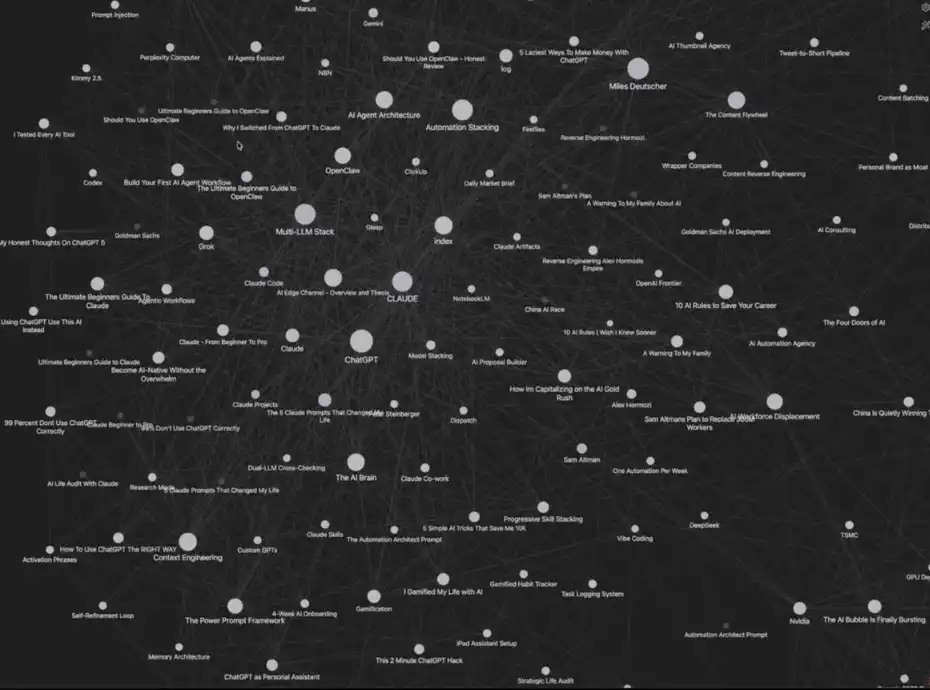
My Claude Code + Obsidian System
While this system may seem a bit complex, setting it up actually only takes 5 minutes. More importantly, it comes with a memory mechanism that continuously self-improves with use.
Next, I will walk you through replicating this "AI Second Brain" system, which truly can enhance your efficiency.
I suggest you read to the end of the article—I will provide a complete Claude Code + Obsidian Cheat Sheet, as well as all the mentioned resources (all free).
Before We Begin
This system is not my original creation alone; its inspiration comes from Andrej Karpathy's viral tweet a few days ago about the "LLM Knowledge Base."
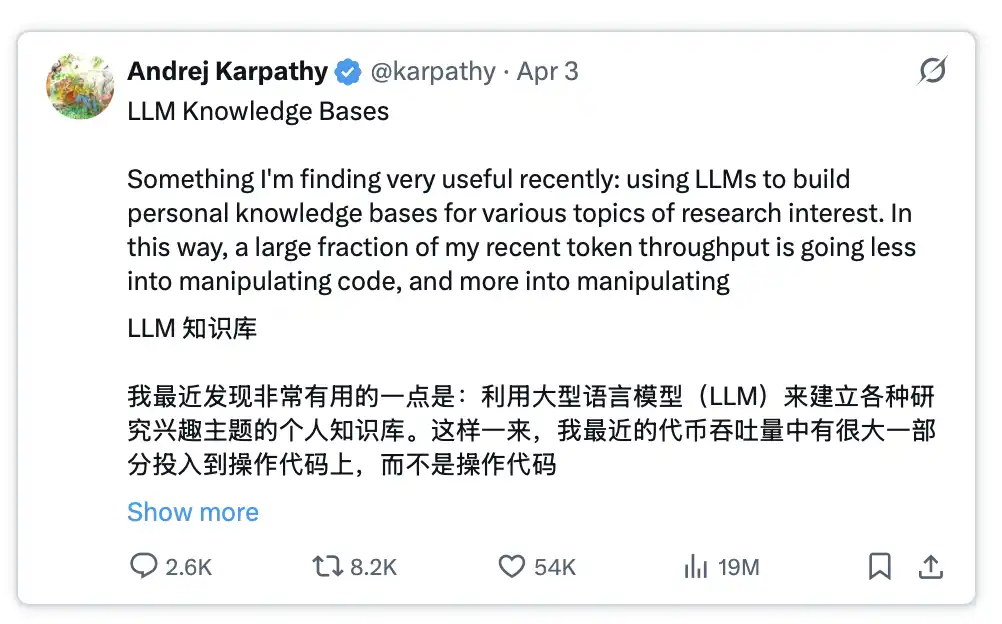
Related Reading: https://x.com/karpathy/status/2039805659525644595
This tweet quickly went viral because it provided a roadmap to address a key pain point in current AI development.
The problem is this: every time you start a new conversation or switch to a new AI tool, you have to repeatedly re-enter prompts, provide context, essentially starting from scratch.
By integrating these system prompts with Obsidian and Claude Code, this problem can be completely solved, while also significantly improving the quality of AI output.
How Does This System Work?
The entire system consists of four core modules:
1. Your data: including articles, notes, transcribed content, inspirational ideas, etc.
2. Organization: automatically done in Obsidian through Claude Code
3. Instant Invocation: you can query this "database" at any time and get answers
4. Evolutionary Memory: The system will become smarter with use
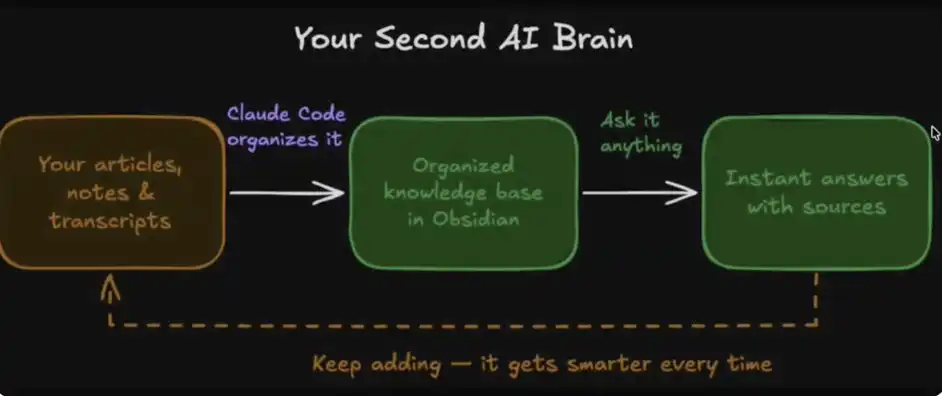
Your AI Second Brain
What is the true power of this system?
As humans, our cognitive bandwidth is limited. We forget, and sometimes it's hard to connect different ideas, as there is a limit to the amount of information we can track and process simultaneously.
However, with this system composed of four modules, you are actually unburdening your cognition, handing over the work of "connecting, organizing, and understanding information" to Obsidian and Claude Code.
Your ideas start to be systematically linked together, where one note can automatically relate to another, and you can retrieve, remix, and recall this content anytime through Claude.
In this structure, your knowledge is no longer fragmented but rather a network that can be continuously called upon and reconfigured—almost limitless.
How to Build Your AI Brain in 5 Minutes
1. Download Obsidian
Website: https://obsidian.md/
https://obsidian.md/
2. Create Your Vault (Knowledge Base)
After downloading, Obsidian will prompt you to create a "Vault."
You can think of it as a folder on your computer where we will store all content and allow Claude Code to access and manage this data.
You can freely set the name of this Vault—for example, I call mine "Obsidian Vault."
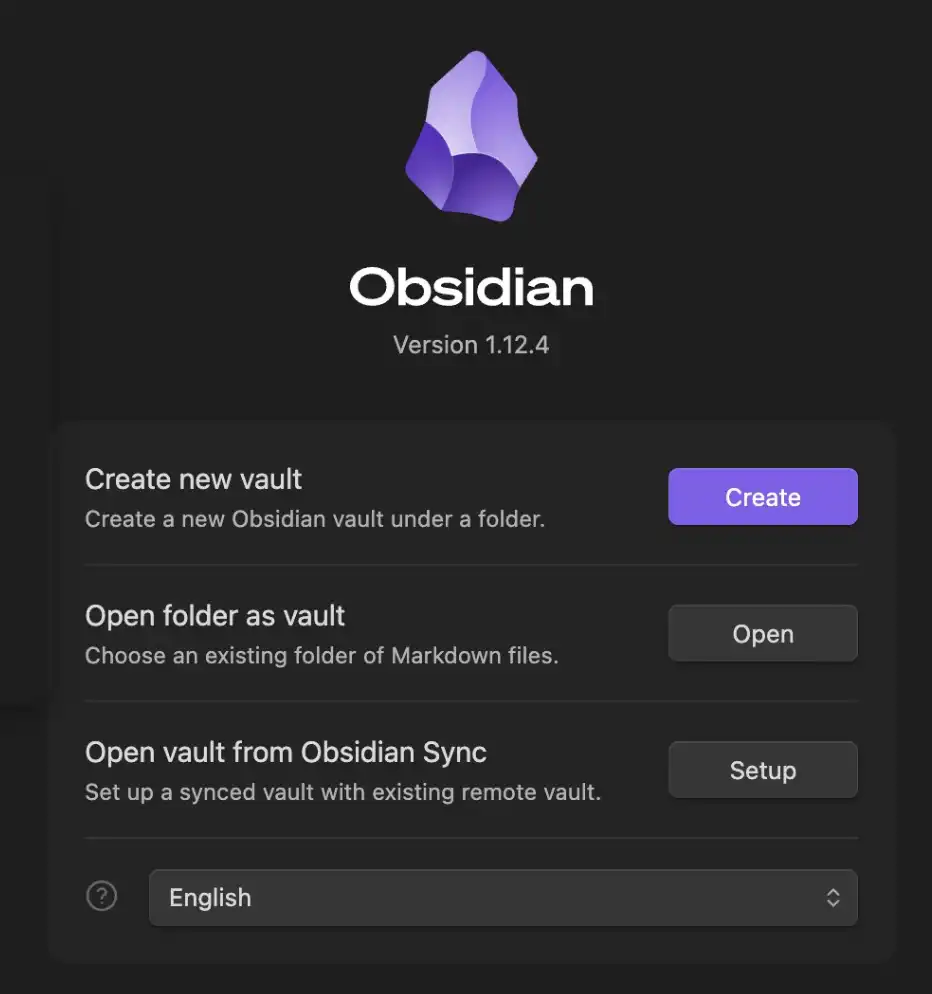
Obsidian Vault (Knowledge Base)
This Vault is where Obsidian stores all your data and notes, and all content is saved in the form of MD (Markdown) files.
3. Set Up Claude Code
Next, you need to set up a way to access Claude Code. For me (and probably for most people), the easiest way is to use the desktop client directly.
In the main chat interface, click on "Select Folder," then navigate to the Obsidian Vault you just created and select it.
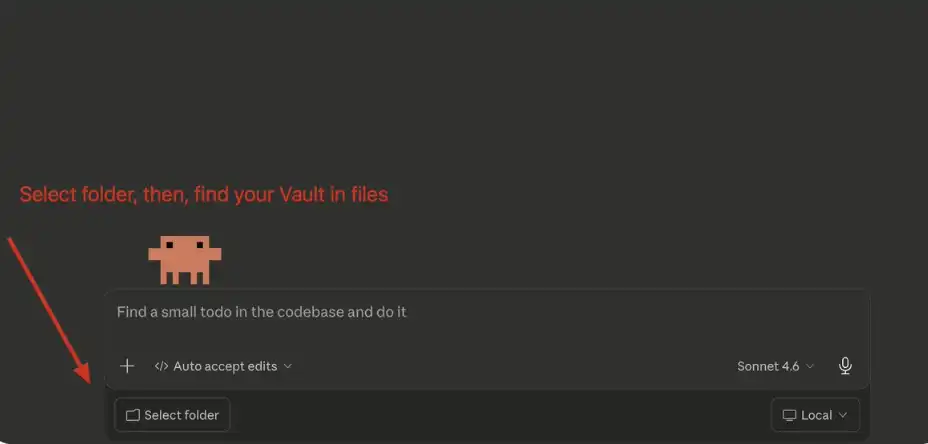
**Claude Code: Connect Your Vault**
4. Set System Prompt
Once you have selected the folder, the next step is to paste Andrej Karpathy's system prompt into the main chat box.
You can copy the prompt from here: https://gist.github.com/karpathy/442a6bf555914893e9891c11519de94f
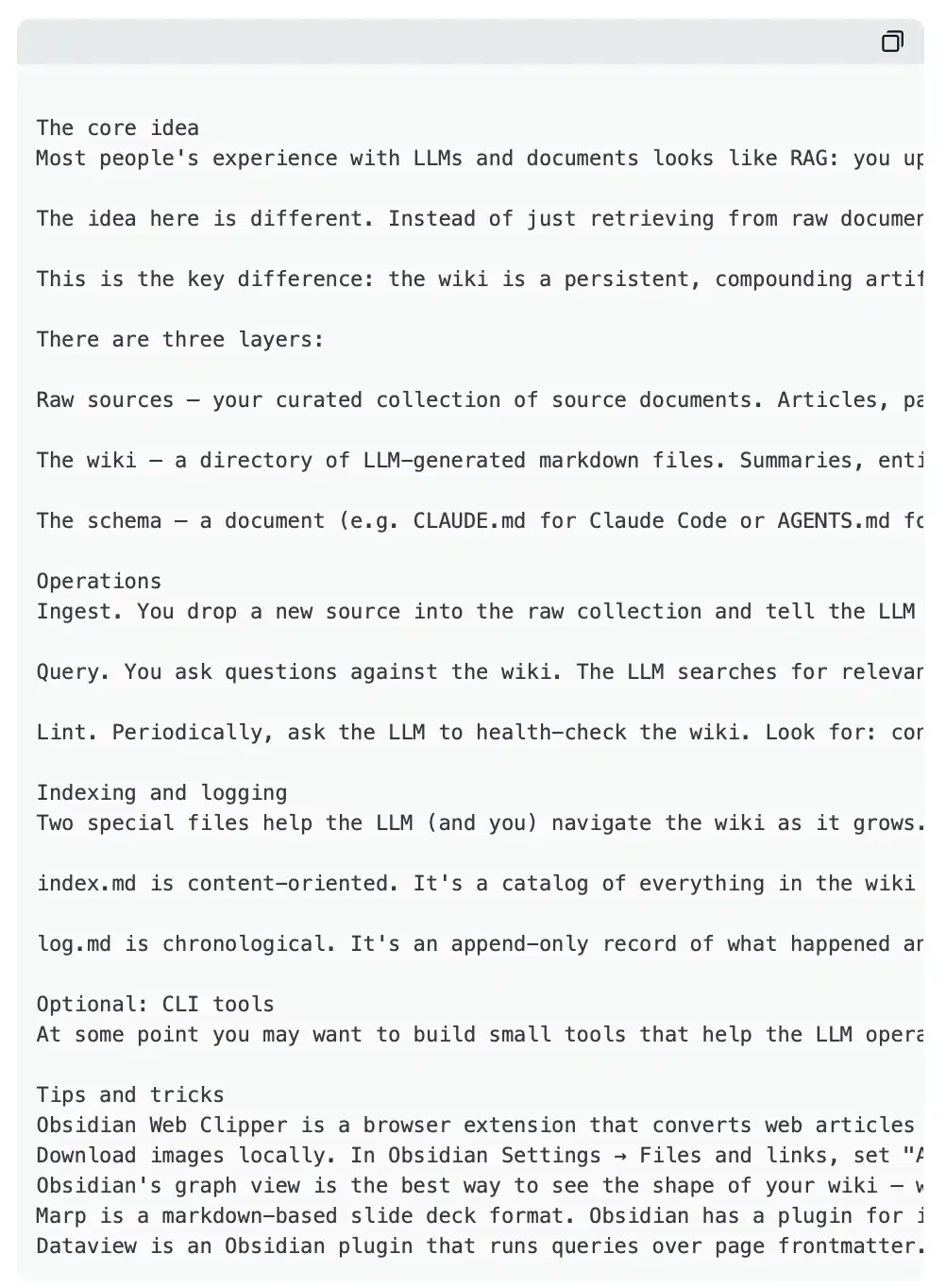
Your input should look like this:
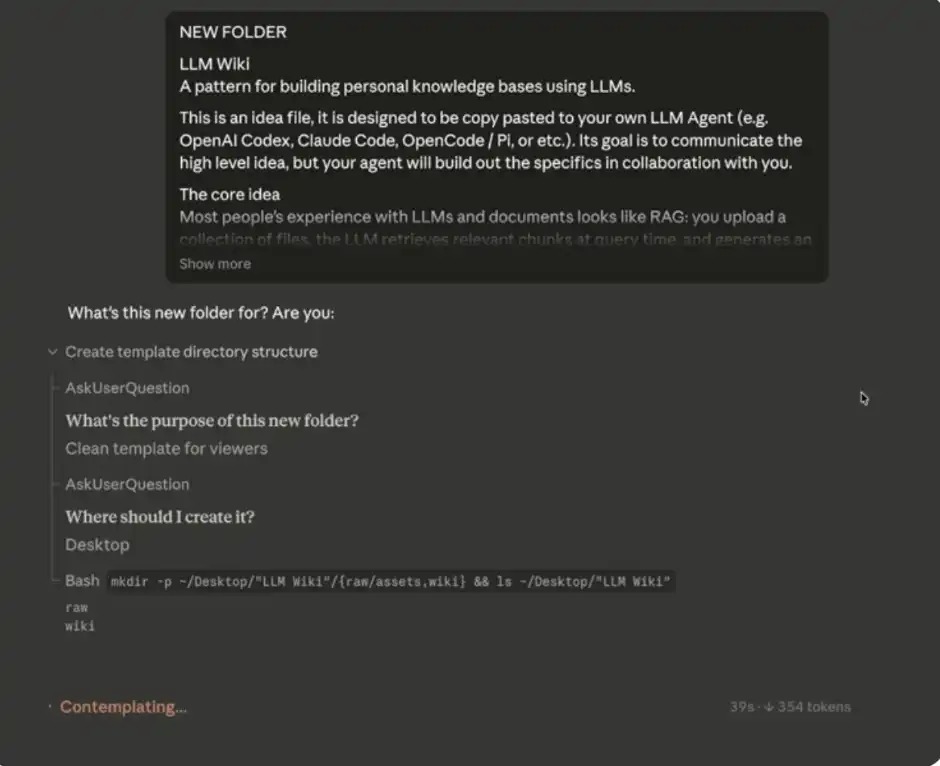
**Claude Code Initial Input**
Pro Tip: If you prefer, you can completely avoid manually opening Obsidian. Just provide the MD folder (your Vault) and relevant data to Claude Code, and it can directly read, write, and modify these files — with the content automatically syncing to your Obsidian "second brain."
5. Build Your Database
After you have entered the system prompt above, Claude Code will start asking you about some data sources to initialize and gradually populate your "second brain."
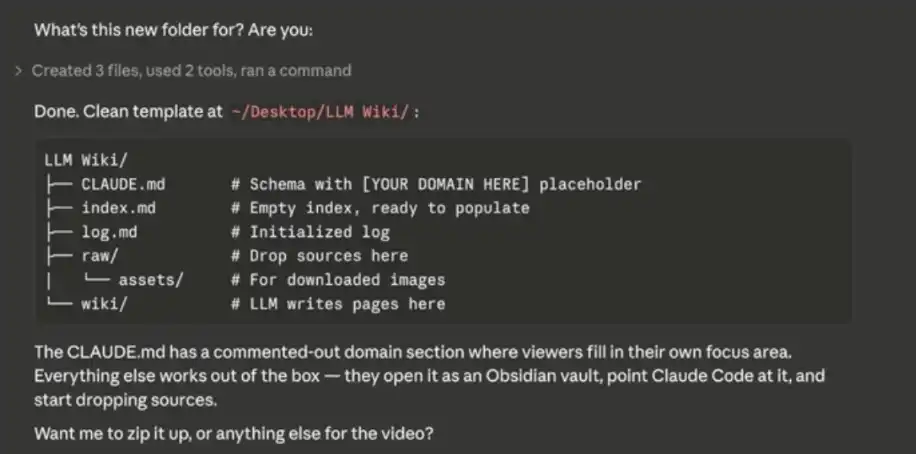
Build Your Database
You can think of Obsidian as a "blank notebook" — initially, you need to actively input content for the database to gradually build up. Importable content includes: notes, CSV files, Markdown/text files, and more.
Some practical advice:
· Export data from your existing note-taking tools
· If you use Notion, you can export it as a CSV file
· Have Claude (or another large model) compile information about you to initialize your "second brain"
· Import all your existing articles, bookmarks, ideas, etc., at once — this is the best time to establish initial data, and you can always add more later
It's important to note that for a database like mine with a large amount of data, it is not built in a day but rather inputted over time, gradually accumulating.
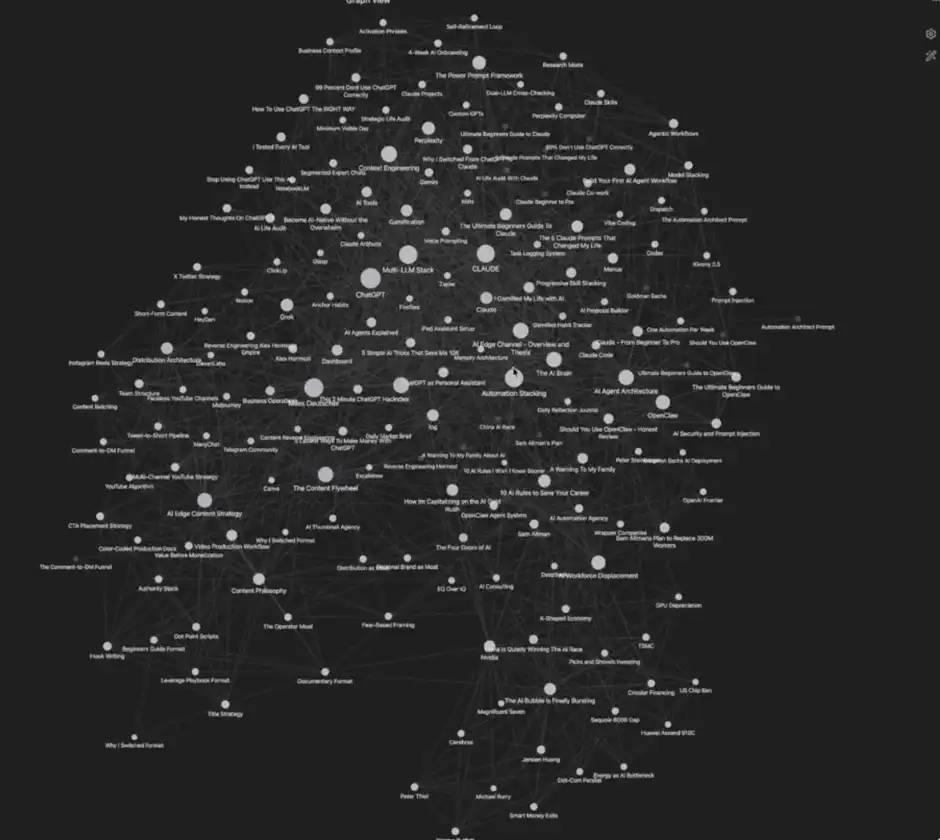
My Database
There you have it, your "AI second brain" has been constructed and is ready to go. Next, I'll share some advanced tips to help you use it more efficiently.
Advanced Tips
1. Obsidian Chrome Extension
If you want to easily add data to the system, just install the Obsidian Chrome extension. It allows you to click "Add to Obsidian" while browsing the web, instantly saving content to your knowledge base. This will make the process of building your "second brain" very convenient.
I often use this feature myself to collect articles, web data, research materials, and more.
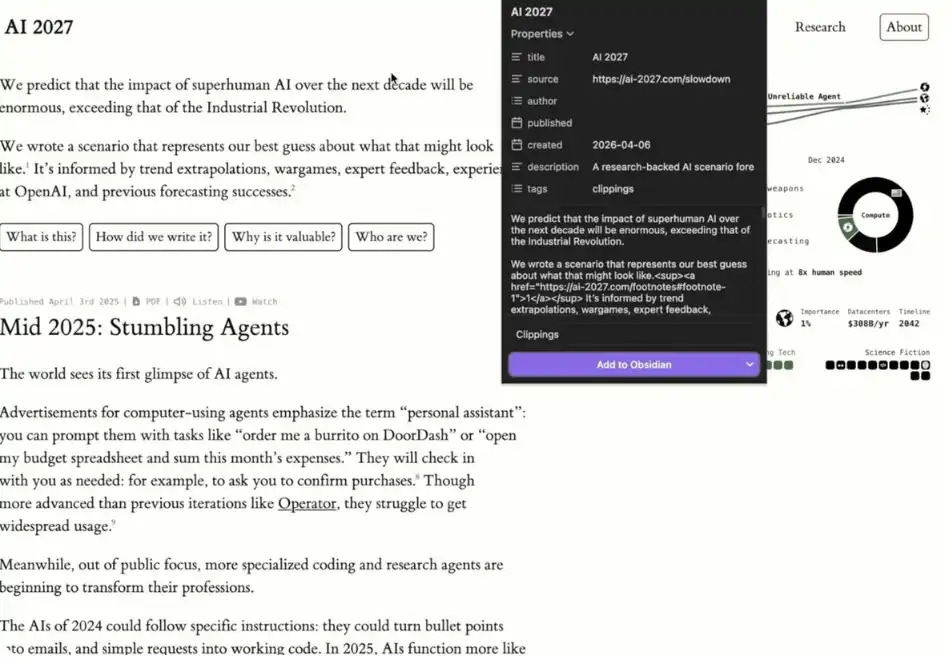
Example: Using the Obsidian Chrome Extension
It's important to note that data added through the extension initially exists as a "standalone data source."
Next, you can tell Claude Code, "I just added [x] in Obsidian, please help me integrate this content into my Wiki."
Claude Code will automatically associate this new data with existing content, create links, and truly integrate it into your "second brain." This is also why this toolset is powerful.
2. Establish Separate Vaults
Andrej Karpathy suggests using two separate vaults:
· One for work/business content
· One for personal life/goal management
My own experience confirms that this structure is the clearest and most effective.
3. Practicality
I've found the most valuable use case of this system to be quite simple: making your LLM prompts more precise.
When the model has access to your full personal information, business plans, writing background, and other contexts, it can generate more "customized," realistic, high-quality prompts (even "super prompts").
Of course, this system has far more applications, but if you're looking to start with the most practical scenario, I would strongly recommend beginning with "improving prompt quality."
4. Orphans
In Obsidian, "Orphans" refer to data points that are not connected to other notes.
This feature is useful because it can help you:
· Find ideas that have not yet been integrated
· Discover "weak spots" in your database
· Determine which content is worth further expanding or deepening
In other words, it serves not only as an organizational tool but also as a mechanism to help you identify blind spots in thinking.
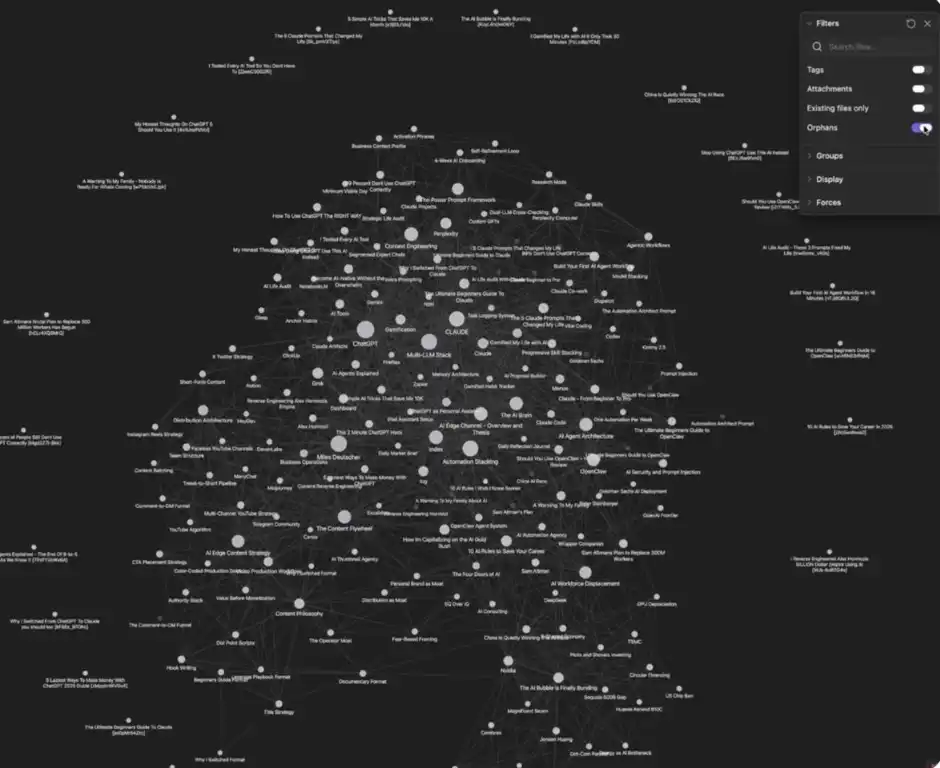
Orphans
You can click on the "three dots" in the upper right corner, find and enable the Orphans toggle to see which content has not been linked yet.
Potential Drawbacks of This System
Earlier, we discussed many advantages, use cases, and optimization methods. So, what are its shortcomings? In what situations might you not be suitable for using this system?
1. Those Unaccustomed to Visualization
One core advantage of this system is the ability to visualize data. If you do not rely on or are unaccustomed to this method, its assistance to you may be limited.
2. Requires Some Maintenance Cost
If you are not willing to consistently maintain a database, then this system may not be suitable for you. Although the maintenance cost is not high, it is difficult for it to provide value if you do not consistently input data into your "second brain."
3. Storage Usage
All content will be stored locally in the form of Markdown files, which will take up some device space. This is also something to consider in advance.
You may also like

Morning Report | BitMine increased its holdings by 126,971 ETH last week; trader Eugene announced his exit from the crypto market

Wang Chuan: How can one not feel anxious after the neighbor Old Wang made thirty times profit by investing in storage stocks? (Seven) - A quarter-century cycle

Cryptocurrency CEXs are flocking to sell US stocks, and traditional brokerages are facing an "uninvited guest."

$75 billion in foreign capital has fled, and South Korean retail investors have absorbed it all using leverage

Japan’s Three Megabanks Plan Joint Stablecoin Issuance in Fiscal 2026
MUFG, SMBC, and Mizuho reportedly plan to jointly issue fiat-pegged stablecoins in fiscal 2026, signaling Japan’s growing push into bank-led digital payment infrastructure.

Humanity Discloses H Token Dual-Chain Attack Details, With Losses on Ethereum and BSC Exceeding $36 Million
Humanity said the H token attack across Ethereum and BSC caused more than $36 million in losses after leaked ProxyAdmin keys enabled malicious contract upgrades and token minting.
White House Discusses CLARITY Act With Law Enforcement Ahead of Senate Vote
The White House discussed the CLARITY Act with law enforcement ahead of a Senate vote, focusing on illicit finance risks and developer protections.

Bitcoin Trading Guide 2026: Strategies for Experienced Traders

What Is XAUT and PAXG? Why Tokenized Gold Is Booming in 2026

Will the SpaceX IPO Hurt Bitcoin? Here's What Traders Are Watching

Foreign selling in the South Korean stock market accelerates, with cumulative net sales reportedly reaching $75 billion this year
On June 9, The Kobeissi Letter, citing Goldman Sachs data, reported that global investors are selling South Korean stocks at an unusually rapid pace. In the latest trading session, foreign investors sold about $801 million worth of Kospi constituent stocks again; total foreign outflows last week reached about $10 billion, and the market has been in net foreign selling on nearly every trading day over the past month. According to the data cited in the report, foreign investors have sold about $75 billion worth of South Korean stocks so far this year. Meanwhile, South Korean retail and institutional investors together recorded roughly $69 billion in net buying over the same period, suggesting that the market’s main buying support has come from domestic capital rather than returning overseas funds. The information currently disclosed still mainly comes from The Kobeissi Letter’s retelling and Goldman Sachs data summaries, while public details on the statistical period and the specific definition of “selling” remain relatively limited.

Fortune Warns of Strategy’s Financing Structure Risks as Bitcoin Premium Narrows
Fortune warned that Strategy’s Bitcoin treasury model faces growing financing risks as MSTR’s net asset premium narrows and preferred stock dividend pressure increases.

Ferrari Challenge Le Mans: Carl Moon to Dominate in WEEX Livery

Sahara AI Responds to SAHARA’s Sharp Drop: No Contract or Product Security Issues Found, Internal Investigation Underway
Sahara AI responded to SAHARA’s 60% price drop, saying no token contract or product security issues have been found and an internal investigation is underway.

WEEX Deposit/Withdrawal Dynamic Island: Your Asset Status, Always in Sight
Scaling Crypto Derivatives: The Digital Asset Infrastructure Behind High-Volume Trading
In the fast-moving digital asset ecosystem, derivatives platforms face an extreme architectural test. High-leverage futures markets demand more than just standard security—they require absolute operational precision, zero-latency matching engines, and ironclad structural scalability, all while navigating intense market volatility.
As global platforms scale to meet these demands, the industry is shifting away from rigid, monolithic setups toward a more agile, "decoupled" infrastructure philosophy.
The Blueprint for High-Volume Copy TradingFor elite global exchanges like WEEX (founded in 2018), this architectural choice becomes critical when scaling high-volume retail features like social copy trading. When thousands of users automatically mirror the real-time strategies of elite traders simultaneously, it triggers sudden, monumental spikes in concurrent transactional volume.
To prevent execution latency or settlement bottlenecks during these peak volatility events, a platform's primary engine must remain entirely dedicated to risk management, copy-trade synchronization, and order matching.
The Architectural Rule: New-generation platforms must separate front-end user execution engines from heavy backend infrastructural overhead to eliminate operational friction.
By separating these layers, platforms can maintain complete sovereignty over their trading environments and user experiences while strategically aligning with institutional-grade infrastructure ecosystems. This strategic framework allows modern exchanges to leverage advanced Digital Asset Custody infrastructure such as Cobo’s behind the scenes, ensuring that backend wallet management scales elastically alongside trading spikes.
Capitalizing on Market Momentum and 400× LeverageIn a derivatives arena where platforms offer up to 400× leverage on perpetual contracts, capital efficiency and market agility are core business metrics. To capture market momentum, an exchange needs the ability to rapidly expand its asset offerings, supporting everything from legacy crypto assets to sudden, trending altcoins across a massive library of trading pairs.
Adopting a flexible, scalable Wallet-as-a-Service (WaaS) solution such as Cobo’s could completely rewrite the development timeline for high-growth exchanges. Instead of spending months of engineering capital building out custom backend wallet architectures for every new blockchain network, platforms can deploy localized infrastructure in days.
This agility allows platforms to instantly scale their listings to over a thousand trading pairs without compromising security or delaying time-to-market. It mirrors the exact operational advantages seen during high-velocity market events, similar to how advanced wallet infrastructure empowers platforms during sudden asset surges; allowing exchanges to pass that speed and liquidity directly to their global user base.
A Mature Foundation for GrowthThe synergy between trusted infrastructure ecosystems and global trading platforms represents the natural evolution of a maturing crypto market. As WEEX continues to scale its global spot and derivatives offerings for over 6 million users, adopting robust backend paradigms proves that platforms no longer have to compromise between cutting-edge trading velocity and uncompromised structural security.

Get Paid to Onboard? Try WEEX’s New Homepage with Rewards for Registration, Deposit & Trade
WEEX Custom Layout: Build Your Perfect Trading Workspace in Seconds
Morning Report | BitMine increased its holdings by 126,971 ETH last week; trader Eugene announced his exit from the crypto market
Wang Chuan: How can one not feel anxious after the neighbor Old Wang made thirty times profit by investing in storage stocks? (Seven) - A quarter-century cycle
Cryptocurrency CEXs are flocking to sell US stocks, and traditional brokerages are facing an "uninvited guest."
$75 billion in foreign capital has fled, and South Korean retail investors have absorbed it all using leverage
Japan’s Three Megabanks Plan Joint Stablecoin Issuance in Fiscal 2026
MUFG, SMBC, and Mizuho reportedly plan to jointly issue fiat-pegged stablecoins in fiscal 2026, signaling Japan’s growing push into bank-led digital payment infrastructure.
Humanity Discloses H Token Dual-Chain Attack Details, With Losses on Ethereum and BSC Exceeding $36 Million
Humanity said the H token attack across Ethereum and BSC caused more than $36 million in losses after leaked ProxyAdmin keys enabled malicious contract upgrades and token minting.


