
Cryptocurrency among Russians: how investments were estimated at ₽3.7 trillion

 Prefer us on Google


Cryptocurrency among Russian users, according to the Ministry of Finance, has reached ₽3.7 trillion: on September 21, Deputy Minister of Finance Ivan Chebeskov stated that 20 million people in Russia use digital currencies, and the mentioned amount includes not only direct ownership of coins but also related financial products.
This estimate is significantly higher than some calculations by the Bank of Russia. Three months ago, the regulator stated that the average monthly amount of funds held by Russians on foreign centralized cryptocurrency exchanges is ₽720 billion. Another approximately ₽3.8 billion was accounted for synthetic investments through Russian instruments: structured bonds, futures, and digital financial assets. In an earlier review, the Central Bank estimated the volume of transactions by Russians from October 2024 to March 2025 at ₽7.3 trillion.
Why the estimates differ so much
Matvey Voitov, director of the Web3 Tech research center, explained that ₽3.7 trillion is not the result of direct statistical counting but an expert estimate. According to him, this figure seems plausible as an order of magnitude, but it should be considered with reservations.
The difference between ₽720 billion at the Central Bank and ₽3.7 trillion at the Ministry of Finance is related to different methodologies. The Bank of Russia accounted for funds on cryptocurrency platforms, while the Ministry of Finance looks at the market more broadly and includes other forms of ownership of digital assets. Voitov noted that the Ministry of Finance's estimate of about $44 billion at the current exchange rate is comparable to data from the blockchain analytics company Chainalysis.
In 2025, Chainalysis released a report stating that the volume of incoming cryptocurrency transactions to Russia reached $376.3 billion over the year. By this indicator, the country ranked first in Europe in terms of cryptocurrency usage. Voitov emphasized that this refers to turnover, not balances, but such data indirectly confirms the scale of the Russian cryptocurrency market.
Why the actual volume may be higher
Dmitry Tsarkov, director of trading operations at GBIH Holdings, believes that the ₽3.7 trillion mentioned by the Ministry of Finance is rather a conservative lower boundary. He suggests that the estimate could have been obtained by extrapolating the share of Russian web traffic on the largest international exchanges to their total user balances, as well as considering indirect sociological indicators.
"Given that historically Russia generated between five and ten percent of activity on leading centralized trading platforms, and considering the acute need of businesses and private capital for cross-border settlements amid the current geopolitical situation, the actual volume of accumulated capital may turn out to be significantly higher than the stated value," Tsarkov said.
The expert also pointed out the limitations of analytical tools. Rosfinmonitoring uses the "Transparent Blockchain" software complex, which the Bank of Russia also relies on. This tool helps analyze clusters of transactions and deanonymize addresses interacting with local fiat gateways. However, according to Tsarkov, it is better suited for compliance control and tracking shadow flows than for accurately assessing funds on non-custodial wallets or in DeFi.
The Bank of Russia indeed emphasizes the use of such systems to identify "dirty" cryptocurrency associated with crimes. On September 25, Rosfinmonitoring reported that more than 80 Russian banks have already connected to the "Transparent Blockchain."
Among the additional methods of regulators, Tsarkov mentioned a comprehensive analysis of banking statistics: monitoring acquiring and P2P transfers, which banking scoring classifies as operations with digital assets. However, this approach, according to the expert, shows liquidity movement rather than actual balances in investors' accounts.
Can cryptocurrency owners be accurately counted?
Voitov notes that the anonymity of users makes counting their numbers a complex task. One technical option is to combine on-chain analysis with studying user behavior on the internet: using IP addresses and data from applications that may store usage time and location settings.
This approach requires first filtering out unnecessary addresses: custodial wallets, Sybil addresses, where one user owns multiple addresses, as well as technical wallets of exchanges and applications. For the TON blockchain, for example, there are already open databases that allow excluding exchange wallets, trading bots, and Sybil addresses from the analysis.
According to Voitov, the realistic goal is not to obtain one absolutely accurate figure, but to form a consistent range. This can be refined as regulation and analytical tools develop.
Tsarkov also believes that it is impossible to obtain a completely accurate picture. He considers the most relevant approach to be a comprehensive audit of liquidity bottlenecks—points where cryptocurrency is converted into fiat money. This area includes institutional over-the-counter markets and data from platforms that conduct client identification.
-- Price
How Regulation Can Change Statistics
In the medium term, according to Tsarkov, counts may become more accurate due to the implementation of standards from the Financial Action Task Force (FATF). However, he believes that strict regulation is likely to push a significant portion of capital into anonymous networks and non-custodial solutions. In such a scenario, the gap between official statistics and the real volume of cryptocurrency capital held by Russians will remain.
At the end of 2025, when the Bank of Russia presented its concept for regulating the crypto market, the first deputy chairman of the Central Bank, Vladimir Chistyukhin, stated that this topic has attracted serious international attention, primarily from the FATF. He emphasized that regulation in Russia needs to be adopted as quickly as possible, considering how closely the organization evaluates national rules.
In the spring, the FATF called for increased control over non-custodial crypto wallets, which allow users to transfer funds directly, without regulated intermediaries. According to Russian laws, owners of such wallets must report their assets to the Federal Tax Service (FNS). This week, the Ministry of Finance reminded that tax residents are obliged to report all cryptocurrency transactions outside the regulated framework.
This content is provided for general informational purposes only and doesn't constitute financial, investment, legal, or tax advice. Any events, rewards, online promotions, or related information mentioned herein should not be considered a recommendation, solicitation, or invitation to purchase, sell, trade, or otherwise deal in any crypto assets. Crypto assets are highly volatile and may result in loss. The availability of WEEX services, products, and related events may vary by region. You are responsible for ensuring that your participation is in accordance with applicable local laws and regulations.
You may also like

Kraken: How Payward Transforms a Cryptocurrency Exchange into a Multi-Billion Dollar Financial Infrastructure

XRP Comment Ratio Drops to 0.67, Investors Remain Cautious

Sui collaborates with OpenAssets on OTAS tokenized asset standard

Trump Calls for Jerome Powell's 'Forced' Resignation After Fed Inspector General Report

Treasuries at Highest Level in 24 Years: What Changes for Investors
Bitcoin Cash: The History of Its Emergence, BCH Technology, Risks and Opportunities for Investors
![[Block Festa 2026] "To Enhance Korea's STO Competitiveness... Attracting Foreign Capital and Investment Products is Key"](/public-static/045_a32863e010.png?format=avif)
[Block Festa 2026] "To Enhance Korea's STO Competitiveness... Attracting Foreign Capital and Investment Products is Key"
Lloyds uses USDC to settle $750,000 with Visa in under an hour

Strong Dollar and High Interest Rates! What is the Latest Situation in the Critical Equation for Bitcoin?
Prosecutors Call for Amendments to Special Financial Transaction Act to Early Freeze Criminal Proceeds in Virtual Assets

Bank of Korea Announces South Korean Virtual Asset Market is More Sensitive to U.S. Stock Market

Cryptocurrency Law in Russia: What Has Changed for Investors

Stellar Releases Soroban SDK v28 with Protocol 28 Support

US Senator Blumenthal Calls Tether's USDT a 'Superhighway' for Iranian Sanctions Evasion

MU Stock Options Are Pricing In a Big Move Before Earnings: Why Open Interest Is Piling Into Micron and Not Its Rivals
MU stock heads into its September 30 earnings report with contract open interest up 7.7% this week, while rival memory names SanDisk and SK Hynix saw open interest fall. That divergence, on top of a "perfect record" of earnings beats, is what's actually being priced in tonight.

Bitcoin: Bukele's El Salvador Shifts to Stablecoins
Tom Lee Announces Entry into Digital Asset Bull Market and Four Bullish Signals

Block Festa 2026 to Open Tomorrow in Yeouido: Digital Asset Investment Institutions and Domestic and International Leaders Gather

Tokenized RWA usage should be judged asset by asset, says Falcon exec

3.568 Bitcoin Outflow from Strategy Wallet Raises Sale Concerns

The Economic Landscape of TCG in the Crypto Space

Now Accepting Bitcoin: Coljac Café Bitcoin Hub With 40+ Nearby Missouri Merchants
Why Bitcoin Rises with Inflows into ETFs. How It Actually Works

MoonPay targets won stablecoins as it expands into South Korea

BCRA reserves fell below $48 billion for the first time in two months, dragged down by the collapse of gold

D'CENT Wallet Hack Steals Over 12.4 Million XRP from 7,000 Users
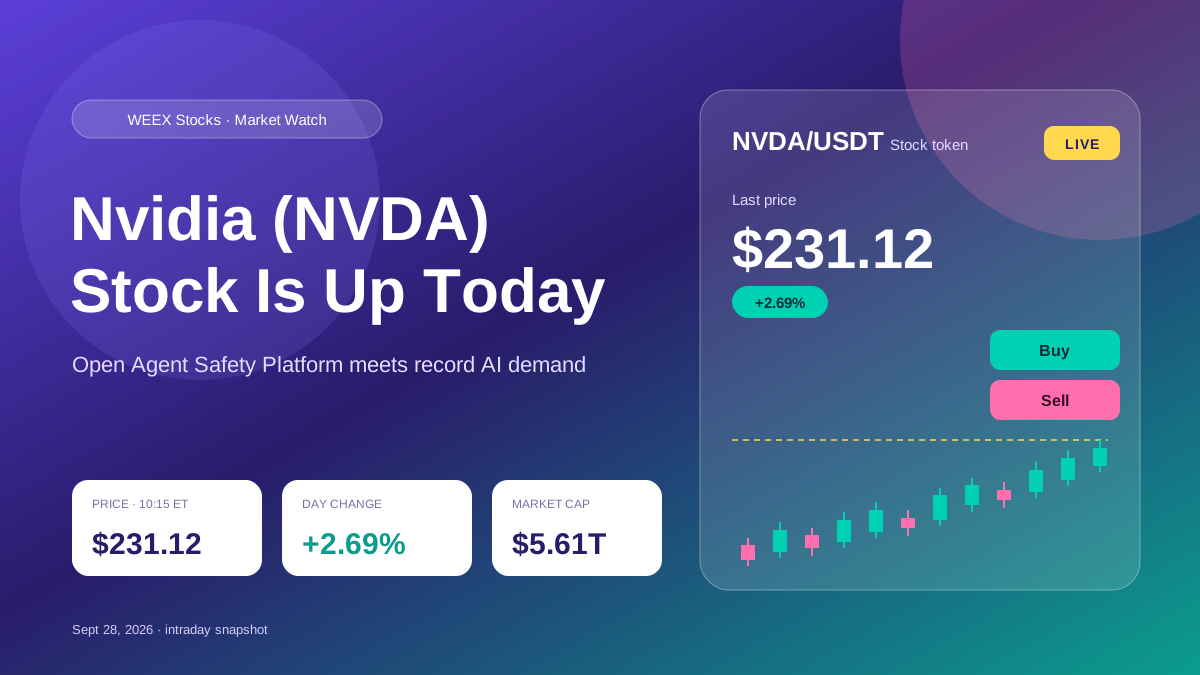
Why Is Nvidia (NVDA) Stock Up Today? New AI Agent Safety Platform Fuels the Rally
Why is Nvidia stock up today? Explore the AI agent safety launch, Nvidia’s growth outlook, key risks and how the NVDA token works on WEEX.

Central Bank Tightens Regulations on Crypto: What Changes for Users of Self-Custody Wallets

Billion-Dollar Inflow Pushes American Bitcoin ETFs Back into the Green

Wintermute’s Hyperliquid shorts reach $126M across ETH, BTC and SOL
Kraken: How Payward Transforms a Cryptocurrency Exchange into a Multi-Billion Dollar Financial Infrastructure
XRP Comment Ratio Drops to 0.67, Investors Remain Cautious
Sui collaborates with OpenAssets on OTAS tokenized asset standard
Trump Calls for Jerome Powell's 'Forced' Resignation After Fed Inspector General Report
Treasuries at Highest Level in 24 Years: What Changes for Investors
Bitcoin Cash: The History of Its Emergence, BCH Technology, Risks and Opportunities for Investors
Contents
Latest articles





Latest coin listings on WEEX


