
$8 Makes a Comeback, This Time X Money Rewrites the Logic of NFT Issuance

 Prefer us on Google


Author: Xiaobing
On January 3, 2023, Elon Musk turned Twitter's blue check into an $8/month paid product. Within 24 hours, Jack Butcher transformed this $8 into an on-chain experiment about identity and scarcity.
16,031 people spent $8 to mint an NFT made up of 80 colorful checks. The secondary market for Checks Editions and Originals has accumulated over $250 million in trading volume. A meme satirizing "identity verification" has become one of the most successful art projects in NFT history.
Three years later, the same person, the same number.
On September 21, Butcher posted a brief message on X: "8 an open edition on x money. send $8 to @jackbutcher. enter your eth address in the memo. your transaction id is the seed for your artwork. closes 8pm est tomorrow."
No mint page. No wallet connection button. Not even needing to own ETH first.
A Completely Off-Chain "On-Chain" Process
The traditional NFT minting process looks like this: open the project website → connect MetaMask → approve the transaction → pay ETH gas → wait for on-chain confirmation → NFT appears in the wallet.
Butcher's process this time is completely different: open the X App → enter X Money → send $8 to @jackbutcher → fill in your ETH address in the memo → done.
Users do not need to own ETH, do not need to interact with any smart contracts, and do not even need to know what gas is. The action of obtaining eligibility occurs at the fiat payment layer of X Money, not on the Ethereum blockchain.
The most ingenious design is that the Transaction ID generated from your X Money transaction is directly used as the random seed for generating your artwork. Each person's payment flow determines what their received artwork looks like. The payment behavior itself is a creative input.
X Money as Anti-Sybil Infrastructure
The most industry-significant part of this experiment may lie in identity verification.
X Money will be available to U.S. Premium and Premium+ users starting July 27, 2026. It is a complete financial account, far exceeding a simple P2P transfer tool, with Visa providing the payment channel, Cross River Bank providing banking services, and FDIC insurance covering deposits. Opening an account requires linking a bank account, providing a Social Security Number (SSN), and verifying via phone number.
This means that behind every X Money account is a real identity verified through KYC.
One of the biggest headaches for traditional NFT projects is Sybil attacks: one person creates dozens or even hundreds of wallet addresses, impersonating multiple independent users to obtain airdrops, whitelist, or limited minting eligibility. Previously, project teams countered with soulbound tokens, on-chain behavior analysis, and Discord role verification, each with vulnerabilities and increasing user friction costs.
Butcher's experiment fundamentally changes the cost structure of anti-Sybil measures. Creating a new Ethereum wallet takes 30 seconds and costs nothing. Creating a new X Money account requires a U.S. bank account verified by SSN, which is an operation that binds to a real identity, making the cost of forgery much higher than creating a wallet.
Previously, crypto projects proved: "There is a wallet here."
Butcher this time proves: "There is a real person here, and this person has really paid."
A New Way of Issuing Crypto Assets
If this experiment succeeds, it suggests a brand new paradigm for crypto-native issuance:
X account is the traffic entry. Project teams do not need to guide users to a strange website. Participant discovery, discussion, and dissemination all occur on X. Each participant is also a dissemination node; when you send Butcher $8 and tweet about it, that itself is a free marketing exposure.
X Money is the payment layer. Fiat payments, no gas, no wallet connection, no on-chain interaction. For users who have never interacted with cryptocurrency, the participation threshold has dropped from "learn to use MetaMask" to "transfer $8 in the app."
X account is the identity layer. Each participant has undergone X's account verification and X Money's KYC process, inherently possessing anti-Sybil attributes.
ETH address is the asset layer. NFTs are ultimately delivered to the Ethereum address filled in by the user, and the ownership and transaction of assets are still completed on-chain.
The entire process is: Post (discovery) → Pay (fiat payment) → Verify (identity verified) → Mint (on-chain delivery).
This path is exactly the reverse of the current mainstream NFT issuance path. The mainstream path is "first go on-chain, then find users"; Butcher's path is "first find users (they are already on X), and only then go on-chain."
More Than Just NFTs
If we replace "$8 buys a piece of generative art" with other uses, the potential of this pipeline becomes clearer.
Meme coin launches. Post on X, users pay $1 through X Money to gain participation eligibility, payment records bind to on-chain addresses, and tokens are directly airdropped. No need for Pump.fun, no need for Bonding Curve pages; X itself is the launchpad.
Crowdfunding and memberships. A creator announces on X, "Send me $20, leave your address in the memo, and you are a Day-1 member of my new project." The entire crowdfunding process is completed within X's information flow.
Product cold starts. A new protocol wants to lock in 1,000 real users before launch. No need to build a waitlist website; directly open X Money payment channels on X, and each paying user automatically gets Early Access eligibility.
The common point of each use case is: X provides traffic and identity, X Money provides payment and anti-Sybil measures, and the blockchain provides asset verification and composability. The three layers have clear divisions of labor, each playing to their strengths.
X Money is currently only available to U.S. users and limited to Premium and Premium+ subscribers. This means that the participant pool for Butcher's experiment has been limited from the start to a very narrow range, and most of the global crypto community cannot participate.
X Money is a centralized fiat payment system. Payment data, user identities, and transaction records are all on X's servers. Using X Money as the entry point for NFT issuance means introducing a centralized dependency into the lifecycle of on-chain assets. If X bans a certain account's X Money privileges, that person loses their eligibility to participate.
How much $8 Butcher himself can receive, how many pieces will ultimately be minted, and how the works will be delivered are still ongoing details, with a deadline of 8 PM EST on September 22.
The Ongoing Experiment of $8
In 2023, $8 is a satire about blue checks and identity verification. Butcher turned Musk's pricing decision into artistic material, completing a collective pricing of "how much is internet identity worth" on-chain.
In 2026, $8 is an experiment about payment pipelines and issuance paradigms. Butcher uses the transaction flow of X Money as the seed for generative art, turning the fiat payment behavior itself into an input for on-chain creation.
He seems to have been selling $8 images, but he has been testing the same thing: what is the shortest distance from a post to an asset.
The common core of both experiments is the same question: how does the internet turn "consensus" into assets?
-- Price
This content is provided for general informational purposes only and doesn't constitute financial, investment, legal, or tax advice. Any events, rewards, online promotions, or related information mentioned herein should not be considered a recommendation, solicitation, or invitation to purchase, sell, trade, or otherwise deal in any crypto assets. Crypto assets are highly volatile and may result in loss. The availability of WEEX services, products, and related events may vary by region. You are responsible for ensuring that your participation is in accordance with applicable local laws and regulations.
You may also like
Crypto: Kalshi accused of inflating its volumes with thousands of identical orders

HODLing ETH: Should You Choose Staking for Yield or Collateralized Lending?

SEC Clarity Meets Fed Rate Hike: How WEEX TradFi Lucky Eggs S2 Taps Into Cross-Market Opportunities

How Significant Are Changes in Overseas AI Investment?
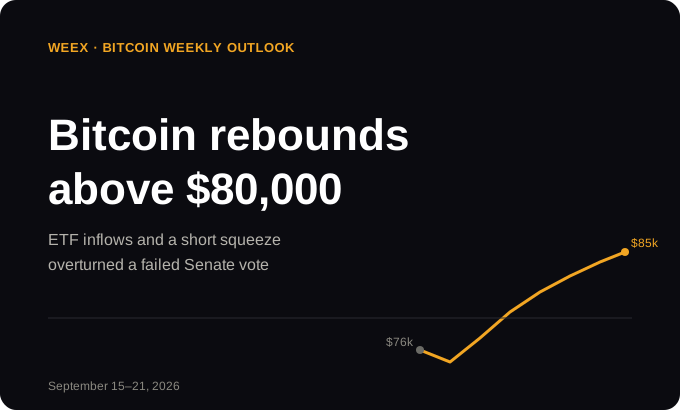
WEEX Bitcoin Weekly Outlook: Why Did Bitcoin Rebound Above $80,000 After the CLARITY Act Vote?
Bitcoin rebounded above $80,000 as SEC and CFTC action, renewed ETF inflows, and a short squeeze outweighed the failed CLARITY Act vote.

AMD Jumps Nearly 10%, Market Cap Tops $1 Trillion| WEEX TradFi Daily Brief (September 22, 2026)
Global markets on September 22 focus on a repair in AI-compute pricing. On September 21 the three major equity indexes closed higher. AMD rose nearly 10% and its market cap crossed $1 trillion for the first time, while Intel and Arm also surged. Brent crude fell about 3.4% to $100.34 and the 10-year Treasury yield eased to about 4.96%, lowering discount-rate pressure on long-duration tech. Bitcoin briefly broke above $87,000 and total crypto market cap returned above $3 trillion. Investors next watch consumer and housing earnings plus PMI flash prints.
Balancer Community Proposes Fork and Rebirth

The Answer to Dreamforce 2026: AI Agent, Has It Finally Turned from Demo to Revenue?

Ethereum: BitMine Approaches 5% of Total ETH Supply

Bitcoin's $84K rally isn't saving miners as difficulty signals already flash caution

ZEC's Largest Mining Company Moves to US Stock Market After Mining 70,000 ZEC in Six Months

Validators Vote on Batch V1.1 After Security Overhaul

Aptos Validators Decrease by 40% in Two Years, Concentration of Validator Nodes Shifts to Europe and America

SEC Takes Action: Who Can Handle "Compliant ICOs"?

TRON Weekly Industry Report: Regulatory and Interest Rate Pressures Fail to Dampen BTC Bullish Sentiment, Detailed Analysis of PayFi High-Performance Payment Infrastructure Axon Finance

When AI Agents Accelerate into Intranets: The Main Battlefield of Cybersecurity Has Changed
How to Earn Crypto Futures Trading Rewards on WEEX: Daily Lucky Eggs S2

ZetaChain, Linera, Switchboard Cease Operations
WEEX Futures Trading Rewards in Sep 2026: Win Up to 10,000 USDT

The Next Phase of Ethereum from the EF Protocol AMA

TapeOut Ecosystem Overview: From NAND, LATCH to On-Chain Application Ecosystem

BlackRock says Bitcoin volatility fell to 35–40
Coinbase Sets $100 Billion Market Cap Threshold for Individual Stock Futures, COIN Fails to Meet Criteria
Ripple says asset managers prepare for XRPL Batch
US Senate Fails to Approve CLARITY Act
XRP Ledger Changes Activated with Validator Approval

From Stablecoins to Consumer Finance, ENA is Gaining New Valuation Logic

Poverty in the World and Crypto Adoption: What If We Crossed the Two?
What is PCE and Why September 30 is Important for Cryptocurrencies
Why Trump backed a crypto ethics rule that stopped at the family business
Crypto: Kalshi accused of inflating its volumes with thousands of identical orders
HODLing ETH: Should You Choose Staking for Yield or Collateralized Lending?
SEC Clarity Meets Fed Rate Hike: How WEEX TradFi Lucky Eggs S2 Taps Into Cross-Market Opportunities
How Significant Are Changes in Overseas AI Investment?
WEEX Bitcoin Weekly Outlook: Why Did Bitcoin Rebound Above $80,000 After the CLARITY Act Vote?
Bitcoin rebounded above $80,000 as SEC and CFTC action, renewed ETF inflows, and a short squeeze outweighed the failed CLARITY Act vote.
AMD Jumps Nearly 10%, Market Cap Tops $1 Trillion| WEEX TradFi Daily Brief (September 22, 2026)
Global markets on September 22 focus on a repair in AI-compute pricing. On September 21 the three major equity indexes closed higher. AMD rose nearly 10% and its market cap crossed $1 trillion for the first time, while Intel and Arm also surged. Brent crude fell about 3.4% to $100.34 and the 10-year Treasury yield eased to about 4.96%, lowering discount-rate pressure on long-duration tech. Bitcoin briefly broke above $87,000 and total crypto market cap returned above $3 trillion. Investors next watch consumer and housing earnings plus PMI flash prints.
Contents
Latest articles





Latest coin listings on WEEX


