
- Buy Crypto
- Markets
 Futures
- Spot
- Copy Trade
 Earn
Earn- More
Uniswap Makes a Splash with $1.65 Billion Ecosystem Incentive - Can It Revitalize the DeFi Market?

Original Title: "Uniswap Community Allocates $165.5 Million to Incentivize Ecosystem Development, Where Is the DeFi Giant Heading Strategically?"
Original Author: Luke, Mars Finance
On March 20, 2025, the Uniswap community passed two governance proposals through on-chain voting, allocating a total of $165.5 million worth of UNI tokens to the Uniswap Foundation (UF) to incentivize ecosystem development. This funding will be divided into two parts: $95.4 million for developer grants and a two-year operational budget, and $25.1 million to support liquidity incentives for Uniswap v4 and Unichain. This decision not only marks Uniswap's largest community grant ever, but also reveals its ambition to pursue transformation and breakthroughs in the fiercely competitive decentralized finance (DeFi) market. This article will delve into the background of the proposal, strategic objectives, potential impacts, and challenges ahead, looking forward to the future development of the Uniswap ecosystem.
Background: Opportunities and Challenges Facing Uniswap
As a pioneer in the DeFi space, Uniswap's automated market maker (AMM) model has changed the landscape of digital asset trading since its launch in 2018. However, with the release of Uniswap v4 and the Layer 2 network Unichain in 2025, the project did not achieve the anticipated success promptly. Data shows that Uniswap v4's total value locked (TVL) is only $85 million, and Unichain is even lower, at only $8.2 million. Meanwhile, competitors are pouring up to $50 million worth of native token incentives monthly to grab market share. In this context, Uniswap urgently needs to revitalize ecosystem vitality through large-scale investment.
Furthermore, the community's call for a "fee switch" has never ceased. This mechanism aims to allocate a portion of protocol revenue from liquidity providers (LPs) to UNI token holders to enhance the token's value capture capability. However, due to the complexity of technology and governance, this feature has been slow to materialize, becoming the focus of community controversy. This allocation is seen as a key step towards paving the way for the "fee switch."
Core of the Proposal: Four Key Strategic Priorities
Uniswap Foundation has clearly outlined four major strategic directions for the next two years in the proposal, and the $165.5 million funding will revolve around these objectives:
1. Network Expansion: Enhancing Capital Efficiency
The goal is to provide the highest capital efficiency across all active EVM-compatible chains. To achieve this, Uniswap will leverage the innovative AMM features of v4 and Unichain's infrastructure to attract liquidity. A $45 million liquidity incentive program will be executed in collaboration with Gauntlet to boost TVL and market share in the short term. However, the foundation emphasizes that the long-term goal is not reliant on continued subsidies but rather on sustaining liquidity through organic demand.
2. Network Demand: Building a Premier Developer Platform
Uniswap v4 has lowered the barrier for developers to build new market structures through hooks, while Unichain has designed a Layer 2 environment optimized for DeFi. A $95.4 million grant budget will support the developer ecosystem, including educational programs (such as the Infinite Hackathon), infrastructure development, and the global developer ambassador program. Currently, over 1,000 developers are engaged in v4 hook development, creating more than 150 prototypes. The key to success lies in increasing the share of hook transactions and the number of Unichain developers.
3. Revenue Activation: Unlocking Value for Governance
Unichain has committed to allocating 65% of its on-chain net revenue to validators and stakers, while the foundation is exploring the establishment of a legal entity (such as DUNA) to enable governance entities to sign agreements with external entities and potentially introduce protocol revenue sharing. This sets the stage for the implementation of a "fee switch." If successful, UNI token holders will directly benefit, and the tokenomics will undergo a significant transformation.
4. Enlisting Core Contributors: Ensuring Long-Term Innovation
To achieve long-term sustainability, the foundation plans to introduce a "Core Contributors" program to fund development teams advancing Uniswap infrastructure (such as non-EVM versions or new hook protocols). These teams will collaborate directly with governance entities and receive compensation in UNI tokens. This initiative aims to reduce reliance on a single entity (such as Uniswap Labs) and promote governance decentralization.
Funding Allocation and Transparency Commitment
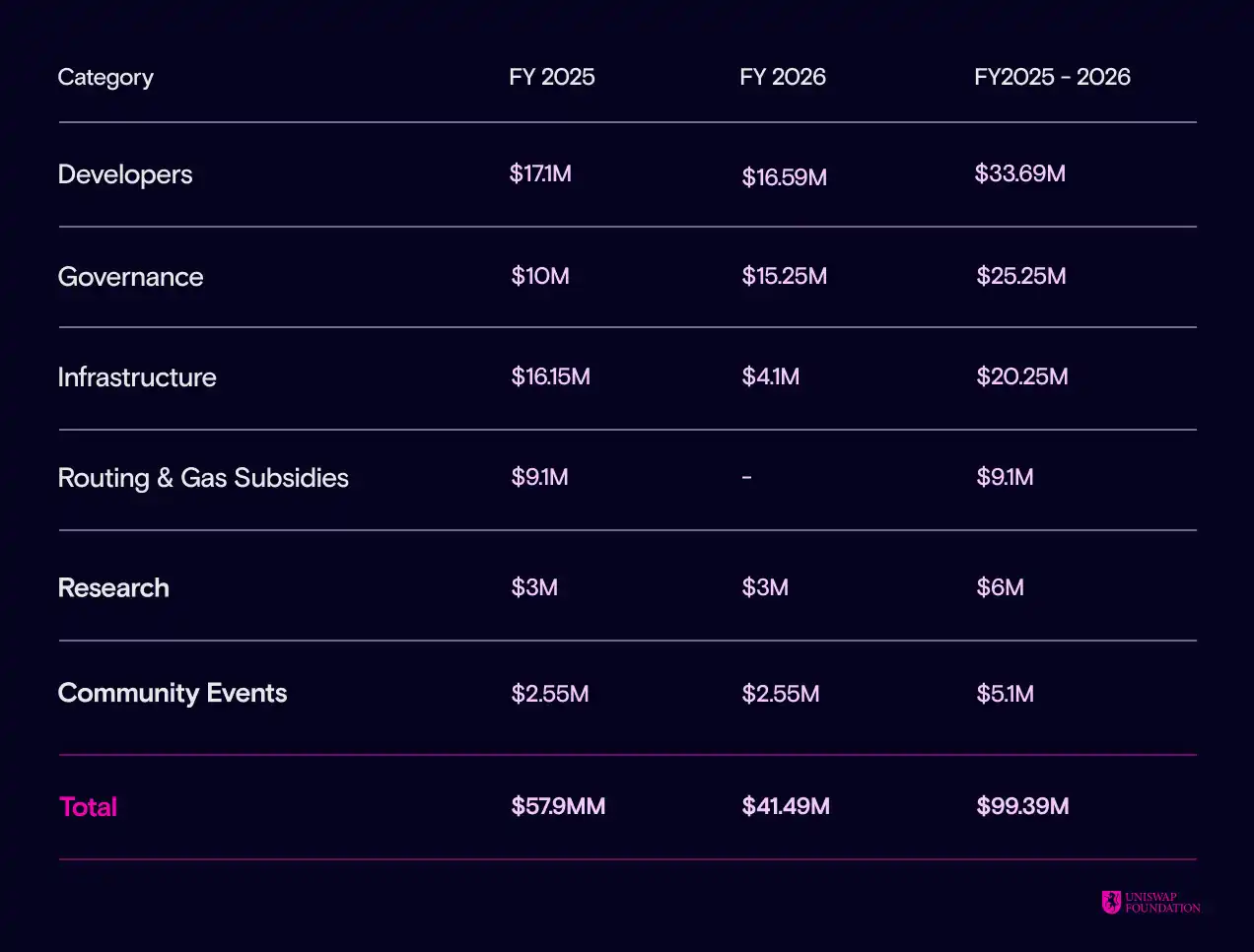
The proposal outlines the detailed use of funds:
· Grant Budget: $57.9 million for 2025 and $41.5 million for 2026, totaling $99.4 million (net $95.4 million). The funds will support developer projects and the Unichain ecosystem, with clear performance targets set (e.g., TVL, market share, etc.).
· Operating Budget: The two-year cash budget is $24.8 million, with an additional 1.5 million UNI (approximately $13.8 million) allocated for employee salaries. The foundation plans to onboard 12 new employees, covering governance, developer support, and other areas.
· Transparency Measures: The foundation commits to enhancing transparency through regular reporting and community meetings. By May 8, 2025, the foundation will collaborate with the Uniswap Accountability Committee (UAC) to establish a board of representatives to oversee strategic execution.
Potential Impact: Balancing Opportunities and Risks
Opportunities
Ecosystem Growth: The $165.5 million allocation, if executed properly, could significantly enhance the competitiveness of Uniswap v4 and Unichain, especially in the developer ecosystem and liquidity provision. Token Value Appreciation: The potential implementation of the "fee switch" would give UNI actual revenue attributes, attracting more investors. Governance Upgrade: The introduction of core contributors and legal entities will drive Uniswap towards a more decentralized governance model.
Risks
Funding Size Debate: Some community members question the necessity of the $165.5 million, pointing out that Uniswap Labs earned $171 million in front-end fees over two years but did not share the profits with UNI holders. This centralized model may erode trust. Liquidity Migration: The $45 million in incentives could potentially draw funds away from Ethereum or other Layer 2 solutions, creating opportunities for competitors. Governance Efficiency: There is still uncertainty surrounding the plans of core contributors and the implementation of a conditional liquidity market, and the governance structure's ability to manage effectively remains to be seen.
Market Response and Future Outlook
Following the proposal's approval, the UNI token price rose to $7.52 on March 19, with a daily increase of 5.62%, demonstrating the market's optimism about its growth plans. However, whether the price can continue to rise depends on the effectiveness of execution. In the short term, liquidity incentives and developer support may yield visible results; in the long term, the implementation of the "fee switch" and governance upgrades will determine whether Uniswap can solidify its DeFi leadership position.
The Uniswap community stands at a crossroads. This $165.5 million investment is not only a ramp-up of its technology and ecosystem but also a profound attempt to reform its governance model. For investors and observers, the upcoming execution details, market feedback, and community consensus will be crucial in determining Uniswap's future trajectory. Whether the pioneer of DeFi can continue to lead the trend, 2025 will be a decisive year.
You may also like

Key Market Intelligence for February 5th, how much did you miss out on?

Wintermute: By 2026, crypto had gradually become the settlement layer of the Internet economy

Tether Q4 2025 Report: USDT Market Cap Nears $190 Billion, Multiple Metrics Reach All-Time Highs

Kyle Samani's about-face, one of the biggest believers in web3, has also left the industry

Bhutan Quietly Sells Over $22M in Bitcoin, Drawing Speculation Over Possible Moves
Key Takeaways Bhutan has transferred over $22 million in Bitcoin from sovereign wallets in the past week. The…

BitMine Endures a $7B Unrealized Loss as Ethereum Dips Below $2,100
Key Takeaways BitMine is facing a significant financial challenge with an unrealized loss of over $7 billion in…

Trump-Linked World Liberty Financial Under Scrutiny Following $500 Million UAE Stake
Key Takeaways A U.S. House investigation is examining a $500 million UAE stake in Trump-related World Liberty Financial.…

Asia Market Open: Bitcoin Tumbles as Asian Equities Reflect Global Tech Retreat
Key Takeaways: Bitcoin’s price plunged by 6% to $72,000, reflecting the spillover effects from the global tech sector’s…

Crypto Firms Propose Concessions to Banks as Stablecoin Disputes Stall Key Crypto Bill
Key Takeaways: Crypto companies are attempting to navigate stablecoin disputes with banks but agreements remain elusive. Industry representatives…

CoolWallet Introduces TRON Energy Rental to Minimize TRX Transaction Costs
Key Takeaways CoolWallet has integrated TRON’s energy rental services, offering users lower transaction fees while maintaining asset security.…

CFTC Officially Withdraws Biden-Era Proposal to Ban Political and Sports Prediction Markets
Key Takeaways: The CFTC has rescinded a 2024 proposal and subsequent 2025 advisory that aimed to prohibit event…

Binance Says Assets Rose Amid Alleged Bank Run Attempt
Key Takeaways: Binance reported an unexpected increase in assets during a community-driven withdrawal campaign, challenging conventional expectations of…

Same Macro Tape, Different Bid – Gold Absorbs Flows as Bitcoin Swings
Key Takeaways: Gold is experiencing significant demand growth, especially via ETFs and central banks, projecting a robust performance…
Crypto Price Prediction Today, February 4 – Focus on XRP, Cardano, and Dogecoin
Key Takeaways Bitcoin is facing significant pressure, affecting the entire cryptocurrency market, including heavyweights like XRP, Cardano, and…

Vitalik Buterin Urges Ethereum Builders to Innovate Beyond Clone Chains
Key Takeaways Vitalik Buterin criticizes the trend of creating copy-paste EVM chains, encouraging developers to focus on truly…
Best Crypto to Buy Now February 4: XRP, Solana, Hyperliquid Picks
Key Takeaways XRP remains one of the top picks for cross-border transactions due to its high speed and…
XRP Price Prediction: Ripple Quietly Unlocks a Billion Tokens – Is a Price Shock Coming in the Next Few Hours?
Key Takeaways Ripple has released one billion XRP tokens into the market, potentially causing a shift in XRP…

Google’s Gemini AI Predicts the Price of XRP, Ethereum, and Solana By the End of 2026
Key Takeaways Google’s Gemini AI forecasts significant growth for XRP, anticipating a price of up to $8 by…
Key Market Intelligence for February 5th, how much did you miss out on?
Wintermute: By 2026, crypto had gradually become the settlement layer of the Internet economy
Tether Q4 2025 Report: USDT Market Cap Nears $190 Billion, Multiple Metrics Reach All-Time Highs
Kyle Samani's about-face, one of the biggest believers in web3, has also left the industry
Bhutan Quietly Sells Over $22M in Bitcoin, Drawing Speculation Over Possible Moves
Key Takeaways Bhutan has transferred over $22 million in Bitcoin from sovereign wallets in the past week. The…
BitMine Endures a $7B Unrealized Loss as Ethereum Dips Below $2,100
Key Takeaways BitMine is facing a significant financial challenge with an unrealized loss of over $7 billion in…


 App
App