
- Buy Crypto
- Markets
 Futures
- Spot
- Copy Trade
 Earn
Earn- More
Six Years of Cultivation, Writing a New Chapter in Finance, Matrixport's Advanced Journey from Crypto Asset Management to Super-Financial Account

Perhaps the memecoin PvP of this cycle has become truly boring, causing the market to fall into aesthetic fatigue. People are starting to reminisce about the golden age that truly shaped crypto history: ICOs littered the ground with money, creating countless wealth myths; Bitcoin fork wars sparked hashrate battles; the "HBO" triumvirate staged a power play among exchanges; the afro-haired SBF shone brightly with Wall Street connections and high-frequency trading capabilities...
Those who once stirred up storms in the crypto world, the "early elders of the coin circle," are now scattered in a parallel timeline, becoming topics of idle chatter: Li Xiaolai just released a new book on mental acuity and focus; Wang Chunhao spent $200 million on a space ticket; Sun Yuchen and Li Lin staged a "wine-sharing" reconciliation scene at a Hong Kong banquet; CZ jokingly mentioned "Sun's Olympic champion girlfriend" at an event. In Hong Kong's dinner parties, the elders of the coin circle mingled, toasted, and smiled brightly...
"Where is Wu Jihan?" someone couldn't help but ask.
The individual who once enlightened the industry as the first Chinese translator of the Bitcoin whitepaper, the creator of the Bitmain Empire, seems to deliberately hide from the spotlight, becoming increasingly low-key and mysterious. Many people know that after Bitmain's split, Wu Jihan, with shared mining operations and overseas mining farms, founded BitDeer.
Few have noticed that in this "split," Wu Jihan also took along Bitmain's Executive Director and Senior Investment Director, the then twenty-something Ge Yuesheng, giving birth to Matrixport, a crypto asset management company.

Left: Ge Yuesheng; Right: Wu Jihan
The Prehistoric Era of Matrixport
"My first internship, President Han was an investment manager and also my internship mentor. He introduced me to things like Bitcoin and mining," in a conversation with BlockBeats, Ge Yuesheng unconsciously traced the texture of the pillow, as if touching memories from 2013.
Let's rewind to twelve years ago, to that summer in Hangzhou, where a 21-year-old business management graduate could never have imagined that the Bitcoin evangelist he met during his internship at a VC firm would completely alter his life trajectory.
At that time, Wu Jihan was already a Bitcoin evangelist. He co-founded the Chinese area's earliest blockchain media outlet, 8btc, with Zhang Nian and others. Ge Yuesheng, who had been interested in hardware and computers since he was young, naturally had a curiosity about Bitcoin. One preached, one sought knowledge, and the two conversed more and more about mining, Bitcoin, and blockchain-related topics.
「So the two of us put our heads together and decided to go mining.」 Subsequently, they together invested in Bitcoin mining machines, built mining farms, and played until they decided to develop their own mining chips. They found the technical partner, Zhan Ketuan, and thus created Bitmain. Ge Yuesheng also joined Bitmain as a director and head of investment, witnessing the entire process of this hashing power revolution.
We mostly know what happened next. After several years of development, Bitmain became a giant in the token circle, covering all aspects of the business including mining machines, mining pools, mining farms, and trading platforms, and it received investments from major capital firms such as Sequoia Capital China. By early 2018, Bitmain had become the world's largest cryptocurrency mining machine company. At its peak, for every ten Bitcoin mining machines globally, seven were from this company, and for every ten Bitcoins mined, over half came from its mining farms.
These brilliant achievements were once Bitmain's medals of honor. However, its blocked IPO, asset shrinkage, management turmoil also brought criticism, leaving indelible scars. The end of 2018 was an especially harsh winter—when the price of Bitcoin fell below $4,000, this hashing power giant faced its darkest moment: a failed Hong Kong IPO, ammunition depleted in the BCH hashing war, and internal founder disputes gradually came to light.
After a night of thorough discussions, Wu Jihan and Ge Yuesheng chose to carry a new torch and leave the old camp. In February 2019, Matrixport was established in Singapore as a cryptocurrency asset management platform, with Wu Jihan as Chairman of the Board and Ge Yuesheng as CEO.
After Bitmain, Wu Jihan and Ge Yuesheng's Second Entrepreneurship
At that time, the main battlefields in the crypto world were only two sectors—the mining industry with roaring machines and the exchange battlefield shrouded in smoke. True asset management services were almost untouched; in the eyes of most, "asset management" was still an exclusive term of traditional finance. As Ge Yuesheng put it: "We were among the first in the industry to start asset management. Before that, the crypto world did not really have the concept of asset management; it was a very niche track."
This means that for Matrixport to engage in crypto asset management was like planting trees in a desert—there were no benchmarks. "Industry recognition" is a very abstract term, and when pioneering a new path, the role of industry recognition becomes apparent.

Left: Ge Yuesheng; Right: Wu Jihan, Image Source: Matrixport
In Ge Yuesheng's cognitive framework, wealth creation in the crypto world is divided into two forms: one is Market Beta Returns, such as "Bitcoin rising from $40,000 to $120,000, everyone becoming wealthy, paper wealth soaring, this all-encompassing appreciation does not lead to actual wealth transfer"; the other is Alpha Returns, "some gain while others lose, wealth undergoes redistribution and financial transfer, fundamentally taking money from others' pockets."
Based on this understanding, Matrixport's early business blueprint was divided into two dimensions: on the Beta side, fees are charged through spot trading and custody services; on the Alpha side, earnings are shared through quantitative strategies and structured product participation.
At a more specific product level, on the Beta side, Matrixport established an institutional-grade digital asset custody service provider, Cactus Custody; on the Alpha side, Matrixport introduced a series of diversified wealth management products, which received significant focus in the later stages.
The First Bull Market, Matrixport Created a New Unicorn
Matrixport was born in a bear market. As crypto OGs, Ge Yuesheng and Wu Jihan have experienced several cycles, witnessing many in the crypto space becoming poor overnight. They are well aware that "crypto investment is ten bets, nine losses, and even ten bets, ten losses." Crypto users need more than just a higher leverage gambling venue; they need a safety net to prevent asset loss, which is the true value of crypto wealth management services.
"Therefore, Matrixport aims to make Alpha money and help users engage in more stable wealth management," Ge Yuesheng told BlockBeats.
To persuade customers to move their money from their own wallets to the Matrixport platform, like in all traditional asset management industries, trust is the first hurdle. Fortunately, the industry credibility they accumulated during their time at Bitmain played a critical role, with those old miner friends who once spent nights debugging miners in the outskirts of Beijing becoming Matrixport's earliest cornerstone users.
Those who understand miners' needs the most are still the miners themselves; as first-generation miners in the crypto space, Ge Yuesheng and Wu Jihan deeply understand the true needs of miners.
At that time, the mining community lacked effective hedging tools. On one hand, they wanted to hoard Bitcoin, but on the other hand, they had to sell coins regularly to pay high electricity bills while also worrying about price volatility affecting mining revenue. Therefore, Matrixport first introduced the "DCI Dual Currency Investment" model from traditional asset management into the crypto space.
Dual Currency Structured Investment is essentially the combination of a money market deposit and a currency option to provide a return higher than the standard yield. In the traditional foreign exchange market, purchasing RMB and HKD dual currency products can achieve an approximately 10% annual return, while automatically hedging the conversion risk between the two currencies. When applied in the crypto field, the product introduced by Matrixport combines fiat currency with cryptocurrency.
For example, a miner who originally had to sell 100 bitcoins every month to pay a $3 million electricity bill can now use this product and set a conversion price 5% below market price. If the price of bitcoin rises, the miner can earn an 8% annualized return; if it falls, they can convert at the predetermined price to USDT to pay the electricity bill. This product falls under the category of fixed-income contracts, with the yield ratio agreed upon at the time of signing and delivered in different currencies upon maturity. It has been imitated by exchanges like Binance and gradually become an industry standard.
A bull market always accompanies the fastest growth. During the 2021 bull market surge, Matrixport achieved a key leap, establishing a closed-loop product matrix covering "custody-trading-lending-wealth management"; structured products gradually went online, the team size expanded from tens of people to over a hundred; and the customer base transitioned from solely miners to diversified entities such as family offices and hedge funds.
It was this "infrastructure + strategic ecosystem" model that enabled Matrixport to successfully attract investments from top institutions such as DST Global, C Ventures, and K3 Ventures in August 2021, valuing the company at $1 billion, completing a Series C funding round, and becoming one of Singapore's unicorns.
Survival Philosophy of Matrixport in a Market Crash
Everything always has two sides. The flip side of the crypto industry's wealth creation effect is the frequent market crashes and high-profile liquidation events. Even the industry darling FTX suffered an overnight liquidation due to poor risk management, causing a one-day evaporation of hundreds of billions of dollars in crypto market capitalization. Those once high-flying institutions: Three Arrows Capital, BlockFi, Celsius, all demonstrated the cost of greed.
Since its inception, Matrixport has weathered two bull-bear cycles. Looking back on the journey of ups and downs, Ge Yuesheng believes that the smartest thing Matrixport has done is its conservative business philosophy.
As he puts it, "Being a conservative asset management institution, instead of always thinking about how to make money, one should leave a safety cushion for any business. This may be the reason why Matrixport still exists today." CEO Ge Yuesheng, who has experienced Bitcoin's more than ten halvings, speaks calmly and firmly, exuding a convincing confidence.
Unlike some companies that suffered from one-sided market-making, Ge Yukun can't remember what he was doing on the day of an extreme market event. For Matrixport, although market impact is inevitable, the impact has always been firmly controlled within an acceptable range. "We ourselves will not face any liquidity crunch because we don't use leverage, we don't need to top up margin, even in an industry-wide crash, the money is still there."
Matrixport has established an internal risk control committee, relying on a rigorous risk model and high-standard operational processes, to properly manage funds even in extreme market conditions. Faced with a scenario of large redemptions due to panic or strategy adjustments, the company has long prepared corresponding plans that can meet clients' needs for bottom fishing or adding positions during liquidity crunch while avoiding endangering overall security due to excessive market speculation.
"For our asset management institution, the most common scenario in an extreme market event is clients redeeming their assets, leading to a liquidity shortage. The liquidity shortage could be due to two possibilities: one is for bottom fishing, and the second is for adding positions. For these two possibilities, we have launched corresponding products that can directly assist clients in their operations."
Security and risk control are actually things that many people have talked about to exhaustion, but in fact, many peers still suffer losses in these two areas. Ge Yukun understands deeply that "security" and "risk control" are the two cornerstones of the asset management industry, and it is on this foundation that service quality and product competitiveness are built.
When asked about the client attraction strategy during a bear market, Ge Yukun's response was quite unexpected: "We don't take specific actions to attract clients."
In his view, regardless of a bull or bear market, the change in Matrixport's asset scale is not significant. Because the fluctuation in coin prices only changes the total market value measured in USD, Matrixport does not make significant operational adjustments in either a bear or bull market, only normal iterations.
"The underlying logic of the asset management industry is actually very simple: help clients make money, and then take a portion of the money earned. Unlike traditional asset management models where a fixed management fee is charged even if clients lose money, the unique high volatility of the crypto industry means that crypto asset management, unable to simply replicate this logic, also has its profit ceiling constrained. Regardless of how sluggish the market is, no product can achieve high returns; even in a bull market, the profit potential is also limited by the actual profit level of clients. Crypto asset management is essentially a collaborative relationship where interests are closely tied with clients."
In Ge Yukun's view, true asset management demand has never been related to market trends: "That's how the asset management industry is – even Buffett doesn't make money every year, but that doesn't stop him from being the richest man."
Compared to the price volatility, Matrixport is more concerned about changes in the interest rate market. Once the interest rate market heats up, the growth rate and yield of the asset management industry will both increase significantly.
However, similar to the growth rate data provided by some trading platforms, Matrixport also feels that, based on the current situation, the current bull market—from last year to this year—is significantly less heated compared to the previous cycle.
"During the violent expansion period from November to early December last year, the interest rate level reached its peak, but then quickly declined. Compared to the previous bull market, not only was the duration shorter, but the peak level was also significantly lower," Ge Yuesheng mentioned some data support, the level of interest rates that long parties are willing to borrow reflects the speculative enthusiasm and the situation of the interest rate market.
Through two bull and bear cycles, Matrixport steadily develops
After weathering the storm, Matrixport has entered a new stage of steady development. In Matrixport's customer portrait, cryptocurrency investors are clearly divided into two types of people: one is hands-on trading, participating in DeFi mining, chasing meme coin trends, the adventurers who "treat this as a casino and playground"; the other is those who view cryptocurrency assets as part of their portfolio, the allocators who "treat it with the same calmness as buying gold ETFs," and the difference between these two types of customers is quite significant.
"Our main customers are still the second type, who can accept a reasonable pricing between returns and risks, and then entrust their funds to us." From the earliest group of miners to now, Matrixport's main users have transitioned to high-net-worth individuals and institutions, who are more concerned about long-term annualized returns than tomorrow's Bitcoin price fluctuations.
In terms of global strategic layout, Matrixport adheres to the operating principle of "where the money is, we go." "Financial institutions have a strong local presence, and if you live in the United States, you will definitely prefer to keep your money in a local bank," as Ge Yuesheng put it. Starting from Singapore, Matrixport has expanded to Hong Kong, Bangkok, and multiple points in Europe. Matrixport's global compliance layout has begun to take shape, securing multiple financial licenses in different regions. As of now, Matrixport's compliance map spans three continents:
Asia: Hong Kong Trust Company License, Money Lender License; Singapore MAS Major Payment Institution License (acquired by subsidiary Fly Wing in 2025);
Europe: UK FCA Compliance Authorization, Switzerland FINMA SRO-VFQ Membership; in 2024, acquired the Swiss CFAM license and upgraded to MAM (Matrixport Asset Management AG);
Americas: US MSB Money Services Business License.
Facing the question of "Why not enter the Middle East," Ge Yuesheng gave a rational answer: "The Middle East is very special, and in fact, today the vast majority of fund management for Middle Easterners is actually in Switzerland."
For Matrixport, Asia as a huge market and the important region for localized operations in Europe and America both occupy a pivotal position in the company's strategic vision. Through the Swiss license, the company can not only cover the entire European market but also radiate to the Middle East region with its unique advantage. As for the higher compliance costs and more competitive US market, the company is adopting a steady and gradual approach.
In terms of product matrix construction, Matrixport continues to innovate and has gradually launched a series of products that can meet the needs of different people with different risk appetites, forming a complete product system.
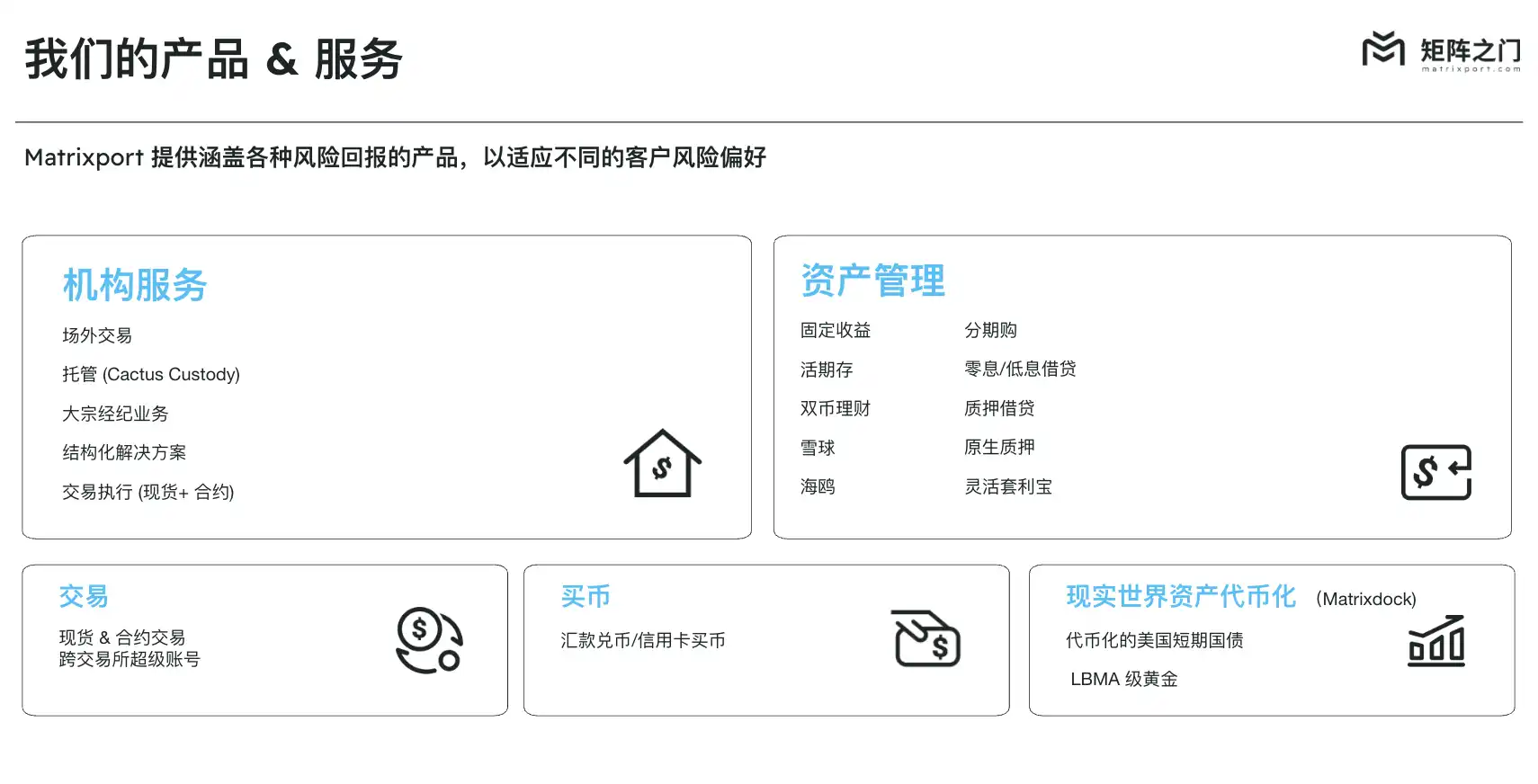
Basic and Advanced Asset Management Solutions: Matrixport provides a diverse and comprehensive wealth management solution. This includes basic wealth management such as current deposits and fixed income that are suitable for stable returns; structured wealth management products such as dual-currency, shark fin, trend win, seagull, snowball, installment purchase, DNT, etc. tailored to different income needs; ETH Staking and Restaking on-chain wealth management that meet the needs of on-chain rewards; as well as strategy investment products targeting public and private domain traffic seeking diversified returns;
Comprehensive Institutional Service Support: Matrixport provides comprehensive professional support, covering over-the-counter trading services (OTC), institutional-grade custody services (Cactus Custody), bulk brokerage services, etc.;
Tokenization of Real-World Assets: Matrixport has also built the RWA platform Matrixdock and issued short-term US bond tokens STBT and gold tokens XAUm. This allows investors to hold excellent assets from the traditional financial markets on-chain, further optimizing asset allocation. Although FTX has also attempted similar products in the past, most competitors do not focus on this niche market. Compared to this area where other platforms rarely venture, Matrixport has shown remarkable foresight in the RWA sector.
Powerful Trading Experience: Matrixport has also enhanced the trading functions of its platform, creating a smooth spot trading system and contract trading functions that rival top exchanges in depth and breadth;
Professional Research Reports to Aid Investment Decisions: Leveraging its professional analytical capabilities, Matrixport regularly produces high-quality industry research reports, delving deep into market dynamics, emerging trends, and providing valuable market information to its users. Its reports' accuracy has gained popularity in the community. Whether you are a novice trader or a seasoned player, you can use the Matrixport App to complete full-circle operations in the cryptocurrency financial field, enjoying a convenient, efficient, and professional cryptocurrency financial experience.
Matrixport started with asset management but has always been committed to becoming a one-stop super account entrance for users to enter the Web3 field. By continuously enriching its product categories, Matrixport has effectively lowered the barrier for users to enter the Web3 field, providing users with one-stop encrypted financial services, truly achieving multidimensional value creation.
At the same time, the company has experienced explosive data growth. According to Ge Yuesheng, the latest market data shows that Matrixport's managed and custodied assets have reached $6 billion, and from the perspective of the balance sheet, core data remains stable at around $4 billion. This achievement is a strong proof of the company's rigorous risk control and sound business philosophy.
Standing at This Moment, Looking at the Next Six Years
Six years have flown by in the blink of an eye, from initially envisioning the Bitcoin miracle in a cold night at the mine to now a global compliance layout and a stage of continuously extending financial services. The birth and growth of Matrixport have witnessed much history.
"I hope to become more compliant and to become a public-listed company." This year marks the sixth year of Matrixport's existence. While envisioning the next six years, Ge Yuesheng confidently outlines the company's blueprint: Matrixport not only aims to become the authoritative entrance for encrypted assets but also aims to extend to a broader financial field, providing customers with one-stop encrypted financial services covering OTC trading to diversified asset management.
For all companies in the encryption industry, when a company grows to a certain scale, there are two ways out: a traditional IPO or the trendy IDO. However, Matrixport has chosen the traditional IPO route because the purpose of going public is not only for cashing out but also to enhance credibility and reduce customer trust costs. Just as the different interest rates offered by traditional financial institutions' deposits symbolize, credibility comes with a cost. It is this openness, transparency, and authority that make customers willing to entrust millions of dollars here.
As the wheels of history roll forward, we will always remember these moments that shape destiny. Just as Ge Yuesheng reflected, "The development of anything follows its objective laws, and the same goes for the encryption industry; what we pursue is not a momentary novelty but long-term stability and profound trust."
Just like its name, Matrixport, derived from Wu Jihan's favorite movie "The Matrix," implies a matrix full of infinite possibilities, while "port" symbolizes an entrance. This not only represents the birth of a company but also serves as a gateway leading investors into the encrypted world.
When Three Arrows Capital sank in the leverage game, when BlockFi collapsed due to liquidity drying up, when trillions of "old money" passed through this gateway, people will finally understand: true asset management never relies on the leverage myth, true asset management is not the frenzy of a bull market, but rather the watchmen who stay committed to the industry long-term regardless of market conditions.
You may also like

Token Cannot Compound, Where Is the Real Investment Opportunity?

February 6th Market Key Intelligence, How Much Did You Miss?

China's Central Bank and Eight Other Departments' Latest Regulatory Focus: Key Attention to RWA Tokenized Asset Risk
Foreword: Today, the People's Bank of China's website published the "Notice of the People's Bank of China, National Development and Reform Commission, Ministry of Industry and Information Technology, Ministry of Public Security, State Administration for Market Regulation, China Banking and Insurance Regulatory Commission, China Securities Regulatory Commission, State Administration of Foreign Exchange on Further Preventing and Dealing with Risks Related to Virtual Currency and Others (Yinfa [2026] No. 42)", the latest regulatory requirements from the eight departments including the central bank, which are basically consistent with the regulatory requirements of recent years. The main focus of the regulation is on speculative activities such as virtual currency trading, exchanges, ICOs, overseas platform services, and this time, regulatory oversight of RWA has been added, explicitly prohibiting RWA tokenization, stablecoins (especially those pegged to the RMB). The following is the full text:
To the people's governments of all provinces, autonomous regions, and municipalities directly under the Central Government, the Xinjiang Production and Construction Corps:
Recently, there have been speculative activities related to virtual currency and Real-World Assets (RWA) tokenization, disrupting the economic and financial order and jeopardizing the property security of the people. In order to further prevent and address the risks related to virtual currency and Real-World Assets tokenization, effectively safeguard national security and social stability, in accordance with the "Law of the People's Republic of China on the People's Bank of China," "Law of the People's Republic of China on Commercial Banks," "Securities Law of the People's Republic of China," "Law of the People's Republic of China on Securities Investment Funds," "Law of the People's Republic of China on Futures and Derivatives," "Cybersecurity Law of the People's Republic of China," "Regulations of the People's Republic of China on the Administration of Renminbi," "Regulations on Prevention and Disposal of Illegal Fundraising," "Regulations of the People's Republic of China on Foreign Exchange Administration," "Telecommunications Regulations of the People's Republic of China," and other provisions, after reaching consensus with the Cyberspace Administration of China, the Supreme People's Court, and the Supreme People's Procuratorate, and with the approval of the State Council, the relevant matters are notified as follows:
(I) Virtual currency does not possess the legal status equivalent to fiat currency. Virtual currencies such as Bitcoin, Ether, Tether, etc., have the main characteristics of being issued by non-monetary authorities, using encryption technology and distributed ledger or similar technology, existing in digital form, etc. They do not have legal tender status, should not and cannot be circulated and used as currency in the market.
The business activities related to virtual currency are classified as illegal financial activities. The exchange of fiat currency and virtual currency within the territory, exchange of virtual currencies, acting as a central counterparty in buying and selling virtual currencies, providing information intermediary and pricing services for virtual currency transactions, token issuance financing, and trading of virtual currency-related financial products, etc., fall under illegal financial activities, such as suspected illegal issuance of token vouchers, unauthorized public issuance of securities, illegal operation of securities and futures business, illegal fundraising, etc., are strictly prohibited across the board and resolutely banned in accordance with the law. Overseas entities and individuals are not allowed to provide virtual currency-related services to domestic entities in any form.
A stablecoin pegged to a fiat currency indirectly fulfills some functions of the fiat currency in circulation. Without the consent of relevant authorities in accordance with the law and regulations, any domestic or foreign entity or individual is not allowed to issue a RMB-pegged stablecoin overseas.
(II)Tokenization of Real-World Assets refers to the use of encryption technology and distributed ledger or similar technologies to transform ownership rights, income rights, etc., of assets into tokens (tokens) or other interests or bond certificates with token (token) characteristics, and carry out issuance and trading activities.
Engaging in the tokenization of real-world assets domestically, as well as providing related intermediary, information technology services, etc., which are suspected of illegal issuance of token vouchers, unauthorized public offering of securities, illegal operation of securities and futures business, illegal fundraising, and other illegal financial activities, shall be prohibited; except for relevant business activities carried out with the approval of the competent authorities in accordance with the law and regulations and relying on specific financial infrastructures. Overseas entities and individuals are not allowed to illegally provide services related to the tokenization of real-world assets to domestic entities in any form.
(III) Inter-agency Coordination. The People's Bank of China, together with the National Development and Reform Commission, the Ministry of Industry and Information Technology, the Ministry of Public Security, the State Administration for Market Regulation, the China Banking and Insurance Regulatory Commission, the China Securities Regulatory Commission, the State Administration of Foreign Exchange, and other departments, will improve the work mechanism, strengthen coordination with the Cyberspace Administration of China, the Supreme People's Court, and the Supreme People's Procuratorate, coordinate efforts, and overall guide regions to carry out risk prevention and disposal of virtual currency-related illegal financial activities.
The China Securities Regulatory Commission, together with the National Development and Reform Commission, the Ministry of Industry and Information Technology, the Ministry of Public Security, the People's Bank of China, the State Administration for Market Regulation, the China Banking and Insurance Regulatory Commission, the State Administration of Foreign Exchange, and other departments, will improve the work mechanism, strengthen coordination with the Cyberspace Administration of China, the Supreme People's Court, and the Supreme People's Procuratorate, coordinate efforts, and overall guide regions to carry out risk prevention and disposal of illegal financial activities related to the tokenization of real-world assets.
(IV) Strengthening Local Implementation. The people's governments at the provincial level are overall responsible for the prevention and disposal of risks related to virtual currencies and the tokenization of real-world assets in their respective administrative regions. The specific leading department is the local financial regulatory department, with participation from branches and dispatched institutions of the State Council's financial regulatory department, telecommunications regulators, public security, market supervision, and other departments, in coordination with cyberspace departments, courts, and procuratorates, to improve the normalization of the work mechanism, effectively connect with the relevant work mechanisms of central departments, form a cooperative and coordinated working pattern between central and local governments, effectively prevent and properly handle risks related to virtual currencies and the tokenization of real-world assets, and maintain economic and financial order and social stability.
(5) Enhanced Risk Monitoring. The People's Bank of China, China Securities Regulatory Commission, National Development and Reform Commission, Ministry of Industry and Information Technology, Ministry of Public Security, State Administration of Foreign Exchange, Cyberspace Administration of China, and other departments continue to improve monitoring techniques and system support, enhance cross-departmental data analysis and sharing, establish sound information sharing and cross-validation mechanisms, promptly grasp the risk situation of activities related to virtual currency and real-world asset tokenization. Local governments at all levels give full play to the role of local monitoring and early warning mechanisms. Local financial regulatory authorities, together with branches and agencies of the State Council's financial regulatory authorities, as well as departments of cyberspace and public security, ensure effective connection between online monitoring, offline investigation, and fund tracking, efficiently and accurately identify activities related to virtual currency and real-world asset tokenization, promptly share risk information, improve early warning information dissemination, verification, and rapid response mechanisms.
(6) Strengthened Oversight of Financial Institutions, Intermediaries, and Technology Service Providers. Financial institutions (including non-bank payment institutions) are prohibited from providing account opening, fund transfer, and clearing services for virtual currency-related business activities, issuing and selling financial products related to virtual currency, including virtual currency and related financial products in the scope of collateral, conducting insurance business related to virtual currency, or including virtual currency in the scope of insurance liability. Financial institutions (including non-bank payment institutions) are prohibited from providing custody, clearing, and settlement services for unauthorized real-world asset tokenization-related business and related financial products. Relevant intermediary institutions and information technology service providers are prohibited from providing intermediary, technical, or other services for unauthorized real-world asset tokenization-related businesses and related financial products.
(7) Enhanced Management of Internet Information Content and Access. Internet enterprises are prohibited from providing online business venues, commercial displays, marketing, advertising, or paid traffic diversion services for virtual currency and real-world asset tokenization-related business activities. Upon discovering clues of illegal activities, they should promptly report to relevant departments and provide technical support and assistance for related investigations and inquiries. Based on the clues transferred by the financial regulatory authorities, the cyberspace administration, telecommunications authorities, and public security departments should promptly close and deal with websites, mobile applications (including mini-programs), and public accounts engaged in virtual currency and real-world asset tokenization-related business activities in accordance with the law.
(8) Strengthened Entity Registration and Advertisement Management. Market supervision departments strengthen entity registration and management, and enterprise and individual business registrations must not contain terms such as "virtual currency," "virtual asset," "cryptocurrency," "crypto asset," "stablecoin," "real-world asset tokenization," or "RWA" in their names or business scopes. Market supervision departments, together with financial regulatory authorities, legally enhance the supervision of advertisements related to virtual currency and real-world asset tokenization, promptly investigating and handling relevant illegal advertisements.
(IX) Continued Rectification of Virtual Currency Mining Activities. The National Development and Reform Commission, together with relevant departments, strictly controls virtual currency mining activities, continuously promotes the rectification of virtual currency mining activities. The people's governments of various provinces take overall responsibility for the rectification of "mining" within their respective administrative regions. In accordance with the requirements of the National Development and Reform Commission and other departments in the "Notice on the Rectification of Virtual Currency Mining Activities" (NDRC Energy-saving Building [2021] No. 1283) and the provisions of the "Guidance Catalog for Industrial Structure Adjustment (2024 Edition)," a comprehensive review, investigation, and closure of existing virtual currency mining projects are conducted, new mining projects are strictly prohibited, and mining machine production enterprises are strictly prohibited from providing mining machine sales and other services within the country.
(X) Severe Crackdown on Related Illegal Financial Activities. Upon discovering clues to illegal financial activities related to virtual currency and the tokenization of real-world assets, local financial regulatory authorities, branches of the State Council's financial regulatory authorities, and other relevant departments promptly investigate, determine, and properly handle the issues in accordance with the law, and seriously hold the relevant entities and individuals legally responsible. Those suspected of crimes are transferred to the judicial authorities for processing according to the law.
(XI) Severe Crackdown on Related Illegal and Criminal Activities. The Ministry of Public Security, the People's Bank of China, the State Administration for Market Regulation, the China Banking and Insurance Regulatory Commission, the China Securities Regulatory Commission, as well as judicial and procuratorial organs, in accordance with their respective responsibilities, rigorously crack down on illegal and criminal activities related to virtual currency, the tokenization of real-world assets, such as fraud, money laundering, illegal business operations, pyramid schemes, illegal fundraising, and other illegal and criminal activities carried out under the guise of virtual currency, the tokenization of real-world assets, etc.
(XII) Strengthen Industry Self-discipline. Relevant industry associations should enhance membership management and policy advocacy, based on their own responsibilities, advocate and urge member units to resist illegal financial activities related to virtual currency and the tokenization of real-world assets. Member units that violate regulatory policies and industry self-discipline rules are to be disciplined in accordance with relevant self-regulatory management regulations. By leveraging various industry infrastructure, conduct risk monitoring related to virtual currency, the tokenization of real-world assets, and promptly transfer issue clues to relevant departments.
(XIII) Without the approval of relevant departments in accordance with the law and regulations, domestic entities and foreign entities controlled by them may not issue virtual currency overseas.
(XIV) Domestic entities engaging directly or indirectly in overseas external debt-based tokenization of real-world assets, or conducting asset securitization activities abroad based on domestic ownership rights, income rights, etc. (hereinafter referred to as domestic equity), should be strictly regulated in accordance with the principles of "same business, same risk, same rules." The National Development and Reform Commission, the China Securities Regulatory Commission, the State Administration of Foreign Exchange, and other relevant departments regulate it according to their respective responsibilities. For other forms of overseas real-world asset tokenization activities based on domestic equity by domestic entities, the China Securities Regulatory Commission, together with relevant departments, supervise according to their division of responsibilities. Without the consent and filing of relevant departments, no unit or individual may engage in the above-mentioned business.
(15) Overseas subsidiaries and branches of domestic financial institutions providing Real World Asset Tokenization-related services overseas shall do so legally and prudently. They shall have professional personnel and systems in place to effectively mitigate business risks, strictly implement customer onboarding, suitability management, anti-money laundering requirements, and incorporate them into the domestic financial institutions' compliance and risk management system. Intermediaries and information technology service providers offering Real World Asset Tokenization services abroad based on domestic equity or conducting Real World Asset Tokenization business in the form of overseas debt for domestic entities directly or indirectly venturing abroad must strictly comply with relevant laws and regulations. They should establish and improve relevant compliance and internal control systems in accordance with relevant normative requirements, strengthen business and risk control, and report the business developments to the relevant regulatory authorities for approval or filing.
(16) Strengthen organizational leadership and overall coordination. All departments and regions should attach great importance to the prevention of risks related to virtual currencies and Real World Asset Tokenization, strengthen organizational leadership, clarify work responsibilities, form a long-term effective working mechanism with centralized coordination, local implementation, and shared responsibilities, maintain high pressure, dynamically monitor risks, effectively prevent and mitigate risks in an orderly and efficient manner, legally protect the property security of the people, and make every effort to maintain economic and financial order and social stability.
(17) Widely carry out publicity and education. All departments, regions, and industry associations should make full use of various media and other communication channels to disseminate information through legal and policy interpretation, analysis of typical cases, and education on investment risks, etc. They should promote the illegality and harm of virtual currencies and Real World Asset Tokenization-related businesses and their manifestations, fully alert to potential risks and hidden dangers, and enhance public awareness and identification capabilities for risk prevention.
(18) Engaging in illegal financial activities related to virtual currencies and Real World Asset Tokenization in violation of this notice, as well as providing services for virtual currencies and Real World Asset Tokenization-related businesses, shall be punished in accordance with relevant regulations. If it constitutes a crime, criminal liability shall be pursued according to the law. For domestic entities and individuals who knowingly or should have known that overseas entities illegally provided virtual currency or Real World Asset Tokenization-related services to domestic entities and still assisted them, relevant responsibilities shall be pursued according to the law. If it constitutes a crime, criminal liability shall be pursued according to the law.
(19) If any unit or individual invests in virtual currencies, Real World Asset Tokens, and related financial products against public order and good customs, the relevant civil legal actions shall be invalid, and any resulting losses shall be borne by them. If there are suspicions of disrupting financial order and jeopardizing financial security, the relevant departments shall deal with them according to the law.
This notice shall enter into force upon the date of its issuance. The People's Bank of China and ten other departments' "Notice on Further Preventing and Dealing with the Risks of Virtual Currency Trading Speculation" (Yinfa [2021] No. 237) is hereby repealed.

Former Partner's Perspective on Multicoin: Kyle's Exit, But the Game He Left Behind Just Getting Started
Why Bitcoin Is Falling Now: The Real Reasons Behind BTC's Crash & WEEX's Smart Profit Playbook
Bitcoin's ongoing crash explained: Discover the 5 hidden triggers behind BTC's plunge & how WEEX's Auto Earn and Trade to Earn strategies help traders profit from crypto market volatility.

Wall Street's Hottest Trades See Exodus

Vitalik Discusses Ethereum Scaling Path, Circle Announces Partnership with Polymarket, What's the Overseas Crypto Community Talking About Today?

Believing in the Capital Markets - The Essence and Core Value of Cryptocurrency

Polymarket's 'Weatherman': Predict Temperature, Win Million-Dollar Payout

$15K+ Profits: The 4 AI Trading Secrets WEEX Hackathon Prelim Winners Used to Dominate Volatile Crypto Markets
How WEEX Hackathon's top AI trading strategies made $15K+ in crypto markets: 4 proven rules for ETH/BTC trading, market structure analysis, and risk management in volatile conditions.

A nearly 20% one-day plunge, how long has it been since you last saw a $60,000 Bitcoin?

Raoul Pal: I've seen every single panic, and they are never the end.

Key Market Information Discrepancy on February 6th - A Must-Read! | Alpha Morning Report

2026 Crypto Industry's First Snowfall
The Harsh Reality Behind the $26 Billion Crypto Liquidation: Liquidity Is Killing the Market
Why Is Gold, US Stocks, Bitcoin All Falling?

Key Market Intelligence for February 5th, how much did you miss out on?

Wintermute: By 2026, crypto had gradually become the settlement layer of the Internet economy
Token Cannot Compound, Where Is the Real Investment Opportunity?
February 6th Market Key Intelligence, How Much Did You Miss?
China's Central Bank and Eight Other Departments' Latest Regulatory Focus: Key Attention to RWA Tokenized Asset Risk
Foreword: Today, the People's Bank of China's website published the "Notice of the People's Bank of China, National Development and Reform Commission, Ministry of Industry and Information Technology, Ministry of Public Security, State Administration for Market Regulation, China Banking and Insurance Regulatory Commission, China Securities Regulatory Commission, State Administration of Foreign Exchange on Further Preventing and Dealing with Risks Related to Virtual Currency and Others (Yinfa [2026] No. 42)", the latest regulatory requirements from the eight departments including the central bank, which are basically consistent with the regulatory requirements of recent years. The main focus of the regulation is on speculative activities such as virtual currency trading, exchanges, ICOs, overseas platform services, and this time, regulatory oversight of RWA has been added, explicitly prohibiting RWA tokenization, stablecoins (especially those pegged to the RMB). The following is the full text:
To the people's governments of all provinces, autonomous regions, and municipalities directly under the Central Government, the Xinjiang Production and Construction Corps:
Recently, there have been speculative activities related to virtual currency and Real-World Assets (RWA) tokenization, disrupting the economic and financial order and jeopardizing the property security of the people. In order to further prevent and address the risks related to virtual currency and Real-World Assets tokenization, effectively safeguard national security and social stability, in accordance with the "Law of the People's Republic of China on the People's Bank of China," "Law of the People's Republic of China on Commercial Banks," "Securities Law of the People's Republic of China," "Law of the People's Republic of China on Securities Investment Funds," "Law of the People's Republic of China on Futures and Derivatives," "Cybersecurity Law of the People's Republic of China," "Regulations of the People's Republic of China on the Administration of Renminbi," "Regulations on Prevention and Disposal of Illegal Fundraising," "Regulations of the People's Republic of China on Foreign Exchange Administration," "Telecommunications Regulations of the People's Republic of China," and other provisions, after reaching consensus with the Cyberspace Administration of China, the Supreme People's Court, and the Supreme People's Procuratorate, and with the approval of the State Council, the relevant matters are notified as follows:
(I) Virtual currency does not possess the legal status equivalent to fiat currency. Virtual currencies such as Bitcoin, Ether, Tether, etc., have the main characteristics of being issued by non-monetary authorities, using encryption technology and distributed ledger or similar technology, existing in digital form, etc. They do not have legal tender status, should not and cannot be circulated and used as currency in the market.
The business activities related to virtual currency are classified as illegal financial activities. The exchange of fiat currency and virtual currency within the territory, exchange of virtual currencies, acting as a central counterparty in buying and selling virtual currencies, providing information intermediary and pricing services for virtual currency transactions, token issuance financing, and trading of virtual currency-related financial products, etc., fall under illegal financial activities, such as suspected illegal issuance of token vouchers, unauthorized public issuance of securities, illegal operation of securities and futures business, illegal fundraising, etc., are strictly prohibited across the board and resolutely banned in accordance with the law. Overseas entities and individuals are not allowed to provide virtual currency-related services to domestic entities in any form.
A stablecoin pegged to a fiat currency indirectly fulfills some functions of the fiat currency in circulation. Without the consent of relevant authorities in accordance with the law and regulations, any domestic or foreign entity or individual is not allowed to issue a RMB-pegged stablecoin overseas.
(II)Tokenization of Real-World Assets refers to the use of encryption technology and distributed ledger or similar technologies to transform ownership rights, income rights, etc., of assets into tokens (tokens) or other interests or bond certificates with token (token) characteristics, and carry out issuance and trading activities.
Engaging in the tokenization of real-world assets domestically, as well as providing related intermediary, information technology services, etc., which are suspected of illegal issuance of token vouchers, unauthorized public offering of securities, illegal operation of securities and futures business, illegal fundraising, and other illegal financial activities, shall be prohibited; except for relevant business activities carried out with the approval of the competent authorities in accordance with the law and regulations and relying on specific financial infrastructures. Overseas entities and individuals are not allowed to illegally provide services related to the tokenization of real-world assets to domestic entities in any form.
(III) Inter-agency Coordination. The People's Bank of China, together with the National Development and Reform Commission, the Ministry of Industry and Information Technology, the Ministry of Public Security, the State Administration for Market Regulation, the China Banking and Insurance Regulatory Commission, the China Securities Regulatory Commission, the State Administration of Foreign Exchange, and other departments, will improve the work mechanism, strengthen coordination with the Cyberspace Administration of China, the Supreme People's Court, and the Supreme People's Procuratorate, coordinate efforts, and overall guide regions to carry out risk prevention and disposal of virtual currency-related illegal financial activities.
The China Securities Regulatory Commission, together with the National Development and Reform Commission, the Ministry of Industry and Information Technology, the Ministry of Public Security, the People's Bank of China, the State Administration for Market Regulation, the China Banking and Insurance Regulatory Commission, the State Administration of Foreign Exchange, and other departments, will improve the work mechanism, strengthen coordination with the Cyberspace Administration of China, the Supreme People's Court, and the Supreme People's Procuratorate, coordinate efforts, and overall guide regions to carry out risk prevention and disposal of illegal financial activities related to the tokenization of real-world assets.
(IV) Strengthening Local Implementation. The people's governments at the provincial level are overall responsible for the prevention and disposal of risks related to virtual currencies and the tokenization of real-world assets in their respective administrative regions. The specific leading department is the local financial regulatory department, with participation from branches and dispatched institutions of the State Council's financial regulatory department, telecommunications regulators, public security, market supervision, and other departments, in coordination with cyberspace departments, courts, and procuratorates, to improve the normalization of the work mechanism, effectively connect with the relevant work mechanisms of central departments, form a cooperative and coordinated working pattern between central and local governments, effectively prevent and properly handle risks related to virtual currencies and the tokenization of real-world assets, and maintain economic and financial order and social stability.
(5) Enhanced Risk Monitoring. The People's Bank of China, China Securities Regulatory Commission, National Development and Reform Commission, Ministry of Industry and Information Technology, Ministry of Public Security, State Administration of Foreign Exchange, Cyberspace Administration of China, and other departments continue to improve monitoring techniques and system support, enhance cross-departmental data analysis and sharing, establish sound information sharing and cross-validation mechanisms, promptly grasp the risk situation of activities related to virtual currency and real-world asset tokenization. Local governments at all levels give full play to the role of local monitoring and early warning mechanisms. Local financial regulatory authorities, together with branches and agencies of the State Council's financial regulatory authorities, as well as departments of cyberspace and public security, ensure effective connection between online monitoring, offline investigation, and fund tracking, efficiently and accurately identify activities related to virtual currency and real-world asset tokenization, promptly share risk information, improve early warning information dissemination, verification, and rapid response mechanisms.
(6) Strengthened Oversight of Financial Institutions, Intermediaries, and Technology Service Providers. Financial institutions (including non-bank payment institutions) are prohibited from providing account opening, fund transfer, and clearing services for virtual currency-related business activities, issuing and selling financial products related to virtual currency, including virtual currency and related financial products in the scope of collateral, conducting insurance business related to virtual currency, or including virtual currency in the scope of insurance liability. Financial institutions (including non-bank payment institutions) are prohibited from providing custody, clearing, and settlement services for unauthorized real-world asset tokenization-related business and related financial products. Relevant intermediary institutions and information technology service providers are prohibited from providing intermediary, technical, or other services for unauthorized real-world asset tokenization-related businesses and related financial products.
(7) Enhanced Management of Internet Information Content and Access. Internet enterprises are prohibited from providing online business venues, commercial displays, marketing, advertising, or paid traffic diversion services for virtual currency and real-world asset tokenization-related business activities. Upon discovering clues of illegal activities, they should promptly report to relevant departments and provide technical support and assistance for related investigations and inquiries. Based on the clues transferred by the financial regulatory authorities, the cyberspace administration, telecommunications authorities, and public security departments should promptly close and deal with websites, mobile applications (including mini-programs), and public accounts engaged in virtual currency and real-world asset tokenization-related business activities in accordance with the law.
(8) Strengthened Entity Registration and Advertisement Management. Market supervision departments strengthen entity registration and management, and enterprise and individual business registrations must not contain terms such as "virtual currency," "virtual asset," "cryptocurrency," "crypto asset," "stablecoin," "real-world asset tokenization," or "RWA" in their names or business scopes. Market supervision departments, together with financial regulatory authorities, legally enhance the supervision of advertisements related to virtual currency and real-world asset tokenization, promptly investigating and handling relevant illegal advertisements.
(IX) Continued Rectification of Virtual Currency Mining Activities. The National Development and Reform Commission, together with relevant departments, strictly controls virtual currency mining activities, continuously promotes the rectification of virtual currency mining activities. The people's governments of various provinces take overall responsibility for the rectification of "mining" within their respective administrative regions. In accordance with the requirements of the National Development and Reform Commission and other departments in the "Notice on the Rectification of Virtual Currency Mining Activities" (NDRC Energy-saving Building [2021] No. 1283) and the provisions of the "Guidance Catalog for Industrial Structure Adjustment (2024 Edition)," a comprehensive review, investigation, and closure of existing virtual currency mining projects are conducted, new mining projects are strictly prohibited, and mining machine production enterprises are strictly prohibited from providing mining machine sales and other services within the country.
(X) Severe Crackdown on Related Illegal Financial Activities. Upon discovering clues to illegal financial activities related to virtual currency and the tokenization of real-world assets, local financial regulatory authorities, branches of the State Council's financial regulatory authorities, and other relevant departments promptly investigate, determine, and properly handle the issues in accordance with the law, and seriously hold the relevant entities and individuals legally responsible. Those suspected of crimes are transferred to the judicial authorities for processing according to the law.
(XI) Severe Crackdown on Related Illegal and Criminal Activities. The Ministry of Public Security, the People's Bank of China, the State Administration for Market Regulation, the China Banking and Insurance Regulatory Commission, the China Securities Regulatory Commission, as well as judicial and procuratorial organs, in accordance with their respective responsibilities, rigorously crack down on illegal and criminal activities related to virtual currency, the tokenization of real-world assets, such as fraud, money laundering, illegal business operations, pyramid schemes, illegal fundraising, and other illegal and criminal activities carried out under the guise of virtual currency, the tokenization of real-world assets, etc.
(XII) Strengthen Industry Self-discipline. Relevant industry associations should enhance membership management and policy advocacy, based on their own responsibilities, advocate and urge member units to resist illegal financial activities related to virtual currency and the tokenization of real-world assets. Member units that violate regulatory policies and industry self-discipline rules are to be disciplined in accordance with relevant self-regulatory management regulations. By leveraging various industry infrastructure, conduct risk monitoring related to virtual currency, the tokenization of real-world assets, and promptly transfer issue clues to relevant departments.
(XIII) Without the approval of relevant departments in accordance with the law and regulations, domestic entities and foreign entities controlled by them may not issue virtual currency overseas.
(XIV) Domestic entities engaging directly or indirectly in overseas external debt-based tokenization of real-world assets, or conducting asset securitization activities abroad based on domestic ownership rights, income rights, etc. (hereinafter referred to as domestic equity), should be strictly regulated in accordance with the principles of "same business, same risk, same rules." The National Development and Reform Commission, the China Securities Regulatory Commission, the State Administration of Foreign Exchange, and other relevant departments regulate it according to their respective responsibilities. For other forms of overseas real-world asset tokenization activities based on domestic equity by domestic entities, the China Securities Regulatory Commission, together with relevant departments, supervise according to their division of responsibilities. Without the consent and filing of relevant departments, no unit or individual may engage in the above-mentioned business.
(15) Overseas subsidiaries and branches of domestic financial institutions providing Real World Asset Tokenization-related services overseas shall do so legally and prudently. They shall have professional personnel and systems in place to effectively mitigate business risks, strictly implement customer onboarding, suitability management, anti-money laundering requirements, and incorporate them into the domestic financial institutions' compliance and risk management system. Intermediaries and information technology service providers offering Real World Asset Tokenization services abroad based on domestic equity or conducting Real World Asset Tokenization business in the form of overseas debt for domestic entities directly or indirectly venturing abroad must strictly comply with relevant laws and regulations. They should establish and improve relevant compliance and internal control systems in accordance with relevant normative requirements, strengthen business and risk control, and report the business developments to the relevant regulatory authorities for approval or filing.
(16) Strengthen organizational leadership and overall coordination. All departments and regions should attach great importance to the prevention of risks related to virtual currencies and Real World Asset Tokenization, strengthen organizational leadership, clarify work responsibilities, form a long-term effective working mechanism with centralized coordination, local implementation, and shared responsibilities, maintain high pressure, dynamically monitor risks, effectively prevent and mitigate risks in an orderly and efficient manner, legally protect the property security of the people, and make every effort to maintain economic and financial order and social stability.
(17) Widely carry out publicity and education. All departments, regions, and industry associations should make full use of various media and other communication channels to disseminate information through legal and policy interpretation, analysis of typical cases, and education on investment risks, etc. They should promote the illegality and harm of virtual currencies and Real World Asset Tokenization-related businesses and their manifestations, fully alert to potential risks and hidden dangers, and enhance public awareness and identification capabilities for risk prevention.
(18) Engaging in illegal financial activities related to virtual currencies and Real World Asset Tokenization in violation of this notice, as well as providing services for virtual currencies and Real World Asset Tokenization-related businesses, shall be punished in accordance with relevant regulations. If it constitutes a crime, criminal liability shall be pursued according to the law. For domestic entities and individuals who knowingly or should have known that overseas entities illegally provided virtual currency or Real World Asset Tokenization-related services to domestic entities and still assisted them, relevant responsibilities shall be pursued according to the law. If it constitutes a crime, criminal liability shall be pursued according to the law.
(19) If any unit or individual invests in virtual currencies, Real World Asset Tokens, and related financial products against public order and good customs, the relevant civil legal actions shall be invalid, and any resulting losses shall be borne by them. If there are suspicions of disrupting financial order and jeopardizing financial security, the relevant departments shall deal with them according to the law.
This notice shall enter into force upon the date of its issuance. The People's Bank of China and ten other departments' "Notice on Further Preventing and Dealing with the Risks of Virtual Currency Trading Speculation" (Yinfa [2021] No. 237) is hereby repealed.
Former Partner's Perspective on Multicoin: Kyle's Exit, But the Game He Left Behind Just Getting Started
Why Bitcoin Is Falling Now: The Real Reasons Behind BTC's Crash & WEEX's Smart Profit Playbook
Bitcoin's ongoing crash explained: Discover the 5 hidden triggers behind BTC's plunge & how WEEX's Auto Earn and Trade to Earn strategies help traders profit from crypto market volatility.


 App
App