
- Buy Crypto
- Markets
 Futures
- Spot
- Copy Trade
- Earn
- More
Russian-Ukrainian War Prediction Market Analysis Report

With the international situation remaining tense in recent years, with events such as the Russia-Ukraine War, Gaza Conflict, Iran-related geopolitical risks continuing to escalate, people have realized that geo-politically related information has an increasingly significant impact on the global capital markets. A war thousands of miles away can potentially lead to a "flash crash" in the global stock market. Intelligence information is no longer just about national defense information. The general public's demand for situational analysis and forward-looking intelligence has also significantly increased. The concept of "Open Source Intelligence" (OSINT) is also emerging: leveraging publicly available information on the internet such as social media, satellite imagery, flight paths, and other public information to cross-validate and compile valuable clues. Examples such as videos posted on TikTok by soldiers on the front lines of a war, their associated account login locations, and the "Pentagon Pizza Index" that infers military movements based on changes in US Department of Defense takeout orders are typical open-source intelligence scenarios.
The open-source intelligence scenario that we focus on studying is market prediction: it allows participants to bet on whether a certain event will occur, with events covering various fields such as technology, entertainment, culture, and geopolitics.
Polymarket was founded in 2020, initially catering to the blockchain-native user base. However, it truly entered the public eye during the 2024 US presidential election cycle: a week before the election results were officially announced, when mainstream media and traditional polling institutions were still struggling to provide a clear conclusion, Polymarket had already placed the probability of Trump's election at 65%. By around 10 p.m. on the election night, Trump's election probability had risen to 90%, while many mainstream media outlets were still reporting the latest vote counts, with the results only being announced in the early hours of the next day.
The total trading volume for bets on this presidential election was $3.686 billion, with the top two most profitable accounts earning $38.62 million by betting on Trump's election. To this day, they still hold the top two positions on the platform's historical profit leaderboard. It was this election that fundamentally transformed the public's perception of Polymarket and the entire prediction market: it was no longer simply seen as a "blockchain casino" or a speculative game but was widely recognized as a data reference platform that was more accurate and sharper than traditional polling. Subsequently, many mainstream media outlets began actively cooperating with prediction markets, systematically incorporating prediction market probability data into news reporting as a supplementary perspective to market consensus.
For a long time, many viewed prediction markets as a "betting game on outcomes." However, in our view, the real value has never been the betting action itself but the information advantage behind the bet. Industry secrets and key intelligence on critical warfare that were once blocked due to confidentiality agreements have become bargaining chips in the financial market with the support of the prediction market. The probability fluctuations in prediction market events caused by insider betting are themselves an undeniable signal of reality.
In other words: if we can systematically identify these accounts, it may be possible to obtain forward-looking clues different from any traditional intelligence channels and even know the results in advance when events occur. The ending of a series has been filmed, an award has been decided, a regulatory outcome has been determined... as long as someone is informed and the platform allows betting, secrets are hard to completely conceal. This has completely rewritten the long-standing unchanging traditional information flow pathway to:
Event Occurrence → Insider Betting → Spread of Insider Betting Action → Public Awareness of (Impending) Event
In a mild scenario, this means that the conclusion of a series, award winners, or business decisions will be known to the market in advance; while in an extreme scenario, it may even involve war and geopolitical conflicts: People can obtain military intelligence-level information by betting through frontline soldiers, directly influencing the course of a war. When the outcome is already known to a few, and the market allows betting on the outcome, the price itself may become an undeniable signal of reality.
In this context, the role of the disseminator becomes particularly important. Based on this consideration, as the largest media outlet in the Chinese-speaking blockchain industry, BlockBeats officially established a prediction market research team in November 2025 to conduct long-term, structured on-chain research on the prediction market. Leveraging Polymarket and the transparent, traceable nature of the blockchain itself, we attempt to identify those accounts that exhibit highly consistent betting in the prediction market and demonstrate abnormally stable long-term performance through systematic transaction profile analysis.
In this article, we have selected one of the most representative research samples: the "Russia-capture" series of prediction market events. In this report, we will systematically present our research methodology, key findings, and the practical value of this approach in reality. Through the analysis methods mentioned in this report, we aim to distill transaction profiles that closely match those of insiders and predict the course of subsequent events by interpreting their trading behavior.
Ⅰ. Executive Summary
This report aims to identify potential abnormal trading behavior around geopolitical events related to the "Russia-Ukraine war" on the Polymarket prediction market platform through systematic on-chain and transaction data analysis and assess whether it exhibits characteristics suggestive of possessing non-public or insider information, thereby drawing conclusions on whether the prediction market can provide early access to real news facts.
Methodologically, the report constructs and applies two complementary screening models: one is a behavior concentration model, which characterizes whether an account is highly focused on a specific geopolitical event from a transactional structure perspective; the other is a fund concentration model, which identifies accounts with strong subjective beliefs or abnormal financial performance based on fund allocation, win rates, and profit/loss outcomes.
Based on the analysis of 79 "Russia-capture" events, 23,316 unique accounts, and over 3.09 million transaction records, the report successfully identified several suspicious accounts that significantly deviate from typical retail trader characteristics in terms of transaction focus, fund allocation, and profit performance. These accounts generally exhibit: high activity focused on Russia-Ukraine-related events, heavy bets on related events, and achieve abnormally stable or significantly positive returns.
The comprehensive analysis indicates that on-chain data can effectively describe traders' interest structure and risk preference, providing strong data support for identifying potential insider trading or information advantage behavior.
II. Research Background and Purpose
Compared to highly macroscopic and vaguely defined issues such as "when will the war end" or "will there be a nuclear conflict," the "Russia-Ukraine Occupation Event" on Polymarket has extremely high research value. The questioning style of such events is usually very specific, for example:
"Will Russia control Polokrovske before October 31st?"
This is a factual judgment about a specific geographical location and a specific point in time, with no room for interpretation. The replicability of such events also makes them the best war intelligence bounty platform for insiders such as soldiers and intelligence personnel.
Polymarket first launched the relevant Russia-Ukraine occupation event in May 2024. As of February 10, 2026, the platform has released a total of 79 related events, each event usually containing one or more time window markets, with a total trading volume of approximately $47.87 million.
For this reason, we conducted a systematic on-chain replay of all 23,316 unique on-chain addresses that had engaged in transactions during the Russia-Ukraine occupation event, along with over 3.09 million historical transaction records, attempting to separate truly explanatory signals from seemingly noisy trading behavior.
2.1 Insider Account Profile
Although the anonymity of blockchain prevents us from fully tracing the identity of account owners, its transparent transaction history allows us to mine insider trading data extensively and construct trading profiles. The analytical approach in this article uses a funnel-like filtering process to gradually narrow down the massive number of accounts to a group most worthy of manual review: first look at behavior→then look at funds→then look at outcomes→manual review. Here, we introduce two profiles:
2.1.1 Profile One: Behavior Concentration — "I Only Participate in Events Where I Know the Outcome"
Those truly privy to frontline information concentrate their trades on the Russia-Ukraine occupation event. We categorize all transactions based on relevance (related event vs. unrelated event) and define transaction concentration as the number of Russia-Ukraine occupation event-related transactions divided by the total number of transactions. Using this metric, we filtered out 439 highly focused accounts from the 23,316 accounts, while excluding 1,284 market maker accounts with transaction counts greater than 500.
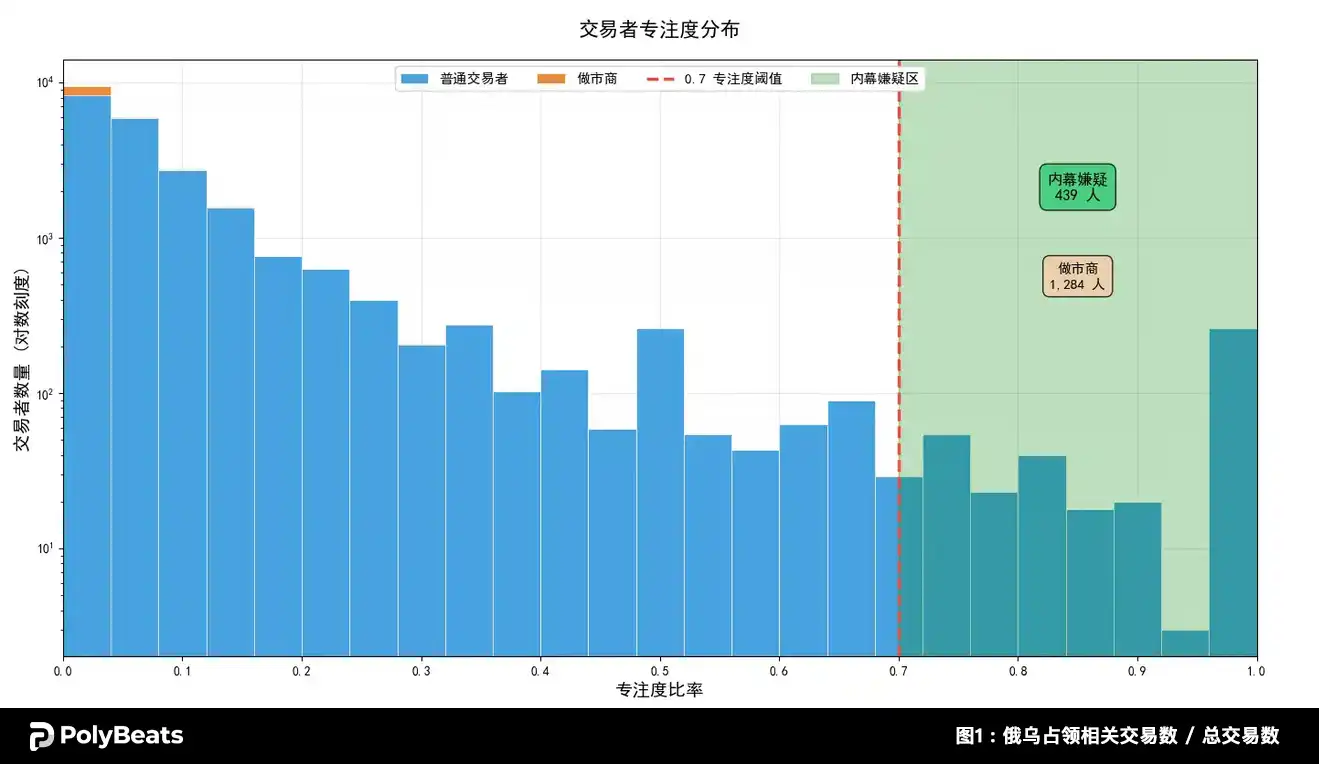
Figure 1: Trader Transaction Focus Distribution Chart
After weighting win rate, profit, and minimum trade quantity, we further refined 47 highly suspicious accounts from these 439 highly focused accounts for manual review.
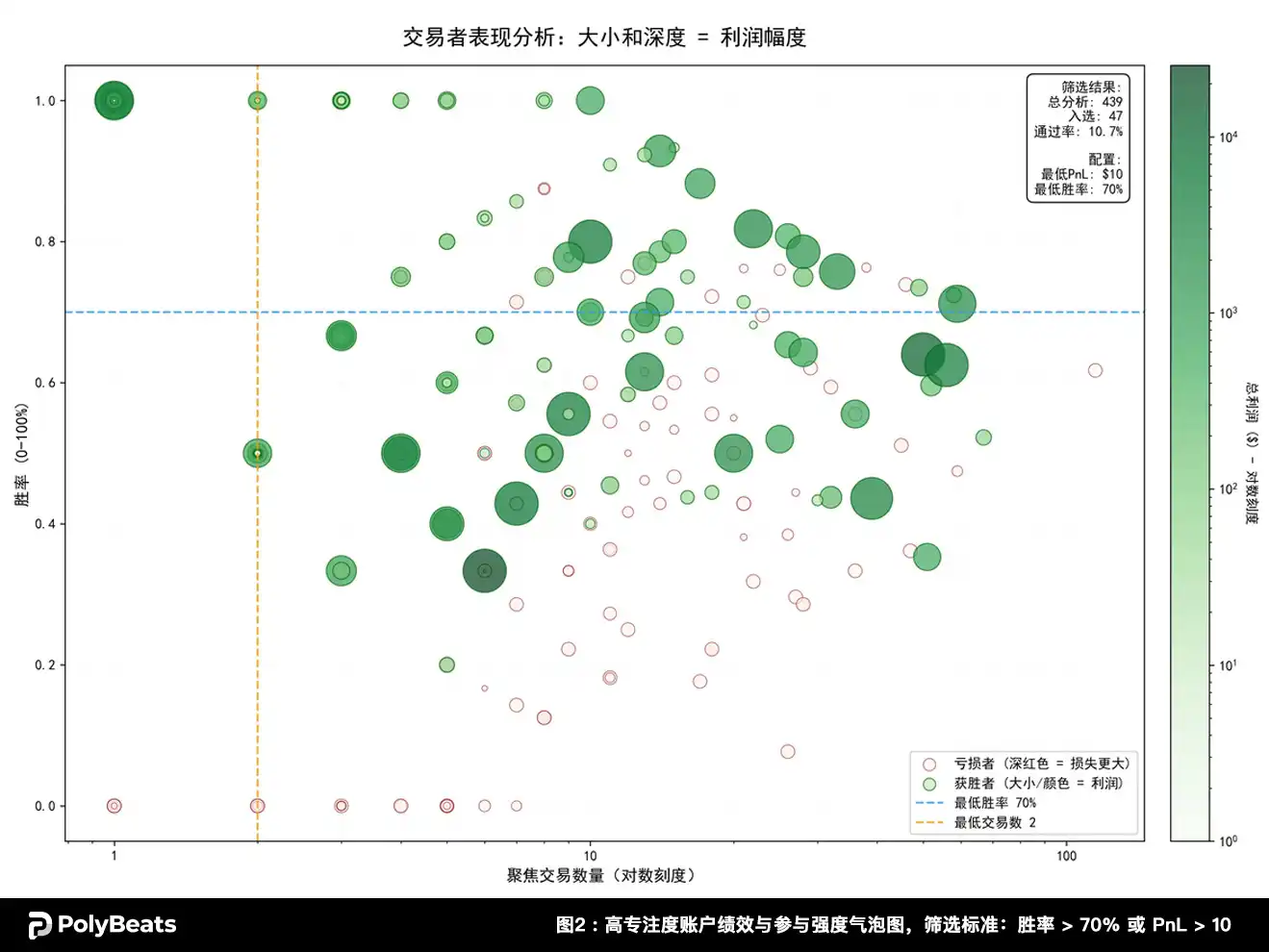
Figure 2: High Focus Account Performance and Participation Intensity Bubble Chart
2.1.2 Profile 2: Capital Focus — "I dare to bet heavily in events where I know the outcome"
From the 21,593 low behavioral focus accounts excluded in the focus distribution, we further screened valuable accounts based on capital focus, using a threshold of capital focus greater than 0.5 to select 773 suspicious accounts (Capital Focus = Transaction Volume related to Russo-Ukrainian occupation event / Total Transaction Volume).
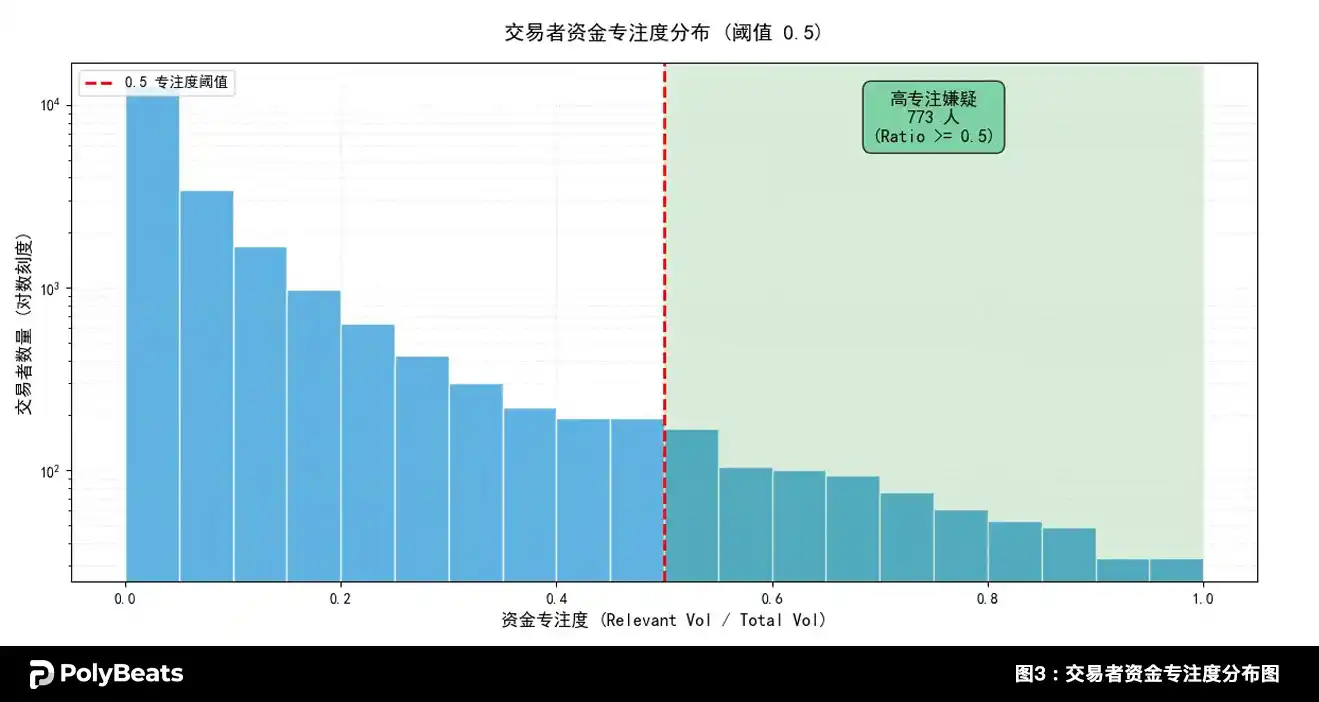
Figure 3: Trader Capital Focus Distribution Chart
Subsequently, we included metrics such as transaction count, profit, win rate, etc., to filter out 282 highly suspicious accounts from the 773 candidate accounts for manual review.
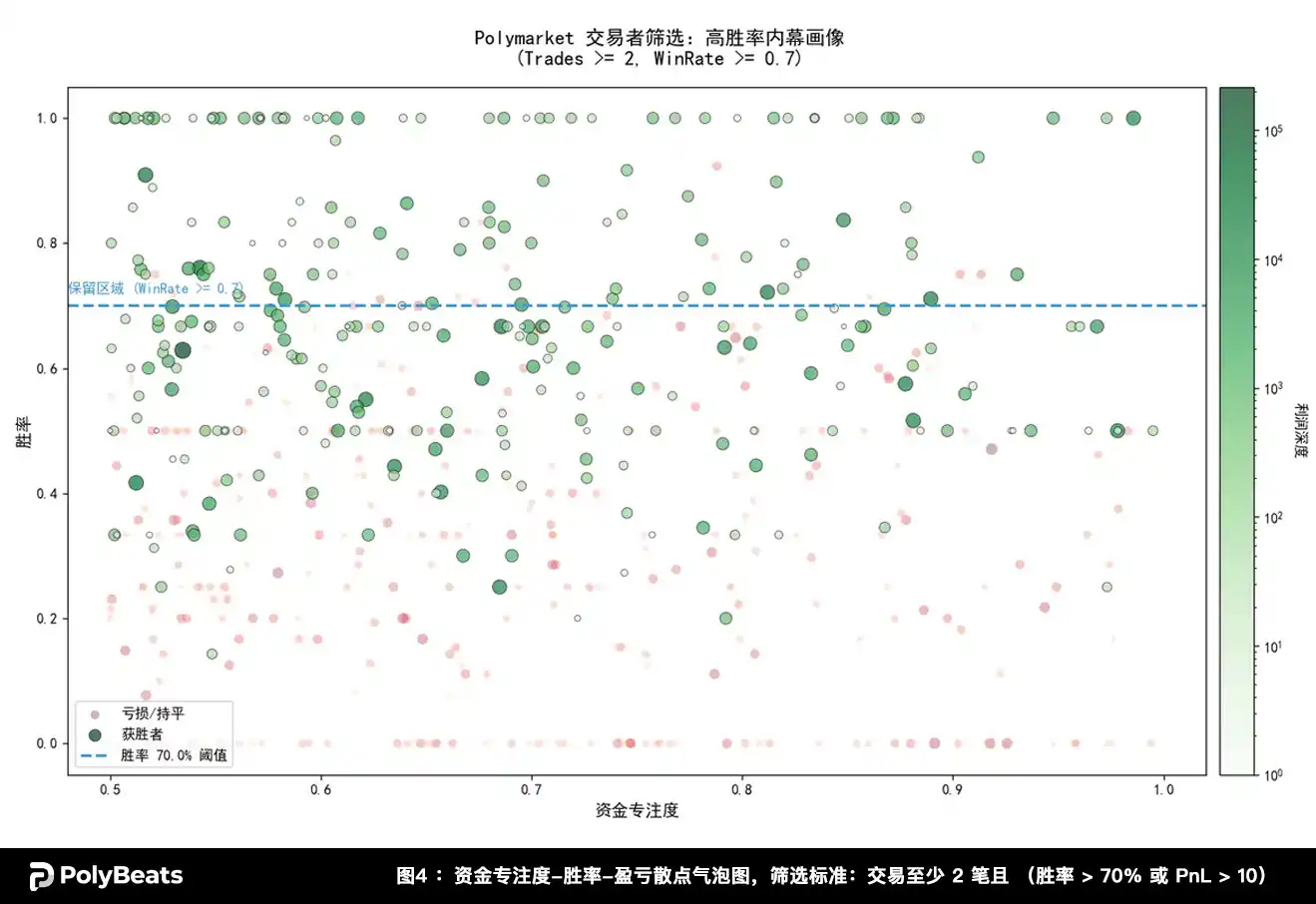
Figure 4: Capital Focus-Win Rate-Profit-Loss Scatter Bubble Chart
2.2 Final Screening and Results Presentation
We reviewed the complete transaction history of the filtered 329 highly suspicious accounts and, to protect the account owners, in this article, we selected 4 of these accounts as case studies for in-depth display and analysis.
These accounts demonstrate the most explanatory anomalous patterns in terms of transaction timing, bet concentration, and performance outcomes.
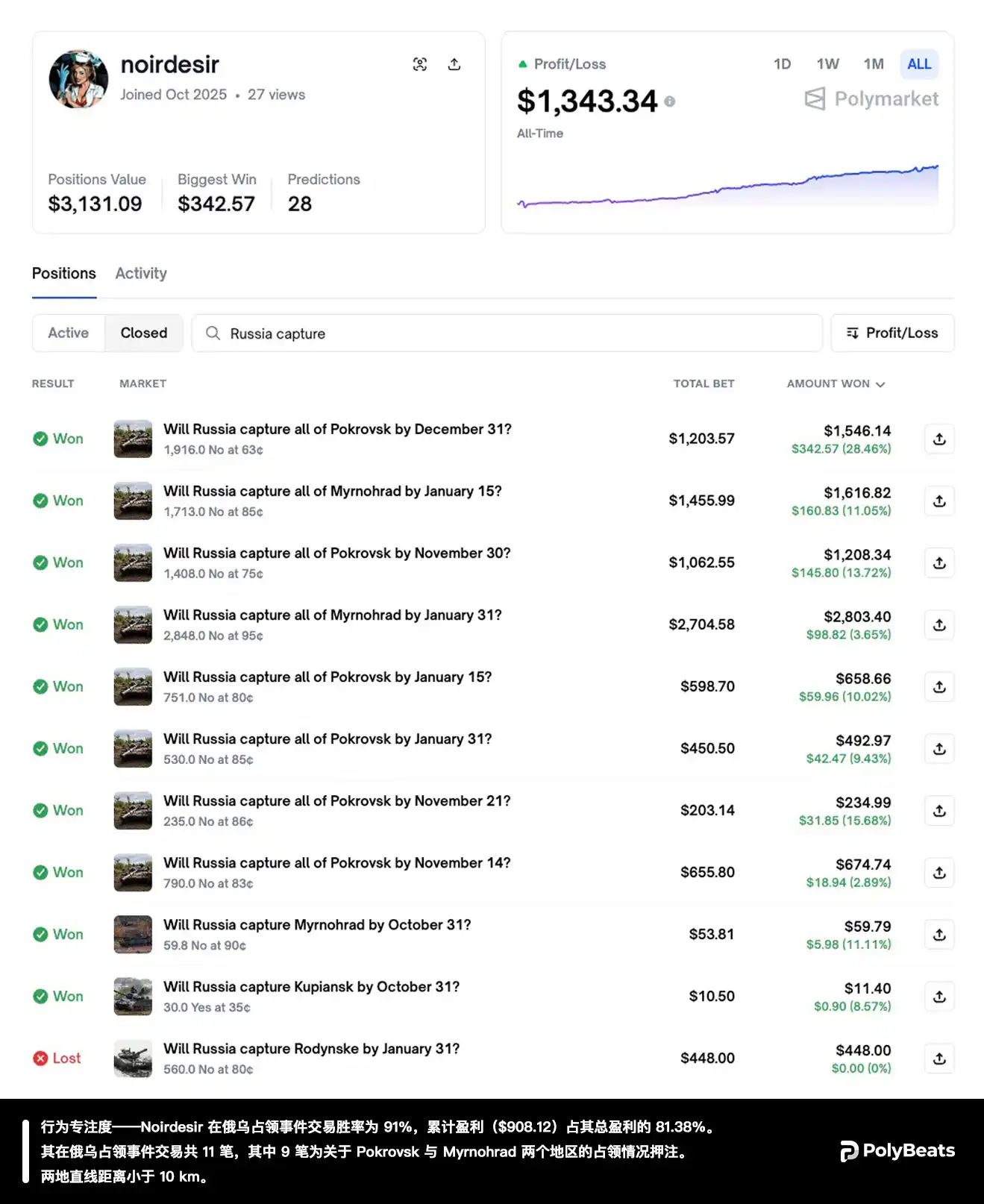
Behavioral Focus — Noirdesir had a 91% win rate in the Russia-Ukraine occupation event trades, with a cumulative profit of $908.12 accounting for 81.38% of their total profit. Out of the 11 trades made for the Russia-Ukraine occupation event, 9 were bets on the occupation status of the Pokrovsk and Myrnohrad regions. The straight-line distance between the two regions is less than 10 km.
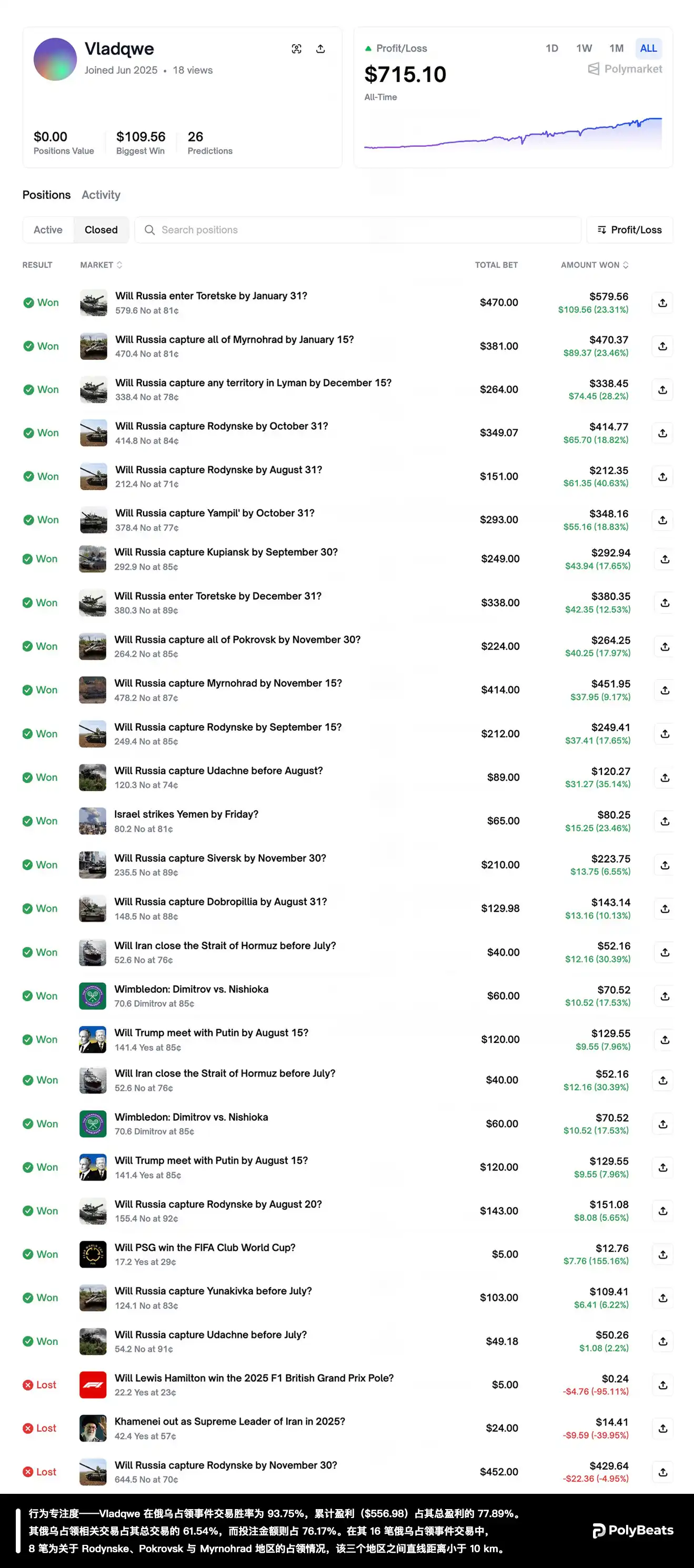
Behavioral Focus — Vladqwe had a 93.75% win rate in the Russia-Ukraine occupation event trades, with a cumulative profit of $556.98 accounting for 77.89% of their total profit. Their trades related to the Russia-Ukraine occupation event made up 61.54% of their total trades and 76.17% of the total amount wagered. Out of their 16 trades for the Russia-Ukraine occupation event, 8 were about the occupation status of the Rodynske, Pokrovsk, and Myrnohrad regions, with the straight-line distance between these three regions being less than 10 km.
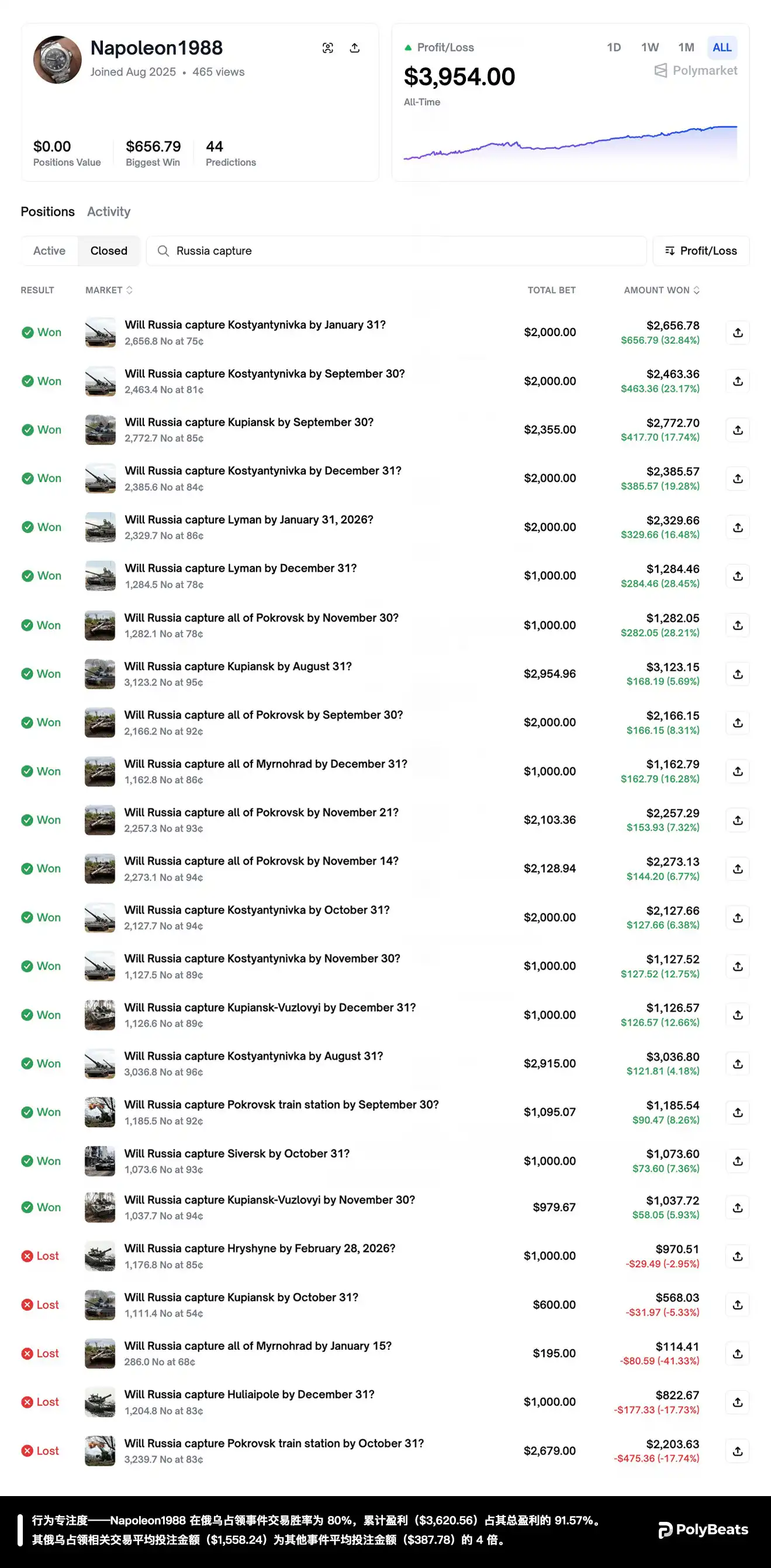
Behavioral Focus — Napoleon1988 had an 80% win rate in the Russia-Ukraine occupation event trades, with a cumulative profit of $3,620.56 accounting for 91.57% of their total profit. The average wager amount for their Russia-Ukraine occupation-related trades ($1,558.24) was 4 times that of trades for other events ($387.78) on average.
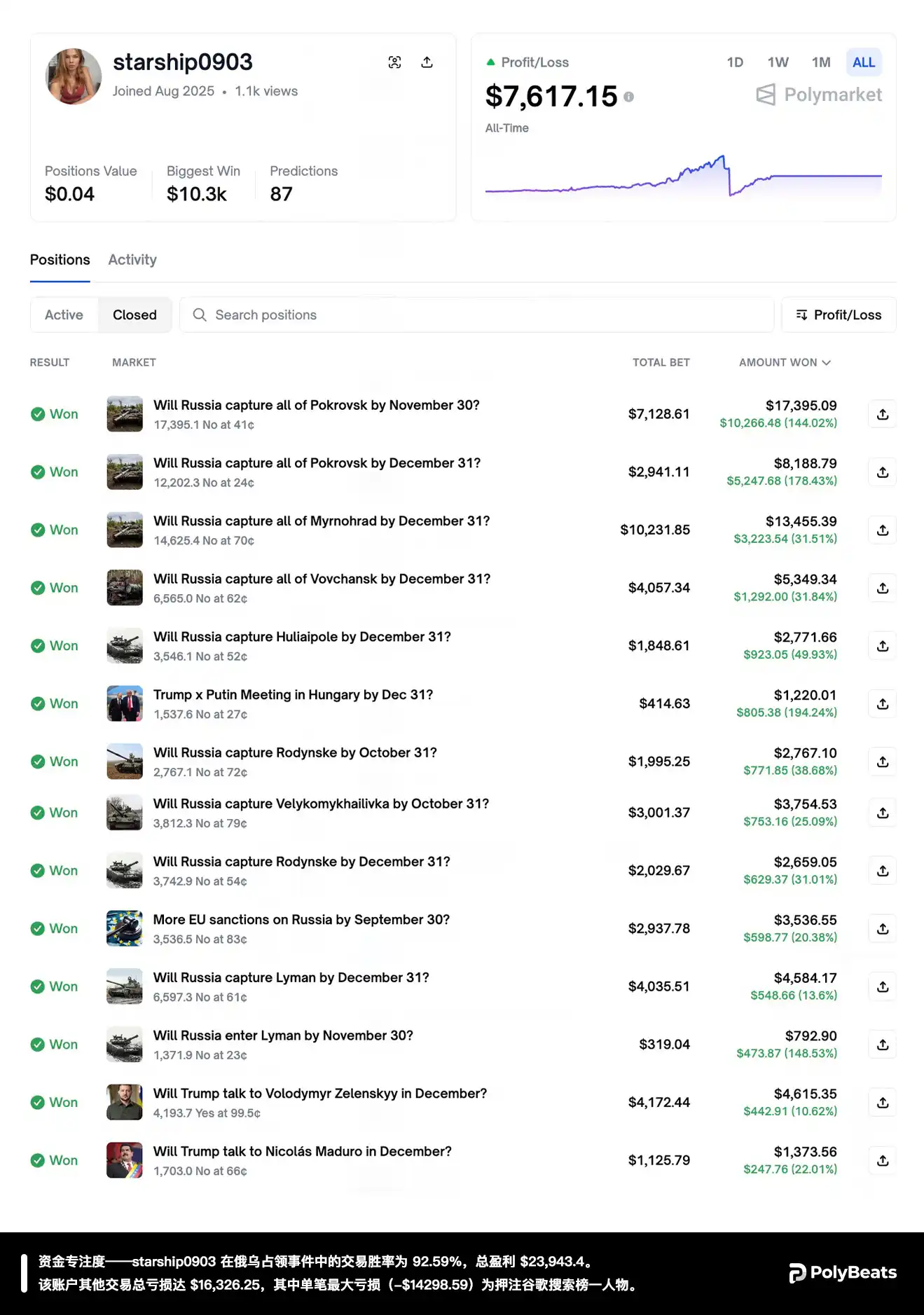
Capital Focus — starship0903 had a 92.59% win rate in the Russia-Ukraine occupation event trades, with a total profit of $23,943.40. The account experienced a total loss of $16,326.25 in other trades, with the largest single loss (-$14,298.59) being a bet on a person in the Google search trends.
3. Summary and Extended Application
The theoretical findings are exciting, but their true value lies in practice. We realize that if we can continue to track the behavior of these anomalous accounts, their betting actions themselves could serve as leading indicators for predicting future events.
BlockBeats is committed to transforming this methodology into productivity. Founded in February 2018, BlockBeats is one of the most influential cryptocurrency industry media in the Chinese Internet community, with over 15 million users across the web, over 4.5 million mobile app downloads, and consistently ranking in the top charts of the App Store for News downloads. After identifying the market's clear impact on the news industry, we quickly established a prediction market team under BlockBeats, known as PolyBeats.
PolyBeats has established a monitoring system to track suspicious accounts' dynamics in various prediction markets in real-time, attempting to integrate on-chain analysis, public opinion, information, and trading profiles into credible current news, which has been validated in multiple fields.
Case Study 1: Successfully Predicting the Release Time of Google's AI Model Gemini 3.0 Flash
Tech Product Launch: On November 28, 2025, PolyBeats captured three suspicious accounts through real-time transaction monitoring: accounts NCW and ambuscade, which had no on-chain intersection but exhibited highly consistent betting behavior. Account NCW fit the "behavior concentration" pattern of a typical one-time insider wallet, while account ambuscade matched the "fund concentration" pattern of abnormal over-betting.
In the context of November 28, the three accounts, through their betting behavior, pinned down Gemini 3.0 Flash's release date between December 15 and December 31. The model was eventually released on December 17, 2025.
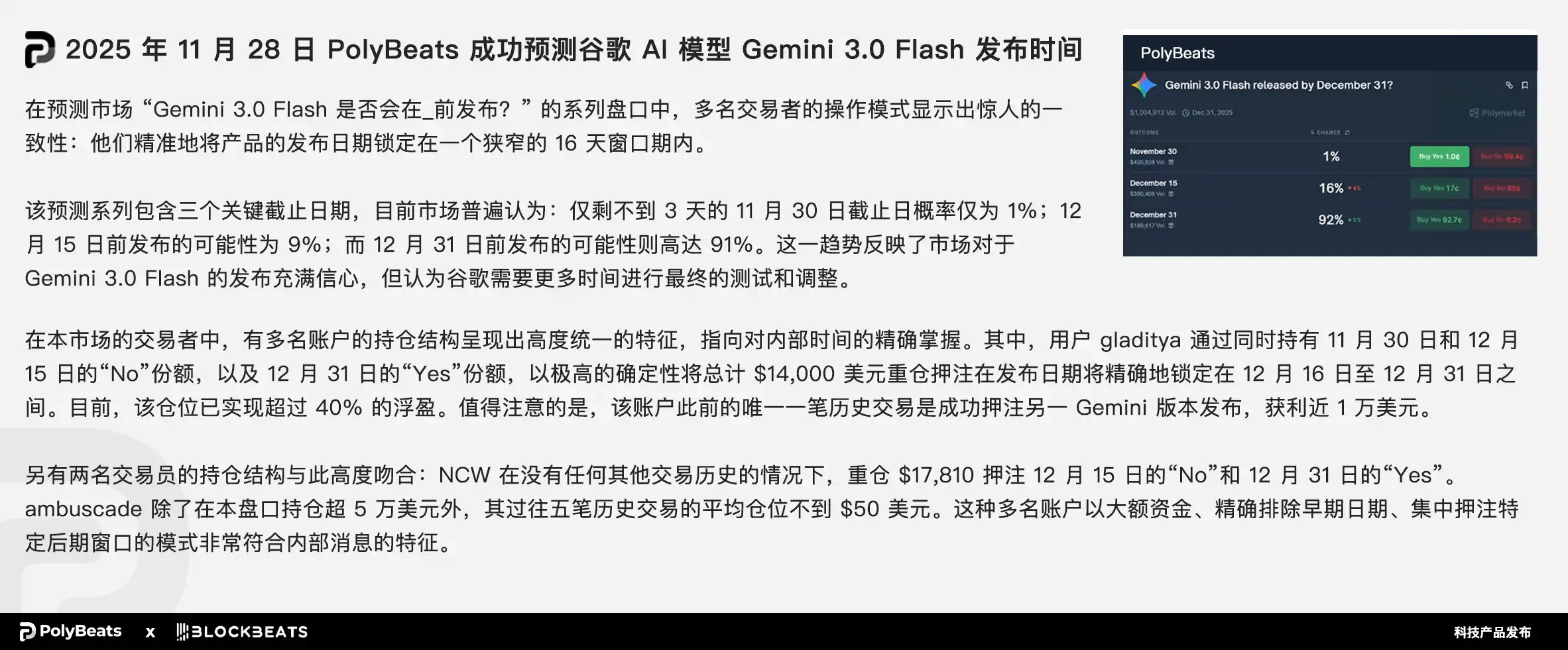
Original Article Link: https://t.me/PolyBeats_Bot/13
Case Study 2: Predicting the US Strike Against Venezuela
Geopolitical Action: On December 9, 2025, PolyBeats, after combining geopolitics, open-source intelligence classic metric Pizza Index, and transactional profile analysis, discovered two new accounts that fit the "capital concentration" profile, betting that a US-Venezuela conflict will occur by December 31, 2025.
The subsequent turn of events for this breaking news was quite dramatic: On December 31, 2025, no relevant military action took place. However, on January 4, 2026, shortly after the world-shaking news of the "US Special Forces Successfully Capture Venezuelan President" emerged, Trump publicly stated that the operation was actually scheduled for December 29 but had to be postponed due to extreme weather conditions in the Caribbean.
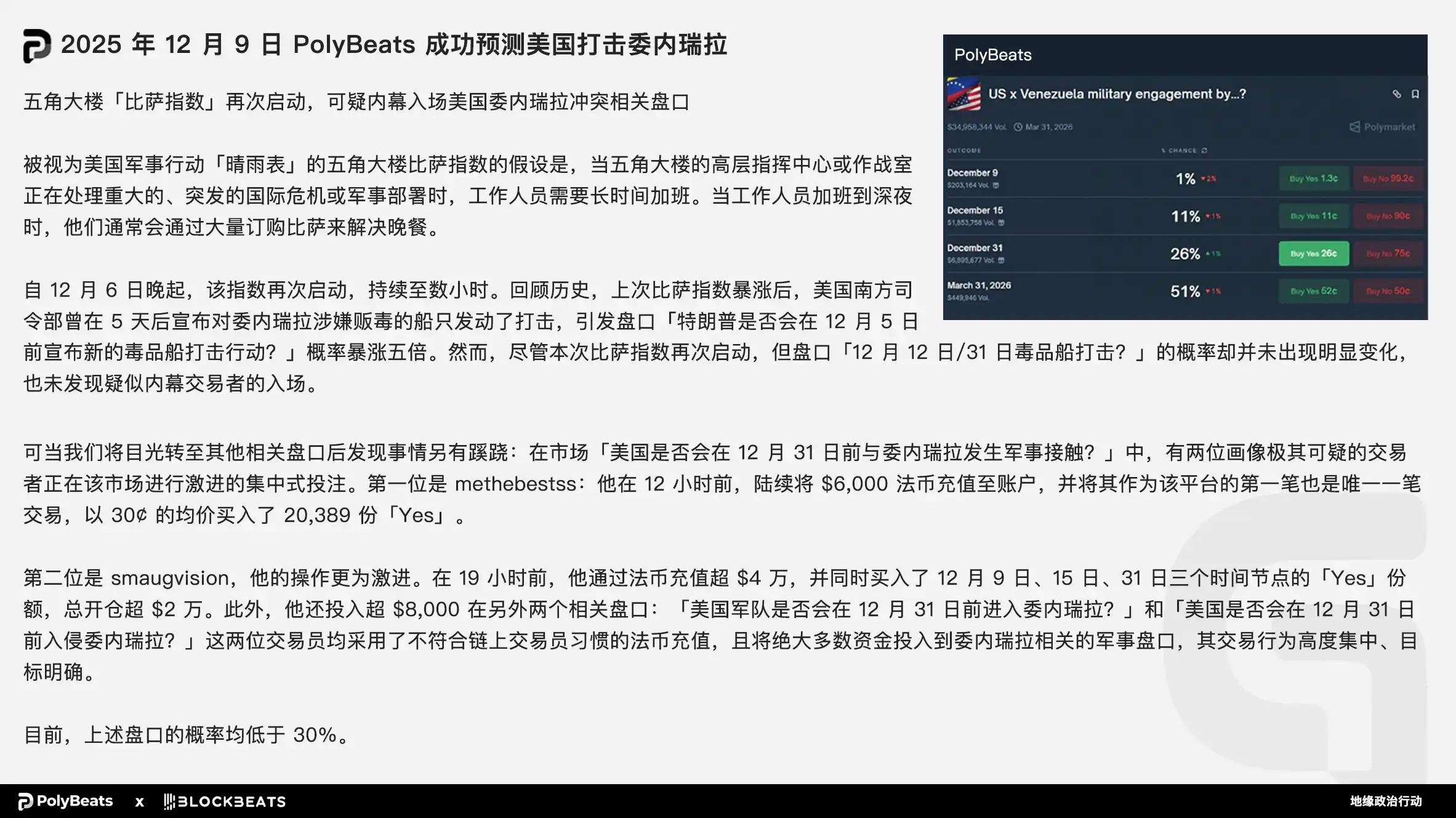
Original Article Link: https://t.me/PolyBeats_Bot/42
Case Study 3: Successfully Predicted 2025 Time Magazine Person of the Year as AI
Culture & Entertainment Award: On December 10, 2025, on the eve of Time Magazine's Person of the Year selection, the account shinewreck, with a historical investment amount of only $1.49, wagered $30,000 on AI as the Person of the Year. This transaction profile exhibited an abnormal concentration of funds through an oversized bet. The next day, Time Magazine's cover was unveiled, with AI and its "architect" being chosen.
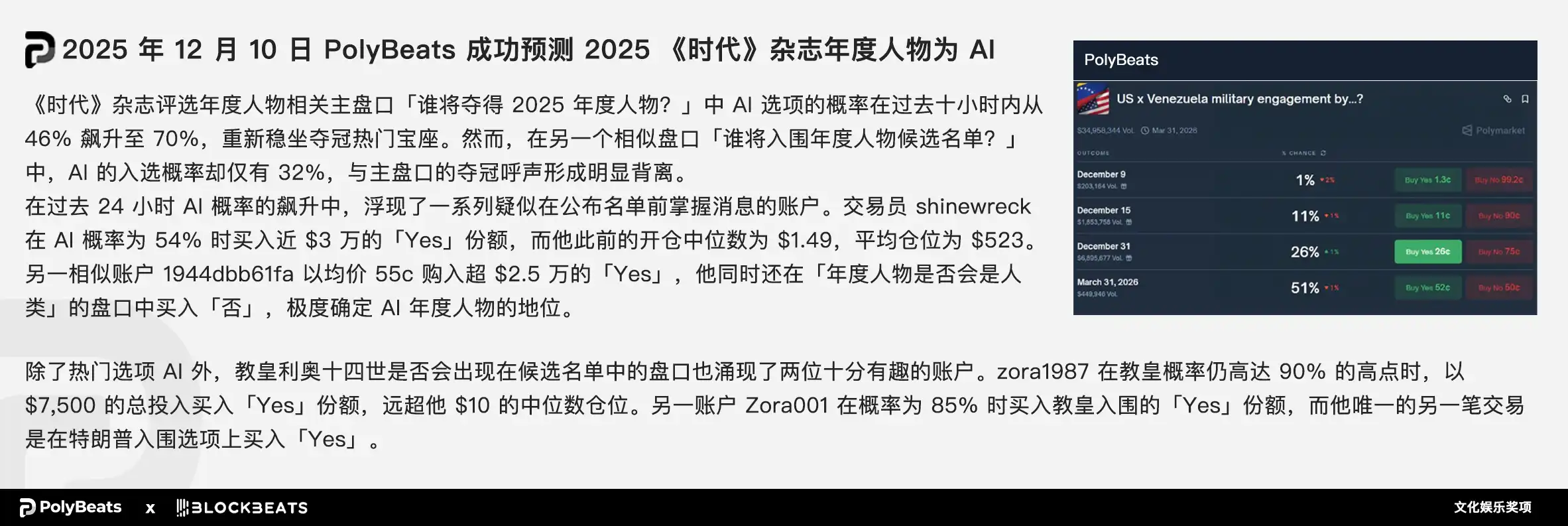
Original Article Link: https://t.me/PolyBeats_Bot/46
Case Study 4: Successfully Captured Israeli Soldiers Leveraging Classified Information for Profit in Prediction Markets
1-Month Lead in Capturing Israeli Official Insider Military Information: On February 12, 2026, Israeli officials confirmed the arrest of two military personnel in possession of classified military intelligence who had bet in prediction markets and profited. The disclosed account, Rundeep, also known by the alias ricosuave666.
As early as January 6, 2026, PolyBeats labeled the account ricosuave666 as an insider just one hour after the Iran conflict, and in the channel, reported on the account's past insider trades and the latest related developments.
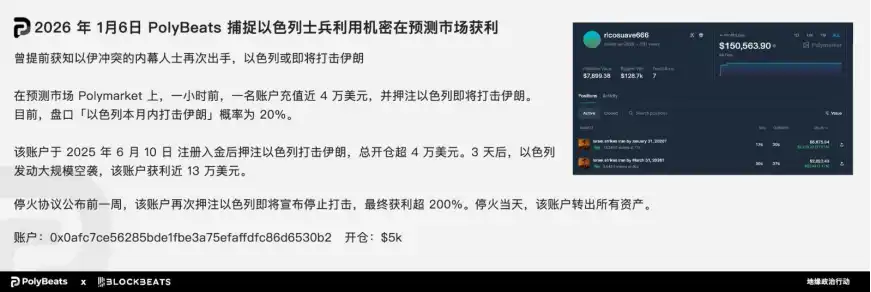
Original Article Link: https://t.me/PolyBeats_Bot/156
These cases cover different fields such as technology, geopolitics, and the entertainment industry, demonstrating that this method does not rely on a single event type but has a certain level of cross-topic generalization ability. By conducting systematic on-chain behavior analysis, converting market prediction funds and transaction behavior into interpretable intelligence signals has paved a new path with tangible real-world value.
In the future, with more data accumulation and model iterations, this method is expected to become a vital bridge connecting blockchain data analysis and news discovery mechanisms.
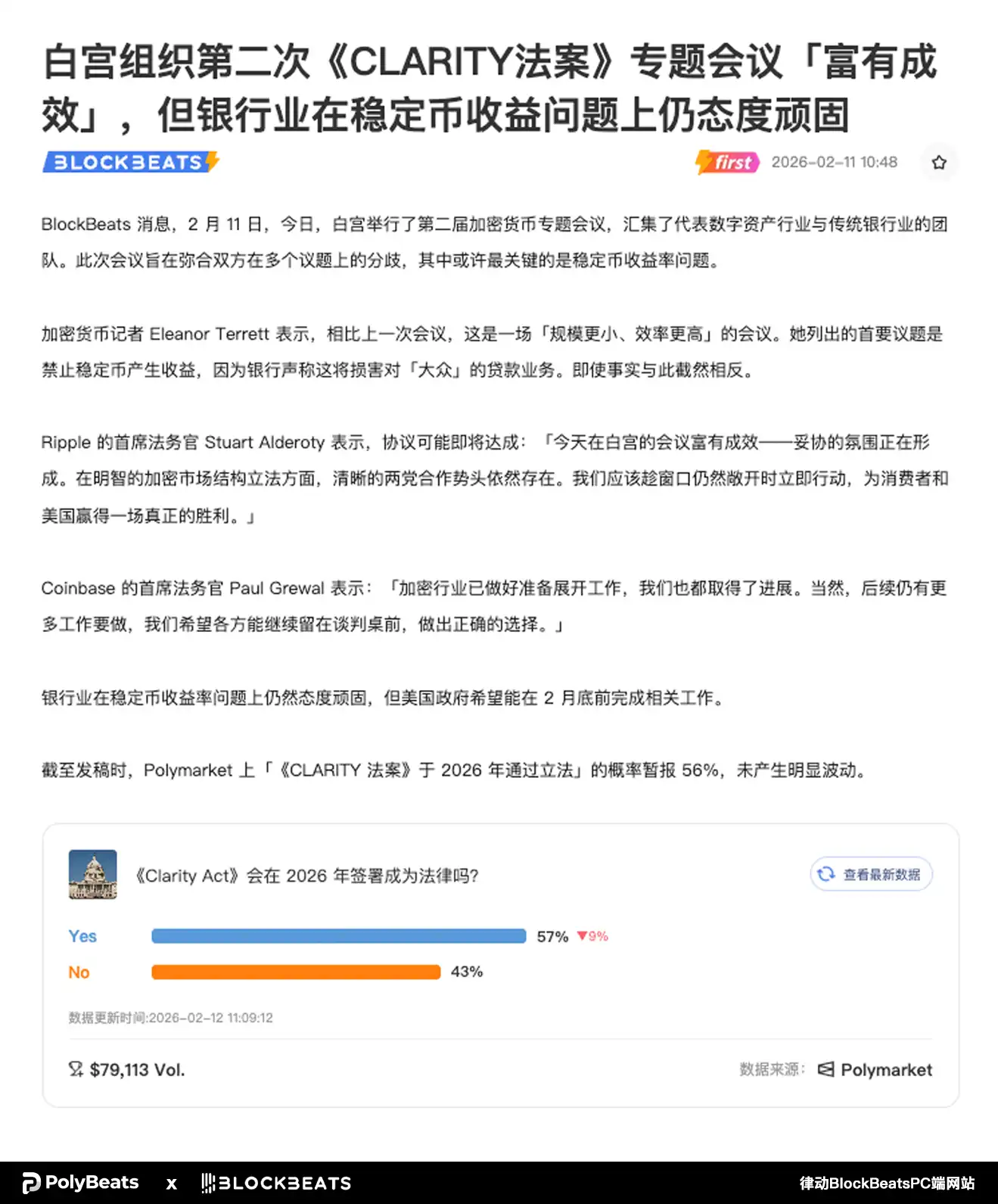
BlockBeats has integrated with the Polymarket market on its PC website and mobile app, becoming the world's first media platform to access a prediction market. In the latest real-time news, readers can directly see relevant market data on Polymarket to help them have a more comprehensive interpretation and understanding of the news.
The real challenge of prediction markets is not accuracy but that they are dismantling a long-standing default order in the content industry and regulation: only information allowed to be disclosed will become "public knowledge." When everything can be bet on, secrets are no longer just constrained by institutions, professional ethics, or press censorship but must continuously combat the price discovery mechanism.
In a mild scenario, this means that series endings, award attributions, and business decisions will be known in advance by the market; in an extreme scenario, it even touches upon war and geopolitical conflicts: people can learn "military intelligence" level information through bets from soldiers on the war front, directly influencing the direction of the war, and even altering reality.
This report has already demonstrated that we can find hidden true information in prediction markets, and we firmly believe that a reality transformed by prediction markets is about to emerge.
You may also like

Resigned in Less Than a Year of Taking Office, Why Did Yet Another Key Figure at the Ethereum Foundation Depart?

Ethereum Foundation Executive Director Resigns, Coinbase Rating Downgrade: What's the Overseas Crypto Community Talking About Today?

Who's at the CFTC Table? A Rebalancing of American Fintech Discourse

AI Trading vs Human Crypto Traders: $10,000 Live Trading Battle Results in Munich, Germany (WEEX Hackathon 2026)
Discover how AI trading outperformed human traders in WEEX's live Munich showdown. Learn 3 key strategies from the battle and why AI is changing crypto trading.

Elon Musk's X Money vs. Crypto's Synthetic Dollars: Who Wins the Future of Money?
How do Synthetic Dollars work? This guide explains their strategies, benefits over traditional stablecoins like USDT, and risks every crypto trader must know.

The Israeli military is hunting a mole on Polymarket

Q4 $667M Net Loss: Coinbase Earnings Report Foreshadows Challenging 2026 for Crypto Industry?

BlackRock Buying UNI, What's the Catch?

Lost in Hong Kong

Gold Plunges Over 4%, Silver Crashes 11%, Stock Market Plummet Triggers Precious Metals Algorithmic Selling Pressure?

Coinbase and Solana make successive moves, Agent economy to become the next big narrative

Aave DAO Wins, But the Game Is Not Over
Coinbase Earnings Call, Latest Developments in Aave Tokenomics Debate, What's Trending in the Global Crypto Community Today?
ICE, the parent company of the NYSE, Goes All In: Index Futures Contracts and Sentiment Prediction Market Tool

On-Chain Options: The Crossroads of DeFi Miners and Traders

How WEEX and LALIGA Redefine Elite Performance
WEEX x LALIGA partnership: Where trading discipline meets football excellence. Discover how WEEX, official regional partner in Hong Kong & Taiwan, brings crypto and sports fans together through shared values of strategy, control, and long-term performance.

Best Crypto to Buy Now February 10 – XRP, Solana, Dogecoin
Key Takeaways XRP is set to revolutionize cross-border transactions, potentially reaching $5 by the end of Q2 with…
Kyle Samani Criticizes Hyperliquid in Explosive Post-Departure Market Commentary
Key Takeaways: Kyle Samani, former co-founder of Multicoin Capital, publicly criticizes Hyperliquid, labeling it a systemic risk. Samani’s…
Resigned in Less Than a Year of Taking Office, Why Did Yet Another Key Figure at the Ethereum Foundation Depart?
Ethereum Foundation Executive Director Resigns, Coinbase Rating Downgrade: What's the Overseas Crypto Community Talking About Today?
Who's at the CFTC Table? A Rebalancing of American Fintech Discourse
AI Trading vs Human Crypto Traders: $10,000 Live Trading Battle Results in Munich, Germany (WEEX Hackathon 2026)
Discover how AI trading outperformed human traders in WEEX's live Munich showdown. Learn 3 key strategies from the battle and why AI is changing crypto trading.
Elon Musk's X Money vs. Crypto's Synthetic Dollars: Who Wins the Future of Money?
How do Synthetic Dollars work? This guide explains their strategies, benefits over traditional stablecoins like USDT, and risks every crypto trader must know.


 App
App