
Over 70% of South Korean Crypto Investors Oppose Crypto Tax: What Are Their Concerns?

 Prefer us on Google



South Korea plans to officially impose taxes on crypto asset gains starting January 2027.
Written by: Ekko An, Jay Jo
Compiled by: Luffy, Foresight News
After three delays, South Korea will officially impose taxes on crypto asset gains starting January 2027. With just over three months until the effective date, discussions around the topic are heating up. A petition submitted to the National Assembly has garnered support from over 50,000 people. As the debate reignites, discussions should not only focus on support or opposition but also examine whether the current tax scheme aligns with the real trading scenarios of crypto assets.
Taxing crypto investment gains is one thing; whether the current scheme can be effectively implemented is another. Crypto assets circulate between domestic exchanges, overseas exchanges, personal wallets, and decentralized exchanges (DEX), and investors often exchange between different crypto assets. For this tax system to operate normally, fragmented trading records must be integrated, and a unified rule must be established to calculate holding costs and actual gains and losses.
The issue is that if this supporting system is not fully established, both investors and tax authorities will bear the burden. Investors will need to verify and provide evidence of their trading records and holding costs, while tax authorities will find it difficult to accurately identify taxable income and tax bases. Therefore, the core issue is not just whether to impose taxes, but whether investors can accurately calculate gains and losses and complete tax filings in real trading scenarios, and whether trading records can be effectively traced.
For this reason, current discussions should not be limited to supporting or opposing taxation; they also need to assess whether the current scheme aligns with the real trading situation, what concerns investors have, and how taxation will change trading behavior and the local market landscape.
How South Korean Crypto Investors View Cryptocurrency Taxation
Tiger Research, in collaboration with the South Korean polling agency PMI, conducted a survey of 2,423 South Korean crypto investors. The questionnaire covered attitudes towards taxation, implementation timelines, the reasonableness of the current scheme, the completeness of the reporting and payment system, and expected changes in investor trading behavior after the tax is implemented.
Age distribution of opponents to crypto taxation in South Korea
Opposition to crypto taxation is present across all age groups, with an overall 73.7% of respondents opposing it. The opposition rate exceeds 75% among those in their 20s, 30s, and 40s; the opposition rates for respondents aged 50 and 60 and above are 61.5% and 63.9%, respectively. The resistance is strongest among the 20 to 40 age group, but the opposition is not limited to younger investors.
South Korean crypto investors do not entirely reject taxation
Simply supporting or opposing taxation does not fully reflect investors' views. Among those opposing taxation, 51.5% indicated that they could accept taxation if the issues with the current scheme are properly addressed. Meanwhile, among those who agree that crypto assets should be taxed, 74.5% believe that the current scheme should be postponed or modified rather than implemented as is.
The survey results indicate that many investors can distinguish between "crypto assets should be taxed" and "the current tax scheme is feasible." Some investors who oppose taxation stated they could accept it once the system is improved; many who agree with the principle of taxation do not support the immediate implementation of the existing scheme. This divergence becomes more apparent when investors evaluate specific rules and the readiness of the system.
Main Concerns of Investors Regarding the Current Tax Scheme
Concerns of South Korean investors regarding crypto taxation
The detailed results of the survey reveal the reasons why investors differentiate between "taxation itself" and "the tax scheme," with concerns focused on three main areas:
- Whether the tax rates and deductions are appropriate and fair compared to other financial assets
- Whether the system correctly considers losses and acquisition costs when calculating taxable income
- Whether the system is ready to support tax reporting and payment, transaction tracking, and investor protection
Investors are not only concerned about whether crypto assets should be taxed but also about the tax burden, how taxable income is calculated, and whether the entire scheme can be implemented. The following sections will explore these three issues.
Is the Tax Burden Fair?
Expected changes in trading behavior among investors of different age groups if the crypto tax is implemented in South Korea
Most respondents hold a negative view of the tax burden under the current scheme. Among all respondents, 73.5% believe that a 22% tax rate is too high, and 65.2% think that the annual basic deduction of about $1,800 is too low. Additionally, 72.1% believe that the crypto asset tax rules are not fair compared to other financial assets.
Proportion of those opposing the crypto tax or supporting its postponement by income level
Low-income investors also express strong concerns. Respondents with a monthly income below about $2,100 account for 24.9% of the total sample, and among this group, 87.9% oppose the current plan and demand another postponement, which is higher than the average of 82.9% among all respondents. This indicates that concerns about the current scheme are not unique to high-income investors.
Seventy percent of investors believe that the crypto tax will hinder wealth accumulation among young people
Respondents are also worried that the policy will limit wealth accumulation for young people. Overall, 73.0% of respondents believe that the cryptocurrency tax may restrict wealth accumulation opportunities for those in their 20s and 30s. The concern is highest among the 20-year-olds at 78.7%, followed closely by the 30-year-olds at 77.2%. Among all other age groups, the proportion supporting this view also exceeds 65%.
The survey shows that investors' concerns extend beyond tax rates and deduction amounts; they also compare fairness with other financial assets. Low-income groups are similarly sensitive to this, and all age groups are concerned about the policy's impact on young investors. Investors consider both the size of the tax burden and the differentiated impact of the policy on different groups.
Can Taxable Income Be Accurately Calculated?
Investors' concerns about the core terms of the current crypto tax framework
To accurately calculate taxable income, the tax system must be able to account for investors' real gains and losses and establish clear rules for losses, holding costs, and various types of crypto income. The survey found that investors have strong concerns in these three areas.
First, 65.9% of respondents believe that the current rules for handling losses are unreasonable. The current rules allow investors to offset profits with crypto asset losses within the same year, but losses cannot be carried forward to offset future gains in subsequent years.
Crypto investors' gains and losses often span multiple years, and the rules for loss offsets directly affect the accuracy of taxable income calculations.
Investors' concerns about holding costs and the traceability of trading records are even more pronounced: 70.6% of respondents worry that they will have to rely on their own trading records and holding costs to calculate and report gains and losses, which is a heavy burden.
Crypto assets can circulate between domestic and overseas CEXs and personal wallets, and investors often exchange different currencies. The more complex the trading paths, the harder it is for investors to match original holding costs with subsequent trades.
Crypto income sources are very diverse, including trading, lending, staking, airdrops, and liquidity mining. The current tax framework mainly covers gains from asset transfers and lending, and which gains need to be taxed and the timing of taxation still need to be clarified further. About 65% of respondents believe that the existing framework does not adequately cover various trading scenarios.
In summary, investors' concerns extend beyond tax rates to include loss handling, holding cost determination, and the definition of different types of income. These rules ultimately determine whether taxable income from crypto assets can be accurately calculated based on real gains and losses.
Is the Supporting System Ready?
Investors' concerns about the readiness of supporting preparations for the implementation of the crypto tax
A tax system requires not only clear rules but also administrative and IT systems to support its implementation. In the survey, 66.4% of respondents believe that the South Korean government's preparations are insufficient; 65.7% stated that it is difficult to fully track and tax transactions across domestic CEXs, overseas CEXs, and personal wallets; and 68.8% believe that the burden of tax reporting and payment on investors is heavy. Investors are not only concerned about the legal texts but also about whether the scheme can operate effectively in practice.
Crypto asset trading can occur outside of South Korean CEXs. Once investors use overseas CEXs or personal wallets, trading data becomes dispersed across multiple channels, making it difficult to consolidate for taxation. Reliable transaction tracking and the burden of investor reporting are both issues that need to be carefully considered.
In addition to administrative and IT preparations, 85.1% of respondents believe that a framework for investor protection must be established before the tax is implemented. Taxation will create new tax obligations for investors, and beyond tax administration, market protection mechanisms are also essential conditions for implementation.
Respondents' views on the implementation of the crypto tax in 2027
The survey results regarding the implementation timeline further confirm these concerns. 82.9% of respondents oppose the timely execution of the current scheme or demand a postponement, and 75.2% believe that implementing it in 2027 is too early. The questionnaire continued to ask 1,823 respondents who chose to postpone the implementation: if the rules and supporting preparations are still not completed by the scheduled time, what should be done? Among them, 93.4% believe that taxation should be postponed again until the system is ready.
For investors, the core issue is not simply delaying for a few years but whether the foundational conditions for implementation are truly ready, including tax administration, transaction data management, reporting systems, and investor protection.
Potential Impact on the South Korean Market
Scale of Funds Flowing from Korean Exchanges to Overseas Exchanges
Investor attitudes towards the taxation scheme indicate that trading behaviors may change after the policy is implemented. A significant amount of Korean crypto funds has already flowed overseas. According to a previous report by Tiger Research, it is estimated that from 2021 to the first half of 2026, approximately 700 trillion KRW (about 490 billion USD) will flow out to overseas markets. Investors are increasingly using trading channels outside of local centralized exchanges (CEX), including overseas exchanges and personal wallets.
This survey assesses the changes in investment scale and trading channels after the implementation of taxation. The results show that investors may reduce their investments and decrease their use of local CEX, shifting towards other trading channels. If these expectations translate into actual behavior, it will weaken the trading foundation of the Korean crypto market and increase the difficulty for tax authorities to track taxable activities and regulate the market.
Impact on Local CEX and the Entire Korean Crypto Industry
The survey predicts that taxation will lower the willingness to invest in crypto and reduce the use of local CEX. 69.7% of respondents indicated they would reduce or even stop crypto investments, while 73.1% said they would decrease their use of Korean local CEX. This will reduce the total amount of funds in the crypto market and lower the trading volume of local exchanges.
66.4% of respondents believe that taxation will have a negative impact on the Korean crypto market. If investors reduce their exposure to crypto assets and shift to other financial assets, the trading volume and liquidity in the local market will decline.
Trading Volume and Revenue of Korea's Top 3 Crypto Exchanges (Upbit, Bithumb, Coinone)
Tiger Research, combining the survey data with changes in trading volumes from other countries that have implemented crypto taxes, estimates the changes in trading volume and revenue for the top exchanges. The calculations show that the annual trading volume of Korea's three major exchanges, Upbit, Bithumb, and Coinone, may drop from approximately 601 billion USD in 2026 to 421 billion USD in 2027, a decrease of about 180 billion USD, or 30%; during the same period, the revenue of the three exchanges is expected to decline from 722 million USD to 509 million USD, a reduction of 213 million USD, or 29.5%.
The contraction in trading will also affect the overall tax revenue of the crypto industry. A decrease in transaction fees will lead to reduced value-added tax revenue, and declining profits for exchanges will lower corporate income tax.
Crypto income taxation could create a new source of tax revenue, but the contraction of the local market will simultaneously squeeze existing tax revenues, weakening the overall increase in revenue from new taxes. The shrinking liquidity and user base of local CEX will also undermine the foundations of supporting financial services such as custody and prime brokerage.
Shift to Offshore Channels, Limitations of the CARF Framework
Usage of Global Centralized Exchanges (CEX) and Decentralized Exchanges (DEX) by Korean Investors
After the implementation of taxation, if investors reduce their trading on local CEX, some funds will flow to overseas CEX and personal wallets. Among investors planning to reduce their use of local exchanges, 88.0% indicated they might increase their use of overseas CEX or self-custody wallets; among all respondents, 60.0% have already used overseas CEX, and 33.3% have used DEX.
Expected Changes in Trading Channels by Age Group
Younger investors show the strongest willingness to shift to offshore channels. Among respondents aged 20, 76.8% indicated they would use overseas CEX more after the implementation of taxation, and 73.2% would increase their use of DEX and personal wallet P2P transactions. Investors who have already used overseas exchanges and on-chain services find it easier to transfer their trading out of local platforms.
As more trading flows out of local service providers, the difficulty for tax authorities to obtain complete trading information increases. The Crypto Asset Reporting Framework (CARF) can help alleviate this gap: it requires crypto service providers to report user and transaction information, allowing tax authorities in different countries to exchange relevant data.
However, the timing for countries to initiate CARF data exchange is not uniform: South Korea plans to start in 2027; Hong Kong, Singapore, and the UAE plan for 2028; and the United States will wait until 2029. This time lag will limit the acquisition of overseas trading data in the early stages of taxation.
Proportion of Transactions Not Covered by CARF in Different Crypto Tax Jurisdictions
At the same time, CARF cannot cover all transaction links. According to Chainalysis data, in 2025, 59.1% of assets flowing out of Japanese CEX will go to channels not covered by CARF; the proportion for the UK is 65.2%, for the US is 75.4%, and for Italy is 76.6%. In Italy, this proportion increased from 50.4% in 2024 to 76.6% in 2025; during the same period, assets transferred to personal wallets grew by 45.7%.
The above data does not directly prove that taxation leads to capital outflow, but it indicates that even in countries that have established crypto taxation and reporting systems, a significant volume of transactions cannot be fully tracked solely through service providers' reports.
This information gap may also lead to issues of tax fairness. Tax authorities can easily verify local CEX transactions through reports from service providers; however, transactions on overseas CEX and personal wallets rely more on self-reporting and post-verification by investors. If investors perceive a significant disparity in regulatory tracking between different trading channels, it will further encourage the shift of trading to overseas CEX and DEX.
Before the implementation of taxation, the South Korean government needs to clarify the rules regarding the recognition of holding costs and information reporting; at the same time, it should establish mechanisms to verify the gains and losses arising from transactions on overseas CEX and personal wallets.
-- Price
Hasty Implementation of Taxation Will Harm the Industry and Tax Revenue
The core contradiction lies not in whether to impose taxes, but in whether South Korea should implement the current scheme in 2027 when the supporting systems are not yet ready. Current laws stipulate that the crypto asset income tax will take effect in January 2027. This survey indicates that investors can distinguish between the principles of taxation and the current scheme; even among those who agree that crypto should be taxed, there is a belief that the rules need to be optimized; some opponents also state that they could accept taxation once the system is improved.
Policymakers must assess that implementing taxation without adequate preparation will bring market shocks. As analyzed earlier, local crypto investment and trading volume may decline, and trading activities will shift to overseas CEX and personal wallets.
Such changes will weaken the trading foundation and competitiveness of the local market, while also dispersing trading data, increasing the difficulty for tax authorities to track the tax base. Creating new tax sources and stabilizing tax base management are two independent challenges.
Policymakers should first evaluate whether this tax system can operate normally in a real market environment, rather than simply determining the implementation date and later addressing any gaps. The survey shows that investors are more concerned about whether the entire system is ready than about specific years. Policymakers should clarify the conditions for implementation before determining the start date for taxation.
Three aspects need to be focused on. First, when assessing the readiness of the taxation support, the overall state of market regulation should also be considered. Having only a tax administration system is far from sufficient; the market also needs clear regulations, investor protection mechanisms, and industry standards for new assets and services. Policymakers need to evaluate the tax authorities' capacity for administration and the maturity of the market in which taxation is implemented. Second, practical assessment criteria should be established to test the operational feasibility of the tax system. Assess whether the system can connect trading data and calculate gains and losses while ensuring that taxpayers can correct reporting errors. Rely on actual implementation tests to assess readiness rather than solely relying on fixed timelines or IT system launches. Third, conduct simulated tax reporting and pilot testing that align with real trading scenarios. The testing scope should not only include simple local CEX transactions but also cover overseas CEX, personal wallets, and DEX. Before formal taxation, issues such as missing trading data, recognition of holding costs, and high-frequency reporting errors should be identified in advance.
Policymakers also need to consider public acceptance. The survey found that many respondents are concerned that taxation will limit young people's opportunities to accumulate wealth, with the 20s and 30s age groups feeling particularly strongly, and individuals of all ages questioning whether crypto taxes are fair compared to other financial assets. Merely having a complete technical framework is not enough; investors also need to recognize the fairness of the tax burden and rules.
The debate over crypto taxes in 2027 should not be limited to whether to maintain the original implementation timeline. Policymakers need to assess whether taxable gains and losses can be accurately calculated in real trading scenarios, whether tax authorities can obtain necessary trading data, whether market rules and investor protection are in place, and whether investors recognize the fairness of tax standards. If implemented hastily without adequate preparation, both the competitiveness of the local market and the capacity for tax base management will be compromised.
This content is provided for general informational purposes only and doesn't constitute financial, investment, legal, or tax advice. Any events, rewards, online promotions, or related information mentioned herein should not be considered a recommendation, solicitation, or invitation to purchase, sell, trade, or otherwise deal in any crypto assets. Crypto assets are highly volatile and may result in loss. The availability of WEEX services, products, and related events may vary by region. You are responsible for ensuring that your participation is in accordance with applicable local laws and regulations.
You may also like

Sam Price: The Impact of Cryptocurrency Legislation on Market Dynamics

The Quantum Issue: You Never Really Know The Future

Crypto Kidnapping: 6 Suspects Charged in Case Involving a Few Hundred Euros in Val-d’Oise

Security and fees hold back deeper crypto use among wealthy investors: Nexo report

Why leaving your crypto on an exchange is not the same as having it in your own wallet?

Binance Under Scrutiny Again for Iran-Related Trading

Altcoin demand meets $18B threat as flows move into RWA perps as just 19% of traders keep alts
90% of U.S. Treasury Yield Increase Concentrated Around Employment Data and Fed Speeches
Can Kraken's Parent Company Open the Door for Hyperliquid to Enter the U.S. Market?
Gold Price Today in Thailand: XAU/USD Holds Near $4,347 as Key Support Level Tested

Scam AI Bot: 274 ETH Lost in Smart Contract Trap

Why Do You Always Make Small Profits and Then Lose Everything? Taleb Explained It with 'Asymmetric Leverage' Twenty Years Ago
AI has become a tool for a new generation of fraudsters: how deepfakes are stealing millions of dollars - research

Can SOXL Reach $160 as AI and Semiconductor Stocks Rally?
Can PEPE Reach $0.000006 as Meme Coin Momentum Returns?
Meta's Muse: A Slightly Smarter Version of 'AI Ordering Coffee'

Howard Marks: U.S. Fiscal Discipline Out of Control, Buying Bonds to Suppress Yields is Just 'Putting Ice Packs on a Feverish Patient'

Bitget Conversations with Trader Shiguang: Seeking the Discrepancy Between Price and Value

AI and Crypto: Why BlackRock Sees a Major Convergence

Nomura Warns of 'Double Whammy' Risk: The Next Market Storm May Start with Interest Rate Volatility
What is Travix? An on-chain omnibroker combining AI trading and blockchain verification
VVV Hits All-Time High: Founder’s Perspective on Models, Privacy, and Crypto
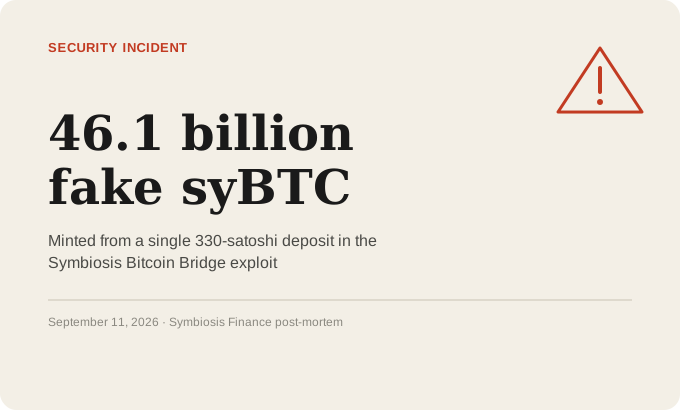
How Did a Hacker Create 46 Billion Fake Bitcoin in the Symbiosis Exploit? Decodes Bitcoin Hacker With WEEX Now
How two Symbiosis bridge bugs let a hacker mint 46.1 billion unbacked syBTC, drain Bitcoin pools and expose critical bridge risks.
This Cycle May Not Be Led by Bitcoin?

Yield Curve Approaches Inversion, TGA and Fed Tools Become New Focus in US Treasury Market

AI Agent Battle Begins: Amazon Blocks Meta's AI Agent, E-commerce Entry War Escalates
![[Interview] Lee Yun-ho, CEO of KIP: "We need to set the stage before the STO market opens... sharing RWA know-how with financial companies"](/public-static/3_1a7f0699b3.png?format=avif)
[Interview] Lee Yun-ho, CEO of KIP: "We need to set the stage before the STO market opens... sharing RWA know-how with financial companies"
Coinmetrics Report: The Competition of Tokenized Stocks and Their Future Development Path

Ki Young Ju Predicts Bitcoin Growth of 3-5 Times

In 12 tests, PQLN makes Bitcoin's Lightning Network communication levels resistant to quantum computers
Sam Price: The Impact of Cryptocurrency Legislation on Market Dynamics
The Quantum Issue: You Never Really Know The Future
Crypto Kidnapping: 6 Suspects Charged in Case Involving a Few Hundred Euros in Val-d’Oise
Security and fees hold back deeper crypto use among wealthy investors: Nexo report
Why leaving your crypto on an exchange is not the same as having it in your own wallet?
Binance Under Scrutiny Again for Iran-Related Trading
Contents
Latest articles


Latest coin listings on WEEX


