Old Order's Backlash: Market Predicted to Be 'Paused' in Tennessee

 Prefer us on Google


Original Title: "Shaking the Billion-Dollar Cake of the Gambling Industry, the Forecasting Market is Predicted to Be Chased by the Old Order"
Original Author: Azuma, Odaily Planet Daily

The booming forecasting market is facing a real challenge.
On January 9, local time in the United States, the Tennessee Sports Wagering Council (SWC) issued a cease-and-desist order to prediction market platforms such as Kalshi, Polymarket, and Crypto.com, demanding that the above platforms stop providing sports event prediction contracts to residents of the state. The reason is that these companies are engaging in illegal sports betting business without obtaining state government permission.
In the notice, the SWC accused these three companies of illegally providing sports betting products under the guise of "event contracts." Although these platforms are registered with the U.S. Commodity Futures Trading Commission (CFTC) as designated contract markets, under Tennessee state law, any entity providing sports event betting services in the state must hold a license issued by the SWC.
The SWC demanded that Kalshi, Polymarket, and Crypto.com cease all activities in the state by January 31, withdraw open contracts, and refund resident deposits. Failure to do so by the deadline may result in civil penalties of up to $25,000 per violation and may even involve criminal charges.
Rapidly Growing Sports Event Betting Market
To understand why Tennessee is taking such a strong stance against prediction market platforms, we need to start with the current state of the U.S. sports event betting market.
Since the U.S. Supreme Court overturned the federal law, the Professional and Amateur Sports Protection Act (PASPA), which had previously banned commercial sports event betting on May 14, 2018, states in the U.S. have had the authority to decide independently whether to legalize sports event betting within their jurisdictions. Currently, sports event betting in the U.S. is regulated at the state level, and states can set their own tax systems, market access thresholds, and responsibility requirements.
According to Legal Sports Report, as of now, 38 states (Washington D.C. and Puerto Rico included) have allowed legal operation of sports event betting services (both online and offline), with 30 states allowing online sports event betting services. Tennessee is one of them and is the first state to only allow online sports event betting, prohibiting physical sports betting locations.
With popular leagues such as the NFL, MLB, NBA, NHL, and more, the United States is undoubtedly a sports powerhouse. Sports betting is a well-defined, heavily taxed, and regulated form of gambling provided by state governments across the country.
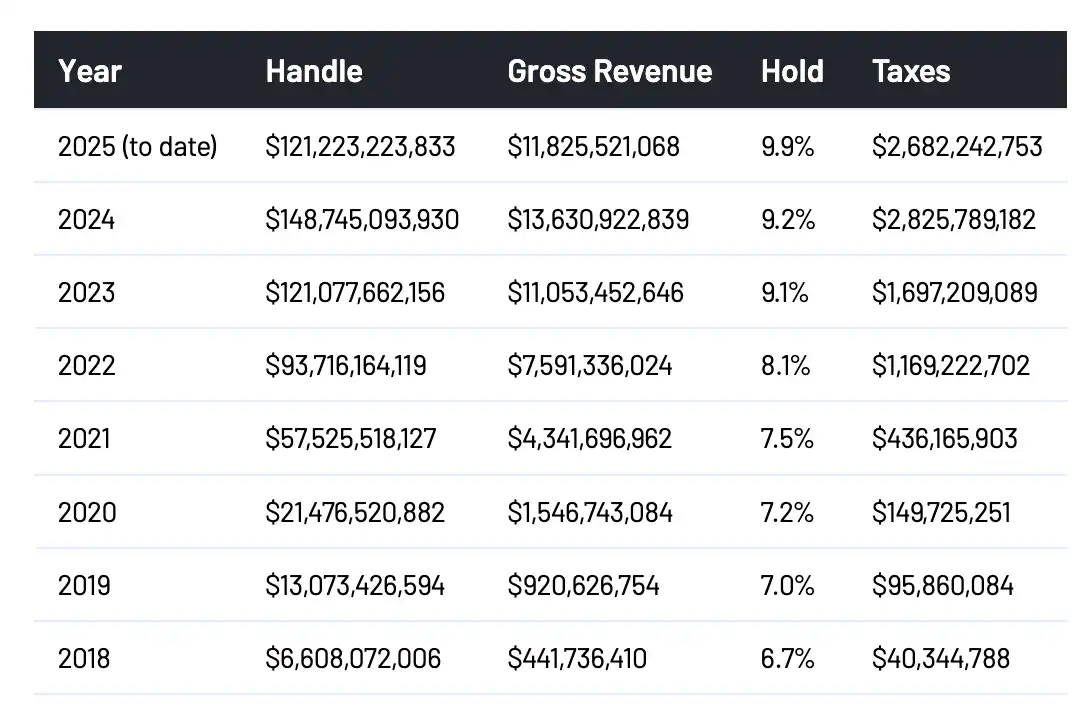
According to the prominent sports betting media Sports Book Review's statistics (see chart below, data as of August 2025), since regulatory expansion in 2018, the total handle and tax revenue of the U.S. sports betting market have shown significant growth in recent years. By 2024, the market's total handle had reached $148.74 billion, with a tax contribution of $2.82 billion. In just the first eight months of 2025, the total handle ($121.22 billion) and tax revenue ($2.68 billion) were already approaching the full-year 2024 levels.
Focus on Tennessee: What Does Sports Betting Mean?
Now, let's turn our attention to the spotlighted state of Tennessee in this event.
In 2019, Tennessee passed the "Tennessee Sports Gaming Act," officially legalizing sports betting. Although the then-Governor Bill Lee had reservations about gambling, he allowed the bill to pass without vetoing it. Between 2021 and 2022, the Tennessee state legislature established a dedicated regulatory body through law to oversee licensing and regulation comprehensively. This body was initially known as the Sports Wagering Advisory Council and later rebranded as the Tennessee Sports Wagering Council, which issued the injunction against Kalshi, Polymarket, and Crypto.com mentioned at the beginning of this article.
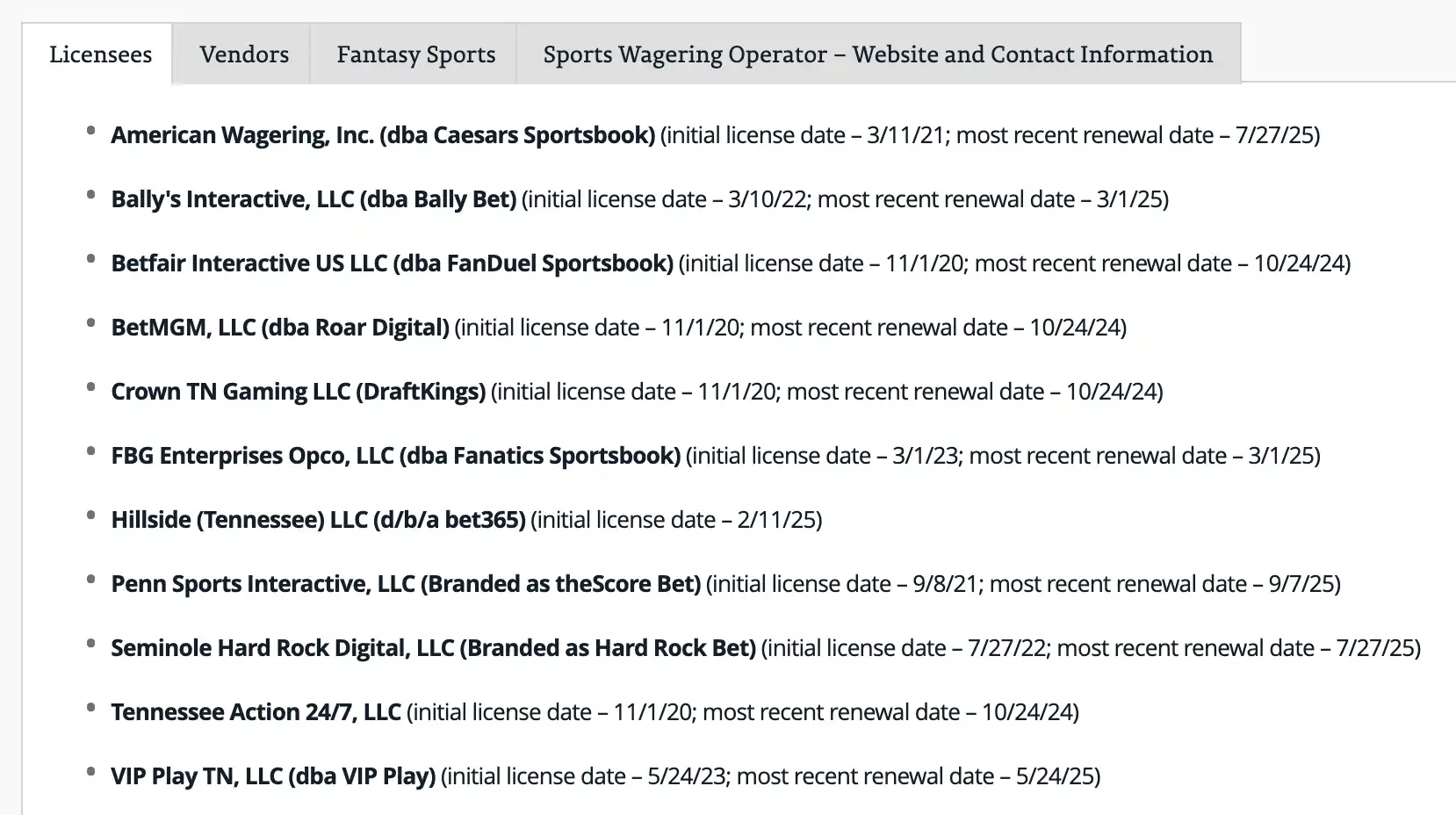
Currently, the SWC is the sole sports betting regulatory agency in Tennessee, responsible for licensing operations, compliance oversight, rulemaking, and enforcement. The SWC mandates that all sports betting operators must obtain SWC licenses to offer services in the state. Currently, a total of 11 licenses have been issued (see chart); only residents aged 21 and over can access these services, and they must undergo geolocation verification to ensure they are betting within the state. Regarding taxes, the state levies a 1.85% tax rate based on total handle—it previously used an income-based tax scheme before switching to a handle-based tax after 2023.
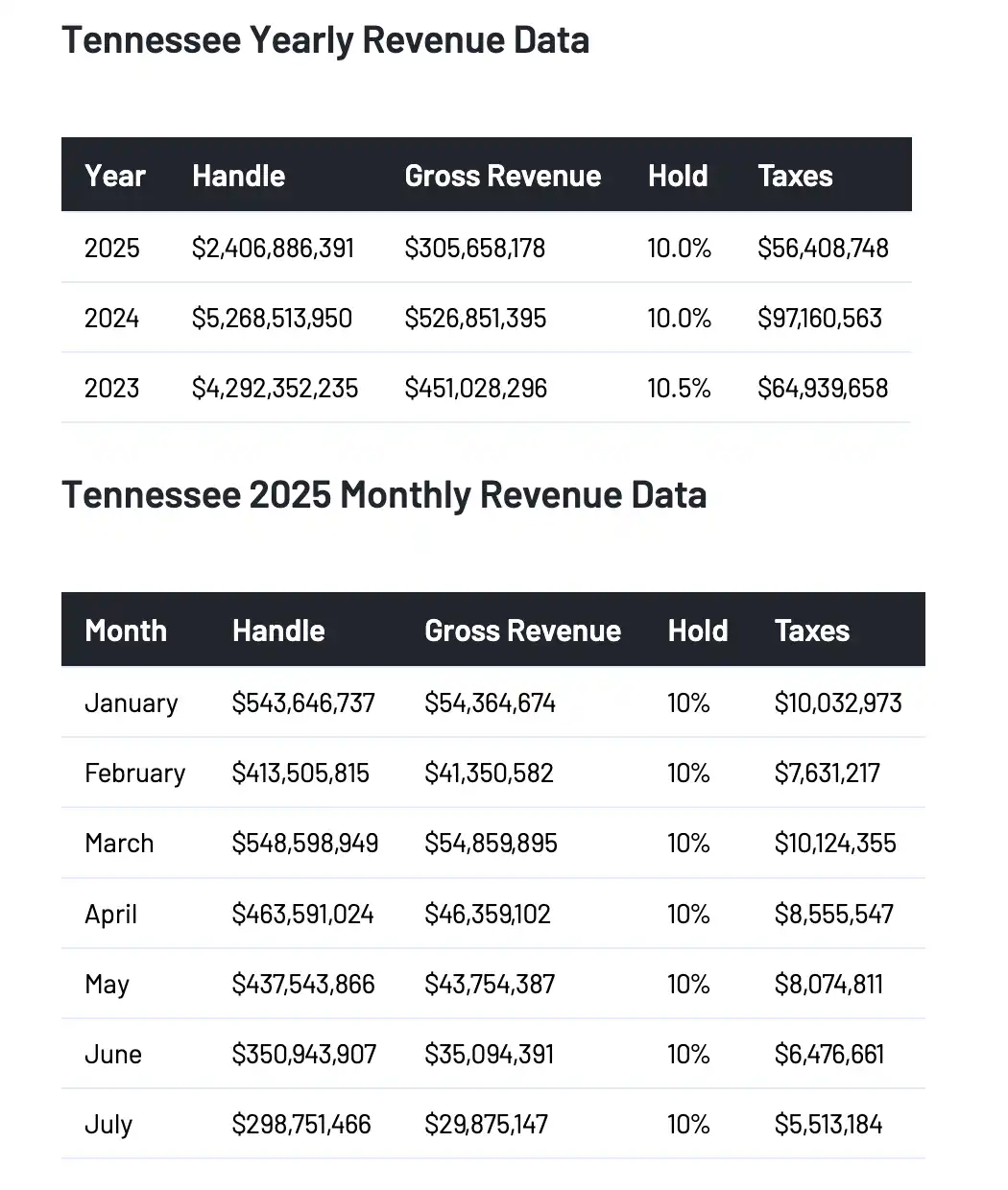
The sports betting market has contributed significant tax revenue to the state of Tennessee. According to the Sports Book Review stats (see below, data as of July 2025), the total sports betting handle in Tennessee reached $52.68 billion in 2024, with a tax contribution of $97.16 million; the handle for the first 7 months of 2025 has already reached $24 billion, with a tax contribution of $56.40 million.
However, this large and still-growing pie is now gradually being eaten into by platforms like Polymarket.
How Did Prediction Markets Eat into the Old World?
On December 3, 2025, Polymarket announced receiving CFTC approval to re-enter the U.S. market after nearly four years; even earlier, platforms like Kalshi and Truth Predict, a prediction market under Crypto.com, had opened their doors to U.S. users under CFTC's permission.
The current regulatory landscape categorizes sports betting as a form of gambling service regulated by individual states. However, platforms like Polymarket are generally viewed as new entities providing "event contract" trading services, where "event contracts" are considered financial derivatives under the CFTC's jurisdiction. This allows prediction markets to bypass the stringent regulations of sports betting services—no need for state-level licenses, adherence to addiction control and user protection regulations, or significant sports betting taxes to states. Yet, they can offer sports event outcome betting services similar to sports betting, creating a certain degree of "regulatory arbitrage" in practice.
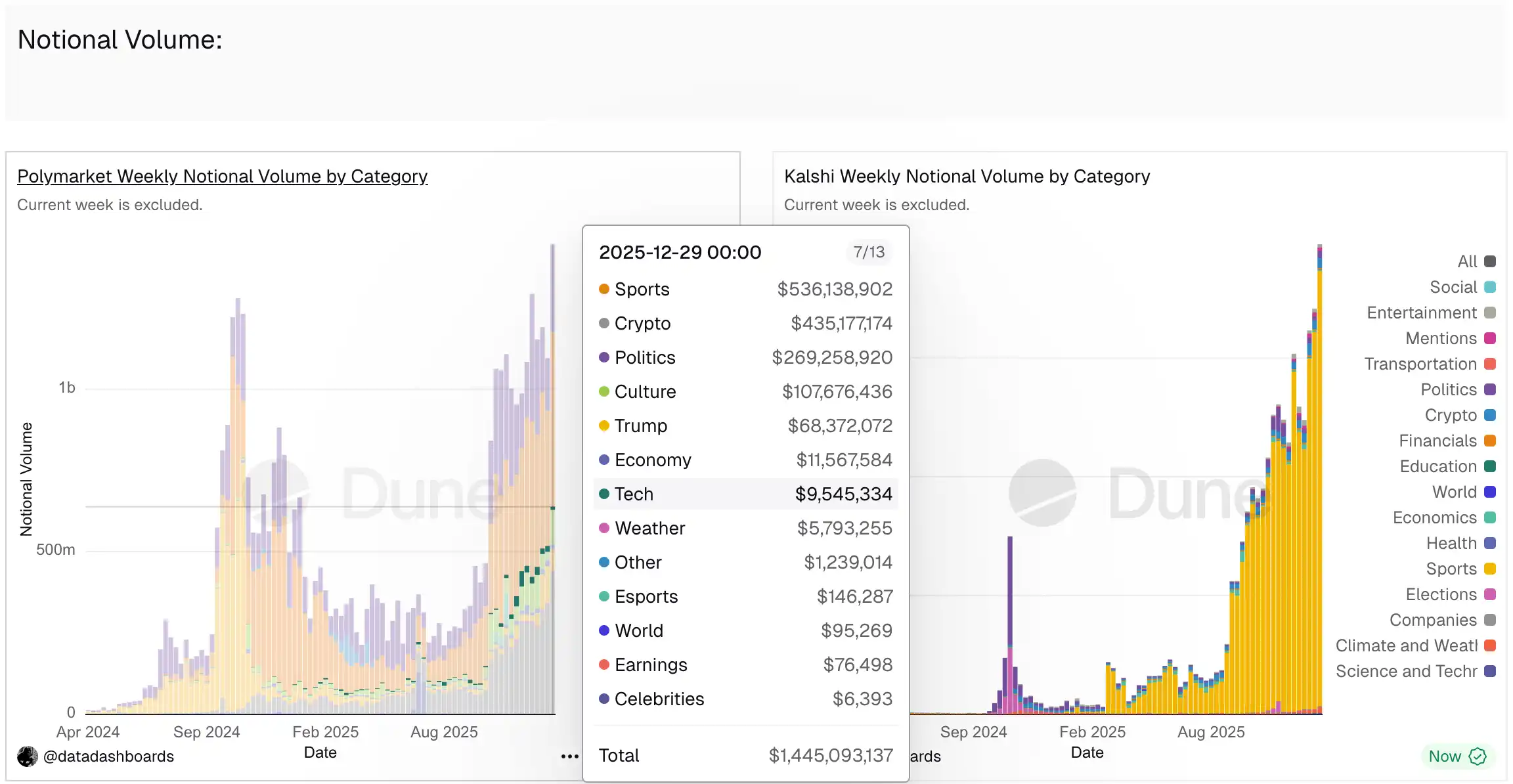
If prediction markets were still just a small-scale experiment, that would be one thing, but the reality is that the growth rate of prediction markets, compared to the already exaggerated sports betting market, is outrageous—in 2025, the total trading volume of prediction markets is approximately $400 billion, a 400% increase from 2024's $90 billion. Data Dashboards' dashboard on Dune (see below) shows that event contract transactions in the sports category have become the highest proportion of trading in the prediction market.
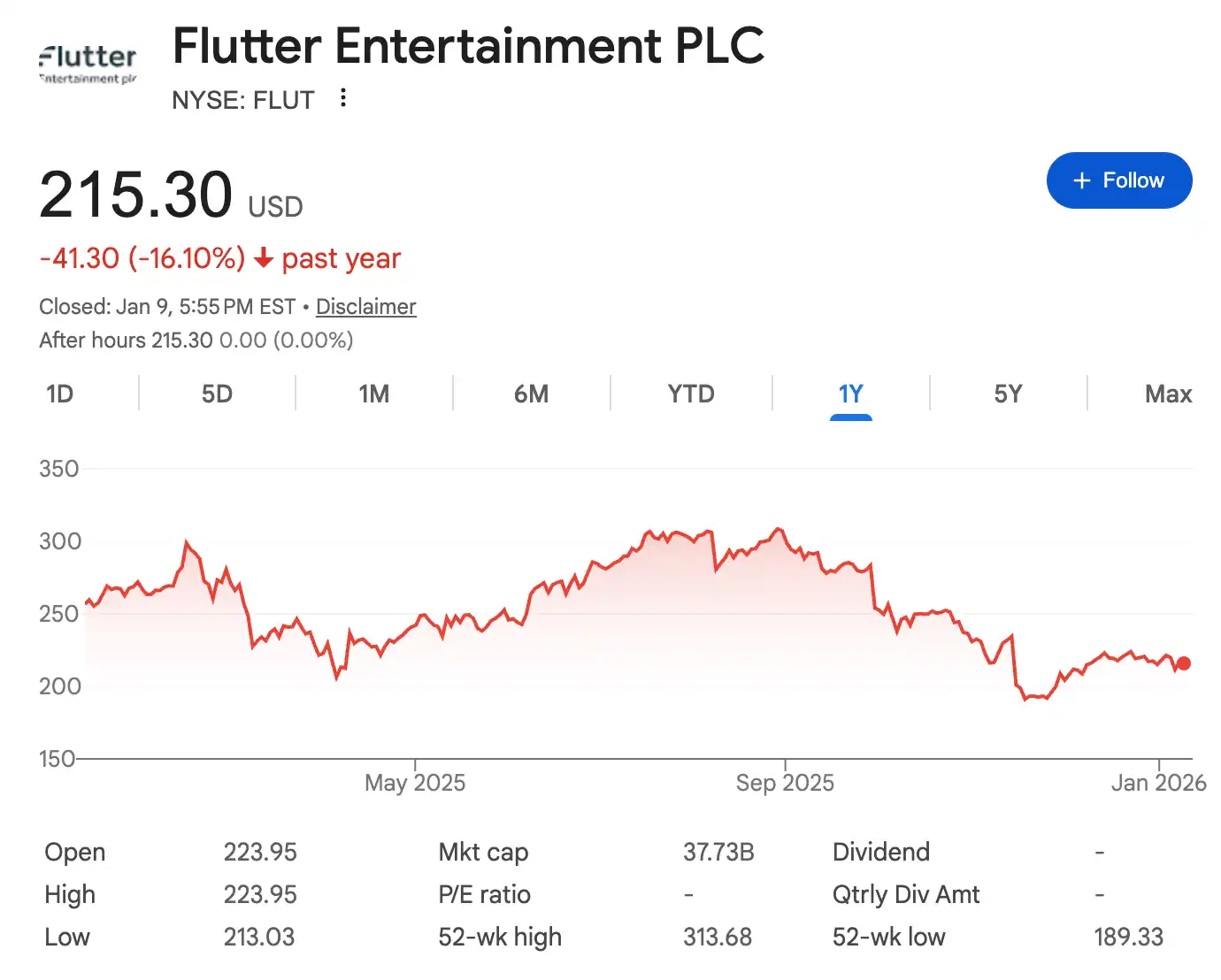
The capital market has long recognized Polymarket's increasing threat to traditional sports betting services. The two sports betting market giants, DraftKings and Flutter Entertainment, saw declines of 11.7% and 16.1% respectively over the past year—while the U.S. stock market was experiencing a bull run, with the Dow up 12.97% for the year, the Nasdaq up 20.36%, and the S&P 500 up 16.39%; and the sports betting market had been on an upward trend for eight years.
Whether it is Tennessee relying on sports betting for tax revenue or the capital forces behind the sports betting market, it is challenging to predict how this new player will fare.
-- Price
Friction Is Not Isolated: How Will the Prediction Market Fight Back?
In fact, Tennessee's ban on prediction markets is not unique. Similar reasons have led Maryland, Ohio, Illinois, New Jersey, Nevada, Montana, Michigan, and Connecticut to crack down on prediction markets, and as Polymarket only reentered the U.S. market last December, Kalshi faced more regulatory blows head-on.
In response, Kalshi once sued Nevada, New Jersey, and Maryland claiming it "complied with higher-priority federal regulations and was not required to follow state-level regulations," but the results were not ideal.
• The litigation in Nevada initially favored Kalshi at the district court level, but then switched to ruling against Kalshi in November last year, with Judge Andrew Gordon determining that Kalshi's event contracts were very similar to sports betting wagers and thus fell under Nevada's sports betting regulations. Kalshi has appealed to the U.S. Ninth Circuit Court of Appeals;
• In New Jersey, the district court chose to support Kalshi, but the state's sports betting regulatory body has appealed to the U.S. Third Circuit Court of Appeals;
• In Maryland, the district court sided with the sports betting regulatory body, with Judge Adam B stating that Kalshi failed to prove that "Congress unmistakably and unambiguously intended to deprive the states of the power to regulate gambling." Kalshi has appealed to the U.S. Fourth Circuit Court of Appeals.
The law firm Benesch commented that as the national debate continues, similar divisions are expected at the appellate court level, laying the groundwork for the Supreme Court to resolve the issue in the coming years... If the appellate courts happen to uniformly support Kalshi's position, other prediction markets may mimic its model and begin similar operations before the Supreme Court hears the matter; but if the appellate courts reach different conclusions, similarly situated companies may wait for clearer legal signals before taking action. Either way, Kalshi's lawsuit will set a precedent with a direct and far-reaching impact on the national sports betting and gambling industry.
In summary, the question of whether the prediction market needs to comply with state sports betting regulations is still a pending issue. The fundamental contradiction of this issue lies in the similarity between the prediction market and sports betting in terms of product service providers, as well as the differences in regulatory requirements.
This is a tug-of-war regarding institutional adaptation. Until the appellate court and even the Supreme Court provide a final conclusion, the gray area between the prediction market and sports betting will persist, and regulatory conflicts will be hard to avoid. In the short term, states may continue to defend their regulatory authority and tax base through enforcement and litigation, while prediction market platforms will seek greater room to operate by relying on federal compliance and an innovation narrative.
This content is provided for general informational purposes only and doesn't constitute financial, investment, legal, or tax advice. Any events, rewards, online promotions, or related information mentioned herein should not be considered a recommendation, solicitation, or invitation to purchase, sell, trade, or otherwise deal in any crypto assets. Crypto assets are highly volatile and may result in loss. The availability of WEEX services, products, and related events may vary by region. You are responsible for ensuring that your participation is in accordance with applicable local laws and regulations.
You may also like

The euro stablecoin's retail VASP transaction volume increased 12 times to $777 million over 15 months

Y Combinator launches the YC Crypto Deals program, with participation from the Solana Foundation and others

The Federal Reserve is seeking feedback on the "streamlined master account" framework, proposing to allow cryptocurrency companies to access its payment system

Futures Trading Hours Explained: How Smart Traders Cut Futures Fees and Earn More Cryptocurrency in 2026

BNKR’s Recent Surge Marks New Heights in Cryptocurrency Market
Key Takeaways BNKR Token Peak: BNKR reached an all-time high of $0.0011 on July 31, 2025. Significant Market…

Beast Industries Acquires Step – Expanding Fintech Horizons
Key Takeaways Beast Industries, led by YouTube celeb MrBeast, has acquired the teen-focused fintech banking app Step, aiming…

SlowMist’s Latest Alert: A Deep Dive into LiteLLM’s Data Breach
Key Takeaways SlowMist identifies a major breach in the LiteLLM library, with approximately 300GB of sensitive data compromised.…

Steakhouse Financial Experiences Phishing Attack: A Comprehensive Overview
Key Takeaways Steakhouse Financial’s domain experienced a phishing attack, prompting user safety advisories. Depositors’ funds and smart contracts…

FTX/Alameda Wallet Transfers Over $8 Million in ZRO Tokens to Wintermute
Key Takeaways An FTX/Alameda-associated wallet moved 4.126 million ZRO tokens to market maker Wintermute, with an approximate value…

Analysis of Recent Ethereum Short Position Activity on HyperLiquid
Key Takeaways Recently, a newly created wallet deposited $4.89 million into HyperLiquid, opening a short ETH position with…

Upbit and Bithumb Designate DRIFT as a Trading Alert Item
Key Takeaways Upbit and Bithumb have labeled DRIFT as a “trading alert” asset following guidance from the Digital…
“Brother Maji” Faces Potential Liquidation with ETH Long Position
Key Takeaways “Brother Maji” currently holds a substantial 25x leveraged long position of 6,000 ETH. The position was…
Binance’s Strategic Delisting of Trading Pairs Enhances Market Health
Key Takeaways Binance has decided to remove 23 spot trading pairs, focusing on those with low liquidity and…

Renew the Spirit, Reveal the Worth: Insights on U.S. Economic Trends
Key Takeaways U.S. Treasury Secretary Scott Bessent confirms the Federal Reserve plans to eventually lower interest rates. Current…

Hackers in Brazil Use Fake Google Play Store to Steal Cryptocurrency
Key Takeaways Hackers in Brazil are exploiting fake Google Play Store pages to spread Android malware. Infected devices…

Binance to Delist Key Spot Trading Pairs: What You Need to Know
Key Takeaways Binance is set to remove several spot trading pairs on March 27, 2026, at 11:00 AM…

Dragonfly Receives $55.8 Million Worth of LIT Tokens, Locked Until December 2026
Key Takeaways Dragonfly has acquired 55.8 million LIT tokens from Lighter, according to Arkham. The tokens are valued…
Circle and Tether Freeze Iranian Exchange Wallex Wallet with $2.49M Assets on Hold
Key Takeaways Circle and Tether have frozen a significant amount of assets from an Iranian exchange called Wallex,…
Binance to Delist 10 Spot Pairs Including ARB/EUR
Key Takeaways Binance has announced the delisting of 10 spot trading pairs. The affected pairs include ARB/EUR, BANANA/FDUSD,…

SpaceX Stock Prediction: Hitting $1,200 at 2026 IPO?
Key Takeaways Elon Musk confirms SpaceX is advancing its IPO plans, with expected filing as early as weeks…

OpenClaw 3.28 Update: Potential Security Risks with Axios
Key Takeaways Recent findings suggest OpenClaw version 3.28 may contain a compromised version of the Axios library. Dependency…
Massive Whale Movement: Unstaking $84.96 Million in HYPE Tokens
Key Takeaways A crypto whale, known as TechnoRevenant, has unstaked approximately $84.96 million in HYPE tokens. The tokens…

Security Risks of Fake Ledger Nano S+ Devices Emerging Through Chinese E-Commerce
Key Takeaways Counterfeit Ledger Nano S+ devices are being sold on Chinese e-commerce platforms, posing significant risks to…

How Crypto Futures Markets Are Fueling ‘Scam Coin’ Insider Schemes
Key Takeaways: RAVE’s market cap skyrocketed to $6.7 billion before plummeting by 95% due to insider control and…

SEC’s “Innovation Exemption” Sets New Rails for Tokenized Securities
Key Takeaways: SEC Chair Paul Atkins introduces an “innovation exemption” to regulate tokenized securities. A five-category token framework…

Ripple Sets 2028 Deadline for Quantum-Ready XRPL
Key Takeaways: Ripple commits to a 2028 deadline for XRPL’s quantum-readiness, focusing on quantum-resistant cryptographic systems. Google’s research…
Breaking: Crypto Investor Tim Cook Steps Down as Apple CEO
Key Takeaways: Tim Cook will transition from CEO to Executive Chairman on September 1, 2026. John Ternus, a…
UK Fintech Stratiphy Reopens Tax-Free Crypto ETNs Through IF ISAs
Key Takeaways: Stratiphy now offers UK investors tax-free crypto ETNs via Innovative Finance (IF) ISAs. Recent policies restrict…

Stratiphy Reopens Tax-Free Crypto ETNs for UK Investors
Key Takeaways: Stratiphy reintroduces tax-free access to crypto ETNs in the UK, reversing limitations imposed by HMRC’s ISA…
Uzbekistan Launches Tax-Free Crypto Mining Zone in Karakalpakstan
Key Takeaways: Uzbekistan has initiated the “Besqala Mining Valley” in Karakalpakstan, offering a supervised zone for crypto mining…
The euro stablecoin's retail VASP transaction volume increased 12 times to $777 million over 15 months
Y Combinator launches the YC Crypto Deals program, with participation from the Solana Foundation and others
The Federal Reserve is seeking feedback on the "streamlined master account" framework, proposing to allow cryptocurrency companies to access its payment system
Futures Trading Hours Explained: How Smart Traders Cut Futures Fees and Earn More Cryptocurrency in 2026
BNKR’s Recent Surge Marks New Heights in Cryptocurrency Market
Key Takeaways BNKR Token Peak: BNKR reached an all-time high of $0.0011 on July 31, 2025. Significant Market…
Beast Industries Acquires Step – Expanding Fintech Horizons
Key Takeaways Beast Industries, led by YouTube celeb MrBeast, has acquired the teen-focused fintech banking app Step, aiming…