
Life charts can't cure anxiety, and predicting the market can't foresee the outcome


Source: TechFlow (Shenchao)
At the beginning of 2026, a sudden geopolitical event shocked the world: On January 3, the United States launched a military operation codenamed "Operation Absolute Resolve," successfully capturing President Nicolás Maduro and his wife Celia Flores, and quickly transporting them to New York to face criminal charges in Manhattan federal court, including drug terrorism conspiracy, cocaine import conspiracy, and weapons charges.
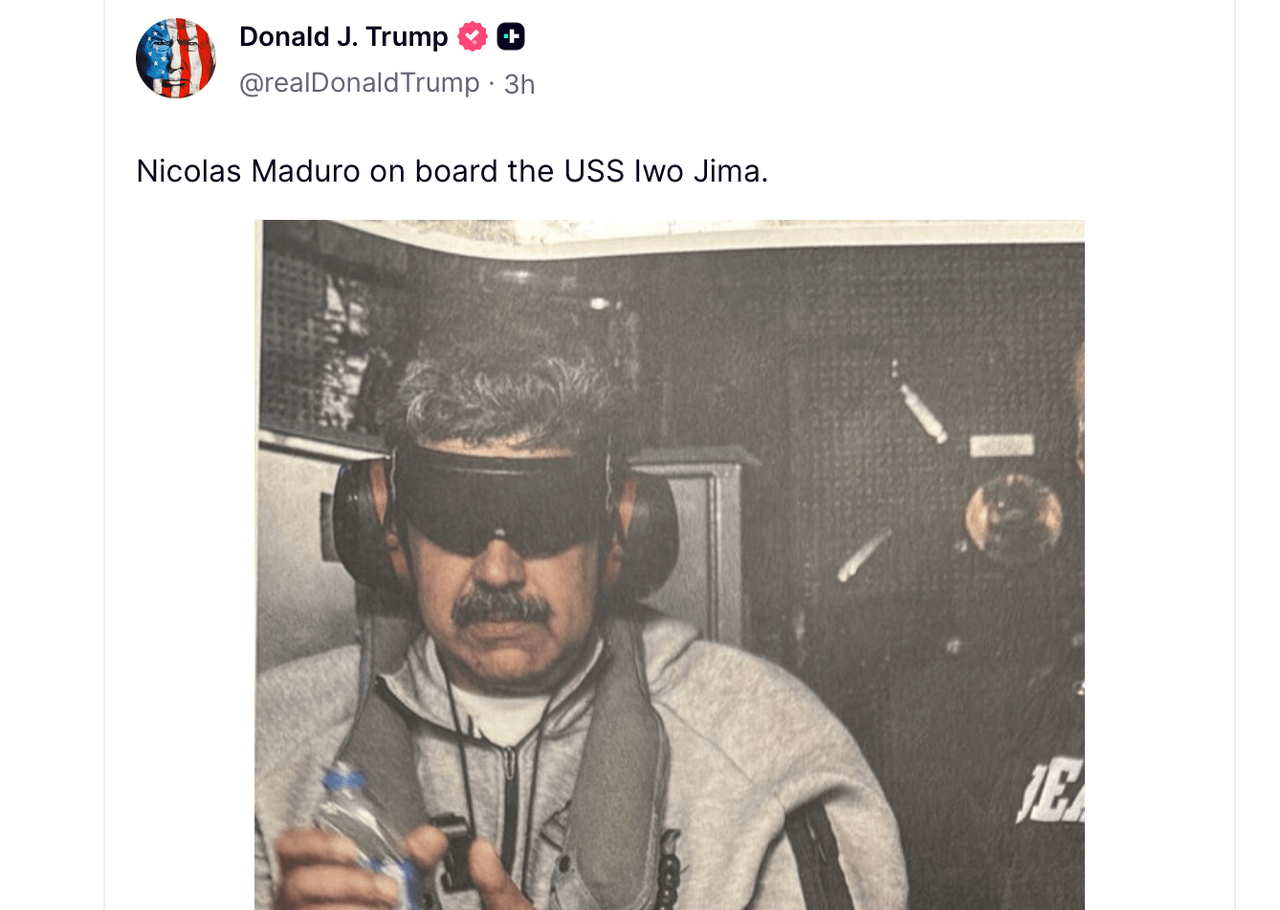
Despite the long-standing standoff between the US and Venezuela, the secrecy and explosiveness of this operation completely defied expectations. Just 24 hours before the raid, everything seemed normal in Caracas, with no public signs of a breakdown in diplomatic efforts. This event quickly made global headlines, not only for its political significance but also because it revealed a stark reality: true historical turning points often occur in the blink of an eye.
Just before the raid, contracts on Polymarket betting on Maduro's potential removal from power were trading at only about 5 to 7 cents, meaning the market generally considered him extremely safe in the short term. No one anticipated his arrest, which brought huge profits to traders who placed bets shortly before the operation was made public.
Despite the unpredictability of life, humanity's desire to predict the future has never been more urgent. At the end of 2025, two tools unexpectedly formed a kind of intertextuality: one is the "life chart," which visualizes the Chinese astrological system, and the other is a prediction market that presents odds on global events.
We attempt to use the former to calculate an individual's fate and the latter to predict the world's destiny. What they both promise is a quantifiable future.
Life charts, through symbolic visualization, provide a sense of certainty; prediction markets, through price signals, offer probabilistic certainty. It seems that by reading these signals early enough, we can prepare in advance, hedge against uncertainty, and seemingly gain a head start. But is this truly the case?
The viral popularity of life charts reflects a psychological need for certainty. Users input their birth information, AI automatically generates a chart, predicts major life cycles, and outputs a candlestick chart; the fluctuations of the graph provide a readable life curve. Under the dual pressures of employment and emotional fluctuations, it acts as a coordinate axis, providing a framework for self-narration and emotional catharsis. This candlestick chart doesn't sell science, but rather meaning and comfort—unquestionable emotional value.
Prediction markets, on the other hand, promise verifiable predictions through financialized language. In 2025, Polymarket and Kalshi dominated the prediction market sector, with sports, political, and economic events becoming predictable and betting targets, and trading volume extending from peak election periods to everyday life. Platforms allowed users to place bets with real money, and prices formed a probabilistic consensus amidst liquidity and divergence.
Amidst the triple anxieties of economic volatility, geopolitical tensions, and AI disruption, young people don't need accurate predictions, but rather the illusion that their destiny is in their hands. These two types of tools offer two heterogeneous forms of "control," seemingly allowing them to hedge against macroeconomic risks and gain an edge in an uncertain world by simulating life and event trajectories in advance.
However, such preparation inevitably has limitations and even carries significant risks. Cultural biases introduced by model training, algorithmic black boxes, and "black swan" events like Maduro's arrest all demonstrate the questionable accuracy of future predictions.
But such preparation inevitably has limitations and carries significant risks. Cultural and algorithmic biases introduced by model training, and the risks of black swan events, all indicate that the true accuracy of future predictions is questionable. The risks of over-focusing on predictions cannot be ignored. While life charts may be presented as entertainment, they can influence crucial individual choices. Cases of market manipulation are frequent, with insider trading and large-scale price manipulation being proven realities.
But this isn't the most dangerous aspect. A deeper crisis lies in the fact that the act of observation itself can interfere with the system, a concept already metaphorically described by Heisenberg's uncertainty principle. The more users blindly trust the probabilities output by tools, the more likely they are to lose their keen intuition for sudden risks. We stare at dashboards for so long that we forget to look up and see where we're going.
Predictive tools can identify trends, but they can never foresee true turning points. They are rearview mirrors, reflecting current anxieties and consensus, but unable to become searchlights illuminating the fog.
Ultimately, uncertainty is the underlying code of the world. After the frequent black swan events of 2025, the best preparation is not staring at candlestick charts or odds on a screen, but acknowledging the limitations of algorithms.
After all, real life often unfolds beyond the candlestick charts. Going with the tide and building individual resilience amidst immense uncertainty may be the only true path we can truly grasp.
You may also like

How WEEX Bridges Crypto and Football: A Deep Look at the LALIGA Partnership Inside the WEEX App
WEEX is not just a LALIGA sponsor. It’s a true partner. From iPhone Dynamic Island to LALIGA-themed app icons and smart posters, see how WEEX brings football passion into every trade — and builds a real bridge between crypto and sports.

FC Barcelona vs Real Madrid Preview: El Clásico – Can Barça Clinch the Title at Spotify Camp Nou?
FC Barcelona vs Real Madrid El Clásico match preview for May 11, 2026. Barça need just 1 point to win LALIGA. Can Madrid delay the trophy? Full preview inside.

Miners welcome a new life

At the Stripe conference, I saw the future of the AI economy

Seven Important Judgments by Claude Code's Founder at the Sequoia Conference

Morning Report | MoonPay acquires Solana's execution layer DFlow; Strategy releases Q1 financial report; Manta Network announces the termination of Manta staking program

Dialogue Velocity Eric: What is the stablecoin track that the CFO really wants?
The payment moment of AI agents: Who will become the Stripe of the machine economy?

Rented Tracks: What is this wave of stablecoin FX hot money really paying for?

Strategy should have said that selling coins is not ruled out

How MegaETH Achieved a TVL of 700m Within a Week of TGE? Analyzing the Packaging Strategy

Futures Trading Hours: Trade Cryptocurrency 24/7 and Earn Back Up to 45% in Trading Fees
Learn futures trading hours and the best time to trade crypto futures. Discover 24/7 market insights, peak trading sessions, and how to earn back up to 45% in fees.

Why is a16z Crypto raising another $2.2 billion to heavily invest in Web3?
Polymarket Underlying Algorithm Explained

What do projects born in the crypto bear market do?

a16z founder's Stanford lecture: Whenever Wall Street and Silicon Valley have different ideas, it's Wall Street that ends up being wrong

Michael Saylor: After three consecutive quarters of losses, Strategy will sell Bitcoin to pay dividends
The toll station at Hormuz and the RMB that cannot be bought
How WEEX Bridges Crypto and Football: A Deep Look at the LALIGA Partnership Inside the WEEX App
WEEX is not just a LALIGA sponsor. It’s a true partner. From iPhone Dynamic Island to LALIGA-themed app icons and smart posters, see how WEEX brings football passion into every trade — and builds a real bridge between crypto and sports.
FC Barcelona vs Real Madrid Preview: El Clásico – Can Barça Clinch the Title at Spotify Camp Nou?
FC Barcelona vs Real Madrid El Clásico match preview for May 11, 2026. Barça need just 1 point to win LALIGA. Can Madrid delay the trophy? Full preview inside.
Miners welcome a new life
At the Stripe conference, I saw the future of the AI economy
Seven Important Judgments by Claude Code's Founder at the Sequoia Conference
Morning Report | MoonPay acquires Solana's execution layer DFlow; Strategy releases Q1 financial report; Manta Network announces the termination of Manta staking program


