
Japanese Opposition Alliance on the Brink of Collapse After Failed Merger

 Prefer us on Google

Japan's centrist opposition alliance faces a possible breakup after the Constitutional Democratic Party rejected joining a merger with Komeito. The crisis threatens to weaken opposition cooperation ahead of next year's local elections and could benefit the ruling coalition led by Prime Minister Sanae Takaichi.
- The Constitutional Democratic Party of Japan decided not to join the proposed tripartite merger with Komeito and the Centrist Reform Alliance.
- The alliance has 49 lawmakers in the House of Representatives: 28 from Komeito and 21 from the CDPJ.
- Political analysts warn that the fragmentation of the opposition could benefit the ruling parties in the upcoming local elections.
Japan's centrist opposition is on the verge of a breakup after talks to expand an alliance formed earlier this year failed. The dispute revolves around a tripartite merger between the Centrist Reform Alliance, Komeito, and the Constitutional Democratic Party of Japan, a formula intended to counter the ruling coalition led by Prime Minister Sanae Takaichi.
The outcome was still to be formalized on Monday, when leaders of the three parties were scheduled to meet to decide the future of the plan. However, sources cited by the South China Morning Post indicated that members linked to Komeito, who joined the alliance just a few months ago, could leave the group if a political solution did not materialize. A potential breakup would open a new phase of more fragmented opposition cooperation.
An Alliance Losing Cohesion
The Centrist Reform Alliance was formed in January with the aim of uniting moderate opposition forces against the bloc controlling the Japanese government. After the general elections in February, the group had 49 lawmakers in the House of Representatives, the lower and more powerful chamber of Parliament, although its members maintain separate party structures.
Of those 49 lawmakers, 28 come from Komeito and 21 from the Constitutional Democratic Party of Japan. The distribution shows the weight that Komeito members have within the alliance and explains why their possible exit poses a direct threat to the continuity of the bloc, especially after the CDPJ ruled out participating in the merger that had been discussed for months.
The ruling coalition retains control of the House of Representatives through the Liberal Democratic Party and its partner, the Japan Innovation Party. In contrast, this coalition does not have a majority in the House of Councillors, where Komeito and CDPJ lawmakers continue to occupy their seats separately, an institutional difference that complicates any common opposition strategy.
The lack of a unified structure in both chambers leaves opposition parties facing a dilemma: preserve separate identities or move towards closer coordination to compete with the government. The current crisis suggests that, even when there is a shared interest in challenging the ruling coalition, the organizations have failed to agree on the level of integration needed.
The Failure of the Tripartite Merger
After months of negotiations, Shunichi Mizuoka, leader of the CDPJ, informed his counterparts in the Centrist Reform Alliance and Komeito on Friday that his party would not join the bloc. The decision halted the proposal to consolidate the three forces into a single opposition alliance, just as their leaders were trying to present a coordinated alternative to Takaichi's government.
Mizuoka proposed exploring mechanisms other than a full merger, including the creation of a joint parliamentary group in the House of Councillors. This proposal would have allowed the CDPJ to maintain its independent identity while facilitating legislative cooperation in a chamber where the ruling coalition does not hold a majority.
However, the initiative was rejected by a senior Komeito executive, according to the report on Friday's meeting. The disagreement highlighted a central difference between the parties: while the CDPJ sought a flexible coordination formula, Komeito appeared to demand a more defined political commitment to sustain the common project.
The meeting scheduled for Monday was supposed to turn the failure of the talks into a formal decision regarding the merger. Until that moment, the alliance remained in a vulnerable position, as the departure of legislators linked to Komeito could unravel the agreement that had allowed 49 representatives to be grouped in the House of Representatives.
Consequences for the Japanese Opposition
The political focus now shifts towards future cooperation among opposition parties, especially in light of next year's unified local elections. Electoral coordination is often decisive when multiple forces compete for the same electorate, as a divided opposition can diminish its chances of challenging candidates backed by the ruling parties.
Political analysts cited in the report believe that the fragmentation of the opposition field will benefit the currently governing forces. The warning does not imply that the electoral outcome is predetermined, but it does indicate an immediate cost for parties that fail to resolve their differences: competing separately may dilute their parliamentary strength and hinder the construction of a national alternative.
The situation also reflects the complexity of maintaining an alliance that operates differently in each chamber. In the House of Representatives, Komeito and CDPJ legislators are integrated into the Centrist Reform Alliance, while in the House of Councillors, both parties continue to sit separately, a duality that leaves open the possibility of partial agreements but also new conflicts.
The tension was represented in the meeting held on Friday in the Tokyo Parliament, attended by Mizuoka, Junya Ogawa, leader of the Centrist Reform Alliance, and Toshiko Takeya, head of Komeito. The next step will depend on the formal decision of their leaders and whether they can preserve any channel of cooperation after the collapse of the tripartite merger.
For now, the project born in January faces its most serious test, while the ruling coalition maintains control of the lower house. The future of the Japanese opposition will depend less on an immediate merger than on its ability to coordinate without deepening the rift that the negotiations have exposed.
-- Price
This content is provided for general informational purposes only and doesn't constitute financial, investment, legal, or tax advice. Any events, rewards, online promotions, or related information mentioned herein should not be considered a recommendation, solicitation, or invitation to purchase, sell, trade, or otherwise deal in any crypto assets. Crypto assets are highly volatile and may result in loss. The availability of WEEX services, products, and related events may vary by region. You are responsible for ensuring that your participation is in accordance with applicable local laws and regulations.
You may also like

"Without Changing the Nature of Government Bonds" Toward Tokenization: Progmat's Saito Explains

LDP Proposes Establishing a Cyber Response Headquarters Ahead of Cybersecurity Crisis, Emphasizing Cryptocurrency Tracking and Post-Quantum Cryptography

Former FTX Executive Slams Netflix's New Series: Turning Financial Fraud into a 'Romantic Film' is Absurd

Delphi Digital: Why Speculation is the Theme of the Next Decade

Bitgo Launches AI Financial Application 'Gokubu' and Research Organization
"Millions of devices are vulnerable": Ledger CTO

Private Jets and Investor Pressure Force Polymarket CEO to Mature

Doctor Profit Warns of a Very Big Monero (XMR) Liquidation Event

Stuttgart Stock Exchange Gets Green Light to Trade and Settle Tokenized Securities
WEEX Exclusive:Tech Rebounds; Bitcoin Holds $81,000–$82,000 Support| WEEX TradFi Daily (October 20, 2026)
Tech Rebounds; Bitcoin Holds $81,000–$82,000 Support| WEEX TradFi Daily (October 20, 2026)
On October 19, tech rebounded. The three major indexes were mixed, with the Nasdaq relatively stronger. Intel rose after a JPMorgan upgrade, and SpaceX closed up more than 2%. Bitcoin traded near $81,000–$82,000, a zone traders viewed as strong support and a local bottom. Worldcoin (WLD) rose more than 10% in 24 hours, leading majors. October 20 focus includes earnings from SPCX and other listed names.
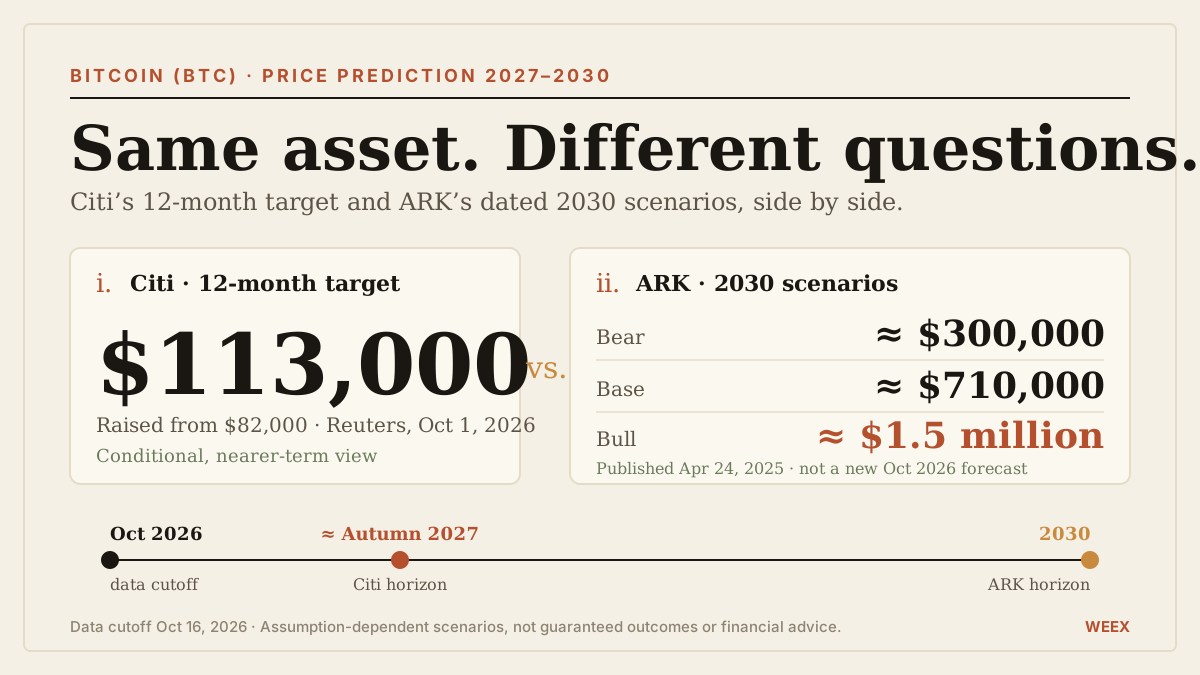
Bitcoin (BTC) Price Prediction 2027–2030: Citi’s $113,000 Target vs. Cathie Wood’s ARK Scenarios
Bitcoin price prediction for 2027–2030: compare Citi’s $113,000 target with ARK’s dated scenarios, demand assumptions, valuation math and key risks.

Crypto: 107 incidents and $1.18 billion stolen in Q3 2026

Is Pearl, Dreaming of Bitcoin in the AI Era, an Innovation or Just Simple Hype?

唐华斑竹 Analyzes Bitcoin Trends, Suggests Monitoring Support Levels

Howard Marks: If Everyone is Talking About a Bubble, Then the Bubble May Not Have Burst Yet

Quantum Alliance Established to Protect Blockchain from Quantum Computers

唐华斑竹 Analyzes the Current State of the Crypto Market, Advises Caution

U.S. Treasury Department's Survey Fails to Signal Debt Reduction, Bond Yields Rise with 10-Year Yield Back Above 5.12%
The Past and Present of Currency in the Age of Exploration

What Business Does Solana Want to Do in Shanghai?
Fractional Reserve: Reserve Requirement Abolished. Where is the Value?

Cyberattack on the ports of Marseille and La Rochelle? Hackers paid 1 dollar in crypto

G20 warns that stablecoins may lose value even if fully backed
![[Legal Insights] Hard Wallet Hacking Incident: Is My Digital Asset Safe in Exchanges?](/public-static/056_26fa6ae6a2.png?format=avif)
[Legal Insights] Hard Wallet Hacking Incident: Is My Digital Asset Safe in Exchanges?
[Full Text] DAXA: "Digital Asset Taxation Should Be Linked to Basic Law Classification and Enforcement Infrastructure"

Crypto Billionaires Invest $100 Million to Disrupt UK Politics

Cybersecurity Incident Involving GoPax and PraBank in the Virtual Asset Industry

Financial Stability Board Highlights Unclear Bankruptcy Laws for Stablecoin Failures
The Era of Industry: Q3 2026 Virtual Asset Industry Investment Status Report – Tiger Research
"Without Changing the Nature of Government Bonds" Toward Tokenization: Progmat's Saito Explains
LDP Proposes Establishing a Cyber Response Headquarters Ahead of Cybersecurity Crisis, Emphasizing Cryptocurrency Tracking and Post-Quantum Cryptography
Former FTX Executive Slams Netflix's New Series: Turning Financial Fraud into a 'Romantic Film' is Absurd
Delphi Digital: Why Speculation is the Theme of the Next Decade
Bitgo Launches AI Financial Application 'Gokubu' and Research Organization
"Millions of devices are vulnerable": Ledger CTO



