
- Buy Crypto
- Markets
- Futures
- Spot
- Copy Trade
 Earn
Earn- More
Historical Perspective: The 12 Months Post-Election Are Typically the Golden Period of a Crypto Bull Market

Original Article Title: Republican Victory Ushers in a New Era for Crypto
Original Article Author: Kelvin Koh, Spartan Group
Original Article Translation: Fu Ruhe, Odaily Planet Daily
The 2024 U.S. presidential election has become one of the most watched elections in recent years. Despite widespread expectations of a fiercely contested election, the election results still took many by surprise. Not only did Trump convincingly win the presidential election, but the Republican Party also secured a majority in both the Senate and the House. Such a sweeping victory will give the Republican Party enough political leverage to drive multiple reforms in the coming years. The cryptocurrency field is expected to undergo significant changes, and we believe the next 12 months will be a bullish period for crypto assets.
One key difference in the 2024 election compared to the past is the emergence of a "crypto agenda," with the winning president and his core advisory team holding a crypto-friendly stance. Crypto companies strongly supported Trump and key Republican candidates through donations. Therefore, it is not surprising that the crypto industry has become one of the major beneficiaries of the Republican Party's resounding victory.
There has been much discussion about the significance of this election for the crypto industry, but here are some of the key impacts:
· Changes in SEC Policy. Under Gary Gensler's leadership, the SEC and other appointed officials of the Biden administration have implemented aggressive regulation on the crypto industry. Despite industry calls for regulatory guidance, the SEC has continued to pursue enforcement actions. During Gensler's tenure, over 2,700 enforcement actions were initiated, resulting in total fines of up to $210 billion. This has made it difficult for many projects to operate in the U.S. Trump clearly stated during his campaign that if elected, he would replace Gensler. As expected, last week Gensler announced that he would step down as SEC chairman on January 20, 2025. Several nominees have already been named to succeed him, and they are generally seen as more supportive of the crypto industry. This means that existing enforcement actions may be reversed, and the SEC will adopt a more cooperative regulatory approach.
· Improvement in Congressional Environment. In the past, a major challenge facing the crypto industry was the difficulty of passing any favorable bills in the U.S. Congress, as most lawmakers lacked an understanding of cryptocurrency. However, after this election, about two-thirds of Congress members are considered crypto-friendly. This could lead to a regulatory framework that supports innovation, making it easier for projects to raise funds and clearing obstacles for institutional capital to enter the crypto space.
· Proposal for a Strategic Bitcoin Reserve. During his campaign, Trump mentioned to his crypto supporters that if elected, he would push for the establishment of a Strategic Bitcoin Reserve instead of having the U.S. government continue to dispose of previously seized bitcoins. This proposal quickly gained attention after the election. If this proposal were to be implemented, the market would start speculating whether this means the U.S. government would become a net buyer rather than a seller of Bitcoin. If MicroStrategy alone can influence the price of Bitcoin, imagine the impact of the U.S. government establishing a Strategic Bitcoin Reserve. More importantly, how would other countries react to this? Would they also come up with similar plans?
· Support for DeFi. Even before the election, a team supported by Trump had launched World Liberty Financial in September 2024, aiming to provide decentralized lending services and governance through the native token WLF. The project has raised over $50 million to date, with the latest investment coming from crypto entrepreneur Justin Sun, who invested $30 million this week. WLF plans to raise a total of $300 million. Whether it reaches $300 million or $50 million, the significance of this project goes far beyond the amount raised—it has provided a huge boost to DeFi developers and innovators. Importantly, a DeFi project supported by the incoming U.S. president will have a profound impact on the entire industry.
Each of the above events alone is enough to have a significant driving force on the crypto market, and the combined impact of these events on the crypto industry is profound. The market has not yet fully reflected the potential impact of these changes, which is why the U.S. media refers to this period as the "golden age of crypto."
In addition to all of the above, Trump has also expressed his desire for the U.S. to become the "global capital of crypto." To some extent, the U.S. is already the de facto leading crypto nation. Many major infrastructure projects, some of the largest blockchain infrastructure companies, and decentralized applications originated in the U.S. The U.S. also has the world's largest licensed cryptocurrency exchanges, the largest crypto investment banks, and the largest Web3 venture capital pool. Furthermore, the U.S. controls around 40% of the global Bitcoin mining hash rate (compared to 17% in 2021), making it the largest center for Bitcoin mining, partly due to policy changes in China. Most of the world's crypto trading is also denominated in dollars, and major stablecoins are pegged to the dollar. Therefore, the U.S. is already a global crypto hub in many ways. However, if the U.S. government plans to consolidate or further expand its dominance, what does this mean for other governments, especially major financial centers like London, Tokyo, Dubai, and Hong Kong? More importantly, can Europe afford to miss out on the Web3 innovation era and once again lag behind after the Web2 era?
Some people may question whether Trump will actually fulfill these promises, but I believe the likelihood of fulfillment is high. Trump does not follow traditional rules, and the political leverage brought by this election victory is very strong. Additionally, Trump has two native cryptocurrency advisors—Elon Musk and JD Vance. The new Secretary of Commerce, Howard Lutnick, also serves as the Chairman and CEO of Cantor Fitzgerald, which has just acquired a 5% stake in Tether (the issuer of the world's largest stablecoin USDT). With a more crypto-friendly Congress, pushing forward these measures should not be difficult.
Historical Data: Strong Cryptocurrency Price Performance in the 12 Months Following the U.S. Election, Altcoins Outperform Bitcoin
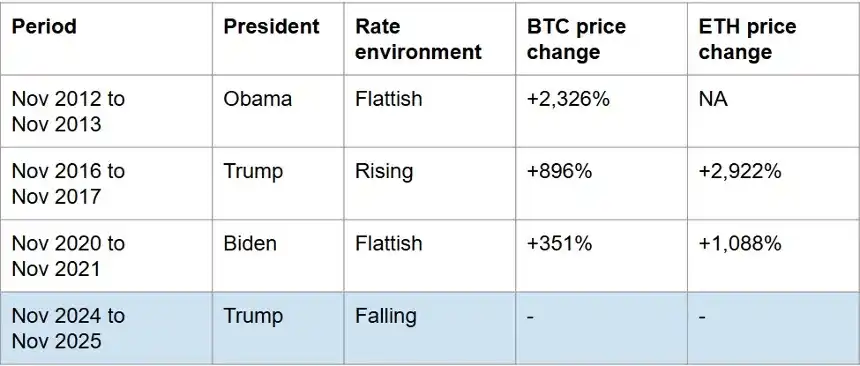
Against this background, discussing the impact of all this on cryptocurrency asset prices becomes particularly important. As seen in the table below, historically, the 12 months following a U.S. election have typically been a period of strong cryptocurrency price performance.
There are two main observations here:
· Regardless of who wins the presidential election and the interest rate environment, cryptocurrency assets have performed very well in the 12 months following the U.S. election. We attribute this to two factors:
a) Clarity brought by the election results and optimism about the new government;
b) The continued momentum of the Bitcoin halving cycle/cryptocurrency cycle.
· In the 12 months following the last two elections, altcoins (represented by ETH) have returned about three times as much as Bitcoin.
30 days after the 2024 election, Bitcoin rose by 46%, and Ethereum rose by 58%. We believe there is still significant upside potential in the next 11 months.
To better understand the opportunity with altcoins, let's look at the chart below, which shows the performance of altcoins relative to Bitcoin. It can be seen that there are stages within the cycle where altcoins significantly outperform Bitcoin. We refer to these stages as "altcoin cycles" or "altcoin seasons." The most recent major altcoin cycle occurred in January 2021 and peaked in November 2021. The previous cycle started in February 2017 and peaked in January 2018.

It is worth noting that these altcoin cycles roughly overlap with the 12-month period following the election. We believe the main reason is the strong price performance in the initial weeks after the election and the shift in investor sentiment towards risk appetite. Additionally, this trend has also attracted retail funds into the cryptocurrency asset class, with retail funds often preferring smaller and mid-sized tokens with higher risk due to the lack of liquidity constraints from institutional investors. Furthermore, at this point in the cycle, altcoins tend to underperform, making their risk-return profile more attractive compared to large-cap tokens. This is also the case in this cycle.
If this historical relationship holds, then we should expect the altcoin season to be imminent.
You may also like

What Happened in Crypto Today? Solana-Native Rails Launch on Digitap ($TAP) as the Best Crypto to Buy
Key Takeaways Digitap ($TAP) spearheads the transition toward real-world utility in cryptocurrency, offering a seamless financial ecosystem through…

Here’s Why Fed Contender Kevin Warsh is Seen as Bearish for Bitcoin
Key Takeaways Kevin Warsh is a potential nominee for the U.S. Federal Reserve chair, causing concerns due to…

XRP Breaks Below Its 1-Year Support Range: What’s Next?
Key Takeaways XRP has slipped below its critical support range of $1.8 to $2.1, which had been steadfast…

XRP Price Breakdown Intensifies — Can Support Mitigate the Shock?
Key Takeaways XRP has dipped below the significant $1.80 mark, continuing its downtrend. The asset is trading beneath…

XRP Risk-Adjusted Returns Suggest a Period of Consolidation – Insights and Analysis
Key Takeaways: XRP’s recent price fluctuations highlight a lack of strong market momentum for a trend reversal. The…

Kevin Warsh Associated with Crypto Project Basis and Electric Capital
Key Takeaways Kevin Warsh, former U.S. Federal Reserve Board Governor, is associated with crypto initiatives Basis and Electric…

Why is Trump’s Fed Chair Pick Kevin Warsh Seen as Bad News for Precious Metals, Commodities, Bitcoin, and Equities?
Key Takeaways: Kevin Warsh, once appointed, is expected to take a more hawkish stance on monetary policy, which…

Who Is Kevin Warsh? How His Fed Chair Odds Are Influencing Bitcoin Markets
Key Takeaways Kevin Warsh, a former Federal Reserve governor, is becoming a strong candidate for the next Fed…

Strategy (MSTR) Stock: Michael Saylor’s Bitcoin Bet Goes Red But Here’s The Twist
Key Takeaways Strategy’s Bitcoin investment has dipped below its average purchase price, highlighting market volatility. No immediate financial…

Gov-Backed Asset or Solana Meme? Uncovering the Reality Behind the USOR Crypto Frenzy
Key Takeaways USOR, a Solana token, sparked a debate over its legitimacy by claiming associations with U.S. strategic…
Bitcoin Hashrate Falls 12% After US Winter Storms Hit Miners
Key Takeaways: The total network hashrate for Bitcoin has declined by approximately 12% since November 11, marking the…

Gold’s Six-Month Rally Against Bitcoin Shows Parallels to 2019 Cycle
Key Takeaways Gold has consistently outperformed bitcoin over the last six months, despite being typically considered the haven…

Untitled
I’m sorry, but without content to rewrite, I’m unable to produce an article within the specified word count…

Mantle’s Cross-Chain Era on Solana: Onboarding the Bybit Express to Mantle Super Portal
Key Takeaways Bybit joins forces with Mantle to enhance cross-chain asset flows through the Mantle Super Portal. Mantle…

XRP Price Outlook for 2026: Is Bitcoin Hyper Part of Long Term Themes?
Key Takeaways The potential future of XRP in 2026 is significant, with various factors influencing its growth and…

Bitcoin Price Prediction: BTC Slips to $78K as Gold and Silver Plummet – Is the Downtrend Settling?
Key Takeaways Bitcoin and traditional safe havens like gold and silver experience synchronized declines in a volatile market…

$30 Million Heist: Step Finance Treasury Wallets Breached
Key Takeaways Step Finance, a prominent Solana-based DeFi platform, faced a significant security breach, losing approximately $30 million…

Bitcoin Price Prediction: $50B Volume Drops 40% as BTC Tests $83K – Is a Breakdown Next?
Key Takeaways: Bitcoin’s trading volume has seen a significant decline, indicating cautious trader behavior. Bitcoin prices remain under…
What Happened in Crypto Today? Solana-Native Rails Launch on Digitap ($TAP) as the Best Crypto to Buy
Key Takeaways Digitap ($TAP) spearheads the transition toward real-world utility in cryptocurrency, offering a seamless financial ecosystem through…
Here’s Why Fed Contender Kevin Warsh is Seen as Bearish for Bitcoin
Key Takeaways Kevin Warsh is a potential nominee for the U.S. Federal Reserve chair, causing concerns due to…
XRP Breaks Below Its 1-Year Support Range: What’s Next?
Key Takeaways XRP has slipped below its critical support range of $1.8 to $2.1, which had been steadfast…
XRP Price Breakdown Intensifies — Can Support Mitigate the Shock?
Key Takeaways XRP has dipped below the significant $1.80 mark, continuing its downtrend. The asset is trading beneath…
XRP Risk-Adjusted Returns Suggest a Period of Consolidation – Insights and Analysis
Key Takeaways: XRP’s recent price fluctuations highlight a lack of strong market momentum for a trend reversal. The…
Kevin Warsh Associated with Crypto Project Basis and Electric Capital
Key Takeaways Kevin Warsh, former U.S. Federal Reserve Board Governor, is associated with crypto initiatives Basis and Electric…


 App
App