
Fed Chair Candidate Upsets Expectations, Powell Surges Ahead: Will "Rate Cuts + Balance Sheet Reduction" Become the New Main Theme?

Original Title: "Fed's Next Chairmanship Up in the Air! Powell's Policy Advocacy: Rate Cut + Balance Sheet Reduction"
Original Author: Bao Yilong, Wall Street News
According to Deutsche Bank's analysis, if Powell is elected as the Fed Chair, his policy advocacy may present a unique combination of "simultaneous rate cut and balance sheet reduction."
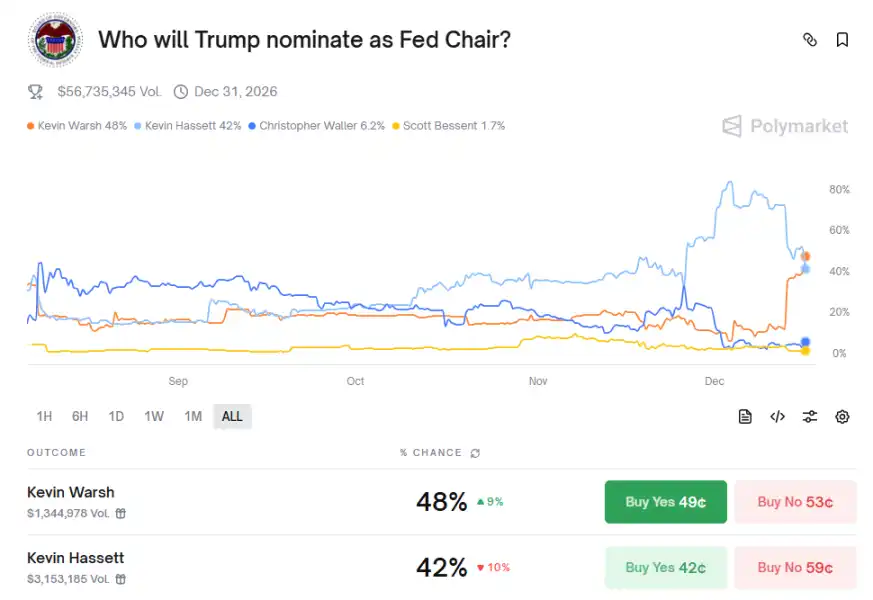
On December 16, Wall Street News mentioned that during a media interview, US President Trump stated that former Fed Governor Kevin Warsh, along with Kevin Hassett, had emerged as leading candidates in the Fed Chair nominee list. He said:
"I think both of these Kevins are great."
Trump's statement above caused a significant drop in Hassett's odds in the prediction market Kalshi. As of Tuesday, Polymarket's data even showed that the prediction market believed Warsh had a greater probability than Hassett to become the next Fed Chair.
On December 15, Windcatcher Trading Station reported that Matthew Luzzetti's team at Deutsche Bank published a research report, providing an in-depth analysis of Warsh's policy advocacy. The report analyzed that if Warsh is elected, he would support a rate cut but would also call for a reduction in the balance sheet.
The report pointed out that the premise of "simultaneous rate cut and balance sheet reduction" is contingent on regulatory reform to lower banks' reserve requirements, with doubts about its short-term feasibility.
Deutsche Bank believes that the market needs to closely monitor whether the new Chair can maintain independence under Trump's pressure for a significant rate cut and the process of establishing policy credibility.
Warsh's Background
In contrast to the Ph.D. economist Hassett, Warsh has a legal background and rich experience in both the public and private sectors.
In the public sector, he served as a Fed Governor from 2006 to 2011, a period when the Fed was dealing with the global financial crisis, playing a crucial liaison role between the Fed and the markets.
He has been a strong critic of the Fed's aggressive balance sheet operations over the past 15 years, believing that the quantitative easing policy has deviated from the central bank's core responsibilities.
Warsh currently serves as a partner at Duquesne Family Office of Stanley Druckenmiller, as well as a Distinguished Visiting Fellow at the Hoover Institution and a lecturer at the Stanford Graduate School of Business.
This experience spanning academia, regulatory bodies, and the investment industry has provided him with a profound understanding of the financial markets and monetary policy.
Volcker's Stance on QE
Deutsche Bank pointed out that in recent years, Volcker has been highly critical of the Federal Reserve, addressing both short-term policy decisions and long-term strategic considerations.
Firstly, Volcker has continuously criticized the Fed's aggressive use of its balance sheet over the past fifteen years.
Although he supported the Fed's quantitative easing (QE) program in response to the global financial crisis, he warned that continuing QE thereafter was inappropriate. He cautioned that it could lead to inflation and financial stability risks, divert the Fed from its core responsibilities, and intervene in credit allocation policies that might distort market signals.
The report cited Volcker's recent remarks:
During the summer and fall of 2010, with the economy growing strongly and financial markets stabilizing, I was deeply concerned that the decision to buy more government debt would draw the Fed into the complex political world of fiscal policy. The second round of quantitative easing came through, and I dissented from that decision, shortly thereafter leaving the Fed.
Furthermore, Volcker believes that the Fed's active use of its balance sheet may have ushered in an era of "monetary dominance." By artificially holding down rates for an extended period, he argues that the Fed has played a leading role in facilitating U.S. government debt accumulation.
Volcker's Other Policy Critiques
In addition to the balance sheet, Volcker has levied various criticisms against the Fed.
For example, he believes that the Fed relies too heavily on data and lacks foresight. He also criticizes the Fed's routine use of forward guidance. He recently noted:
Forward guidance, a tool that was prominently rolled out during the financial crisis, has virtually no role in normal times.
Volcker also questions other aspects of the Fed's monetary policy formulation and communication, including the mistaken beliefs that "monetary policy is unrelated to money," "black box DSGE models are grounded in reality," and "Putin and the pandemic should be blamed for inflation, not government spending and money printing."
The report analysis suggests that these critiques imply that Volcker wishes to place greater emphasis on the Fed's balance sheet size and money supply in monetary policy execution and may call for a comprehensive overhaul of the Fed's research team.
Lastly, while he describes Fed independence as a "valuable" endeavor, he also believes that the Fed itself has invited questions about its independence. Volcker points out:
The Fed's outsized role and poor performance have eroded one of the key and valuable reasons for monetary policy independence.
Additionally, Volcker condemns the Fed's mission creep, including considerations of climate and inclusivity issues.
Recent Policy Impact Outlook
Despite Powell's recent advocacy for rate cuts, Deutsche Bank believes he is not a dove structurally.
His views during his tenure as a Board Governor amid the global financial crisis were sometimes more hawkish than his colleagues, especially on balance sheet issues. Recently, he has stated that he did not support the Fed's decision to cut rates by 50 basis points last September.
In terms of policy decisions, Powell's recent remarks suggest that he may support lowering the policy rate, but this move could come at the expense of shrinking bank balance sheets.
However, given that reserves are at comfortable levels and the Fed recently restarted its reserve management purchases, this trade-off would only be feasible if regulatory reforms reduce banks' reserve requirements.
While several Fed officials, including Vice Chair Bowman and Governor Mester, have recently made this argument, the feasibility of these reforms in the short term remains unclear.
Finally, the research report analyzes that from a more macro perspective, regardless of who President Trump chooses, the market may test the next Fed chair's independence and their credibility in achieving the inflation target.
Deutsche Bank emphasizes that a new chair always needs to earn this trust. Considering Trump's call for significant rate cuts, this need may be more pressing.
Therefore, Deutsche Bank is skeptical about whether there will be a substantive policy change after the June turnover in the Fed leadership, especially since the new chair will have only one vote in a particularly divided committee.
You may also like
What you bought on CEX is really not US stocks: Analyzing the 94% liquidation monopoly and the evaporation of equity under a five-layer pipeline
In such a crowded cross-border payment arena, where is the next stop for the future?
Why Is Bitcoin Down in 2026? What We Can Learn From 2022
The large models in the United States are moving towards closure in the name of security
From the white-haired stock god to the billionaire fund mogul, the smart people shorting Nvidia are all getting rich using the same framework
Morning Report | CoinEx becomes a key hub for Iran to evade sanctions, involving over $3.8 billion in funds; Kalshi seeks a new round of financing, with a valuation potentially rising to $40 billion
Global Launch: As predictions become the most scarce asset in the AI era, Manadia is defining the next generation of the value internet
Why do cryptocurrency projects always like to change their names?
Who is footing the bill for the $64 billion accounting frenzy?
I never expected that the first application of AI x Crypto would be in security auditing
What is your view on Binance's competitive advantages?
ETH has entered a non-consensus phase, and the turning point is approaching!
The shift in the cloud of the air: from despising stablecoins a year ago to the high-profile entry of capital today
The survival dilemma of small and medium exchanges behind the withdrawal anomalies exposed by AscendEX
Why Is Bitcoin Falling Below $60K? 5 Key Market Drivers Explained
Bitcoin has dropped sharply amid ETF outflows, Strategy stock weakness, AI stock rallies, and changing Fed expectations. Explore the key forces driving BTC’s latest correction and what traders should watch next.
Bitcoin vs. Gold in 2026: Which Asset Performs Better in Different Markets?
The cryptocurrency industry has entered the "Show Me" era: merely relying on vision is no longer enough
Morning News | The draft amendment to the People's Bank of China Law aims to clarify the legal status of digital renminbi; South Korea will transfer about 40 unregistered virtual asset service providers to law enforcement agencies
What you bought on CEX is really not US stocks: Analyzing the 94% liquidation monopoly and the evaporation of equity under a five-layer pipeline
In such a crowded cross-border payment arena, where is the next stop for the future?
Why Is Bitcoin Down in 2026? What We Can Learn From 2022
The large models in the United States are moving towards closure in the name of security
From the white-haired stock god to the billionaire fund mogul, the smart people shorting Nvidia are all getting rich using the same framework
Morning Report | CoinEx becomes a key hub for Iran to evade sanctions, involving over $3.8 billion in funds; Kalshi seeks a new round of financing, with a valuation potentially rising to $40 billion


