
- Buy Crypto
- Markets
- Futures
- Spot
- Copy Trade
 Earn
Earn- More
Fact Check: How Much Money Did the University of Chicago Lose in its Crypto Investment?

Original Article Title: "Fact Check: How Much Money Did the University of Chicago Really Lose in Crypto Trading?"
Original Article Author: Darren Terminator
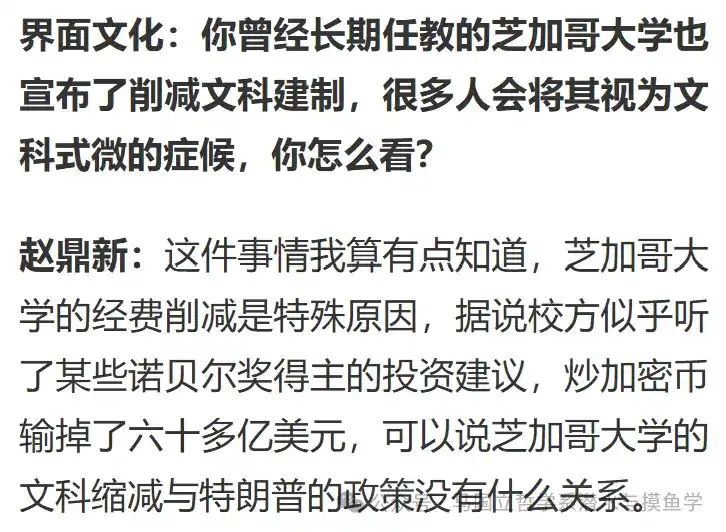
Recently, Jiemian News seized the opportunity of the publication of Professor Zhao Dingxin's "Lectures on Society and Political Movements" (the second edition of this book is really good) to interview Professor Zhao. In the interview, Professor Zhao said that the University of Chicago's recent various budget cuts were because "it is said that the school seemed to have listened to investment advice from certain Nobel laureates, traded cryptocurrencies, and lost over six billion dollars. It can be said that the University of Chicago's reduction in liberal arts has nothing to do with Trump's policies."
So did the University of Chicago really lose over six billion dollars in crypto trading?
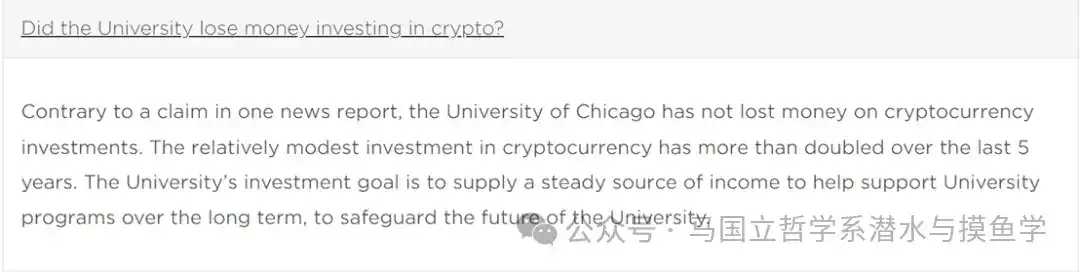
Coincidentally, in the FAQ updated by the University of Chicago in December 2025 [1], the matter of cryptocurrency trading was mentioned. According to the official website: "Contrary to a claim in a news report, the University of Chicago did not suffer losses in cryptocurrency investments. Our school's investment in cryptocurrency is relatively small but has more than doubled in the past five years. Our investment goal is to provide a stable source of income to long-term support our school's various projects and secure our school's future."
So is the University of Chicago's Provost definitely telling the truth?
Hard to say. However, intuitively speaking, the total amount of the University of Chicago's donation funds in the last five years is approximately around $100 billion (a record high in the 2021 fiscal year, around $116 billion; in the 2025 fiscal year, around $109 billion [2]). Unless the University of Chicago is really crazy enough to take at least 60% of its own donation funds to trade crypto (which obviously violates various regulations), or embezzle a large amount of operating funds to trade crypto and lose it all, it should not have lost as much as sixty billion.
So how much was actually lost? Or did they actually make a killing as stated in the official FAQ?
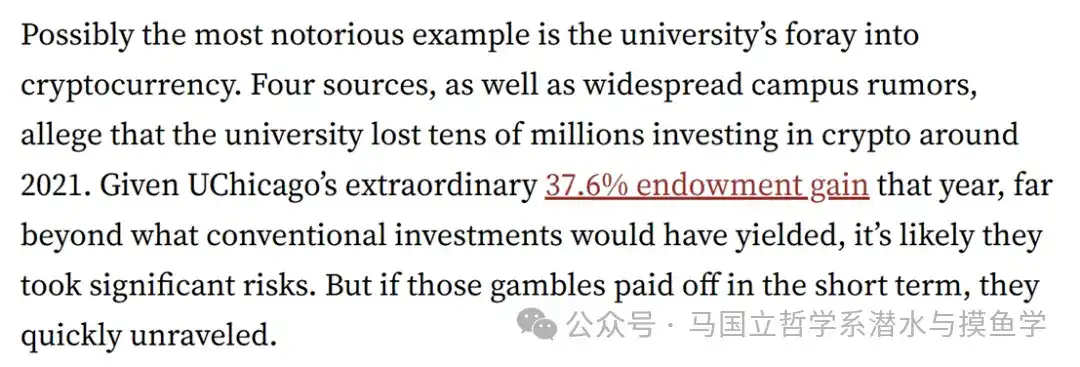
The Stanford Daily [3], Financial Times [4], and Investopedia [5] reported on this last year. According to The Stanford Daily, their four sources said: "The University of Chicago lost tens of millions of dollars in cryptocurrency investment around 2021."
So what does the University of Chicago's financial report [6] say?
Unfortunately, the financial report did not directly tell us how much money was lost in crypto trading. However, in the 2022 fiscal year report, the University of Chicago disclosed its cryptocurrency investment (fair market value): around $64 million as of June 2021 and around $45 million as of June 2022 (a difference of approximately $19 million). In subsequent reports, perhaps due to either significant gains or losses, the University of Chicago changed its reporting method and no longer disclosed its cryptocurrency investments. However, according to a 2025 Q&A session, the University of Chicago is still cautiously investing in cryptocurrency.
Of note, the 2022 financial report indicated that as of June that year, the University of Chicago endowment fund had incurred a total loss of approximately $1.5 billion. The 2023 financial report then showed that the University of Chicago's investments only incurred a small loss. In the following two years, the University of Chicago turned a profit.
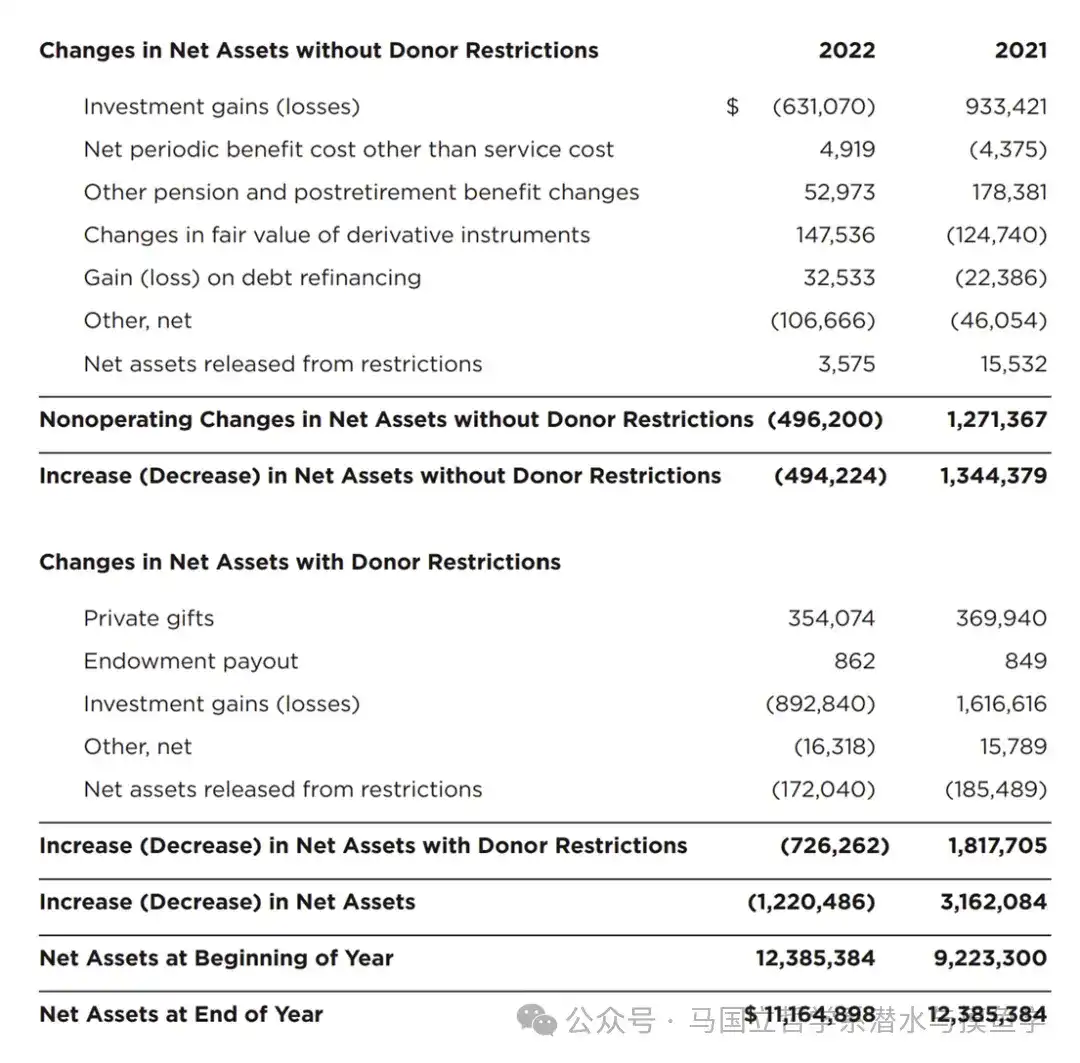
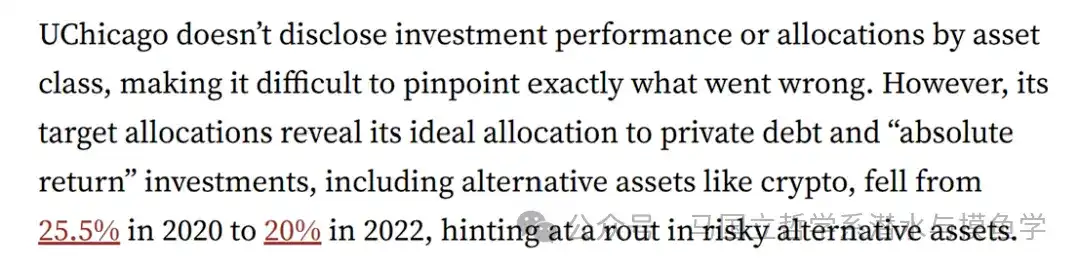
However, we do not know the specific sources of these losses and gains, especially how much was related to crypto trading. The Stanford University newspaper provided a somewhat unreliable clue: "[The University of Chicago's] target asset allocation shows that the University's ideal mix for private debt and 'absolute return' investments (which include alternative assets like cryptocurrency) has decreased from 25.5% in 2020 to 20% in 2022, implying a significant retreat (or downturn) in high-risk alternative assets."
However, the Stanford University newspaper also made an interesting observation: "From 2013 to 2023, the University of Chicago endowment fund's annualized return rate was only 7.48%, while the stock market's annualized return rate for the same period was 12.8%, and the Ivy League average was 10.8%. If the University of Chicago had simply followed the market performance, its endowment fund would now have an additional $6.45 billion. This (dreamy) sum of money would have been more than enough to pay off all of the school's debt. Of course, universities cannot simply replicate market indices as they must hedge during economic downturns to maintain financial stability. But even if the University of Chicago had only achieved the average level of its Ivy League peer group, its endowment fund size would still be $3.69 billion higher today. This would be enough to cover the school's current budget deficit for the next 15 years."
However, apart from crypto trading and investment losses, what other reasons could explain the University of Chicago's budget cuts?
A common explanation, besides calling Trump a rogue, often emphasizes the University of Chicago's own strategic mistakes: debt leveraging, extensive infrastructure projects, and aggressive expansion. As of the end of June 2025, the University of Chicago's debt is around $9.2 billion, approximately 90% of the endowment fund. Although the financing cost of this debt is relatively low, unlike across the pond, the University of Chicago still needs to pay over $200 million in interest this fiscal year.
Such a high level of debt is certainly not coming out of thin air. Since the turn of the century, the University of Chicago has spent a lot of money on new laboratories, libraries, dormitories, technology, and other facilities to enhance its reputation, attract students, and compete with various long-standing prestigious schools. However, these expansions have been largely supported by significant borrowing. Yet, new infrastructure brings ongoing operating costs, and the university has not figured out how to sustainably fund these expenses in the long term.
The University of Chicago's student newspaper [10] quotes Professor Clifford Ando of the university, who suggests that any parents who are considering sending their child to the University of Chicago need to think about whether the high tuition fees they are paying are contributing to their child's education or to the university's debt. The reckless expansion and the resulting debt issue are clearly the responsibility of a management team that acted irrationally and overly ambitiously. What's even more ironic is that between 2006 and 2022, the university president's base salary increased by 285%. Now, faced with some financial challenges, the university's leadership has shifted the burden onto students and regular faculty members: even in years when assets are sold, staff are laid off, and admissions are frozen, executive compensation continues to rise.
So, what should be the University of Chicago's next steps?
In addition to continuing cost-cutting measures, the university, of course, needs to increase revenue. Evidently, a common trick used by U.S. universities to generate more income is to admit more undergraduate students. The University of Chicago is now following suit, but the justification is sure to be noble.

[1]https://provost.uchicago.edu/actions-budget
[2] Throughout this article, the University of Chicago's budget, endowment, and debt are all calculated by combining the main university campus, the Medical Center, and the Marine Biological Laboratory. Common news reports (especially the university's own press releases) usually combine these figures for the endowment but only consider the main campus for the debt.
[3]https://stanfordreview.org/uchicago-lost-money-on-crypto-then-froze-research-when-federal-funding-was-cut/
[4]https://www.ft.com/content/4501240f-58b7-4433-9a3f-77eff18d0898?utm_source=chatgpt.com
[5]https://www.msn.com/en-us/money/careersandeducation/university-s-investment-losses-spark-outrage-resulting-in-drastic-program-cuts/ar-AA1Nxhgx
[6]https://intranet.uchicago.edu/en/tools-and-resources/financial-resources/accounting-and-financial-reporting/financial-statements
[7]https://www.wsj.com/us-news/education/colleges-face-a-financial-reckoning-the-university-of-chicago-is-exhibit-a-8918b2b0
[8]https://www.ft.com/barrier/corporate/d5c7c0f4-abf1-4469-8dca-87ff01cbebf6
[9] The main campus's debt is around $6 billion. Perhaps this is the source of Professor Zhao's $6 billion.
[10]https://chicagomaroon.com/40486/news/uchicago-professor-sounds-alarm-over-troubling-university-finances/
You may also like

Kevin Warsh Associated with Crypto Project Basis and Electric Capital
Key Takeaways Kevin Warsh, former U.S. Federal Reserve Board Governor, is associated with crypto initiatives Basis and Electric…

Why is Trump’s Fed Chair Pick Kevin Warsh Seen as Bad News for Precious Metals, Commodities, Bitcoin, and Equities?
Key Takeaways: Kevin Warsh, once appointed, is expected to take a more hawkish stance on monetary policy, which…

Gov-Backed Asset or Solana Meme? Uncovering the Reality Behind the USOR Crypto Frenzy
Key Takeaways USOR, a Solana token, sparked a debate over its legitimacy by claiming associations with U.S. strategic…

Gold’s Six-Month Rally Against Bitcoin Shows Parallels to 2019 Cycle
Key Takeaways Gold has consistently outperformed bitcoin over the last six months, despite being typically considered the haven…

US Court Sentences Chinese National to Nearly Four Years for $37M Crypto Fraud
Key Takeaways Jingliang Su, a Chinese national, received a nearly four-year prison sentence for laundering over $36.9 million…

Ripple Co-Founder Initiates $40M Initiative to Combat California Wealth Tax
Key Takeaways Chris Larsen and Tim Draper initiate Grow California, a $40 million effort to counter a proposed…
JPMorgan’s Dimon Tells Coinbase’s Armstrong to Stop “Lying” About Crypto Bill
Key Takeaways: JPMorgan Chase CEO Jamie Dimon accused Coinbase CEO Brian Armstrong of misrepresenting banks’ role in opposing…

Tether Profit Dips 23% in 2025, Yet Sets Record with $122B in Treasury Holdings
Key Takeaways: Tether’s profit for 2025 fell by 23% to just over $10 billion, reflecting a decline from…

CZ Pushes Back on Claims Binance Triggered Historic $19B Crypto Liquidations
Key Takeaways: Changpeng Zhao, known as CZ, denies that Binance played a pivotal role in the $19 billion…

Coinbase Insider Trading Lawsuit Moves Forward Despite $2.9B Stock Sale Defense
Key Takeaways A Delaware court has allowed a shareholder lawsuit against Coinbase directors for alleged insider trading to…

KuCoin’s New European Chapter Begins: KuCoin EU Secures MiCAR Compliance, Celebrates With a Ball in Vienna
Key Takeaways: KuCoin’s expansion into the European market has been cemented by achieving compliance with MiCAR regulations, crucial…

Brazil’s Nubank Secures OCC Conditional Approval for U.S. National Bank – Potential Crypto Custody Ahead?
Key Takeaways Nubank has received conditional approval from the U.S. OCC to establish a national bank, with potential…

Weekly Crypto Regulation Roundup: Trump Backs Fed Nominee, SEC Clarifies Tokenization Rules
Key Takeaways: Shift in U.S. Crypto Regulation: Recent developments indicate a move towards clearer regulations, though the process…
Navigating the Complexities of Cryptocurrency Trading
Cryptocurrency trading has surged, attracting diverse investors. Understanding market strategies and trends is crucial for success. Risk management…

Hong Kong-Based OSL Group Launches $200M Equity Raise for Stablecoin and Payments Expansion
Key Takeaways OSL Group, a prominent digital asset platform in Asia, has initiated a significant $200 million equity…

Gold Price Prediction: Current Trends and Future Outlook for January 28, 2026
Key Takeaways Gold and silver prices play a significant role in the global economy, reflecting both market trends…

Central Bank of the UAE Endorses First USD-Backed Stablecoin
Key Takeaways The UAE Central Bank has endorsed the first US dollar-backed stablecoin, USDU, to streamline compliant settlements…

Can the Gold Price Rise to $6,000?
Key Takeaways Gold prices in 2026 have experienced dramatic surges, reaching unprecedented levels in just the first month…
Kevin Warsh Associated with Crypto Project Basis and Electric Capital
Key Takeaways Kevin Warsh, former U.S. Federal Reserve Board Governor, is associated with crypto initiatives Basis and Electric…
Why is Trump’s Fed Chair Pick Kevin Warsh Seen as Bad News for Precious Metals, Commodities, Bitcoin, and Equities?
Key Takeaways: Kevin Warsh, once appointed, is expected to take a more hawkish stance on monetary policy, which…
Gov-Backed Asset or Solana Meme? Uncovering the Reality Behind the USOR Crypto Frenzy
Key Takeaways USOR, a Solana token, sparked a debate over its legitimacy by claiming associations with U.S. strategic…
Gold’s Six-Month Rally Against Bitcoin Shows Parallels to 2019 Cycle
Key Takeaways Gold has consistently outperformed bitcoin over the last six months, despite being typically considered the haven…
US Court Sentences Chinese National to Nearly Four Years for $37M Crypto Fraud
Key Takeaways Jingliang Su, a Chinese national, received a nearly four-year prison sentence for laundering over $36.9 million…
Ripple Co-Founder Initiates $40M Initiative to Combat California Wealth Tax
Key Takeaways Chris Larsen and Tim Draper initiate Grow California, a $40 million effort to counter a proposed…


 App
App