
Eve of Martian Colonization: Musk, Narrative Leverage, and a Trillion-Dollar Industry Rail

 Prefer us on Google
Author | Sleepy.md
Every escape of human civilization has started like this.
In September 1620, 102 people crammed aboard a wooden ship named the Mayflower, set sail from Plymouth, England, and ventured into the treacherous North Atlantic. The cramped cabin not only carried luggage but also a whole political blueprint. They aimed to build a "City upon a Hill" in the New World, a fresh land free from the constraints of the Church of England and the exploitation of corrupt nobles.
They did not come for exploration or for trade; they were merely a group of people trying to escape their fate.
168 years later, in 1788, the first batch of British convicts was exiled to Australia. At that time, Europeans viewed that continent as the edge of the world, a natural penal colony used to dispose of unwanted individuals, leaving them to fend for themselves. However, those discarded convicts somehow took root there, built cities, and established a nation.
Looking further back, there was the California Gold Rush in 1848, the Siberian development in the 1880s, the rubber boom in Brazil in the early 1900s... Every time human civilization attempted a "reset," they always followed the same script: find unclaimed land, declare the arrival of a new order, then witness the influx of capital, people, and technology. In extremely harsh conditions, a brand-new logic of survival was forged.
And now, it's Mars's turn.
However, the difference is that the Mayflower had the tacit approval of the British government, Australia was already a British royal colony, and the California Gold Rush was supported by the U.S. federal government's land policies. This time, the driving force behind this process is no longer any national will but a group of private capital, including venture capitalists, Silicon Valley entrepreneurs, former NASA engineers, and Elon Musk.
Nation-driven colonization is based on taxation, military, and sovereignty logic; while privately funded colonization is fundamentally about ROI, exit strategies, and narrative premiums. The civilizations born out of these two underlying logics were destined to be fundamentally different from the start.
So, what are these wielders of private capital really betting on?
While You're Still Anxious About AI, They're Already Discussing Mars Mineral Rights
On a typical workday in 2025, Tom Mueller was pitching his new company to a group of investors.
Mueller was no ordinary entrepreneur. He had worked at SpaceX for nearly 20 years, personally designing the Merlin engine of the Falcon 9. It was that roaring engine that propelled humans to the International Space Station, placed satellites into orbit, and transformed SpaceX from a near-bankrupt startup into the trillion-dollar business empire it is today.
At the end of 2020, Mueller left SpaceX and went on to found Impulse Space. The core mission of this new company can be summed up in one sentence: to deliver cargo to Mars orbit.
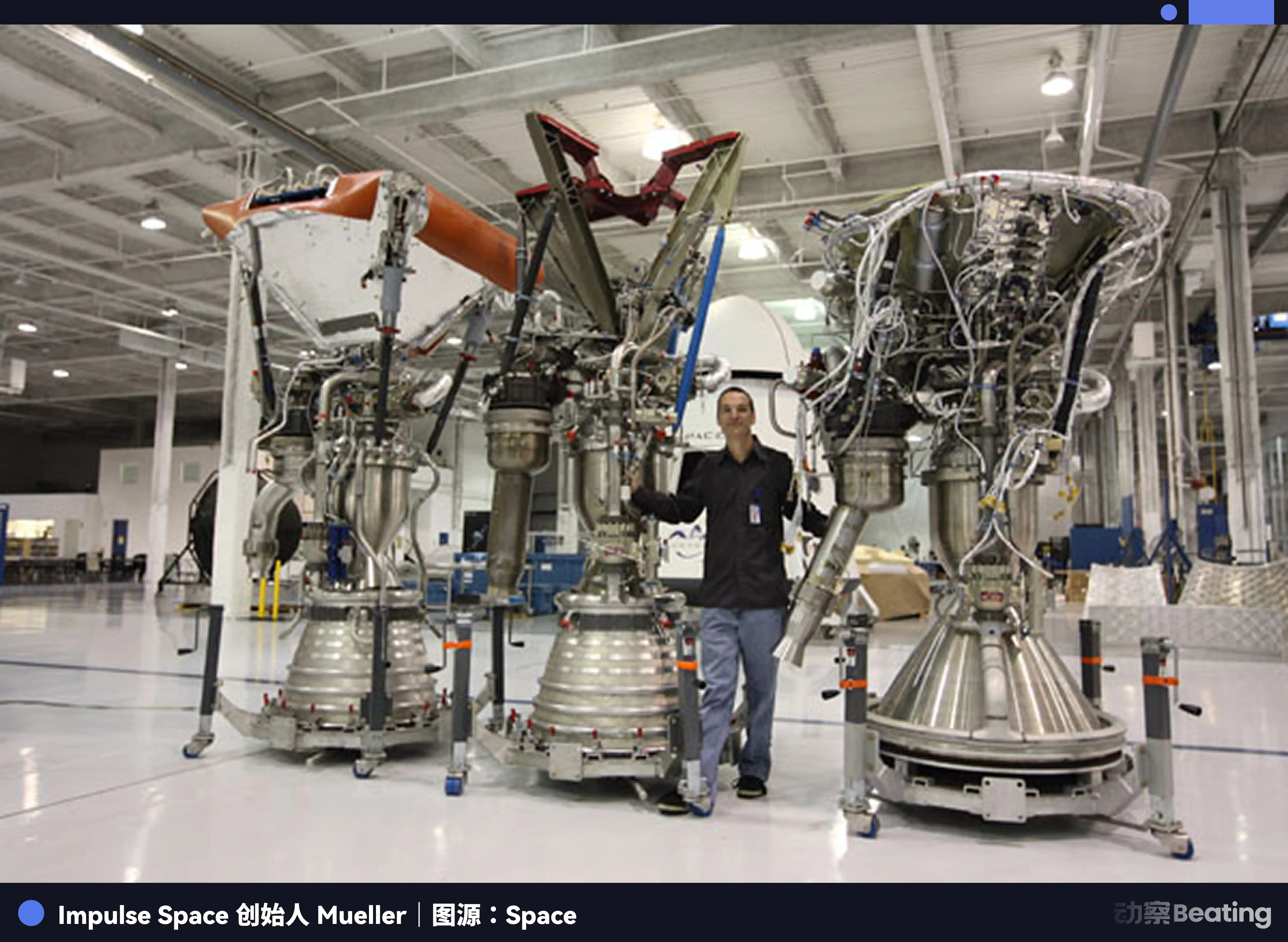
Yes, not aiming for Low Earth Orbit, not the Moon, but Mars orbit.
His target customers are those institutions and companies in urgent need to deploy satellites, probes, and supply ships to Mars orbit. His logic is exceptionally clear: the infrastructure for Mars missions must start construction from this moment. When Musk's Starship truly takes off, there must be someone already waiting in that orbit.
In June 2025, Impulse Space secured a $300 million Series C funding, bringing the total funding amount to $525 million. The list of investors is quite impressive, with Linse Capital leading the round and Founders Fund, Lux Capital, DCVC, and Valor Equity Partners participating. Founders Fund belongs to Peter Thiel, and Valor Equity Partners are early investors in Musk's companies. These are not a bunch of retail investors with their heads filled with Mars fantasies; they are the most sophisticated group of capital in Silicon Valley.
Shifting our focus back to the present, the hottest topic in our social circles is "Will AI make me lose my job?"
On the same planet, on the same timeline, some are anxiously dealing with their current livelihood, while others are playing the game of Martian mining rights ownership. This is the most authentic cognitive gap, where different people are folded into different time dimensions—some living in 2025, some in 2035, and some in 2050.
This cognitive gap is not a new phenomenon. In the early 1990s, when most Chinese were debating whether to buy a color TV, a small group was already tinkering with the internet; by the early 2010s, when most people were still using Nokia's keypad, some were developing mobile apps.
Every technological wave inevitably creates such a gap. Those who are the first to wake up are not necessarily smarter but are caught in the swirl of information and capital, forcing them to seek answers from a more distant future.
But this time gap is more significant than any before.
The anxiety about AI is indeed real, yet it is still an anxiety confined to the "now." Whereas the Martian industry is a bet on the "future," and this future is not just five years ahead but twenty years, fifty years.
Mars Industry Chain
When mentioning the "Mars industry," many people's first instinct is that it is an unreachable science fiction concept, Elon Musk's ethereal daydream, or a Silicon Valley magnate's money-burning plaything.
This assessment had no flaws in 2015, was largely fair in 2020, but in 2025, it is no longer valid.
The current form of the Mars industry chain is remarkably similar to the Internet in 1998. At that time, the infrastructure was not yet established, most companies were still burning cash, the business models were not clear yet, but there were enough real capital, real technology, and real talent operating within it. You could say it's Still Early, but you absolutely cannot deny its existence.
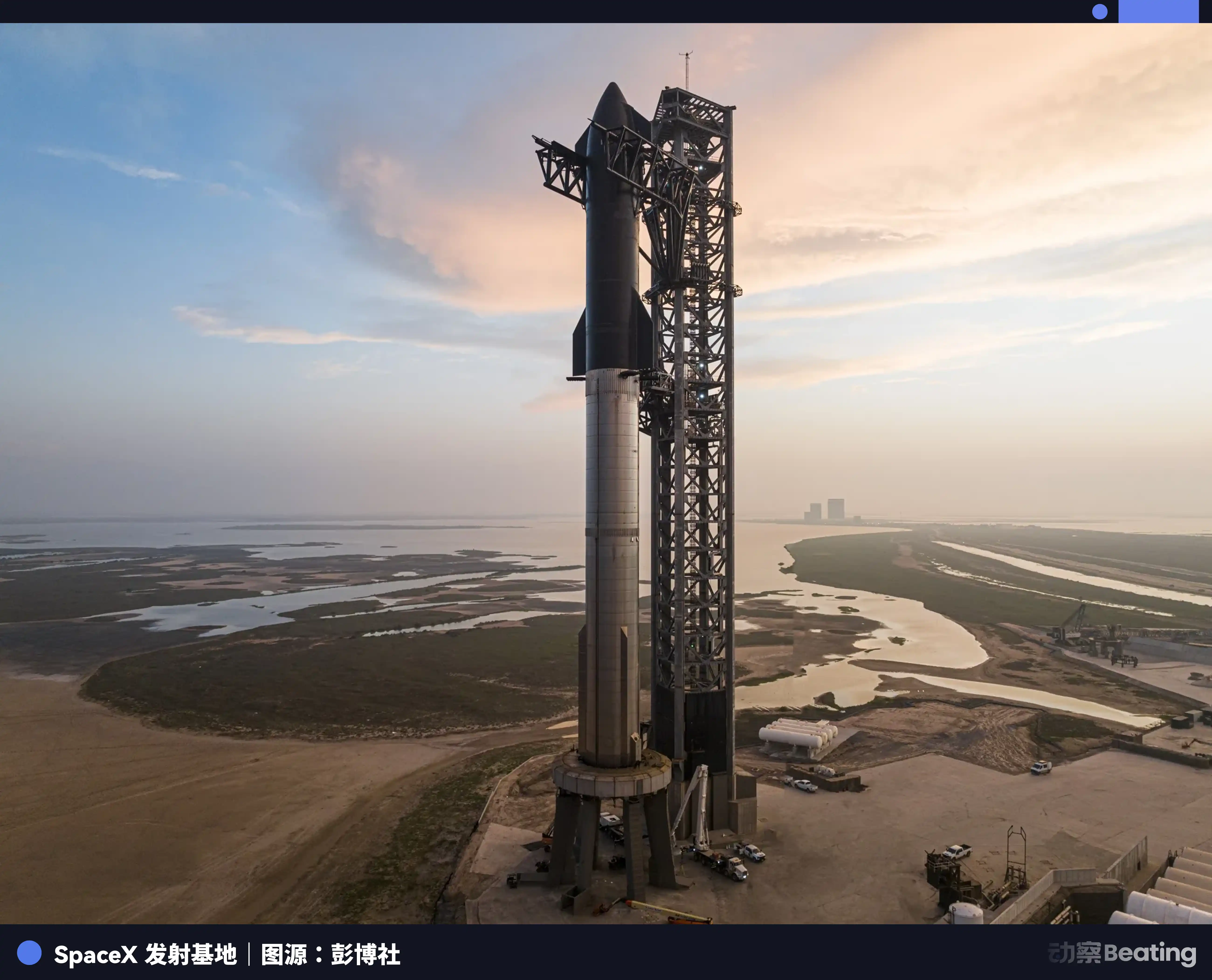
This interstellar industry chain, from the bottom to the top, can be roughly divided into five layers.
Layer One: Transport.
To send things from Earth to Mars, you first need a rocket. In this infrastructure layer, the leader is undoubtedly SpaceX's Starship, but another company named Relativity Space is equally significant.
What this company does is 3D print an entire rocket with robots. Their Terran R rocket, from the engine to the fuselage, is 95% printed. Previously, Relativity Space had already secured $2.9 billion in launch contracts. Their logic is that the traditional rocket's supply chain is too long and too fragile. Once entering the high-frequency, large-scale launch phase, parts supply would become a bottleneck. 3D printing can compress the supply chain to the extreme because you only need a pile of raw materials and a printer.
Layer Two: Orbital Transport.
To move goods from low Earth orbit to Mars orbit presents a completely different engineering challenge, requiring dedicated propulsion systems and orbital planning. This is the terrain that Impulse Space under Mueller's command is currently conquering. The propulsion system they have developed can support spacecraft in deep space to perform precise micro-manuevers. It is an indispensable infrastructure for future Mars expeditions, much like today's logistics lifeline is to a massive e-commerce empire.
Layer Three: Construction.
Once people land on Mars, where will they live? The most interesting company in this layer is called ICON, a 3D printing construction company. They have successfully printed homes and military bases on Earth and now hold a $57.2 million contract from NASA, focusing on researching how to locally source materials, using Martian soil (basalt, perchlorates, sulfur) to directly print human habitats. This project is named Project Olympus.
Not only that, ICON also built a Mars habitat simulation chamber named CHAPEA for NASA in Houston, Texas. This 158-square-meter fully 3D-printed chamber welcomed four volunteers in June 2023. They were not actors or influencers, but scientists and engineers handpicked by NASA. During the 378-day Mars survival simulation, they personally planted crops, had to wear spacesuits for outdoor excursions, and even communication with the outside world was strictly set to a one-way delay of 22 minutes, reflecting the actual communication delay between Mars and Earth.
On July 6, 2024, this long and lonely interstellar survival exercise officially came to an end.
Level Four: Mining.
What resources are there on Mars? Iron, aluminum, silicon, magnesium, as well as abundant carbon dioxide and water ice. However, the more commercially imaginative resources are the asteroids in Mars's orbit. Within those rocks lie precious platinum group metals extremely scarce on Earth — platinum, palladium, rhodium — which are crucial to the current new energy vehicles, semiconductor, and hydrogen energy industries.
A company called AstroForge is working on mining these metals on asteroids. In February 2025, they successfully launched their first mining probe satellite, Odin, heading straight for the asteroid designated 2022 OB5. With a total funding of $55 million, AstroForge is not considered a significant amount in the aerospace industry, but they are the world's first private company to truly send a mining satellite to deep space.
Level Five: Energy and Resources.
Mars is barren, lacking fossil fuels, and with only 43% of the solar energy efficiency of Earth, nuclear energy naturally becomes the only viable option. But the truly epoch-making energy treasure trove lies on the Moon. There lies a vast amount of helium-3, an isotope extremely scarce on Earth yet astonishingly abundant on the lunar surface, regarded as the theoretically perfect nuclear fusion fuel.
A company named Interlune is actively pursuing helium-3 extraction technology from the Moon. In May 2025, they officially signed a purchase agreement with the US Department of Energy. This is not just a transaction but also the first-ever government procurement contract in human history for extraterrestrial resources.
These five levels, each with operational companies, substantial funding, and cutting-edge technology. In 2025, the total funding of global space startups approached $9 billion, a 37% year-on-year increase. This is not ethereal science fiction but a rapidly emerging real industry.
But there is a question here, a very practical question: Do these deep-pocketed investors really believe they will see a tangible return on their investment in their lifetime?
The Bigger the Dream, the Easier the Money Flows
Among these investors, few truly believe they will live to see the completion of a Martian city.
Josh Wolfe, a partner at Lux Capital, once said in an interview that their heavy investment in space companies is not about betting on a specific timeline for deliverables, but about valuing the technological spin-offs these companies will produce while tackling interstellar challenges, whether successful or not.
Interlune, developing technology to extract helium-3 from the moon, even if lunar mining is a business that can never close the loop, the technology they have developed in cryogenic separation and vacuum operations still has great potential in Earth's semiconductor and medical device fields. ICON, persisting in using Martian soil to 3D print houses, even if the timeline for Martian colonization is delayed by another fifty years, is fine because their 3D printing technology has already proven its business model in Earth's low-cost housing market.
This is fundamentally a "win-win" investment framework. Capital is not gambling on Mars but, under the guise of Mars, hedging the uncertainties of Earth's operation.
But this is only the first layer of this logic. The underlying second-layer logic is even more intriguing.
On April 1, 2026, SpaceX secretly submitted an IPO application. Target valuation: $17.5 trillion, planned fundraising: $750 billion. If this number becomes reality, it will be the largest IPO in human history, surpassing Saudi Aramco's $25.6 billion in 2019, Alibaba's $25 billion in 2014, surpassing everyone's imagination.
In the IPO filing, there were three stated uses for the funds: First, to push Starship launch frequency to "insane levels"; second, to deploy AI data centers in space; and third, to fully drive unmanned and manned Mars expeditions.
Notice this sequence. Mars is listed last but is the valuation narrative's ceiling.
If you take Mars out of SpaceX's story, what is left? Just an ordinary rocket manufacturer plus a satellite internet business called Starlink.
The valuation ceiling for a rocket company is probably on the order of Boeing or Lockheed Martin, a few hundred billion dollars. Starlink is a good business, but in the increasingly clear landscape of satellite internet competition, it definitely does not justify a $17.5 trillion valuation.
Mars, and Mars alone, is the ultimate narrative lever that can forcefully push a valuation from the "hundreds of billions" to the "trillions."
This is the most extreme play of "expectational economics." The narrative lever moves capital, capital funds technology, technology materializes the narrative, and then extracts an even larger scale of capital. Musk has completely mastered this flywheel loop.
When SpaceX was founded in 2002, the market simply did not believe that a private company could send people to the International Space Station. In 2012, when the Dragon spacecraft first docked with the International Space Station, those who had once mocked Musk began to sing a different tune. In 2020, SpaceX used the Crew Dragon to send astronauts into space and fulfilled NASA's order. Every technological milestone turned the narrative into reality, and then reality generated new narratives.
Within this loop, "belief" itself is elevated to a form of productivity. Betting on belief, capital drives technology, technology confirms faith, and then ignites even more fervent followers and more surging hot money.
But this logic has one prerequisite: Musk himself must believe.
-- Price
"Nowhere to Hide"
In June 2025, Peter Thiel, in an interview with New York Times columnist Ross Douthat, made a profound statement: "2024 was the year Musk stopped believing in Mars."
Peter Thiel is one of Musk's oldest friends and one of his earliest investors. The two co-founded PayPal and together went through the early brutal battles of Silicon Valley. What he said carries a different weight than outsiders' speculations.
According to Peter Thiel, Musk's initial plan was to build Mars into a utopian political utopia of original liberalism. This vision has a very clear cultural anchor—Robert Heinlein's masterpiece, "The Moon is a Harsh Mistress."
The book depicts a group of exiled prisoners on the Moon who, after breaking free from Earth's rule, establish spontaneous order, eventually igniting the flames of revolution to declare independence. Musk has read this book inside out; he wants to replicate that story on Mars, creating a zone without US government taxation, without EU blind regulations, and absolutely rejecting "woke culture." Everything operates according to the cruelest rules of the free market, where the winners take all and the weak are eliminated.
This ambition, Musk has never explicitly stated in public, but it is the underlying driving force of the entire Mars plan. Going to Mars has never been just about a technological expedition; fundamentally, it is a grand political escapade.
One day, Musk was chatting with DeepMind's CEO Demis Hassabis. Hassabis casually threw out a line: "You see, my AI will follow you to Mars."
The meaning is that you can't escape. When you migrate humanity to Mars, you are also packaging all of humanity's values, prejudices, power structures, and ideologies into the past. AI is the concentrated and amplified essence of all this civilization's festering sore. The AI you nurture on Earth will flourish differently on Mars. Mars has never been a blank canvas; it is merely a copy of Earth, but at a higher cost and greater difficulty of survival.
Musk fell silent for a long time and finally said, "Nowhere to run. Indeed, there is nowhere to run."
In Peter Thiel's view, it was this conversation that forcibly pushed Musk into the political arena in 2024. Rather than building a utopia on Mars, it is better to directly change power structures on Earth. This is why he wholeheartedly supports Trump and deeply involves himself in DOGE (Department of Government Efficiency). Since there's no escape, why not completely transform the place you originally wanted to escape to?
The Puritans on the Mayflower sailed to America, but they also carried Britain's class rigidity, racial prejudices, and power dynamics into the cabin. Their painstakingly constructed "City Upon a Hill" eventually became a reflection of the Old World, where slavery, class entrenchment, and religious conflicts reignited, just under a different guise.
Australia's penal colony was the same, perfectly replicating the British Empire's class hierarchy, only passing the titles of "nobility" to "free immigrants." Every time humanity attempts to create a new order in a new land, they involuntarily implant genes of the old civilization.
People bring their ideologies, and their ideologies follow.
The struggle to escape itself becomes irrefutable evidence of inevitable capture.
In that case, is there still a significance in this trillion-dollar interstellar game? Under the shadow where civilization has nowhere to escape, are there still people conducting this Sisyphean expedition?
But the Starship will still fly
After Musk said "Nowhere to run," he did not stop moving forward.
By the end of 2026, the Starship will still fly, carrying the Tesla Optimus robot to set foot on Mars' red soil, paving the way for subsequent manned missions. In 2029, the countdown for a manned expedition will officially begin. To build a Martian city with a population of a million means pouring a million tons of supplies, assembling a thousand starships, completing ten thousand launches. Just the staggering launch cost alone amounts to an astonishing one trillion dollars. Today, Musk is still in the spotlight, stubbornly repeating these dizzying numbers.
But this is not just his story.
In March 2025, AstroForge's mining satellite Odin went completely dark in deep space.
It had launched on February 26, 2025, aboard a SpaceX Falcon 9, as a secondary payload for the IM-2 mission, targeting the asteroid 2022 OB5. Its mission was to capture images of the rock's surface to confirm the presence of platinum-group metals.
Initially, everything proceeded as usual. However, soon ground stations started losing signal. The Australian primary station went offline, the backup station was misconfigured, an amplifier at another site mysteriously malfunctioned on the eve of launch, and even a newly erected cell tower interfered, completely scrambling the reception frequency. Odin drifted into silence, lost in the dark void 270,000 miles from Earth, its fate unknown.
Faced with this setback, AstroForge CEO Matt Gialich wrote in the postmortem report, "At the end of the day, you damn well have to step into the ring and take a chance. You have to give it a try."
They humorously dubbed this failed mission "Odin't" (Odin + didn't). Following this, they resolutely announced the grand plan for DeepSpace-2, a behemoth weighing 200 kilograms equipped with electric propulsion and landing legs, aiming to truly land on an asteroid this time.
This is the rawest essence of the aerospace industry. It is far from Silicon Valley's agile "fail fast, fail often" game; instead, it is a heavier, more desolate destiny. When you hurl your blood, sweat, and tears creation into deep space, once the signal is lost, it becomes a nameless speck of dust in the vast universe. You have no knowledge of its fate, no place to find its remnants. All you can do is swallow the deafening silence, go back, and craft another.
On July 6, 2024, in Houston, Texas. As the 3D-printed airlock slowly opened, four volunteers who had completed 378 days of "Mars exile" returned to Earth.
Microbiologist Anca Selariu faced the camera and said, "Why go to Mars? Because it is a genuinely achievable goal. Deep space binds humanity tightly together, igniting the brightest spark in our souls. This is a small step for Earthlings, yet enough to illuminate the long nights of centuries to come."
Structural engineer Ross Brockwell confessed that his deepest realization during this isolated period was that in the face of the boundless cosmos, imagination and awe of the unknown are the most precious qualities that sustain humanity's journey forward.
Meanwhile, Medical Officer Nathan Jones had an extremely introspective experience during this prolonged isolation. He reflected, "I have learned to savor each season of the moment and await the arrival of the next season with serenity." Over the course of over three hundred days, he learned to paint.
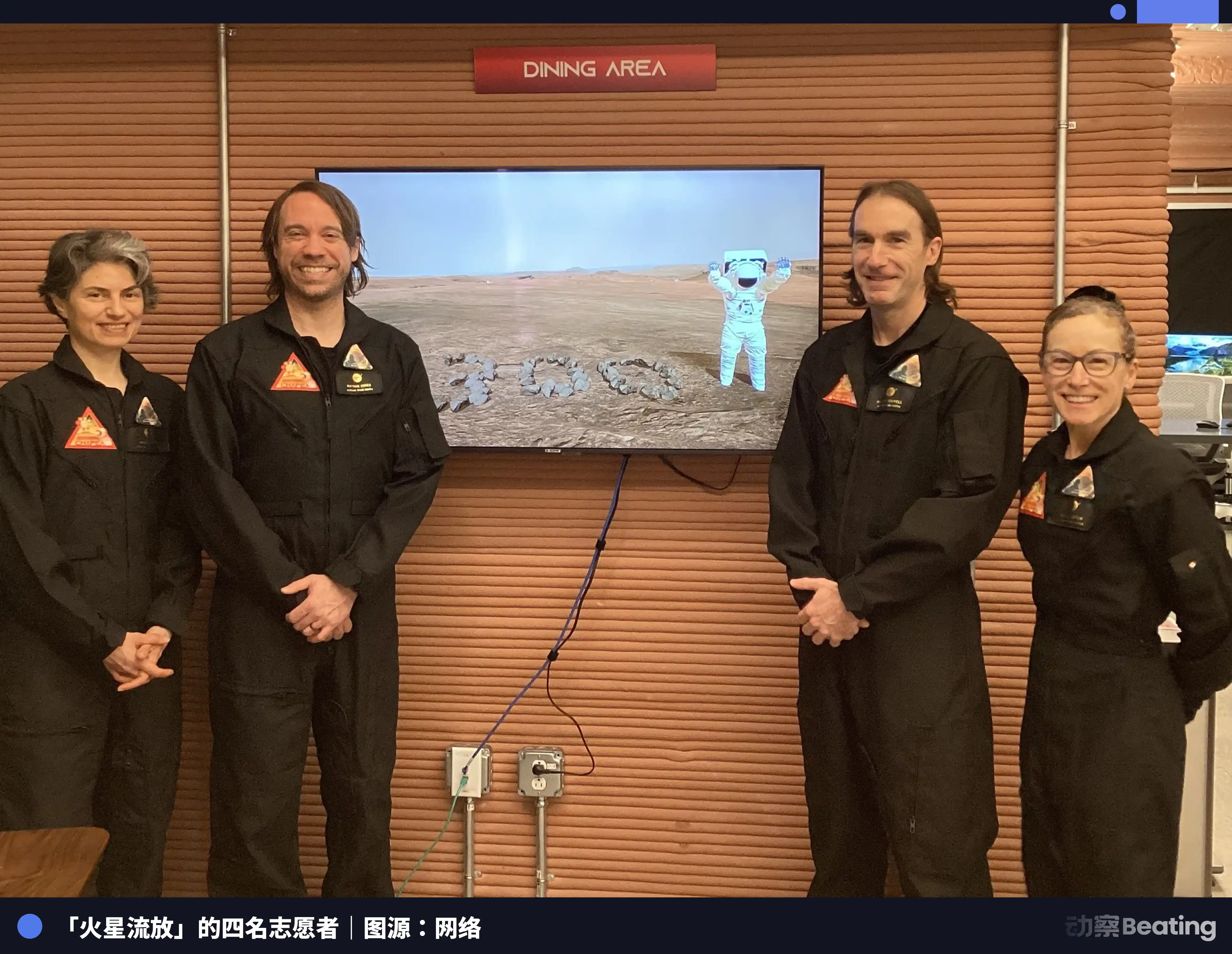
These four individuals are not Musk. They do not carry the $1.75 trillion market capitalization mythology, and nobody cares about their fleeting remarks on social media. They entered that room because someone had to go there first. Gialich launched that satellite because someone had to go there first. Mueller departed SpaceX to found Impulse Space because someone had to go there first.
Faced with Musk's pessimistic "nowhere to hide," these individuals did not run away, did not give up, but instead went to that place first to see how it felt.
Upon exiting the airlock, Selariu said, "I do indeed feel fortunate to regain instantaneous access to information, but I will miss the luxury of disconnection. After all, in this world, one's worth is somehow defined by the digital world's presence."
She spent 378 days in a simulated Mars room, and upon returning to the bustling Earth, what she missed the most was the tranquility of that place.
This content is provided for general informational purposes only and doesn't constitute financial, investment, legal, or tax advice. Any events, rewards, online promotions, or related information mentioned herein should not be considered a recommendation, solicitation, or invitation to purchase, sell, trade, or otherwise deal in any crypto assets. Crypto assets are highly volatile and may result in loss. The availability of WEEX services, products, and related events may vary by region. You are responsible for ensuring that your participation is in accordance with applicable local laws and regulations.
You may also like

ICON replay exploit triggers 119,866,000 ICX release through 1,492 message reuses

12th Anniversary of Hal Finney's Death, Pioneer of Blockchain Technology

Balanced v1 to Be Discontinued on December 1, 2026

Fear Strikes the Crypto Street: Coldcard Hacked - Are Ledger and Trezor Safe?

How to Pay for Telegram Premium with Crypto and Other Methods in Russia in 2026

Why locked liquidity does not mean a token is safe

The ICON Network will permanently shut down on December 31, 2026, and fully migrate to SODAX
Track Markets At a Glance: New WEEX Price Widgets for iOS & Android
To streamline your market data access, WEEX has officially launched "Market Watchlist" desktop widgets

Major Upgrade on Web: 10+ Advanced Chart Styles for Deeper Market Insights
To deliver more powerful and professional analysis tools, WEEX has rolled out a major upgrade to its web trading charts—now supporting up to 14 advanced chart styles.

Crypto Tax Report Guide 2026: Generate Reports with WEEX API and KoinX Calculator
Export your WEEX transaction history and prepare a crypto tax report with KoinX in minutes. Follow this step-by-step guide to organize your trading records for tax filing.

WEEX OTC Lists 200+ Trading Pairs
The WEEX OTC platform now supports 200+ new trading pairs, letting you buy crypto directly with your local currency—quick, simple, and secure.

New: Estimated Liquidation Price on App Candlestick Charts
WEEX has introduced a new Estimated Liquidation Price (Est. Liq. Price) feature on the candlestick chart to help traders better manage risk and identify safe ranges for their positions.

WEEX AI Trading Hackathon Guide: Find Your WEEX UID and Register
From now to February 2026, WEEX is launching AI Wars: WEEX Alpha Awakens, the world’s first global crypto AI trading hackathon. Come your UID and register for the WEEX Global AI Trading Hackathon.
New feature launch: Customisable Trading Page Layouts
You can now customise your trading page just the way you like it! The new customisable layout of our trading pages gives you full control over how your workspace looks and feels.

Historical B/S Indicators for Candlestick Charts
WEEX just got smarter! Review past trades and refine your strategies with our brand-new feature: Historical B/S (Buy/Sell) markers for candlestick charts!
Password Reset Issue on X: Thousands of Reports, But Is It an Attack?

Google Pics Brings AI Images to Workspace, Challenging Canva and Adobe

Warsh Passes Jackson Hole with Ease, but the Real Challenge is Just Beginning

Virtual Asset Companies Knock on U.S. Bank Doors... 13 Applications Awaiting Review by OCC
MSCI to Conclude on Strategy's Inclusion in October

Strikes on Iran: What Impact on Bitcoin, Stocks, Oil, and Gold?
Why is Grouping LP Better than PvP under Robinhood Chain's High Fees?
Deribit already holds 96.6% of Coinbase's derivatives open interest ahead of Sept. 9 migration
GTA VI leaker reportedly cashes out $350K in crypto
USA: A Narrowly Averted Shutdown Three Months Before the Midterms

$700 Million Annual Revenue, Yet Betting $10 Billion: IREN's Gamble for AI Computing Power

Breaking the 'Blame-Shifting Narrative' and Secret Governance: A Structural Bloodletting in Tokenomics and the Governance Challenge Behind Sun Yuchen's Lawsuit Against WLFI
Fairshake affiliate spends $189K as Auchincloss wins
Crypto: Token Buybacks Reach $640 Million in 2026
Finst Launches Tailored Offer for Institutional Investors in Europe
ICON replay exploit triggers 119,866,000 ICX release through 1,492 message reuses
12th Anniversary of Hal Finney's Death, Pioneer of Blockchain Technology
Balanced v1 to Be Discontinued on December 1, 2026
Fear Strikes the Crypto Street: Coldcard Hacked - Are Ledger and Trezor Safe?
How to Pay for Telegram Premium with Crypto and Other Methods in Russia in 2026
Why locked liquidity does not mean a token is safe

Contents
Latest articles


Latest coin listings on WEEX


