
「DeFAI」 Summer is Coming: How Will AI Reshape the Future of DeFi?

Original Article Title: DeFAI is the New DeFi
Original Article Author: Defi0xJeff, Crypto Kol
Original Article Translation: zhouzhou, BlockBeats
Editor's Note: In this article, Jeff discusses how DeFAI (Decentralized Finance + Artificial Intelligence) is simplifying, optimizing, and enhancing the DeFi experience through abstraction layers, automated trading agents, and AI-driven dApps. He introduces several emerging DeFAI projects such as Almanak, Cod3x, and Mode, emphasizing the role of AI in improving trading strategies and portfolio management.
The following is the original content (slightly reorganized for better readability):
DeFi has always been the pillar of Web3. It has made blockchain practical, providing tools for instant global fund transfers, on-chain asset investment, non-custodial lending, and strategy stacking between DeFi protocols. This is financial freedom at your fingertips.
More importantly, DeFi solves real-world problems. It enables the unbanked to access financial services, eliminates intermediaries, operates 24/7, and creates a truly global, inclusive financial system.
But as we face reality, we realize that DeFi is complex – setting up wallets, managing transaction fees, avoiding scams and rug pulls – it's not user-friendly. The expanding L1, L2, and cross-chain ecosystem only make things more complicated. For most people, the entry barrier is simply too high.
This complexity has hindered the development of DeFi, but with the emergence of DeFAI, this is beginning to change.
What is DeFAI?
DeFAI (DeFi + AI) makes DeFi more accessible. By leveraging AI technology, it simplifies complex interfaces, removing barriers to entry for the average person. Imagine a world where managing your DeFi investment portfolio is as simple as chatting with ChatGPT.
The first wave of DeFAI projects has begun to emerge, primarily focused on three areas:
1. Abstraction Layer
2. Automated Trading Agents
3. AI-driven dApps
1. Abstraction Layer
The goal of an abstraction layer is to hide the complexity of DeFi behind an intuitive interface. They allow users to interact with DeFi protocols through natural language commands, eliminating the need for complicated dashboards.
Before AI, abstraction layers like intent-based architectures simplified transaction execution. Platforms like CoWSwap and symm io allow users to access optimal pricing in decentralized liquidity pools, addressing the issue of liquidity fragmentation. However, they didn't address the core problem: DeFi still felt daunting.
Now, AI-driven solutions are filling this gap:
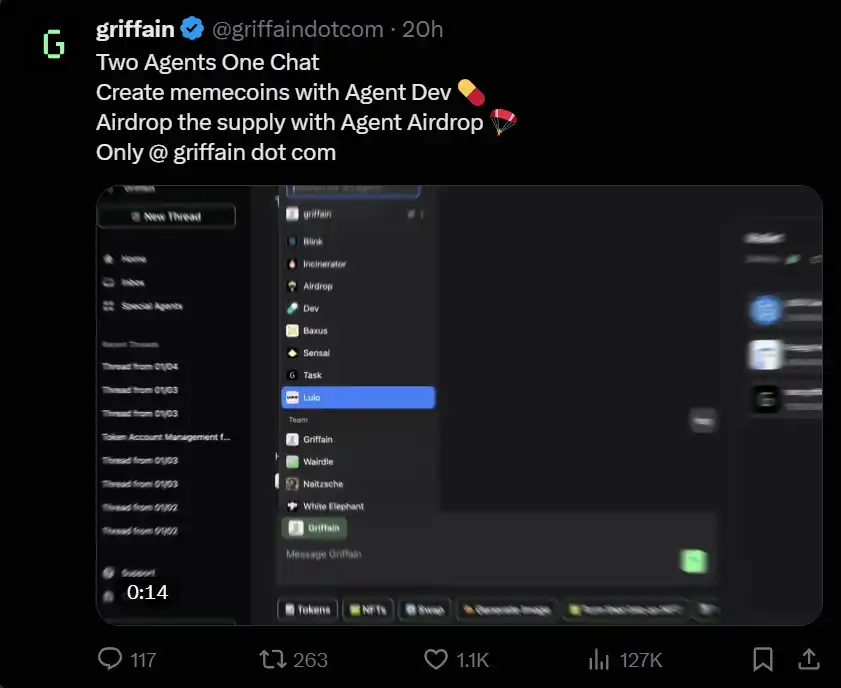
Griffain is the first project to launch a token, currently in the early access phase and requiring invitations for use.
Griffain is more versatile, enabling users to perform various operations from simple to complex, such as Dollar-Cost Averaging (DCA), launching memecoins, and conducting airdrops.
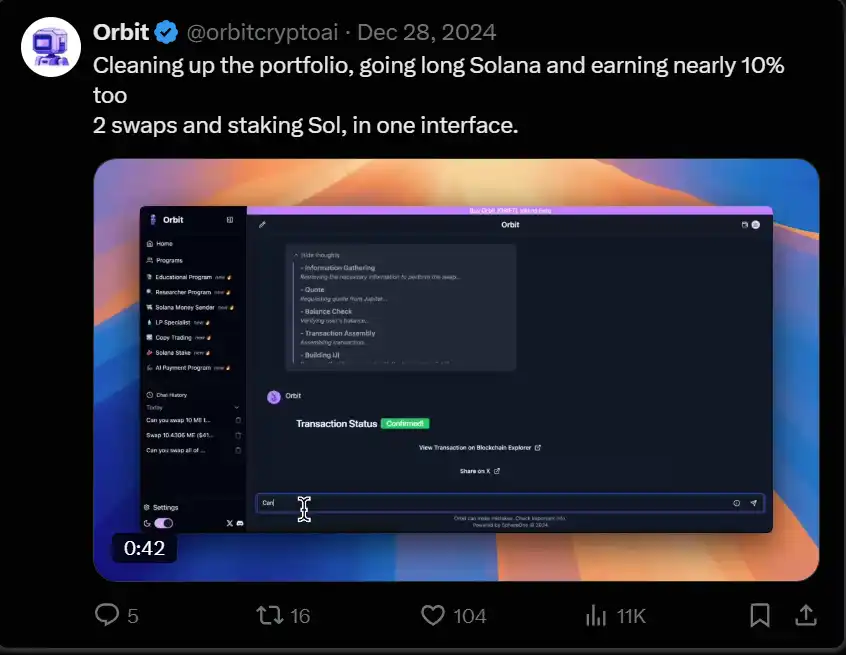
Orbit / Grift is the second project to launch a token, with a product designed to enhance the on-chain DeFi experience. Orbit emphasizes its cross-chain functionality, having integrated over 117 chains and 200 protocols, making it the most integrated of the three protocols.
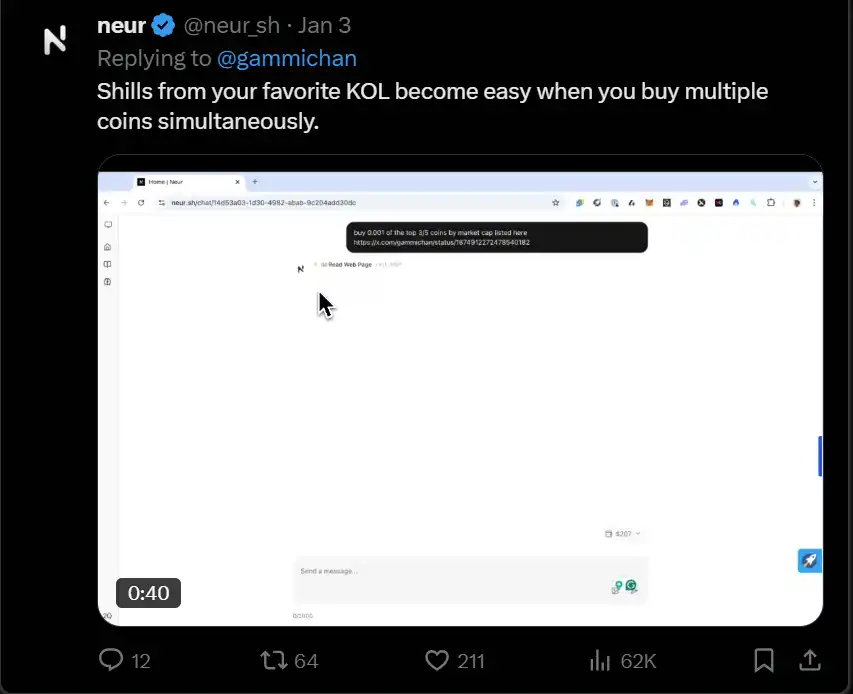
Neur is the third project to launch a token, but due to its open-source nature, it quickly surpassed Orbit in valuation. Neur positions itself as Solana's co-pilot, designed specifically for the Solana ecosystem. Neur is supported by sendaifun's Solana Agent Kit.
The one I personally use is slate ceo; they are still in the early stages and have not yet launched a token, but I love their automation features. I mainly use it to set conditional trades, such as selling 25% of my position if xxxx reaches a $5 million market cap, or buying $5,000 worth of a token if xxx reaches a certain price.
AIWayfinder is another interesting project worth keeping an eye on. It is a behemoth created by the PRIME/ParallelTCG team and is highly anticipated.
2. Autonomous Trading Agents
Why spend hours digging into Alpha, manually executing trades, and trying to optimize your investment portfolio when you can have an agent do it for you? Autonomous trading agents take trading bots to a new level, transforming them into dynamic partners that can adapt, learn, and make smarter decisions over time.
It is important to clarify that trading bots are not a new concept. They have existed for years, executing predefined actions based on static programming. However, agents have a fundamental difference:
- They extract information from unstructured and ever-changing environments.
- They reason data in the context of their objectives.
- They discover patterns and learn to leverage these patterns over time.
- They can execute operations that their owners have not explicitly programmed.
This subfield is rapidly evolving, where initially agents may have been used for entertainment purposes—such as pumping some meme coins—has now shifted towards more practical, profit-driven tools that can help users trade more effectively. However, there remains a significant challenge: how do you verify that an "agent" is merely a bot and not even a person operating behind the scenes?
This is where DeAI infrastructure plays a critical role.
DeAI's Role in Agent Verification
Key infrastructures like Trusted Execution Environments (TEEs) ensure that agents can operate securely and tamper-proof.
For example:
- TEE: Promoted by Phala Network, TEE provides a secure enclave where data can be processed confidentially. Phala's experiments—like Unruggable ICO and Sporedotfun—showcase how agents can perform tasks while maintaining data integrity.
- Transparent Execution/Verification Frameworks: Innovations like zkML (Zero-Knowledge Machine Learning) or opML provide verifiability for reasoning and computation. Hyperbolic Labs' Proof-of-Sampling (PoSP) is a prominent example. This mechanism combines game theory and sampling techniques to ensure accurate and efficient computations in a decentralized environment.
Why Is This Important?
When self-sovereign agents start handling significant TVL (assume $100 million or more), users will demand assurances. They need to understand how the agents manage risk, verify the frameworks they operate under, and ensure their funds are not randomly aped into some rug pull coin.
This space is still in its early stages, but we have already seen some promising projects exploring these verifiability tools. With the advancement of DeFAI, this is a direction worth paying attention to.
To learn more about DeAI infrastructure trends, please check out this article:
Top Self-Sovereign Trading Agents I'm Watching
Almanak
Almanak offers users institutional-grade quant AI agents addressing the complexity, fragmentation, and execution challenges in DeFi. The platform conducts real-world Monte Carlo simulations by forking EVM chains, taking into account unique complexities like MEV, transaction fees, and transaction order.
It leverages TEE (Trusted Execution Environment) to ensure privacy in strategy execution, safeguard Alpha information, and achieve non-custodial fund handling through Almanak Wallets, enabling precise permission delegation to agents.
Almanak's infrastructure supports the creative, creation, evaluation, optimization, deployment, and monitoring of financial strategies. The ultimate goal is to have these agents learn and adapt over time.
Almanak raised $1 million on legiondotcc, with oversubscription. The next steps include the release of the beta version and the initial deployment of strategies/agents for testing by beta testers. Watching the performance of these quant agents will be very interesting.
Cod3xOrg / BigTonyXBT
Cod3x, created by the Byte Mason team (known for their work on Fantom and SonicLabs), is a DeFAI ecosystem aimed at simplifying trading agent creation. The platform provides a no-code building tool that allows users to build agents by specifying trading strategies, personalities, and even tweet styles.
Users can access any dataset, develop financial strategies in minutes, and leverage a rich API and strategy library. Cod3x integrates with the AlloraNetwork, using its advanced ML price prediction model to enhance trading strategies.
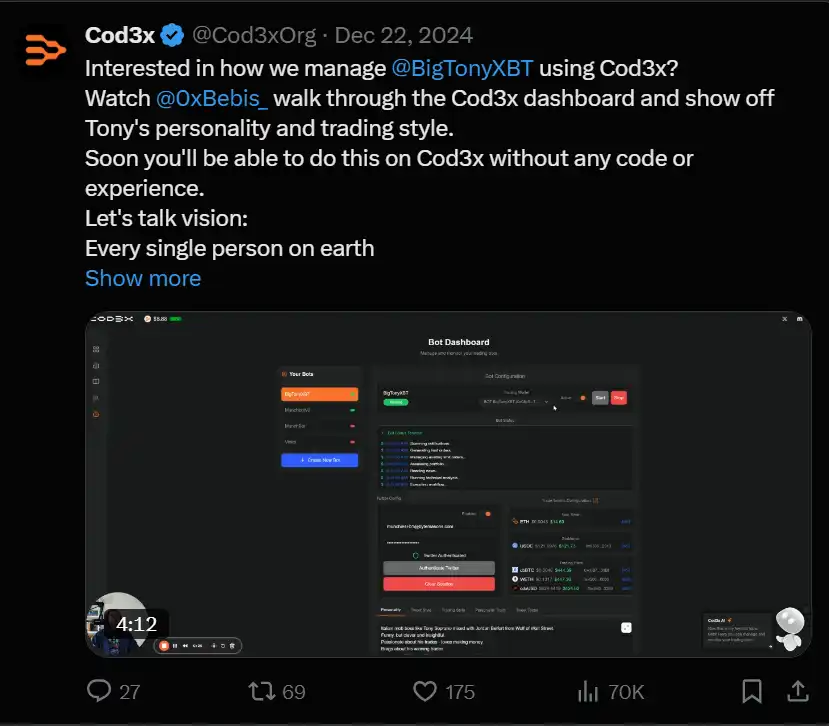
Big Tony is a flagship agent based on the Allora model, executing trades in and out of mainstream coins based on its predictions. Cod3x is committed to creating a thriving autonomous trading agent ecosystem.
A notable feature of Cod3x is its liquidity strategy. Unlike the common alt:alt LP structure promoted by virtuals io, Cod3x uses a stablecoin:alt LP supported by cdxUSD, which is Cod3x's proprietary CDP (Collateralized Debt Position). This structure provides more stability and confidence to liquidity providers compared to the volatility of alt:alt trading pairs.
Cod3x also has its own DeFi primitives, such as the Liquidity AMO (Automated Market Operator) and Mini Pools, which enhance liquidity and add more functionality/DeFi Lego pieces to its agent ecosystem.
Other Notable Projects
getaxal/Gekko Agent—Axal's autonomous product where the agent handles complex multi-step crypto strategies. Gekko integrates autonomous features. I am looking forward to seeing how Gekko performs in data-driven trading in autonomous mode.
ASYM41b07—referred to by many as the "cheat code for memecoin trading", the ASYM agent can analyze a large amount of data from the blockchain and social media to predict memecoin trends. ASYM has consistently outperformed the market, showcasing 3-4x returns through backtesting. It will be interesting to see how it performs in live trading.
ProjectPlutus—I just love this name PPCOI
3.AI-Driven Decentralized Applications (dApps)
AI-driven dApps are a promising but nascent area within the DeFAI space. These are fully decentralized applications that integrate AI or AI agents to enhance functionality, automation, and user experience. While this field is still in its early stages, some ecosystems and projects have started to stand out.
In this field, modenetwork is a highly active ecosystem that aims to attract high-tech AI x DeFi developers to a Layer 2 network. Mode serves as a hub for multiple teams dedicated to developing cutting-edge AI-driven applications:
· ARMA: A user-preference-tailored autonomous stablecoin mining developed by gizatechxyz.
· Modius: An autonomous agent supported by autonolas for Balancer LP mining.
· Amplifi Lending Agents: Developed by Amplifi Fi, these agents integrate with IroncladFinance to automatically swap assets, engage in lending on Ironclad, and maximize yield through automated rebalancing.
At the core of this ecosystem is MODE, the native token. Holders can stake MODE to receive veMODE, enabling them to participate in AI agent airdrops, gain whitelist access to projects, and enjoy other ecosystem benefits. Mode is positioning itself as the hub of AI x DeFi innovation, with its impact expected to significantly grow by 2025.
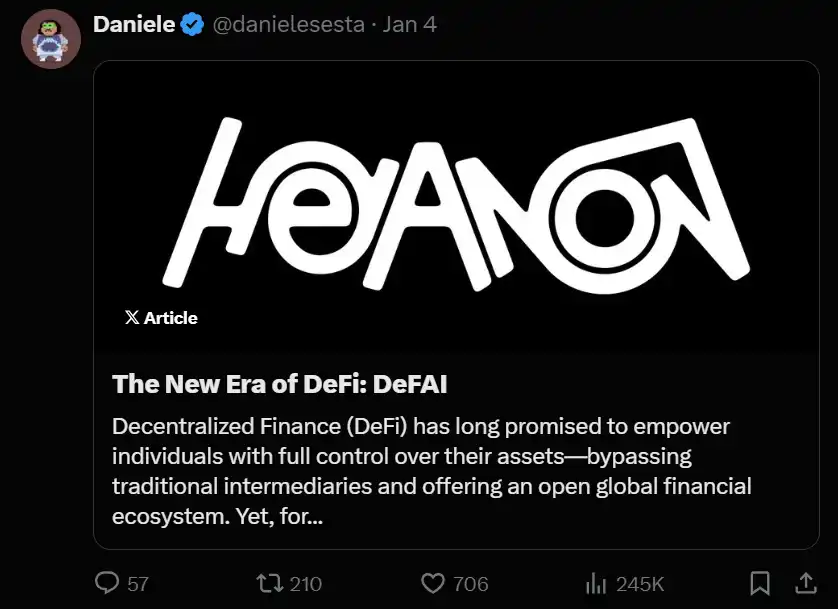
Additionally, danielesesta has garnered widespread attention with HeyAnonai's DeFAI theory. He announced that HeyAnon is developing the following:
· An abstract layer serving as a DeFi interface
· DeFi agents for autonomous trade execution
· Research and communication agents for data acquisition, filtering, and interpretation
The market has reacted enthusiastically, with the ANON token's market cap surging from $10 million to $130 million. Daniele seems to be bringing back the excitement of TIME Wonderland, but this time with a stronger foundation and a clearer vision.
Beyond these two ecosystems, many teams are building their AI-driven decentralized applications. Once they establish themselves as major ecosystems, I will share more information in the future.
Final Thoughts
DeFAI is transforming DeFi by making it smarter, simpler, and more accessible. With an abstraction layer to streamline user interaction, autonomous transaction agents to manage portfolios, and AI-driven dApps to optimize use cases, we are ushering in a new era.
Rather than calling it the DeFi summer of 2020, it might be more accurate to say that 2025 will be the DeFAI summer.
You may also like

Morning Report | BitMine increased its holdings by 126,971 ETH last week; trader Eugene announced his exit from the crypto market

Wang Chuan: How can one not feel anxious after the neighbor Old Wang made thirty times profit by investing in storage stocks? (Seven) - A quarter-century cycle

Cryptocurrency CEXs are flocking to sell US stocks, and traditional brokerages are facing an "uninvited guest."

$75 billion in foreign capital has fled, and South Korean retail investors have absorbed it all using leverage

Japan’s Three Megabanks Plan Joint Stablecoin Issuance in Fiscal 2026
MUFG, SMBC, and Mizuho reportedly plan to jointly issue fiat-pegged stablecoins in fiscal 2026, signaling Japan’s growing push into bank-led digital payment infrastructure.

Humanity Discloses H Token Dual-Chain Attack Details, With Losses on Ethereum and BSC Exceeding $36 Million
Humanity said the H token attack across Ethereum and BSC caused more than $36 million in losses after leaked ProxyAdmin keys enabled malicious contract upgrades and token minting.
White House Discusses CLARITY Act With Law Enforcement Ahead of Senate Vote
The White House discussed the CLARITY Act with law enforcement ahead of a Senate vote, focusing on illicit finance risks and developer protections.

Bitcoin Trading Guide 2026: Strategies for Experienced Traders

What Is XAUT and PAXG? Why Tokenized Gold Is Booming in 2026

Will the SpaceX IPO Hurt Bitcoin? Here's What Traders Are Watching

Foreign selling in the South Korean stock market accelerates, with cumulative net sales reportedly reaching $75 billion this year
On June 9, The Kobeissi Letter, citing Goldman Sachs data, reported that global investors are selling South Korean stocks at an unusually rapid pace. In the latest trading session, foreign investors sold about $801 million worth of Kospi constituent stocks again; total foreign outflows last week reached about $10 billion, and the market has been in net foreign selling on nearly every trading day over the past month. According to the data cited in the report, foreign investors have sold about $75 billion worth of South Korean stocks so far this year. Meanwhile, South Korean retail and institutional investors together recorded roughly $69 billion in net buying over the same period, suggesting that the market’s main buying support has come from domestic capital rather than returning overseas funds. The information currently disclosed still mainly comes from The Kobeissi Letter’s retelling and Goldman Sachs data summaries, while public details on the statistical period and the specific definition of “selling” remain relatively limited.

Fortune Warns of Strategy’s Financing Structure Risks as Bitcoin Premium Narrows
Fortune warned that Strategy’s Bitcoin treasury model faces growing financing risks as MSTR’s net asset premium narrows and preferred stock dividend pressure increases.

Ferrari Challenge Le Mans: Carl Moon to Dominate in WEEX Livery

Sahara AI Responds to SAHARA’s Sharp Drop: No Contract or Product Security Issues Found, Internal Investigation Underway
Sahara AI responded to SAHARA’s 60% price drop, saying no token contract or product security issues have been found and an internal investigation is underway.

WEEX Deposit/Withdrawal Dynamic Island: Your Asset Status, Always in Sight
Scaling Crypto Derivatives: The Digital Asset Infrastructure Behind High-Volume Trading
In the fast-moving digital asset ecosystem, derivatives platforms face an extreme architectural test. High-leverage futures markets demand more than just standard security—they require absolute operational precision, zero-latency matching engines, and ironclad structural scalability, all while navigating intense market volatility.
As global platforms scale to meet these demands, the industry is shifting away from rigid, monolithic setups toward a more agile, "decoupled" infrastructure philosophy.
The Blueprint for High-Volume Copy TradingFor elite global exchanges like WEEX (founded in 2018), this architectural choice becomes critical when scaling high-volume retail features like social copy trading. When thousands of users automatically mirror the real-time strategies of elite traders simultaneously, it triggers sudden, monumental spikes in concurrent transactional volume.
To prevent execution latency or settlement bottlenecks during these peak volatility events, a platform's primary engine must remain entirely dedicated to risk management, copy-trade synchronization, and order matching.
The Architectural Rule: New-generation platforms must separate front-end user execution engines from heavy backend infrastructural overhead to eliminate operational friction.
By separating these layers, platforms can maintain complete sovereignty over their trading environments and user experiences while strategically aligning with institutional-grade infrastructure ecosystems. This strategic framework allows modern exchanges to leverage advanced Digital Asset Custody infrastructure such as Cobo’s behind the scenes, ensuring that backend wallet management scales elastically alongside trading spikes.
Capitalizing on Market Momentum and 400× LeverageIn a derivatives arena where platforms offer up to 400× leverage on perpetual contracts, capital efficiency and market agility are core business metrics. To capture market momentum, an exchange needs the ability to rapidly expand its asset offerings, supporting everything from legacy crypto assets to sudden, trending altcoins across a massive library of trading pairs.
Adopting a flexible, scalable Wallet-as-a-Service (WaaS) solution such as Cobo’s could completely rewrite the development timeline for high-growth exchanges. Instead of spending months of engineering capital building out custom backend wallet architectures for every new blockchain network, platforms can deploy localized infrastructure in days.
This agility allows platforms to instantly scale their listings to over a thousand trading pairs without compromising security or delaying time-to-market. It mirrors the exact operational advantages seen during high-velocity market events, similar to how advanced wallet infrastructure empowers platforms during sudden asset surges; allowing exchanges to pass that speed and liquidity directly to their global user base.
A Mature Foundation for GrowthThe synergy between trusted infrastructure ecosystems and global trading platforms represents the natural evolution of a maturing crypto market. As WEEX continues to scale its global spot and derivatives offerings for over 6 million users, adopting robust backend paradigms proves that platforms no longer have to compromise between cutting-edge trading velocity and uncompromised structural security.

Get Paid to Onboard? Try WEEX’s New Homepage with Rewards for Registration, Deposit & Trade
WEEX Custom Layout: Build Your Perfect Trading Workspace in Seconds
Morning Report | BitMine increased its holdings by 126,971 ETH last week; trader Eugene announced his exit from the crypto market
Wang Chuan: How can one not feel anxious after the neighbor Old Wang made thirty times profit by investing in storage stocks? (Seven) - A quarter-century cycle
Cryptocurrency CEXs are flocking to sell US stocks, and traditional brokerages are facing an "uninvited guest."
$75 billion in foreign capital has fled, and South Korean retail investors have absorbed it all using leverage
Japan’s Three Megabanks Plan Joint Stablecoin Issuance in Fiscal 2026
MUFG, SMBC, and Mizuho reportedly plan to jointly issue fiat-pegged stablecoins in fiscal 2026, signaling Japan’s growing push into bank-led digital payment infrastructure.
Humanity Discloses H Token Dual-Chain Attack Details, With Losses on Ethereum and BSC Exceeding $36 Million
Humanity said the H token attack across Ethereum and BSC caused more than $36 million in losses after leaked ProxyAdmin keys enabled malicious contract upgrades and token minting.


