Crypto VC, Mass Producing "Fake AI Projects"

Original Title: "I Investigated 5 Cryptocurrency AI Projects with Funding of Hundreds of Millions, and Discovered…"
Original Author: Golem, Odaily Planet Daily
The frenzy around AI has caused Web3's main VCs to lose their minds. On February 28, Paradigm announced plans to raise a fund of up to $1.5 billion focused on AI and robotics. I analyzed this as a signal that the crypto capital was shifting its focus from Web3 to the AI industry. When there are no good projects in the crypto industry to invest in, AI, as a booming industry, has become the new battlefield for crypto capital. (Related Read: When Openclaw Founder Advises Young People to Stay Away from Crypto)
However, what I overlooked is that good projects in the AI industry are not waiting for crypto VCs to invest. Projects that attract top-tier investors often value "experience" and resources. While well-known crypto VCs like Paradigm may still be able to enter the frontline AI investment circle, other crypto small VCs with no reputation in traditional finance can only watch the big players feast from outside the door.
Is there no way out? Of course, there is. There are always more solutions than difficulties. Since they can't invest in top AI projects, they can turn to invest in projects related to AI within the comfort zone of crypto, which can also be seen as securing a ticket to this era.
However, as some online jokes mock, as long as a Web3 company changes all the "loading..." in its product to "thinking...", it can transform into a startup related to AI. Driven by the anxiety of crypto VCs, some Crypto+AI projects can receive millions of dollars in funding with just a whitepaper and a product without PMF.
To illustrate this "industry abstraction," I have selected 5 recent "paper AI projects" that have completed funding as examples.
Derivio: A DEX That Isn't a Meme Tool and Is Not a Good AI Trading Platform
A fresh example is the AI-native trading platform Derivio, which announced on March 18 that it had raised $6 million in funding, with investors including YZiLabs and other crypto VCs. However, the official statement about this funding also clarifies that the $6 million is all the funds raised to date, not just the amount raised in this announcement.
It is rare to see early-stage projects announce their total funding amount without mentioning the new fundraising amount. Is it because the VC investment was too little to proudly disclose? Or is it part of a PR strategy to align with an AI transformation? According to reports, Derivio was a sixth-season incubation project of Binance Labs in 2023 (now known as YZiLabs), back when it was a decentralized derivatives trading platform on zkSync.
In 2024, Derivio launched the Ethereum L2 Derivio Network, claiming full compatibility with the Solana Virtual Machine (SVM) in an attempt to straddle both ecosystems. Unfortunately, and perhaps fortunately, it failed.
Nowadays, if you visit Derivio's website, you won't see trading candlestick charts or the typical Swap page of a DEX. Instead, you'll be greeted with Pump.fun's on-chain monitoring.
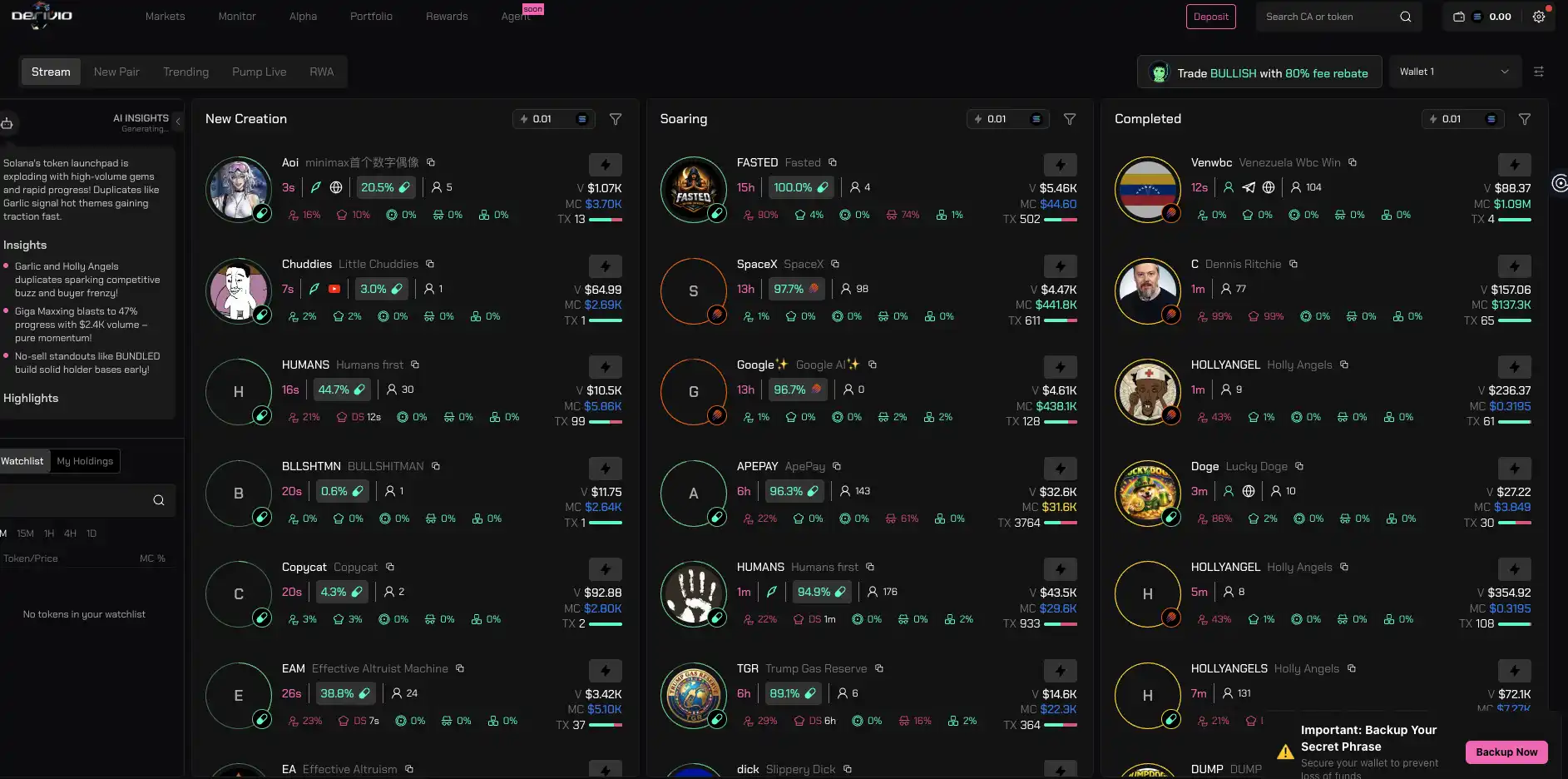
Yes, you read that right. This former centralized derivatives trading platform, now an AI-native trading platform, primarily focuses on helping pump-and-dump groups monitor on-chain activities. Not being a meme tool DEX is what defines a good AI trading platform. Additionally, you can even buy tokenized stocks on this platform.
As an AI-native trading platform, Derivio should have AI-related features. However, when you click on Agent in the top left corner, a "COMING SOON" page pops up...
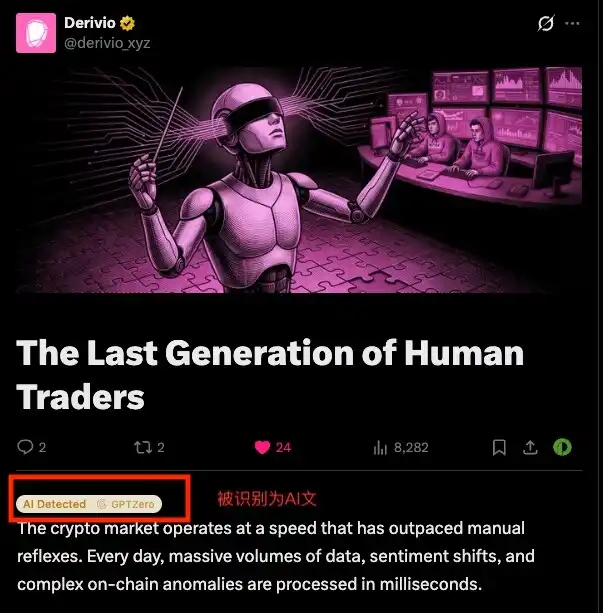
Although Derivio currently offers nothing, its envisioned future is imaginative. In an article published on X Platform titled "The Last Generation Human Trader," they wrote that most trading terminals are designed for humans, while Derivio is creating the first all-stack trading terminal designed for AI. They claim to have independently developed a high-performance data streaming engine from 0 to 1, compressing the latency from "on-chain events" alerts to "frontend AI processing" close to the physical limit.
After reading it, I thought this idea was brilliant, something not everyone can accomplish. So, I used a recognizer to check, and it turns out the article wasn't written by a human; it was indeed AI-generated. Derivio is truly ahead, replacing employees before replacing human traders with AI.
Superpower: The Disappeared AI Agent Product
Superpower is an AI Agent Revenue Protocol that announced the completion of its Pre-Seed funding round on March 6. Taisu Ventures, Paper Ventures, CatcherVC, and 280 Capital participated, but the specific amount was not disclosed. Superpower aims to build a platform for AI agents to autonomously generate income, access funding channels, and achieve capital appreciation.
To achieve such a grand project vision, it is crucial to have technology accumulation and continuous development. However, Superpower hasn't even prepared its website yet. March 6 was not only the day they announced their funding, but also the day their official X account made its first post.
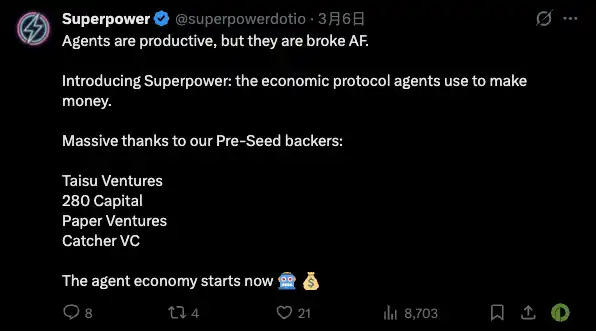
First Post of Superpower's Official X Account
While Derivio may not have an AI Agent, at least there is something interactive, but if you happen to open Superpower's website, your visual senses will be severely assaulted. Superpower's website has no clickable buttons; it only has a continuous slideshow with the phrase "YOUR AGENT IS BROKE AF." I don't even understand what that sentence means because the slides change so quickly that I can't even tell if the last word is "AI" or "AF."

In the link posted on Superpower's official X account, I also found a prediction market project named Prolly, along with a description of how the Agent can make money on this Prolly platform. I was thinking of giving it a try, but this product requires an invitation code, so I had to give up. Of course, the post introducing the project on Superpower's homepage was also written by AI without exception.
finrob: Unusable Cryptocurrency-Specific Model
Finrob is an AI-driven cryptocurrency market research platform. On February 25, it successfully raised $3.9 million in a seed round with investments from Maven11, Placeholder, Archetype, Fabric Ventures, Dispersion Capital, and Node Capital. So, what does this project do? Simply put, it is a conversational large model, not much different from interacting with ChatGPT or Gemini, and Finrob uses these same models.
If you ask what the difference is between directly conversing with users and ChatGPT or Gemini, Finrob's response is that it is specifically tailored for the cryptocurrency field, with real-time data integration, on-chain analysis, and specialized tools. Its specific implementation involves integration with CoinGecko for real-time price and market data, Glassnode for over 200 on-chain analytics, Tavily for web search and news, Perplexity for in-depth research, and other sources including DefiLlama, Etherscan, and LunarCrush for social sentiment.
In other words, when Finrob connects these data sources to the free large model (Finrob does not support user selection of advanced models like ChatGPT5.4), it can call itself tailored for the cryptocurrency field, and it's worth $3.9 million. Looking at it from a different angle, this is indeed much cheaper than spending money to train a large model.
From the officially presented use cases, Finrob's ultimate purpose seems to be to provide users with investment advice. Leaving aside whether AI can actually guide real trading decisions, is Finrob's intelligence using the free model really better than GPT5.4, Claude Opus 4.6, and others? I initially thought Finrob would be better at real-time token price retrieval than ChatGPT, but when I tried it, I found that with just a prompt, ChatGPT5.4 could also fetch BTC's real-time price from CoinGecko.
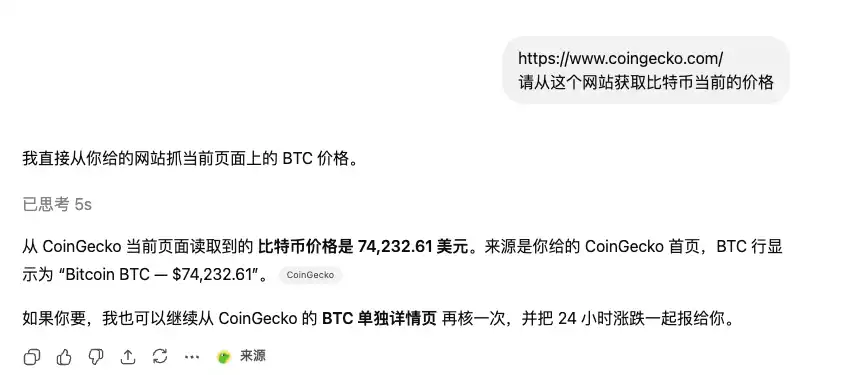
After all the complaints, I still wanted to personally experience Finrob, but it didn't give me a chance. Regardless of whether I used email or wallet login, the page kept showing errors.

PlutonAI: The DeFAI in the Corner
PlutonAI is a DeFAI platform aimed at having AI agents replace users to analyze markets, optimize strategies, manage yield opportunities, and perform complex on-chain operations. On February 17, PlutonAI completed a $2.7 million private funding round, led by kitchenvc with participation from HyperGPT.
From the project positioning, PlutonAI is a fairly standard Crypto+AI project. Leaving aside whether DeFAI has achieved Product-Market Fit, whether it is secure, or whether it can help users make money, in today's rapidly evolving AI landscape, letting AI take over on-chain operations has become a piece of cake.
Especially after the OpenClaw craze, the crypto community has been swept by the lobster-raising craze, with numerous bloggers sharing how to install OpenClaw, how to use OpenClaw for on-chain transactions or market predictions, and so on. Additionally, exchanges like Binance, OKX, and others have also introduced similar AI Agent trading tools/assistance. (Related Reading: Amid the OpenClaw Craze, CEX Compete for AI Agent Trading Entry)
Therefore, one could even argue that DeFAI has become a moot point. I also wanted to try out the AI Agent on PlutonAI, but unfortunately, I still couldn't log in.

Unicity: The True Master of Pie in the Sky
Unicity is an infrastructure developer dedicated to building the "Agentic Autonomous Internet," with the vision of enabling billions of AI Agents to engage in trustless discovery, transactions, and settlements at machine speed. On February 19, Unicity closed a $3 million seed funding round led by Blockchange, with participation from Outlier Ventures and Tawasal.
Another visionary company, I took the effort to read their project whitepaper to understand what they are really up to (finally not written by AI). Overall, Unicity believes that existing chains are unsuitable for AI high-frequency automated trading and collaboration in terms of throughput, latency, privacy, and fees. Therefore, they aim to create an underlying network for AI Agents, with a specific solution of moving all transactions off-chain to be peer-to-peer, using the chain only to confirm state changes to prevent double spending, while employing verifiable Agents to oversee execution.
Compared to the projects mentioned earlier, Unicity sounds much more serious and may indeed form a public chain ecosystem in the future. But what has Unicity, founded in 2025, delivered so far? With no testnet, zero ecosystem projects, in their March 10 project update, they mentioned the upcoming launch of the AstridOS agent operating system, allowing tools like Claude Code and OpenClaw to run on it, but whether anyone will actually use it remains to be seen.
Crypto VCs Foolish?
Of course, among recent AI projects that raised funding, there are still solid ones. For instance, on March 17, RoboForce completed a $52 million funding round led by YZi Labs. RoboForce is an AI robotics company with no ties to the crypto space, building physical AI, a track that Hwang In-hyun also mentioned as a future direction in his speech at GTC 2026. Additionally, RoboForce's robots did indeed make an appearance at NVIDIA GTC 2025.
Then there are projects like Kled, which raised $5.5 million on March 11 to create an AI data marketplace, and VeryAI, which raised $10 million on March 12, focusing on building an AI Agent identity system. They not only have product-market fit but also demonstrate real product ecosystems and performance delivery.
However, such projects are few and far between in the crypto industry. So the question is, are other crypto VCs fools? Knowing full well that many so-called AI projects lack a truly viable product logic, why are they still willing to invest?
The answer lies in the clue itself: Crypto VCs are only after the liquidity of the words "AI". Even though they can't join the top project's table and contribute chips, money still has to be spent. Therefore, in the crypto context, creating some "AI substitutes" is also a business. The project team only needs to package themselves as AI, and VCs can blindly pour money in. As long as both parties can eventually recover the funds, it's considered good AI.
You may also like

A valuation of 8 billion dollars, doubling in 8 months! What makes the crypto-friendly bank Erebor Bank stand out?
340 billion valuation: Li Yanhong's largest IPO, a seat in Kunlunxin's shares is hard to come by
Stablecoins are the "royalists" of the crypto world: Open USD brings the old currency system into play
Cape Verde 2-3 Argentina: The Underdog Team That Stunned the World in Defeat
Cape Verde's run ended in a 3-2 defeat to Argentina, but their journey — three unbeaten draws, one heroic goalkeeper, and a fight that pushed the defending champions to the brink — is the kind of story markets recognize too: small caps can rattle blue chips long before anyone expects it.
Semiconductor stocks plummet, yet Anthropic wants to create a 2nm chip
Where is Zhao Changpeng's billion-dollar investment going? YZi Labs' investment landscape fully revealed
Ethereum Foundation Report: A Basic Guide to Ethereum for Governments and Financial Institutions
A pre-announced harvesting case: After the cryptocurrency price dropped by 99%, the public chain Saga exited to transform into AI
When American giants collectively "defect" from Chinese AI models
BIS Report Compliance Observation: The Real Risks of Stablecoins, Not Just "Depegging"
Portugal 2-1 Croatia: Ronaldo's 20-Year Knockout-Stage Drought Ends With a Debt Finally Collected
Portugal beat Croatia 2-1 in the 2026 global football championship's knockout rounds as Ronaldo scored his first-ever knockout-stage goal, Gonçalo Ramos struck a stoppage-time winner, and VAR ruled out a late equalizer for offside.
Bitcoin Price Prediction July 2026: Will BTC Recover to $70K or Drop Below $55K?
A South Korean company that learned the strategy of hoarding coins, from a bull market to delisting?
WEEX API Broker Program: Turn Your Trading Platform Into a Revenue Engine
How to choose between buying discounted ETH, Bitmine, and SharpLink?
Wosh: Inflation has cooled in recent weeks, AI is reshaping the economy, and forward guidance has lost its necessity
From Pump.fun to Collector Crypt: Has Solana's income throne changed hands?
Dan Bin's latest speech: Don't miss out on a great era
A valuation of 8 billion dollars, doubling in 8 months! What makes the crypto-friendly bank Erebor Bank stand out?
340 billion valuation: Li Yanhong's largest IPO, a seat in Kunlunxin's shares is hard to come by
Stablecoins are the "royalists" of the crypto world: Open USD brings the old currency system into play
Cape Verde 2-3 Argentina: The Underdog Team That Stunned the World in Defeat
Cape Verde's run ended in a 3-2 defeat to Argentina, but their journey — three unbeaten draws, one heroic goalkeeper, and a fight that pushed the defending champions to the brink — is the kind of story markets recognize too: small caps can rattle blue chips long before anyone expects it.
Semiconductor stocks plummet, yet Anthropic wants to create a 2nm chip
Where is Zhao Changpeng's billion-dollar investment going? YZi Labs' investment landscape fully revealed