
Cassius Cuvee on Market Euphoria, High Leverage, and How to Stay in the Game

 Prefer us on Google


Phemex Prime: Institutional Spotlights is a collaborative thought leadership series produced in partnership with industry pioneers and institutional investors. It provides strategic insights to cut through market noise.
Before becoming a full-time trader, Cassius Cuvee was an artist. When SPACs took the market by storm, he transformed that moment into the song "SPAC Dream," merging his life in music and trading. Now, as the founder of the community "The Profit Circle," he continues to pay attention to what people are talking about, stating that reading market sentiment is just the entry point to trading.
In this interview, Cassius discusses the relationship between culture and market sentiment, the difference between leveraged plans and "hopium" (baseless optimism), and why no platform can manage a trader's capital for them. His advice for beginners is also the clearest message of this interview: If you incur small losses, you still have the capacity to seize the next opportunity, but if you lose all your capital, that won't be the case.
"Being an artist is why I can be sensitive to what’s happening around me."
Q1. In 2021, your song "SPAC Dream" became a big topic on Wall Street, catching the attention of hedge fund giant Bill Ackman on Twitter and appearing on CNBC's Fast Money. While many people see it as a fleeting entertainment trend, you took a serious step into trading as a full-time leveraged trader. Looking back at that turning point, how did your experience connecting Wall Street's high finance with raw hip-hop culture influence your understanding of current market psychology and institutional liquidity?
Cassius Cuvee: I have been an artist long before my life as a trader. I wrote rap since childhood and released numerous songs and albums before encountering finance.
Now, as a "reality rapper," I put what’s happening in my life directly into my songs. I became a full-time trader after the pandemic and learned about this world from people on Twitter and CNBC. So, creating "SPAC Dream" was a natural progression, though it was unexpected for financial media.
That song is primarily a tribute to everyone who taught me. I live in the market every day, and I still do. It was also a moment of capturing "lightning in a bottle." Knowing that timing is everything, I rushed to finish the song and music video while SPACs were still hot.
Everyone was forced to stay home, and individual investor participation surged. Such moments are rare in both human and financial history.
My songs often teach about trading and finance because that is my life. Being an artist allows me to be sensitive to what’s happening around me, and that awareness translates into understanding market sentiment on TV and social media. Sentiment combined with chart reading brings directional bias, and technical analysis teaches me the timing for entries and exits.
"Trading is trading, and risk management is risk management—it's the same no matter where you trade."
Q2. Despite your extensive experience in the world of fund-backed prop trading (managing six-figure evaluation accounts at Breakout Prop, etc.), you use Phemex as your main platform for leveraged and copy trading. Prop firms have strict trailing drawdown rules and profit sharing, but Phemex offers millisecond order matching, thick order book liquidity during high volatility, and leverage up to 100x, providing an institutional-grade execution environment. How do you balance between the strict prop constraints and Phemex's frictionless capital efficiency? How should serious traders allocate risk in both environments?
Cassius Cuvee: Trading is trading, and risk management is risk management. The essence doesn’t change no matter where you trade, whether at a prop firm or on a leveraged trading platform like Phemex.
Prop firms indeed have different rules. For example, you can’t adjust leverage there, but at Phemex, you can tailor it to individual needs. Conditions also vary by product at prop firms, so simple comparisons aren’t possible.
Phemex offers a far greater selection of assets. Exploring various products and thinking of new ways to apply your trading ideas is also enjoyable. However, regardless of the environment, the platform's rules cannot replace your own risk management.
"The difference between a gambler and a sniper is whether they have hopium or lack it."
Q3. In songs like "The Premonition," you have embedded strong warnings against market crashes and unscrupulous operators. In an ecosystem where influencers often hype individual investors about meme coins with 100x leverage, you preach strict discipline. What is the fundamental mindset difference between a reckless gambler using 50x leverage and a calculated sniper using 50x leverage? Please share the psychological steps to avoid revenge trading and cut losses when trades go completely against you.
Cassius Cuvee: My passion is to ensure that individual investors do not suffer catastrophic losses. That’s why I created multiple songs and music videos like "Crashing Waves" and "The Premonition." I warned about the risks that seemed like meme coins because I didn’t want the general public to lose money.
The difference between a gambler and a sniper is hopium (baseless optimism) or its absence.
If you are trading with high leverage, you should have a specific plan for that individual trade and for every trade. Don’t buy entries blindly without knowing your exit strategy.
To avoid revenge trading, decide on your position size in advance and stick to that plan. You need to make the judgment to not change the rules before losses occur.
-- Price
"No platform guarantees someone will make a profit."
Q4. You have built the community "The Profit Circle" and guided thousands of active traders to Phemex. Beyond marketing headlines, daily trading ultimately relies on infrastructure. How crucial have Phemex's core operational mechanics—such as execution with minimized slippage during cascading liquidation events, ultra-low latency API/sub-account configurations, and reliable copy trading architecture—been in supporting the community's stable operation and loyalty over the years?
Cassius Cuvee: I remember October 10, 2025, the day the cryptocurrency market was heavily sold off. I had multiple short positions and had set take-profit orders. Phemex's orders executed as expected, and its reliability was a significant help at that critical moment.
I want to talk about consistency rather than guaranteeing results. No platform guarantees someone will make a profit. However, it is important to trust that the platform will operate as it should during moments of extreme volatility.
I have consistently told the community this from day one. It pains me every time I hear that traders lost all their capital due to platform issues.
"Capital management is everything."
Q5. Finally: If a hopeful trader is sitting in front of the chart now, with little capital and desperate to succeed in cryptocurrency, what is the most important rule you would want to convey, whether in rap or sermon, to avoid losing all their capital in the first 90 days?
Cassius Cuvee: Capital management is everything. You can endure small losses and bounce back, but if you lose everything, you are completely out of the game.
I no longer feel FOMO. I know there is always the next opportunity in trading. However, if you chase after trades without a plan and incur catastrophic losses, you won’t even be able to capitalize on the next opportunity.
Beginners should start with small position sizes and practice as much as possible. Don’t use position sizes that could be fatal when you lose. As a general guideline, do not risk more than 1% of your total capital on any trade. This means that if you lose that trade, your loss should be around 1% of your total capital.
I also provide free educational materials at CassiusCuvee.com for new traders and those struggling with consistency.
In Conclusion
Cassius has created a song themed around a moment in the market that everyone wanted to participate in. His closing words point in a rather opposite direction. There is no need to chase every price movement. Whether the driving force of trading is the chart, a cultural moment, or a strong belief, the first question to ask should be—if I’m wrong, what happens to my capital?
This content is provided for general informational purposes only and doesn't constitute financial, investment, legal, or tax advice. Any events, rewards, online promotions, or related information mentioned herein should not be considered a recommendation, solicitation, or invitation to purchase, sell, trade, or otherwise deal in any crypto assets. Crypto assets are highly volatile and may result in loss. The availability of WEEX services, products, and related events may vary by region. You are responsible for ensuring that your participation is in accordance with applicable local laws and regulations.
You may also like

Lee Chang-yong Discusses Potential Erosion of Capital Movement Regulations with Introduction of Won Stablecoin

Bitcoin’s supply squeeze narrative faces scrutiny after 11,000 BTC moves to Kraken

Korean Token Securities Need Connection to Overseas Blockchain Financial Infrastructure
ECB Seeks Partners for Tokenized Deposits and Securities Pilot
[Analysis] Reasons Why This Bitcoin Decline Is Different from the Past
SBF Expresses Regret Over Anthropic Sale: AI Has a 25% Chance of Destroying Humanity, Young People Should Master AI

VIX Soars to Highest Level Since Last Year’s Tariff Turmoil, Goldman Sachs Fear Index Nears Maximum, US Stocks May Face Over $80 Billion Sell-off Next Week
Is Arthur Hayes buying the dip after moving $5M in USDC?
Bitcoin: Major Investors Return After Nine Months of Selling

Musk Regrets Spending Over $400 Million on Republican Candidates

ZRO Unlock on November 20: Why Are Supply Estimates Different?

Options Overview | AMD Sees $37.88 Million in Forward Double Call Sell, Limited Upside Ahead; Intel Shows Large Put Buys Indicating Bearish Dominance
APEC Releases Connectivity Blueprint
Institutional Withdrawal and Retail Frenzy: Why is the Eastern European Crypto Market Exhibiting 'Abnormal' Trends?

Bitcoin income ETFs promise regular payments. What do investors give up?
USD.AI Evaluates GPU Transactions at $25 Billion

Solana tokenized equities reach $1.22 billion as stock offerings expand
IoTeX adds quantum-resistant technology to developer portal
How to Choose Precious Metal ETFs? A Comprehensive Analysis of Mainstream Gold, Silver, and Mining Stock ETFs
Shiba Inu Experiences Outflow of 300 Billion SHIB from Exchanges
Hacker moves over 34279.66 ETH from Binance after inactivity
Why Are Tokenized Stocks Seeing Strong Buying Pressure While Prices Keep Falling?
XRP holders demand Ripple burn 31.1 billion tokens by March 2027
Pump.fun Launches Prediction Market Feature in Collaboration with Polymarket

ARTEX AI tool breaches networks in under 3 hours, FBI warns
Gnosis Safe wallet reportedly drained of $6.45M in suspected exploit
Thailand Stablecoin Transfer Limit: What the SEC Draft Proposes
Tesla Autopilot Team Veterans Found Simulation Startup Valued at $1 Billion
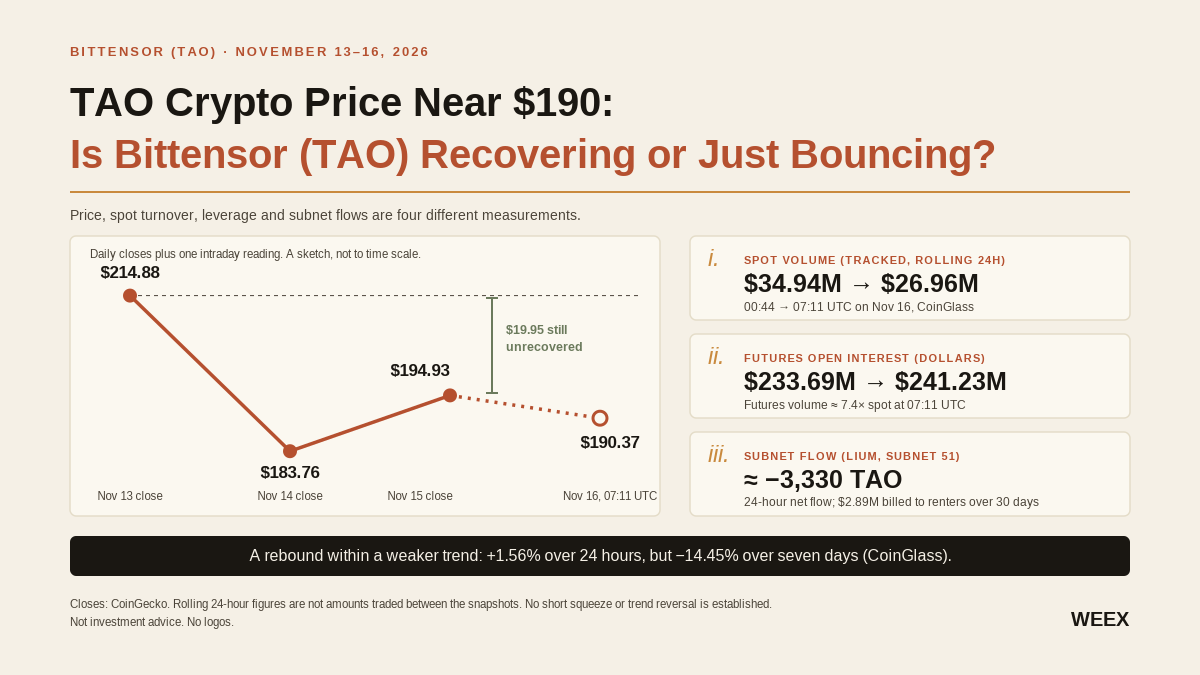
TAO Crypto Price Near $190: Is Bittensor (TAO) Recovering or Just Bouncing?
TAO bounced near $190. Compare spot volume, futures positioning, and Bittensor subnet flows to see what would confirm a more durable recovery.
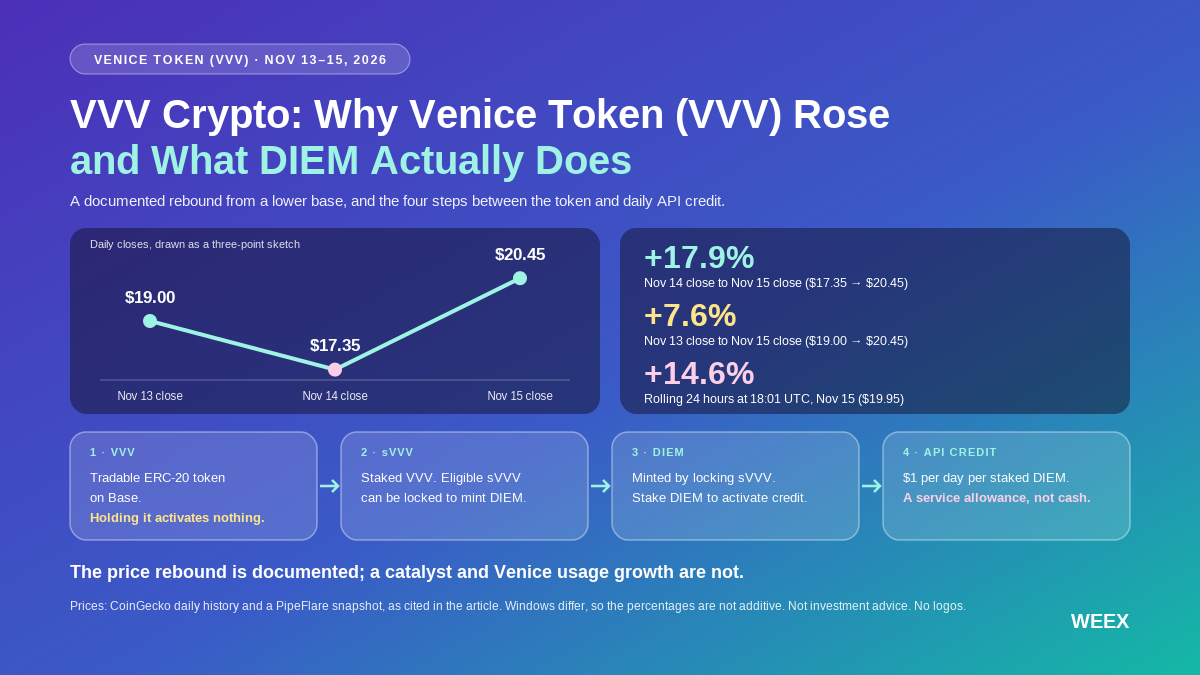
VVV Crypto: What Is Venice Token, Why Venice Token (VVV) Rose and What DIEM Actually Does
Venice Token rose about 14.6% in one November 15 snapshot. Learn what the data shows, how VVV staking works, and what DIEM’s daily API credit buys.
Lee Chang-yong Discusses Potential Erosion of Capital Movement Regulations with Introduction of Won Stablecoin
Bitcoin’s supply squeeze narrative faces scrutiny after 11,000 BTC moves to Kraken
Korean Token Securities Need Connection to Overseas Blockchain Financial Infrastructure
ECB Seeks Partners for Tokenized Deposits and Securities Pilot
[Analysis] Reasons Why This Bitcoin Decline Is Different from the Past
SBF Expresses Regret Over Anthropic Sale: AI Has a 25% Chance of Destroying Humanity, Young People Should Master AI
Latest articles



Latest coin listings on WEEX


