
- Buy Crypto
- Markets
 Futures
- Spot
- Copy Trade
- Earn
- More
Bitwise Files S-1 with SEC to Launch Spot $NEAR ETF, Bringing Institutional Exposure to NEAR Protocol
By: bitcoin ethereum news|2025/05/08 17:45:02
0
Share
Bitwise, a premier firm in the world of digital asset management, has formally submitted an S-1 registration to the U.S. Securities and Exchange Commission (SEC) in pursuit of an opportunity to launch a spot exchange-traded fund (ETF) that would offer direct exposure to $NEAR, the native token of the NEAR Protocol. This event represents a significant advance in the evolution of cryptocurrency investment vehicles. It would allow traditional, SEC-regulated investment funds to gain exposure to NEAR without the complexities (and fund accountant hair-pulling) that come with directly holding or managing the cryptocurrency. If approved, this ETF could signal an opening of the floodgates for more institutional capital to enter the crypto space, a phenomenon many of us in the Bitcoin space like to call the “next bull run.” For years, the world of decentralized finance (DeFi) and blockchain technology has been interested in decentralized finance and blockchain technology, but direct participation in these markets has proven very challenging for the mainstream investment world. Investors have expressed interest in participating directly in these markets, but directly purchasing, holding, and securing cryptocurrencies has thwarted participation in what many believe to be a world of huge growth potential. Bitwise works on ETFs, and this one is designed to work with an investment in NEAR and then is directly backed with a purchase of NEAR NFTs. Institutional Access and the Future of Crypto ETFs The $NEAR spot ETF filing is part of a broader trend in the crypto space, where institutional and retail investors are increasingly after traditional financial products to interact with digital assets. ETFs are long-popular in traditional markets. They provide exposure to various asset classes (in an ETF’s case, a basket of assets) with ease. They have become a sought-after tool for investors in the digital asset world because of the promise to deliver exposure to the actual asset (or, in a tokenized funds case, the actual tokens). A spot ETF is attractive because it tracks the actual price of the underlying asset—in this case, the $NEAR token itself—without relying on futures contracts or other derivative products. Special attention should be given to the prospect of what a $NEAR spot ETF would actually do. If the SEC gives the green light to Bitwise’s filing, it will be a huge moment for the NEAR Protocol. It will put the relatively nascent blockchain project in the same company as some of the other big names in the space, like Solana and XRP, which are also in the race to offer access to institutional investors through ETF products. And an approval of a spot ETF for NEAR specifically could have huge implications for the token’s adoption and liquidity. In addition, a NEAR ETF would probably lure in many more retail investors because it would permit them to obtain exposure to the blockchain sector through good old-fashioned brokerage accounts. In this way, an ETF could serve as an entry point to something resembling a near-infinite variety of potential investments built on the NEAR platform. And, because the assets held within the ETF would need to be liquid enough for operators to make the sorts of trades that keep an ETF operating smoothly, it seems likely that demand for $NEAR itself would increase if the NEAR ETF succeeds. So, more retail and institutional investors exchanging $NEAR on various crypto trading platforms would seem to be the most direct pathway to a future in which the NEAR protocol has a much larger market cap and a much broader base of support. Bitwise has filed an S-1 with the SEC to launch a spot $NEAR ETF! This move aims to provide investors with direct exposure to @NEARProtocol ‘s native token through a regulated exchange traded fund, without the need to hold the cryptocurrency Why This Matters? Institutional... pic.twitter.com/QHu5YRj6Dp — Marcus (@marcus_NEAR) May 7, 2025 Security and Transparency with Coinbase Custody A key component of the proposed Bitwise $NEAR ETF is the selection of the custodian for the $NEAR tokens. The $NEAR tokens are to be held at Coinbase Custody Trust Company, which is an extremely reputable entity in the digital asset world. Coinbase Custody has solid crypto security (ask James Zhong about that!), is well-regulated, and holds the assets it safeguards in the location where those assets are most likely to remain secure. Those are just a handful of the reasons why we have confidence in Coinbase Custody and consider it a trustworthy place for holding $NEAR. Furthermore, the ETF will keep tabs on the CF NEAR<>Dollar Settlement Price—a standard created to offer pricing for $NEAR that’s as clear and accurate as it is possible to get, given the current state of blockchain technology. This is a pricing mechanism that, when it is right (as we contend it will be, all things considered), provides a product with a degree of transparency that instills a lot of trust. If you can see a price move in relation to a near-term dollar price with a high degree of certainty, then you can also be pretty assured that the asset you’re following has moved in a way you would have predicted it to. Hence the trust. And that’s a big part of what cryptocurrency needs in order to go more mainstream. A Growing Trend in Crypto ETFs Bitwise’s choice to apply for a spot $NEAR ETF reflects the strong interest that’s emerging in curated, diversified crypto investment products. The favorable reception that Bitcoin ETFs (both spot and futures-based) are enjoying has opened the door for other digital assets to pursue similar kinds of approvals from the SEC. With regulatory clarity around cryptocurrency products slowly but surely coming about, the $NEAR ETF could become one of the first SEC-approved products of its kind. If it does, the influx of institutional capital that many crypto advocates hope for could become a reality. The filing also shows that NEAR Protocol is being recognized in the crypto ecosystem and is positioning itself as a strong contender for mainstream adoption. If approved, the $NEAR ETF would provide a new and different way for investors to access the unique technology of the NEAR protocol and would, in my view, help enshrine NEAR as one of the top-tier blockchain projects. To sum up, Bitwise’s S-1 filing for a spot NEAR ETF is a key instance in the advancement of cryptocurrency investments. If SEC approval is granted, this could really open up pathways for institutional and retail investors into the NEAR Protocol, with all the possible associated positive outcomes for growth. Lots of strong language in here about security, strength of the $NEAR asset, and pricing mechanism transparency. If this is a thumbs up for the ETF, it’s also a potential thumbs up for DeFi on NEAR. Disclosure: This is not trading or investment advice. Always do your research before buying any cryptocurrency or investing in any services. Follow us on Twitter @nulltxnews to stay updated with the latest Crypto, NFT, AI, Cybersecurity, Distributed Computing, and Metaverse news ! Source: https://nulltx.com/bitwise-files-s-1-with-sec-to-launch-spot-near-etf-bringing-institutional-exposure-to-near-protocol/
You may also like

Particle Founder: The entrepreneurial insights I have gained the most from in the past year
Stop lean startup, stop lightning entrepreneurship, and think carefully about what your product aspirations are.

Huang Renxun's latest podcast transcript: The future of Nvidia, the development of embodied intelligence and agents, the explosion of inference demand, and the public relations crisis of artificial intelligence
The competition in the future is not just about whose model is larger or whose computing power is stronger, but also about who understands the industry better, who can embed AI more deeply into real processes, and who can organize these capabilities into a runnable and scalable system.

OKX Ventures Research Report: AI Agent Economic Infrastructure Research Report (Part 1)
The existing infrastructure is hostile to the Agent economy. Agents can think and act independently at the "capability level," but at the "economic level," they are still locked into infrastructure designed for humans.

The migration of settlement rights: B18 and the institutional starting point of on-chain banks
In the traditional system, banks decide the settlement; in the on-chain system, code begins to take over this responsibility.

From Tencent and Circle: Looking at the Simple and Difficult Questions of Investment
The AI narrative continues to ferment, but the recent performance of related stocks varies, with some in the midst of summer and others as if in winter.

The second half of stablecoins no longer belongs to the crypto circle
What Coinbase doesn't want, Mastercard is eager to buy.

Cursor "Shell" Kimi Controversy Reversed: From Copyright Infringement Allegations to Authorized Collaboration, China's Open Source Model Once Again Becomes a Global AI Foundation
Cursor was accused of being based on Kimi K2.5, which sparked controversy, and was later confirmed to be compliant through Fireworks AI due diligence.

The Real Reason Tokens Don't Sell: 90% of Crypto Projects Overlook Investor Relations
Provide an Investor Relations Best Practices Guide for Crypto Projects.

Is the income of pump.fun real, earning a million dollars a day despite the market downturn?
If it can really earn this much, what is the reason for the low price of $PUMP?

The real reason why tokens are not selling: 90% of crypto projects neglect investor relations
Investor Relations Practice Guide for Cryptocurrency Projects.

Who is the true winner of the "Tokenization" narrative?
Virtually everyone benefits, but the reason for the benefit, the timing, and the underlying logic are completely different.

Moss: The Era of AI-Traded by Anyone | Project Introduction
AI Trading Agent is rapidly growing its infrastructure.

Chip Smuggling Case Exposes Regulatory Loophole | Rewire News Evening Update
AI chips have become a strategic asset more sensitive than missiles

How a Structured AI Crypto Trading Bot Won at the WEEX Hackathon
Ritmex demonstrates how disciplined risk control and structured signals can make an AI crypto trading bot more stable and reliable on WEEX, highlighting the importance of combining execution discipline with scalable AI trading systems.

Old Indicator Fails, Three Major New Signals Emerge: BTC True Bottom May Still Be Below $60K
When the grocery shopping auntie on the subway, or Tony the hairdresser, start asking you about BTC, crypto, and cryptocurrency investments, selling immediately will be the only best option.

Meeting OpenClaw Founder at a Hackathon: What Else Can Lobsters Do?
Imperial College London MetaGame: AI Agent × Web3 Landing Three Major Directions.
Huang Renxun's Latest Podcast Transcript: NVIDIA's Future, Embodied Intelligence and Agent Development, Soaring Demand for Inferencing, and AI's PR Crisis
The future of competition is not only about whose model is bigger, whose computing power is stronger, but also about who understands the industry better, who can more deeply integrate AI into real processes, and who can organize these capabilities into a set of executable, scalable systems
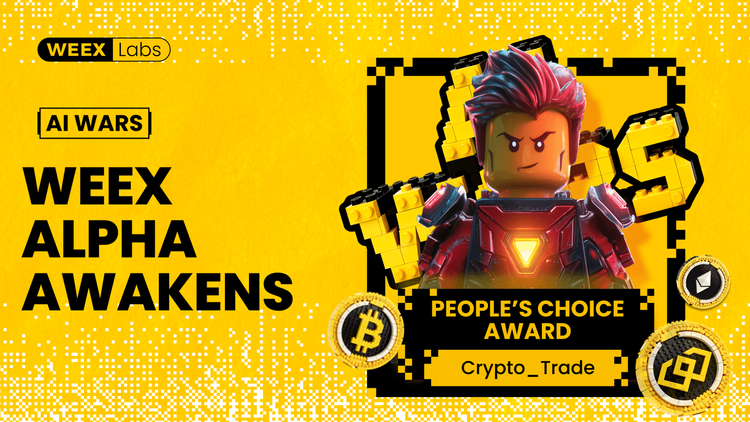
How a Structured AI Crypto Trading Bot Won at the WEEX Hackathon
Crypto_Trade shows how structured inputs and controlled adaptability can build a more stable and reliable AI crypto trading bot within the WEEX AI Trading Hackathon, highlighting a practical path toward scalable AI trading systems.
Particle Founder: The entrepreneurial insights I have gained the most from in the past year
Stop lean startup, stop lightning entrepreneurship, and think carefully about what your product aspirations are.
Huang Renxun's latest podcast transcript: The future of Nvidia, the development of embodied intelligence and agents, the explosion of inference demand, and the public relations crisis of artificial intelligence
The competition in the future is not just about whose model is larger or whose computing power is stronger, but also about who understands the industry better, who can embed AI more deeply into real processes, and who can organize these capabilities into a runnable and scalable system.
OKX Ventures Research Report: AI Agent Economic Infrastructure Research Report (Part 1)
The existing infrastructure is hostile to the Agent economy. Agents can think and act independently at the "capability level," but at the "economic level," they are still locked into infrastructure designed for humans.
The migration of settlement rights: B18 and the institutional starting point of on-chain banks
In the traditional system, banks decide the settlement; in the on-chain system, code begins to take over this responsibility.
From Tencent and Circle: Looking at the Simple and Difficult Questions of Investment
The AI narrative continues to ferment, but the recent performance of related stocks varies, with some in the midst of summer and others as if in winter.
The second half of stablecoins no longer belongs to the crypto circle
What Coinbase doesn't want, Mastercard is eager to buy.


 App
App