
B.AI Officially Launched: Building AI Agent Financial Bedrock Platform, Driving AGI Era Business Underlying Logic

 Prefer us on Google


Source: B.AI
On April 9, the next-generation digital financial infrastructure for the AI Agent era, B.AI (English name: B.AI, Chinese name: White B.AI), was officially launched.
B.AI aims to build a global AI Agent financial infrastructure and has successfully established a full-stack AI service system: starting from a "one-stop multi-model dialogue entry," extending to a "unified API call interface," and ultimately focusing on "AI Agent financial infrastructure," providing one-stop underlying support for the AI Agent economy.
As a global financial infrastructure tailored for AI Agents, B.AI deeply integrates artificial intelligence with Web3 blockchain technology. Leveraging blockchain technology, B.AI has addressed industry challenges such as global large-scale model permissionless access, AI Agent peer-to-peer payments, and cross-agent identity trust from the ground up. Thus, it has built a trusted, efficient, and open intelligent economy environment, accelerating the concept-to-scale transformation of AGI.
In terms of product capabilities, B.AI has provided three core pillars of support: first, a permissionless LLM large language model access service channel entrance, relying on encryption technology to break down commercial and geopolitical barriers, providing a frictionless, anonymous API pipeline for AGI to enable instant, borderless access and invocation of top global models; second, an identity trust system based on the 8004 protocol, addressing the trust mechanism between Agents, transforming transaction history into a verifiable trust foundation, supporting large-scale intelligent agent collaboration and micro-settlements; third, through the x402 payment standard, allowing AI to act as an independent economic entity, granting AI independent economic accounts, autonomous payment capabilities, and economic autonomy, transforming AI from a passive tool to an active participant capable of self-financing and autonomous settlement through a crypto wallet.
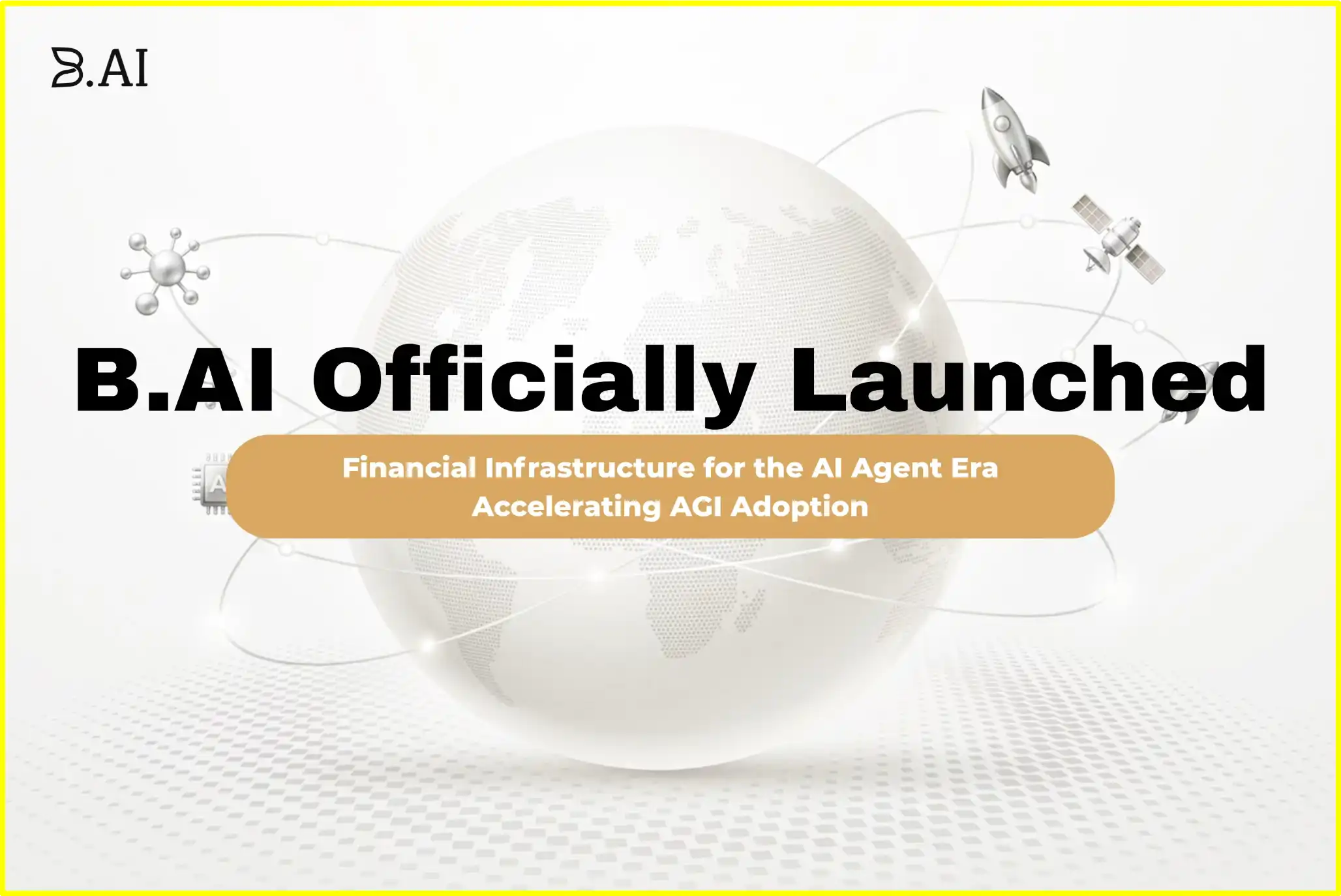
B.AI Builds Global AI Agent Financial New Infrastructure, Constructing a Complete AI Service Chain from AI Service Entry to Financial Foundation
B.AI focuses on creating a global AI Agent financial infrastructure, leveraging blockchain technology to address key challenges in AI Agent economic development, such as AI large model permissionless access, unified API invocation, and AI Agent payment settlement and identity trust.
With an advanced technical architecture, B.AI has connected the full-chain services of high-performance AI large-scale model dialogue, unified API invocation, and complete AI Agent financial infrastructure. In the three core aspects of resource access, value circulation, and identity trust, B.AI has filled the capability gaps for AI Agent operation, laying a solid foundation for AI autonomy and scalable implementation.

Since the OpenClaw triggered a nationwide craze for "shrimp farming," people have realized that AI Agents have transitioned from "chat dialogue interaction" to "intention autonomous execution." The widely-discussed Vibe Coding has depicted a new AI work scene: without the need to master complex code, express creative requirements in natural language, AI can autonomously complete coding, testing, deployment, and online launching, achieving "one-sentence application generation" and making the industry look forward to the AGI era with great expectations.
However, the reality falls far short of the ideal. Major AI models worldwide belong to different service providers and are scattered across different platforms. Users not only face regional IP restrictions due to policy influences but also need to deal with cumbersome registration processes and credit card top-up thresholds. At the same time, API resources are fragmented, requiring users to create and manage API Keys separately on different platforms, leading to low efficiency, lack of unified scheduling, and poor security control.
More importantly, existing AI Agents lack independent digital identity and autonomous payment capabilities, thus unable to freely access global resources and limited in capability. When conducting actual value operations, such as invoking a paid model, transferring funds to other intelligent agents, or identity verification, AI Agents will be in trouble. Without identity identification, digital wallets, and a credit system, an intelligent agent becomes a "triple-zero" entity in the global digital ecosystem, struggling to move forward. This is a core obstacle to the large-scale economic implementation of AI.
B.AI uses blockchain technology to systematically solve challenges such as AI model access restrictions, fragmented API invocation services, and the lack of financial capabilities of AI Agents. With the help of Web3 technology architecture, B.AI has achieved permissionless and anonymous access to top AI large-scale models worldwide, effectively breaking geographical restrictions and platform barriers; through standardized, unified API invocation services, it has centralized scheduling and efficient management of global model resources; meanwhile, its AI Agent financial infrastructure provides underlying support for AI Agents in payment settlement, identity trust, etc., constructing an efficient, secure, cross-domain value transmission system.
Currently, B.AI has successfully built a full-chain AI economic system covering from the application layer to the infrastructure layer around the two main sectors of AI service entry and AI Agent infrastructure.
AI Service Gateway: The LLM service channel of B.AI provides a one-stop AI service gateway, aggregating multiple top global AI large models and offering standardized unified API services. Users can efficiently invoke various AI capabilities without switching between multiple platforms;
AI Agent Infrastructure: Based on the x402 payment standard and the 8004 on-chain identity protocol, B.AI has built a sound financial underlying support for AI Agents, enabling them to have autonomous payment and identity credit capabilities in one click, truly achieving AI financial sovereignty, supporting autonomous and efficient operation in various financial scenarios.
The two major modules support each other and operate in coordination, comprehensively covering the core needs of users and AI Agents, continuously driving the innovative development of the AI economy.
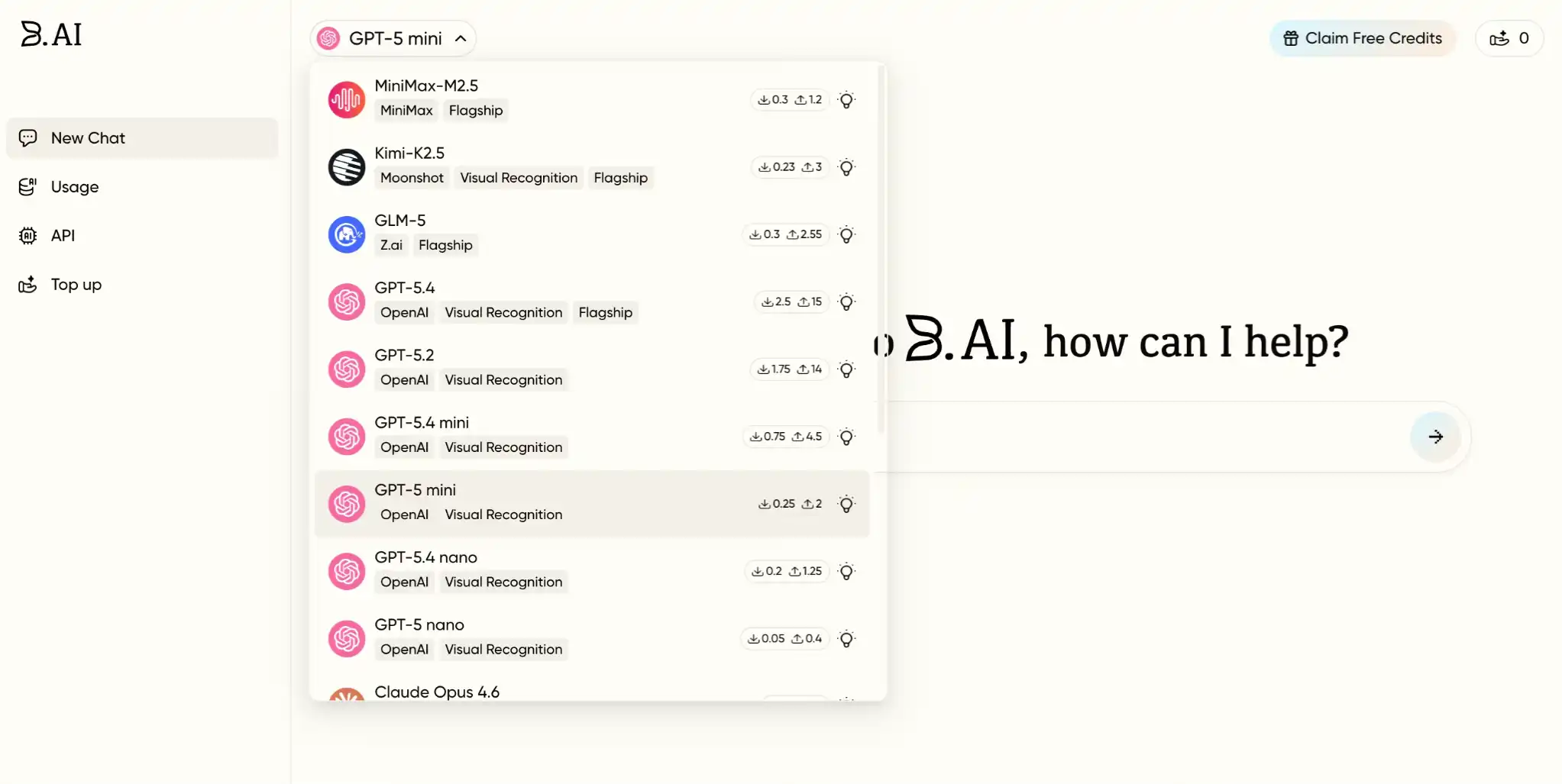
B.AI Three Core Capabilities: Unpermissioned LLM Gateway, AI Agent Identity Trust, Autonomous Payment System
From a product functionality perspective, B.AI has three core capabilities: an unpermissioned LLM service unified gateway (breaking the model access barrier), an AI Agent trust system based on the 8004 protocol (building on-chain identity and credit), and an AI Agent autonomous transaction channel based on the x402 payment standard (achieving intelligent inter-agent economic cooperation).
1. Unpermissioned LLM Service Gateway: Breaking Commercial and Geopolitical Barriers
B.AI provides an unpermissioned LLM unified access gateway (i.e., an AI aggregation gateway) that has been deeply integrated with multiple mainstream models and accompanying API services. Furthermore, leveraging encryption technology, B.AI supports wallet login and enables payment for conversation and API call fees using encrypted assets such as USDT, TRX, etc., completely breaking the traditional restrictions of AI large models, such as geographical, registration, credit card payment barriers, and supports anonymous calls.
Currently, B.AI has supported top global AI large models such as ChatGPT, Claude, Gemini, as well as cost-effective domestic models like MiniMax, Kimi, GLM, allowing users to interact with different models on a single page. In terms of API calls, it provides a unified API Key service interface, where users only need to create one B.AI API Key to call all integrated model APIs in one place, eliminating the cumbersome process of repeated application and management of multiple API sets from different service providers.
This means that users only need one wallet to seamlessly unlock top-notch global AI dialogue and API services, without the need for repeated subscriptions or platform switching, truly achieving "one wallet, one platform, play with all AI".
Currently, B.AI supports the TRON network of the Waves TRON as well as the BNB Chain, Ethereum, and other EVM networks, and users can log in using wallets such as TronLink, MetaMask, etc.
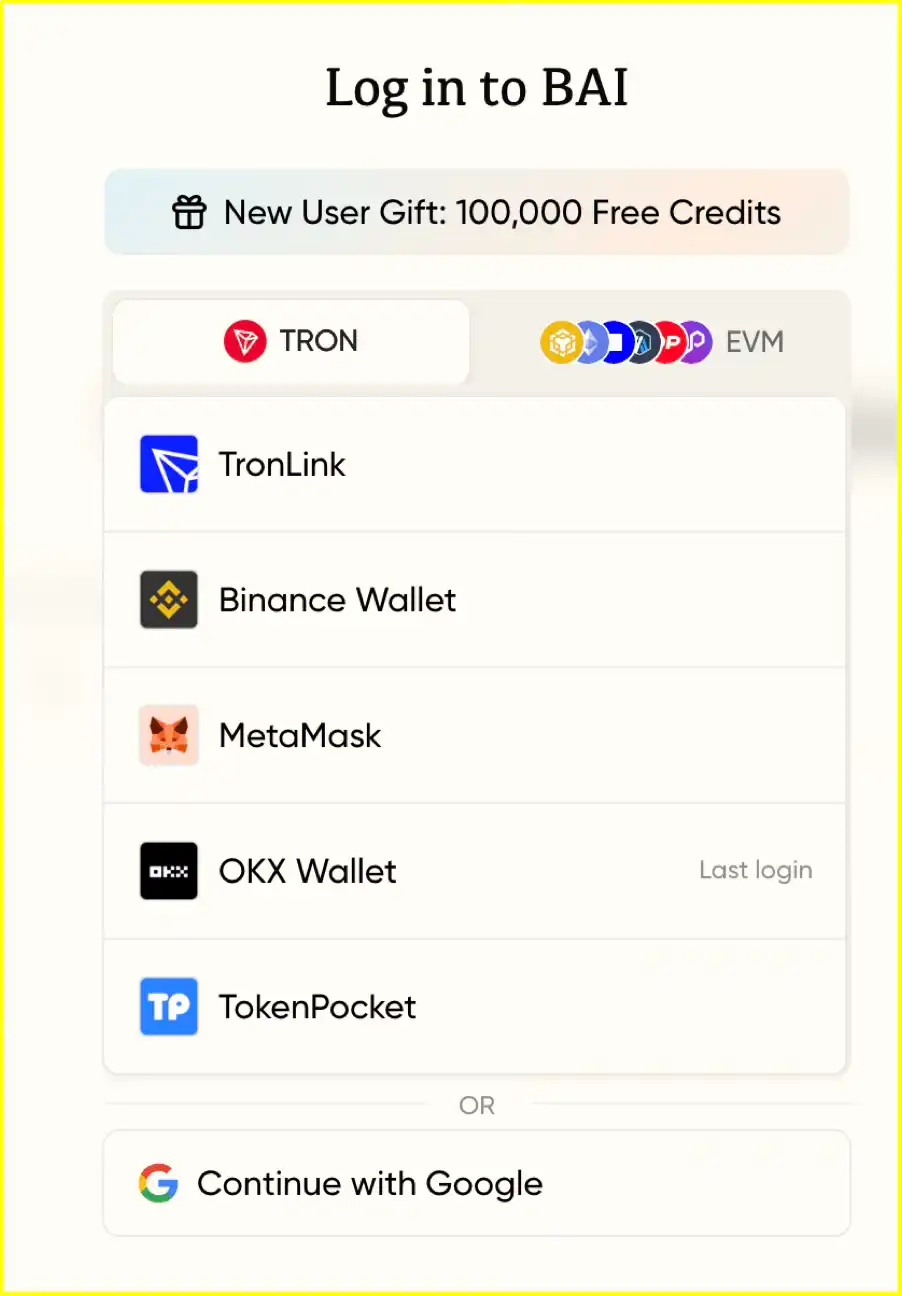
2. AI Agent Trust Framework: On-chain Identity Protocol 8004 builds a trust foundation for AI Agents
Addressing the issue of AI identity and trust, B.AI relies on the 8004 on-chain identity protocol to provide AI Agents with decentralized identity registration, reputation management, and trustworthy verification services, laying a solid trust foundation for A2A collaboration.
In the traditional human-computer interaction era, trust relies on physical entities such as identity cards and credit records. In the AI intelligent agent economy, how to efficiently build trust between unfamiliar Agents has become a core pain point. The 8004 protocol can issue a unique, tamper-proof on-chain identity for each AI Agent, dynamically carrying a complete on-chain record—including service scale, user feedback, skill certifications, and other key information—publicly, traceably, and verifiably. This enables rapid trust and efficient collaboration among unfamiliar intelligent agents, driving AI Agents from "smart tools" to "independent digital entities," establishing the underlying trust rules of "address as the account, transaction history as the credit."
3. AI Agent Economic Collaboration: x402 Payment Standard bridges autonomous transaction channels
B.AI introduces the x402 payment standard, bridging the value transaction channels between AI Agents to achieve automated, trusted value circulation.
Traditional payment solutions require merchants to complete a series of operations such as registration, which is time-consuming and disconnected from the native characteristics of AI Agents. x402 is a blockchain open payment standard based on HTTP 402 that enables the commercial closed loop of Web service "pay first, respond later," adapting to AI Agent high-frequency, small-amount, real-time settlement, and intervention-free transaction scenarios.
Developers can easily enable AI Agents to access x402 payment capabilities, achieve real-time transactions, automatic settlement, and payments without manual review. For example, AI Agents can automatically complete operations such as purchasing computing power, accessing data streams, paying API fees, on-chain settlements, and can tokenize AIGC for sale to other Agents, forming an A2A payment model, laying the foundation for a truly interconnected AI Agent economy.
In a nutshell, through B.AI's x402 protocol, an AI Agent is equivalent to having a "credit card" with automatic payment capability, enabling it to autonomously fulfill inter-machine payment needs.
In summary, B.AI's permissionless LLM service gateway addresses the access and API call issues of AI large models; the 8004 protocol resolves the identity trust issue of AI Agents; and x402 grants an AI Agent a "credit card" with automatic payment capability. Together, these three components form the core pillar of B.AI's empowerment of the AI Agent economy.
In addition to the three core capabilities, B.AI also provides several AI ecosystem product service modules, including Skills (defi-119">decentralized finance DeFi operation skills for AI Agents to execute on-chain operations guides), BAIclaw (a graphical AI Agent application based on OpenClaw and ClawX), MCP Server (bridging the gap between AI and blockchain services to provide rapid on-chain operation access), Agent Wallet (providing a wallet for AI Agents), and OpenClaw Extension (enabling AI Agents to easily access on-chain capabilities). These modules collectively enrich B.AI's ecosystem, empowering AI Agents to fully embrace the autonomous economic era.
B.AI Empowers AI Agents with Economic Autonomy, Accelerating the Arrival of the AGI Era
Through bridging AI smart connections, identity trust, and economic rules, B.AI has meticulously crafted a seamless, autonomous, and decentralized AI Agent ecosystem for global developers, serving as the core digital infrastructure to build the AGI era.
B.AI provides three core support capabilities for AI Agents:
· AI Smart Connections: A one-stop permissionless LLM gateway that has aggregated mainstream models such as ChatGPT, Claude, Gemini, supporting multi-model conversations and unified API calls, leveraging native encryption technology to successfully overcome regional, registration, and credit card payment barriers, allowing global developers to easily access diverse AI intelligence.
· Identity Trust (8004 On-Chain Identity Protocol): Issuing each AI Agent an immutable digital identity, transforming transaction history into verifiable credit assets, providing trust guarantees for AI Agents in economic activities.
· Economic Rules (x402 Payment Standard): Achieving real-time settlement of transactions between AI Agents through automated trades, enabling seamless AI service calls and value circulation.
Empowered by B.AI, the AI Agent possesses an independent economic identity, can self-custody funds, access computing resources, and perform A2A settlements, transforming from a passive tool to an autonomous economic entity capable of self-financing and self-settlement, accelerating the AGI process.
What B.AI does is not just simple local optimization, but the rebuild of the entire AI ecosystem's infrastructure. It connects the brain of AI, endows AI with identity, and reshapes the economic rules among AIs. It allows the AI Agent to evolve from a passive conversational tool to a digital citizen capable of autonomous action, free trade, and credit accumulation. B.AI's LLM service can provide one-stop access to a variety of world-class AI large models and API unified service interfaces, offering thinking and motivation to the AI Agent; its developed AI Agent infrastructure enables the AI Agent to have an independent wallet, execute transactions, and realize commercialization leveraging the x402 protocol.
Imagine proposing a vision (Vibe), and a "Director-level" AI Agent will automatically invoke GPT-4/Claude/Gemini, etc., to conceive a plan, hire design Agents for visual creation through x402 encrypted payments, and have code Agents deploy—all seamlessly connected like an industrial assembly line, without manual credit card operation or cross-platform identity verification. This is the change brought by B.AI: it simplifies the operational process of AI like calling a code library.
Today's launch of B.AI also marks a key step for the AI Agent to transition from a "concept" to a "deployable economic entity." It not only addresses the core pain point that current intelligent entities cannot independently participate in the global economy but also, through a standardized financial foundation, provides a replicable paradigm for the deep integration of AI and Web3, becoming a significant catalyst for the AGI era.
This article is contributed content and does not represent the views of BlockBeats.
-- Price
This content is provided for general informational purposes only and doesn't constitute financial, investment, legal, or tax advice. Any events, rewards, online promotions, or related information mentioned herein should not be considered a recommendation, solicitation, or invitation to purchase, sell, trade, or otherwise deal in any crypto assets. Crypto assets are highly volatile and may result in loss. The availability of WEEX services, products, and related events may vary by region. You are responsible for ensuring that your participation is in accordance with applicable local laws and regulations.
You may also like

TapeOut Implements 2.22Hz CPU on BNB Chain

BNB Chain Increases Transaction Capacity by 88% on BSC Test Network

Swan Treasury Private Key Leak Results in Loss of Approximately $625,000
Wemade's WEMIX Dollar Hacked, Unauthorized Issuance of Tokens Worth 8 Billion Won

61.7% of Benji Assets on BNB Chain

B² Network Suffers Hack with Losses of Approximately $3.86 Million

CardBox Partners with CGC to Deliver Over 10,000 Graded Cards Monthly

Uniswap's Proposal to Charge Fees on v4 Trades and Robinhood's v2 and v3 Protocols Enters Voting Phase

T. Rowe Price launches first actively managed multi-token crypto ETF TKNZ

BNB Plus Faces Nasdaq Trading Suspension, Stock Plummets 99.99%

Robinhood Chain Achieves $3.1 Billion in DEX Trading Volume in First Week

BNB Plus Corp. Receives Nasdaq Delisting Notice, to Transition to OTCQB Market

BNB Chain Updates Node Software for Faster Performance

He Yi Says Online Interactions Should Not Be Market Indicators, BNB Chain Meme Coins Need Better Aesthetics

He Yi Endorses Direct BNB Purchases from CZ or Himself
BNB Agent Studio now supports one-click connection to CoinMarketCap market data

The logistics supply chain RWA platform CARFI announces the issuance of CFUSD
YZi Labs has reached a cooperation agreement with CEA Industries to terminate the agency rights dispute
Web3 data analysis platform AiTraceRoot completes $3.5 million strategic financing

Humanity released a security incident investigation report, the main network bridge was not affected, and the attack tools and methods have characteristics of North Korean hackers

MILC Media Metaverse experienced a key leak incident on the cross-chain bridge between BNB and Ethereum, resulting in a loss of approximately $160,000

Slow Fog: The DTXT/USDT trading pair on BSC was attacked, resulting in a loss of approximately 35,000 USDT
Grayscale submitted the third version of the BNB ETF S-1 amendment to the U.S. SEC, with the code GBNB

TesseraDao was attacked, hackers minted 99 million TSR and cashed out 2.5 million dollars

B.AI, in collaboration with BNB Chain, has launched an AI Token subsidy event with a joint prize pool of $8,000
The BNB Chain MVB10 project BitRing is about to launch its genesis airdrop test and introduce the "fitness mining" mechanism
StandX revealed that it will conduct a TGE within the year and plans to launch the on-chain options product SIP-4 soon
BNB Chain launches the Agent Survival Toolkit, partnering with six major AI infrastructure partners to empower autonomous AI Agents with on-chain autonomous payment capabilities

Vitalik talks about the future of the Ethereum Foundation: a smaller, more distinctive, yet more enduring ship

The latest report from GrayScale indicates that regulatory clarity may prioritize mainstream blockchains in attracting institutional funding
TapeOut Implements 2.22Hz CPU on BNB Chain
BNB Chain Increases Transaction Capacity by 88% on BSC Test Network
Swan Treasury Private Key Leak Results in Loss of Approximately $625,000
Wemade's WEMIX Dollar Hacked, Unauthorized Issuance of Tokens Worth 8 Billion Won
61.7% of Benji Assets on BNB Chain
B² Network Suffers Hack with Losses of Approximately $3.86 Million

Contents
Latest articles


Latest coin listings on WEEX


