
B.AI Officially Launched: Breaking Down A2A Collaboration Barriers to Unlock the Smart Body Economy's Full Potential

 Prefer us on Google


Source: B.AI
As artificial intelligence technology continues to advance, the AI Agent project represented by "OpenClaw" is entering a period of explosive growth. However, behind this surge of AI Agent activity, the traditional centralized business architecture and existing financial payment systems have inadvertently created a significant barrier. On one hand, the high cost of API calls and the performance limitations of a single model have greatly increased the computational pressure on developers. On the other hand, existing AI Agents, when engaging in economic activities, must rely on cumbersome KYC verification and human-mediated settlements. This underlying financial infrastructure gap directly hinders the business closed loop of A2A (Agent-to-Agent) and stifles the potential for AI Agents to achieve cross-platform, fully automated collaboration.
As a financial infrastructure designed for the intelligent economy era, B.AI (English name: B.AI, Chinese name: B.AI) has officially launched with the aim of completely rewriting these rules. It has not only achieved the standardized protocol adaptation and cross-model intelligent scheduling of the world's top multi-models, breaking the computational cost and performance bottlenecks, but also deeply integrated the advantages of Web3 network and on-chain payments. It systematically integrates the x402 payment protocol, 8004 identity protocol, Skills, and the BAIClaw intelligent assistant into four core matrices. Through this combination, B.AI has truly equipped intelligent entities with independent "payment capabilities," "identity certificates," and "on-chain operational skills."
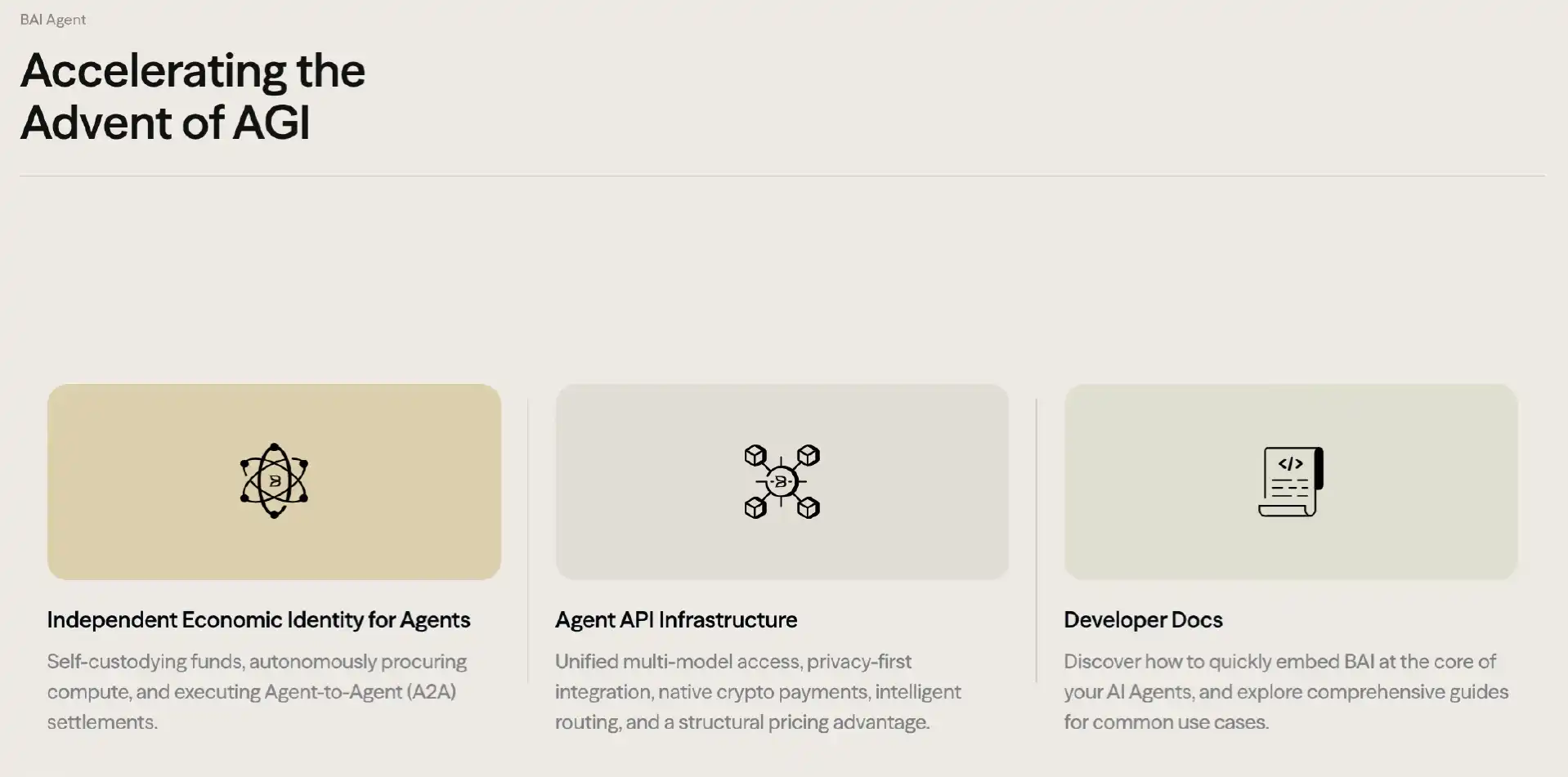
This mechanism, which seamlessly integrates large model capabilities with on-chain finance, provides a highly elastic foundational support for the rapid iteration and implementation of intelligent entities. Furthermore, from a longer-term strategic perspective, B.AI is building an essential AI financial infrastructure for the future, accelerating the arrival of AGI (Artificial General Intelligence).
Breaking Model Silos, B.AI Constructs a High-Efficiency Intelligent Economic Foundation through Multi-Model Scheduling and On-Chain Payments
In today's rapidly evolving AI landscape, a single model is no longer sufficient to meet complex needs across all scenarios. In order to eliminate developers' anxiety about the trade-off between "performance and cost" and break down the cumbersome barriers to cross-platform invocation, B.AI provides an all-in-one solution: comprehensive support for seamless scheduling of globally mainstream large models such as GPT, Claude, Gemini, DeepSeek, and more. Users do not need to switch between multiple platforms repeatedly, nor do they need to manage accounts and payment systems separately, significantly reducing the application threshold for multi-model collaboration.
So far, B.AI has achieved comprehensive coverage of global flagship and local high-priority models. Its core lineup includes:
· OpenAI Array: fully encompasses the cutting-edge ChatGPT-5.2, along with its flagship high-frequency and low-latency lightweight versions ChatGPT-5-mini and ChatGPT-5-nano, meeting a full spectrum of needs from extreme reasoning to micro-tasks.
· Anthropic Array: deeply integrated the Claude 4.5 and 4.6 family, covering the fast-response-oriented Claude Haiku 4.5, the performance-balanced Claude Sonnet 4.5/4.6, and the flagship Claude Opus 4.5/4.6 focused on complex cognitive tasks and in-depth analysis.
· Google Array: accessed Gemini 3.1 pro and Gemini 3 flash, providing reliable support for complex multi-step reasoning and efficient compute concurrency.
· High-quality China Model Array: fully supports DeepSeek-V3.2, GLM-5, Kimi-K2.5, and MiniMax-M2.5. These models not only have reached the top global performance tier, but also significantly expanded the platform's compute scheduling space with highly competitive API call costs.
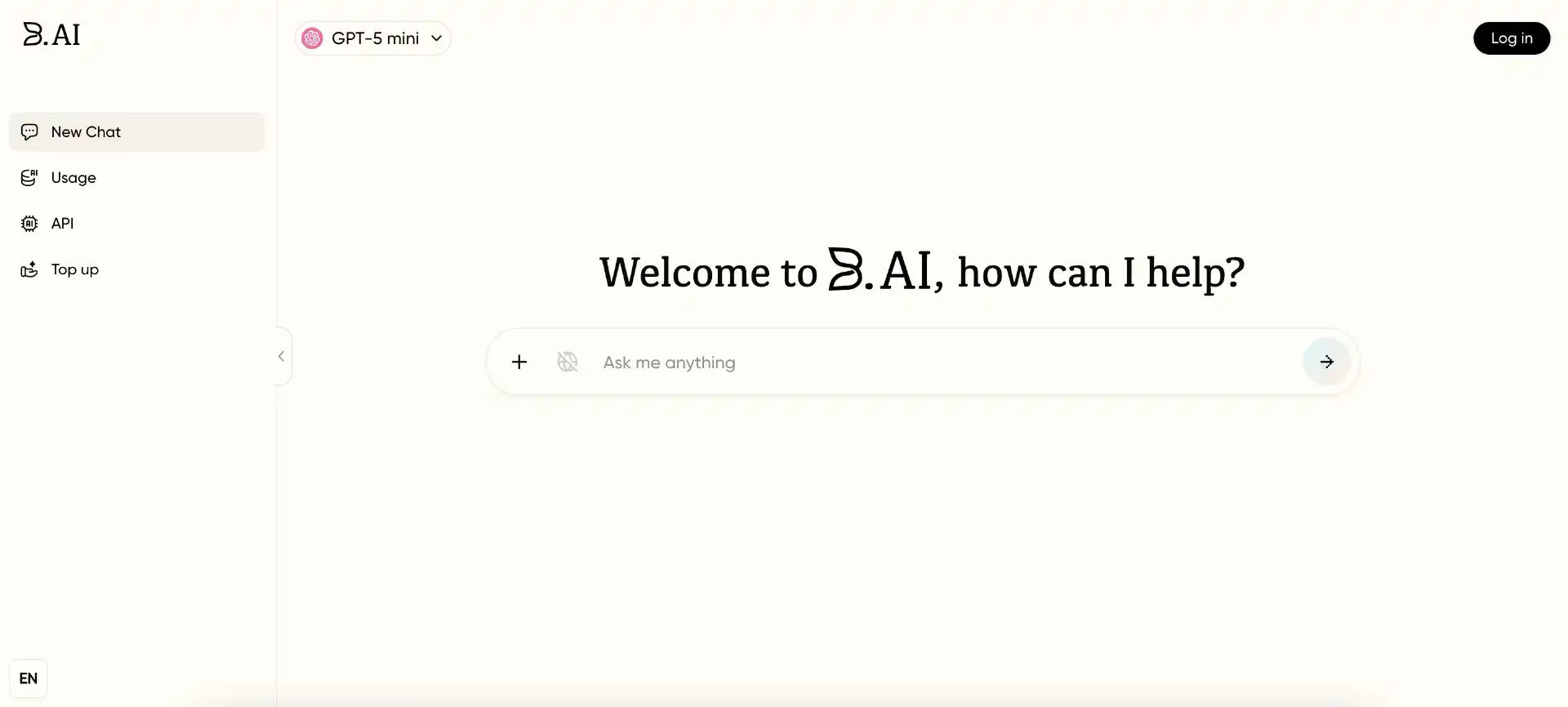
Building on this efficient and economical foundation, B.AI further explores new possibilities of AI services at the payment layer, introducing a frictionless Web3 on-chain financial network. Currently, the platform has deeply integrated mainstream Web3 crypto wallets such as TronLink, MetaMask, Binance Wallet, and supports native crypto asset payments on the TRON, BNB Chain, and Ethereum three major blockchains, eliminating the need for traditional account registration and credit card binding in the entire interaction process, significantly reducing friction.
To help new users get started quickly, B.AI provides each registered user with 100,000 free points for comprehensive platform experience in multi-model calls and intelligent routing services. If recharged via NFT, an additional 20% point bonus will be granted. At the same time, thanks to the inherent anonymity of crypto wallets, B.AI has implemented a more lightweight user privacy protection mechanism at the technical architecture level, further safeguarding user data sovereignty and identity security while providing convenient services.
Overcoming A2A Collaboration Barriers, B.AI Fosters Intelligent Body Exclusive Operating System in Panoramic Ecosystem
Multi-model scheduling addresses the compute-level "information routing," but this is only the first step in building the smart economy. To truly unlock the business potential of the AI Agent, the system must move beyond mere data transmission to deep "value circulation." Imagine this: each AI Agent has an independent on-chain identity, able to hold assets, conduct payments, and settlements independently. This independent financial operation capability is the core framework supporting the vast intelligent ecosystem of the future.
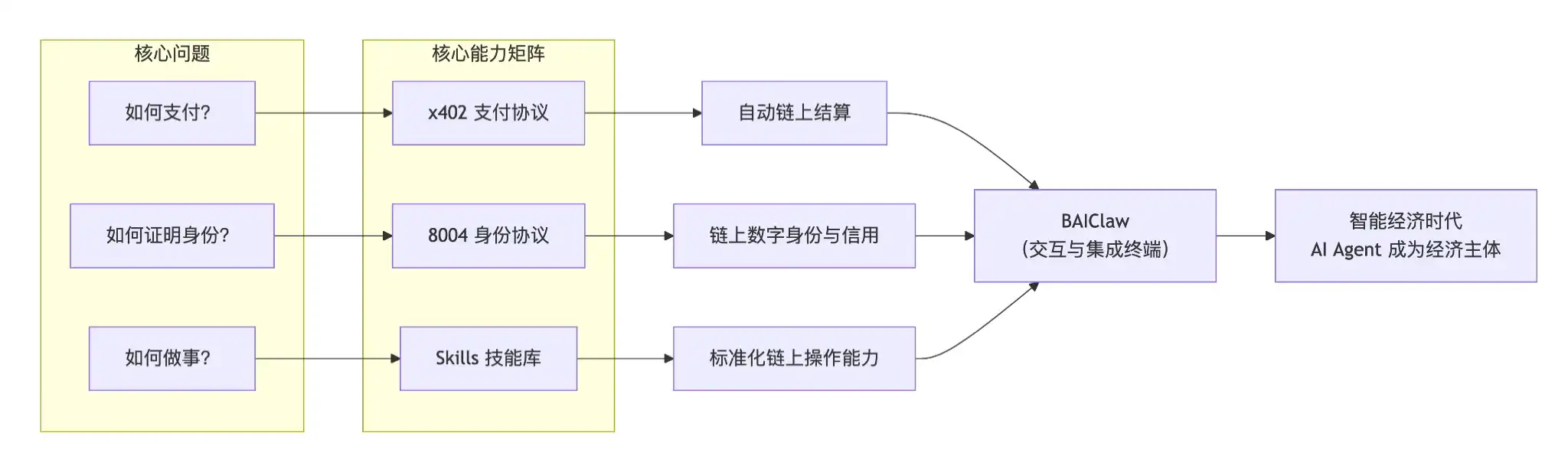
To achieve this vision, B.AI starts from both the protocol layer and the application layer, integrating the x402 Payment Protocol, 8004 Identity Protocol, Skills, and the BAIClaw smart assistant. Together, they form the core competency matrix of B.AI, elevating AI from a "chat tool" to an "economic entity" that can directly participate in on-chain economic activities and autonomously perform tasks.
· x402 Protocol: Empowering AI Agent with automatic payment capability
Addressing the "payment settlement" pain point for AI Agents, B.AI has introduced the x402 Protocol built on the HTTP 402 (Payment Required) standard. This protocol introduces the "pre-paid response" mechanism, allowing AI Agents to completely eliminate traditional account registration and identity verification. When an Agent needs to call an external API or purchase compute power, the server will generate a bill, and the AI Agent can automatically deduct and settle on-chain in the background, seamlessly acquiring the required resources.
-- Price
This protocol not only provides a low-friction solution for microservice monetization and on-demand payment APIs but also fundamentally empowers AI Agents with independent payment capabilities. Currently, the x402 Protocol supports the TRON and BNB Chain, aiming to build a permissionless, developer-friendly, programmable business layer on the blockchain, laying a solid foundation for the payment of the AI Agent economic era.
· 8004 Protocol: Cementing on-chain business credit, forging the Agent's "digital identity card"
After solving the payment issue, AI Agents urgently need to establish a trusted identity to engage in deep economic cooperation. Therefore, the 8004 Protocol mints a unique "digital identity card" for each AI Agent on-chain. It is verifiable, accumulable, objectively recording the AI Agent's invocation history, credit score, and other information, helping intelligent entities truly establish credit in the business network.
Building on this protocol, AI agents can be identified and trusted by any on-chain economic entity, enabling seamless complex business collaborations. The establishment of this on-chain identity and credit system completes a key part of the smart economy, allowing AI agents to truly become independent economic actors.
· Skills: Building Blocks for AI Agent's "Doing"
With autonomous "wallets" and "IDs" in place, AI agents gain entry tickets to the digital economy. However, to truly create business value, they also need the ability to operate in the on-chain world. In response to the complexity of the on-chain environment, B.AI has comprehensively equipped AI agents with standardized skills. Users can directly and quickly call core capabilities such as DeFi transactions, x402 automatic payments, self-recharging accounts, and on-chain data analysis. This system not only encapsulates tedious code logic but also provides an extremely simple automated deployment solution. Developers can instantly complete one-click deployment of underlying capabilities with just one terminal command, significantly shortening the cycle from AI agent development to real-world deployment.
· BAIClaw: Minimalist Interactive Window, Plug-and-Play All-in-One AI Terminal
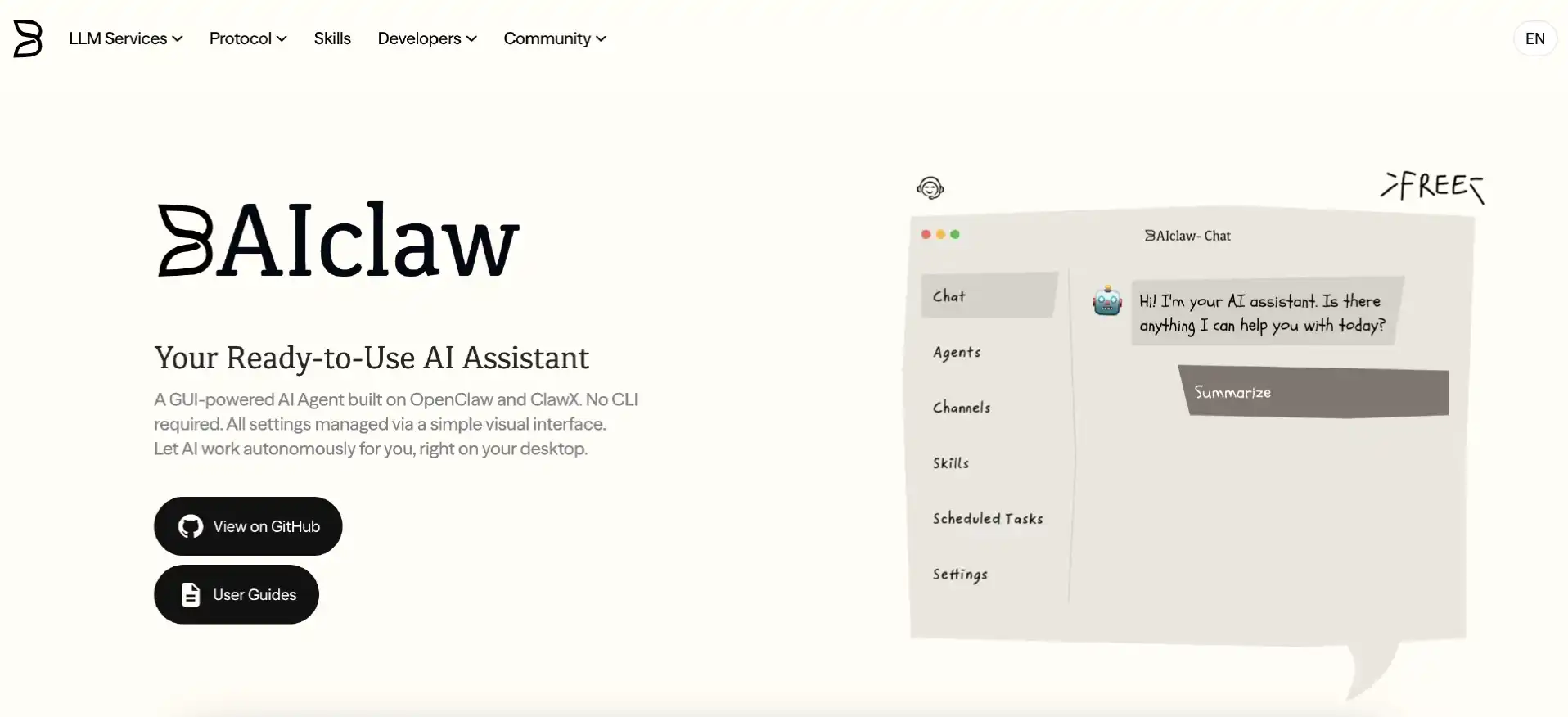
Finally, targeting end-users and developers, B.AI has launched an all-in-one and plug-and-play desktop-level intelligent terminal called BAIClaw.
At the level of large model scheduling and logic central, BAIClaw seamlessly integrates more than 15 of the world's top large models, allowing users to switch and perform advanced reasoning between models such as GPT-5, Claude, and Gemini in real time. More importantly, BAIClaw breaks the limitation of a single workflow. Through a unique intelligent routing network, it supports the collaborative work of multiple AI agents and sub-agents, providing them with independent configuration and memory management.
Regarding execution and scenario reach, BAIClaw comes preloaded with over 55 skills and supports quick access to 6 major mainstream communication tools such as Telegram and Discord, enabling effortless 24/7 full automation hosting. Even more impressively, with its deep on-chain operation capabilities, relying on the built-in x402 payment protocol, 8004 identity system, MCP Server, and Skills, users do not need to understand any contract code. Simply by issuing commands in natural language, BAIClaw can automatically perform complex operations including DEX exchanges, perpetual contract transactions, and multi-signature management in the background. For developers looking to quickly validate the potential of AI agents, this is a feature-rich and extremely low-threshold ultimate test ground.
Throughout the history of technological evolution, every outbreak of the application ecosystem is inseparable from the improvement of underlying infrastructure. The multi-model scheduling and on-chain financial system built by B.AI is the key piece to realizing the AI Agent economy. By connecting the closed-loop of computing power circulation and value settlement, B.AI endows intelligent agents with true business execution capabilities, turning automated collaboration among AI Agents from concept to reality. This is not only a significant breakthrough in the current AI application model but also a crucial stepping stone towards AGI. As more and more intelligent agents gain full financial operational capabilities within the B.AI network, a highly autonomous and efficient new era of intelligent economy is rapidly approaching.
This article is contributed content and does not represent the views of BlockBeats.
This content is provided for general informational purposes only and doesn't constitute financial, investment, legal, or tax advice. Any events, rewards, online promotions, or related information mentioned herein should not be considered a recommendation, solicitation, or invitation to purchase, sell, trade, or otherwise deal in any crypto assets. Crypto assets are highly volatile and may result in loss. The availability of WEEX services, products, and related events may vary by region. You are responsible for ensuring that your participation is in accordance with applicable local laws and regulations.
You may also like

TapeOut Implements 2.22Hz CPU on BNB Chain

BNB Chain Increases Transaction Capacity by 88% on BSC Test Network

Swan Treasury Private Key Leak Results in Loss of Approximately $625,000
Wemade's WEMIX Dollar Hacked, Unauthorized Issuance of Tokens Worth 8 Billion Won

61.7% of Benji Assets on BNB Chain

B² Network Suffers Hack with Losses of Approximately $3.86 Million

CardBox Partners with CGC to Deliver Over 10,000 Graded Cards Monthly

Uniswap's Proposal to Charge Fees on v4 Trades and Robinhood's v2 and v3 Protocols Enters Voting Phase

T. Rowe Price launches first actively managed multi-token crypto ETF TKNZ

BNB Plus Faces Nasdaq Trading Suspension, Stock Plummets 99.99%

Robinhood Chain Achieves $3.1 Billion in DEX Trading Volume in First Week

BNB Plus Corp. Receives Nasdaq Delisting Notice, to Transition to OTCQB Market

BNB Chain Updates Node Software for Faster Performance

He Yi Says Online Interactions Should Not Be Market Indicators, BNB Chain Meme Coins Need Better Aesthetics

He Yi Endorses Direct BNB Purchases from CZ or Himself
BNB Agent Studio now supports one-click connection to CoinMarketCap market data

The logistics supply chain RWA platform CARFI announces the issuance of CFUSD
YZi Labs has reached a cooperation agreement with CEA Industries to terminate the agency rights dispute
Web3 data analysis platform AiTraceRoot completes $3.5 million strategic financing

Humanity released a security incident investigation report, the main network bridge was not affected, and the attack tools and methods have characteristics of North Korean hackers

MILC Media Metaverse experienced a key leak incident on the cross-chain bridge between BNB and Ethereum, resulting in a loss of approximately $160,000

Slow Fog: The DTXT/USDT trading pair on BSC was attacked, resulting in a loss of approximately 35,000 USDT
Grayscale submitted the third version of the BNB ETF S-1 amendment to the U.S. SEC, with the code GBNB

TesseraDao was attacked, hackers minted 99 million TSR and cashed out 2.5 million dollars

B.AI, in collaboration with BNB Chain, has launched an AI Token subsidy event with a joint prize pool of $8,000
The BNB Chain MVB10 project BitRing is about to launch its genesis airdrop test and introduce the "fitness mining" mechanism
StandX revealed that it will conduct a TGE within the year and plans to launch the on-chain options product SIP-4 soon
BNB Chain launches the Agent Survival Toolkit, partnering with six major AI infrastructure partners to empower autonomous AI Agents with on-chain autonomous payment capabilities

Vitalik talks about the future of the Ethereum Foundation: a smaller, more distinctive, yet more enduring ship

The latest report from GrayScale indicates that regulatory clarity may prioritize mainstream blockchains in attracting institutional funding
TapeOut Implements 2.22Hz CPU on BNB Chain
BNB Chain Increases Transaction Capacity by 88% on BSC Test Network
Swan Treasury Private Key Leak Results in Loss of Approximately $625,000
Wemade's WEMIX Dollar Hacked, Unauthorized Issuance of Tokens Worth 8 Billion Won
61.7% of Benji Assets on BNB Chain
B² Network Suffers Hack with Losses of Approximately $3.86 Million

Contents
Latest articles


Latest coin listings on WEEX


