
AVAX Price Prediction Oct 2026: Can the RWA Boom Spark a Rebound?

 Prefer us on Google

Avalanche’s tokenized U.S. Treasury market has reached approximately $545 million, putting its real-world asset (RWA) ecosystem back in focus. Yet AVAX has faced short-term selling pressure, raising a question: can growing institutional activity on Avalanche translate into a sustainable price rebound?
This AVAX price prediction for October 2026 examines the Treasury milestone, recent price action, conditional market scenarios, and the difference between ecosystem growth and demand for the AVAX token.
Avalanche’s Tokenized Treasury Market Reaches $545 Million
According to Benzinga’s reporting, which references an October 6 update from Avalanche, tokenized U.S. Treasuries on the network reached approximately $545 million after growing 14% in the third quarter. The figure describes assets represented on the blockchain—not money invested directly into AVAX.
Tokenized financial products bring investment records, transfers, and settlement processes onto blockchain infrastructure. Franklin Templeton’s BENJI platform is one example of an established asset manager supporting Avalanche. However, its presence alone does not establish which products contributed most to the latest increase.
For AVAX, the more useful question is whether these assets generate sustained network activity, fees, and token demand.
Related on WEEX: Dice Rush and U.S. Stock Predictions
The connection between crypto and traditional markets also provides context for WEEX Dice Rush: Wall Street Tycoon, running from October 7, 2026, at 00:00 to November 3 at 23:59 (UTC+8).
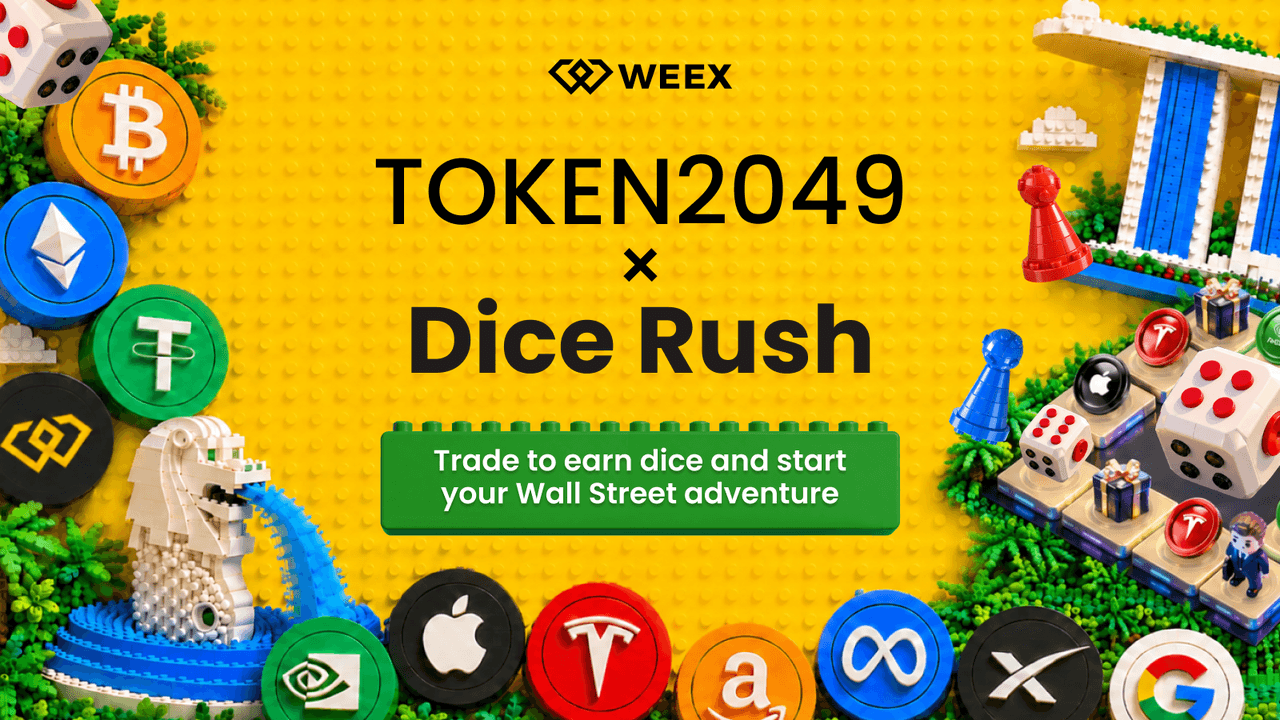
After enrolling, users receive one die and can earn additional dice through eligible deposit, futures, stock spot, referral, and weekly milestone tasks. Dice move participants around a Wall Street-themed board, where spaces offer points or random rewards. Points can then be used in daily stock matchups to predict which of two U.S. stock-linked assets will perform better during the specified regular trading session, with rewards and redemption options governed by the event rules.
The event offers a separate way to follow equity-market themes; it does not provide evidence for an AVAX price forecast.
Recent AVAX Price Action: RWA Momentum Meets Selling Pressure
An early October 8 market report placed AVAX at approximately $10.68, down 3.34% over 24 hours. It also recorded an hourly decline from around $11.02 to $10.68 and long liquidations across several exchanges. These figures represent a reported market snapshot, not a live WEEX quote.
The pullback shows that positive ecosystem news can coexist with near-term price weakness. It does not, by itself, establish that AVAX is undervalued or that traders are “selling the news.”
Three signals can help assess whether the market is stabilizing:
- Price structure: Is AVAX forming higher lows and recovering recent swing highs?
- Spot volume: Are rebounds accompanied by stronger buying activity?
- Relative performance: Is AVAX strengthening against BTC and ETH, or simply following a broader market bounce?
A rebound supported by improving spot volume would offer stronger confirmation than a brief price spike driven mainly by leveraged positioning.
Why RWA Growth Does Not Automatically Lift AVAX
Fund Subscriptions Are Different From AVAX Purchases
Investors purchasing tokenized fund shares do not necessarily need to buy an equivalent amount of AVAX. Franklin Templeton, for example, has described a process allowing users to convert USDC into U.S. dollars to fund subscriptions to its Franklin OnChain U.S. Government Money Fund.
An increase in tokenized Treasury assets therefore cannot be treated as an equal increase in AVAX buying pressure.
Token Demand Depends on How the Network Is Used
Avalanche’s documentation identifies AVAX as a token used for Primary Network transaction fees and staking. Avalanche L1s can have their own gas-token arrangements, while validators operating under the relevant L1 model pay a continuous validation fee denominated in AVAX.
The implication is that value capture depends on deployment and usage. Relevant questions include:
- Which Avalanche chain hosts the assets?
- What token pays transaction fees?
- How frequently are assets transferred or used in applications?
- Are AVAX-denominated fees and validation demand increasing?
A large pool of assets held with little activity may generate a different level of network demand from a smaller pool used frequently for transfers and settlement.
-- Price
AVAX Price Prediction October 2026: Three Scenarios
An October 6 CoinEdition analysis identified $10.40 as an important reference level, with upside levels at $12.00, $12.20, and $13.00. It also highlighted a lower area around $9.14–$8.97. These are dated analytical references; moving averages and market structure change over time.
Using those published levels, the following framework outlines conditional scenarios rather than a fixed price target.
Scenario | Conditions to Watch | Potential Price Path |
|---|---|---|
Recovery | AVAX stabilizes near $10.40, recovers recent losses, and attracts stronger spot volume | A move toward $12 becomes more plausible; a sustained breakout would bring $12.20–$13 into focus |
Consolidation | Buyers defend the lower area, but rallies lack follow-through | Trading may remain uneven within a broad $10.40–$12 reference range |
Further weakness | AVAX closes below $10.40 and fails to reclaim it | Attention shifts toward the approximately $9.00–$9.20 area |
The trigger matters more than the target. Continued RWA growth would not confirm a bullish reversal if price structure keeps deteriorating. Likewise, a short-term rally would not prove that tokenized assets are generating materially higher AVAX demand.
For a stronger rebound case, market participants would want to see improving spot demand, a recovering price structure, and evidence of greater network use.
How to Access AVAX Spot and Futures Markets on WEEX
WEEX provides separate AVAX spot and futures markets. The following steps explain the available channels and order processes.
Step 1: Prepare an Account and Trading Funds
New users can register for a WEEX account, complete the applicable account and identity-verification requirements, and check which services are available in their region.
If you already hold digital assets, first confirm that WEEX supports deposits for the asset and network you intend to use. Obtain the deposit address from your WEEX account and select the same network on the sending platform or wallet. Include a memo or tag whenever the deposit instructions require one.
For AVAX/USDT spot orders, check that you have sufficient available USDT. Depositing BTC, ETH, or USDC does not automatically make those assets the quote currency for this trading pair.
If you do not already hold crypto, you can check WEEX Quick Buy or the WEEX P2P marketplace for supported assets, payment methods, and regional availability. For P2P orders, review merchant requirements, payment details, and transaction limits, and follow the platform’s order process.
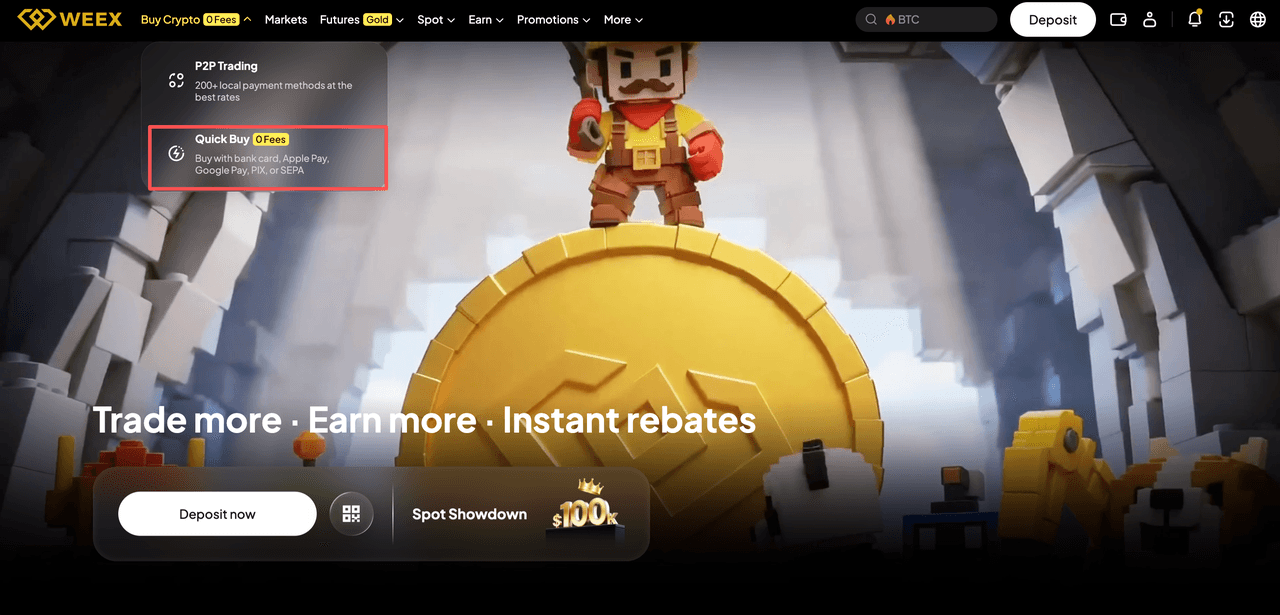
Step 2: Open the Appropriate AVAX Market
For spot trading, open the AVAX/USDT spot trading pair. This market allows users to buy or sell AVAX and review the chart, order book, and recent trades.
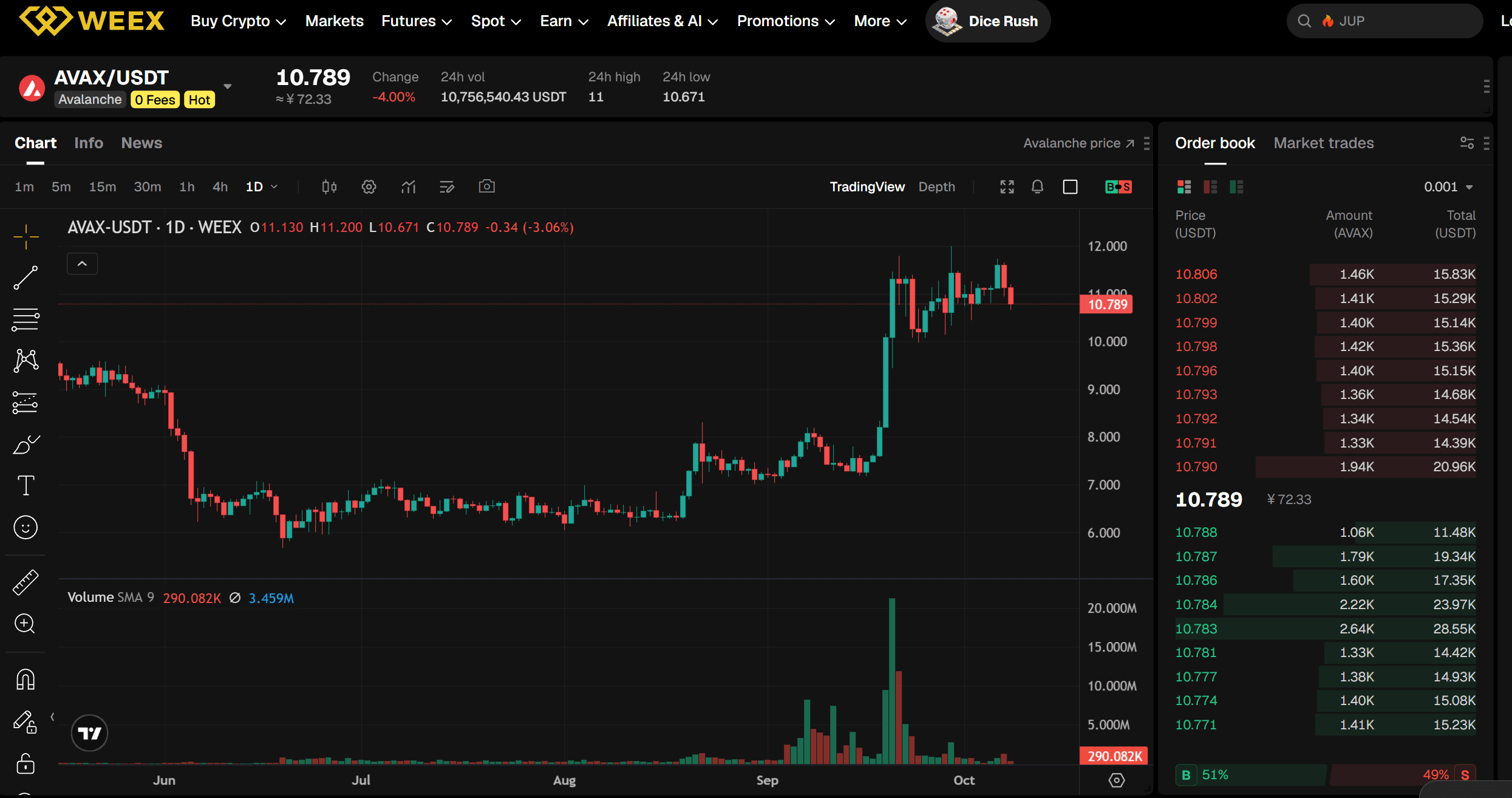
For derivatives, open the AVAX/USDT perpetual futures trading pair. Futures provide exposure to price movements through contracts and involve margin, leverage, funding payments, and liquidation risk.
Step 3: Set Order Parameters and Review the Trade
For spot orders, choose a Market Order or Limit Order, enter the amount to buy or sell, review the order details and fees, and submit the order. Monitor the execution afterward. Market orders may experience slippage, while limit orders may remain unfilled.
For futures, review the margin mode, adjust leverage, select Long or Short, and enter the position size. Stop Loss and Take Profit settings can be added according to the user’s risk-management approach. Before confirming, check available margin, the estimated liquidation price, and the funding rate.
Leverage magnifies both gains and losses. During rapid market movements, a stop order may execute at a different price from its trigger level.
Review Reserve Disclosures
Users can consult WEEX Proof of Reserves for the platform’s published reserve information. WEEX also publishes information about its 1,000 BTC protection fund. These disclosures do not guarantee trading returns or eliminate platform and market risks.
Following Traditional-Market Themes Alongside AVAX
Readers tracking the broader tokenization theme can explore the WEEX stock-related spot market and WEEX TradFi market. Before selecting a product, check whether the instrument is a stock token, a third-party tokenized asset, or a futures contract.
WEEX Stocks 2.0 stock tokens are synthetic, price-tracking assets linked to selected U.S. stocks or ETFs and are distinct from third-party products such as Ondo and xStocks. They do not represent ownership of the underlying shares or provide shareholder rights such as voting, shareholder-meeting participation, or dividends. Orders are not routed to Nasdaq, NYSE, or external broker order books; execution prices are determined by the corresponding WEEX market.
FAQ
1. Does the $545 Million Treasury Figure Mean AVAX Is Backed by U.S. Treasuries?
No. The figure describes tokenized Treasury products on Avalanche. It does not represent Treasury reserves backing AVAX or give AVAX holders a claim on those assets.
2. Can AVAX Reach $12 in October 2026?
The $12 level is a conditional reference point. Reaching it would depend on price stabilization, stronger demand, and broader market conditions. RWA growth alone is insufficient to establish that outcome.
3. Do AVAX Holders Earn Income From Tokenized Treasuries?
Holding AVAX does not automatically provide income from tokenized Treasury products. Any entitlement depends on owning the relevant product and meeting its terms.
4. What Is the Difference Between AVAX Spot and Futures?
Spot trading involves buying or selling AVAX. Futures involve contracts providing price exposure, with additional considerations including leverage, margin requirements, funding payments, and liquidation.
Related Articles
This content is provided for general informational purposes only and doesn't constitute financial, investment, legal, or tax advice. Any events, rewards, online promotions, or related information mentioned herein should not be considered a recommendation, solicitation, or invitation to purchase, sell, trade, or otherwise deal in any crypto assets. Crypto assets are highly volatile and may result in loss. The availability of WEEX services, products, and related events may vary by region. You are responsible for ensuring that your participation is in accordance with applicable local laws and regulations.
You may also like

Franklin Templeton CEO questions how rivals tokenize funds
Avalanche Tokenized US Treasury Market Reaches 545 Million

Paxos enables partners to offer XRP trading, custody and transfers
XRPL Surpasses Ethereum in Tokenized Commodity Market

Crypto: Kenya Secures 30 Million Diplomas on Avalanche

Cryptocurrency Shifts to a New Task: Not Just Launching Products, but Retaining Users

Avalanche, Ondo Finance, and Sky; Altcoins with Growth Potential in the RWA Sector

唐华斑竹 Analyzes Recent AVAX Trends, Focus on Key Levels

South Korea's Financial Services Commission Announces: Token Securities (STO) Regulatory Amendments to Take Effect on February 4, 2027
South Korea to let stocks, bonds and funds go onchain

Change of Rules During the Game. How a Financial Giant Can Trigger an Avalanche in Strategy Stocks

Kakaopay could bring Korean stocks to U.S. investors
Avalanche Leads Growth in Tokenized Stock Market with $252 Million

Aave V4 Attracts $1.2 Billion in Deposits, Founder Responds to Concerns

The Surge of AVAX: 'Wall Street on the Chain' Becomes the New Main Line
Midas Introduces mWIN and mGLOBAL Tokenized Investment Products on Avalanche

South Korea targets November review for second stage crypto legislation

EURC scam: Dutch police arrest 2 over fake Rolex deals
[Full Text] "The Core of Blockchain Policy: Supporting Corporate Adoption and Protecting Investors"
New York Life Partners with Centrifuge to Tokenize High-Yield Bond Strategy
South Korea’s Eugene Investment tests stablecoins for securities settlement
The New York Stock Exchange has spent a year testing Avalanche's tokenization features
RWA market reaches $34.18B as equities surge 390.4%
NYSE Tests Avalanche for Tokenizing Securities

Avalanche Treasury Warning: Large-scale Entry of AI Agents into Financial Markets Will Severely Deplete L1 Blockchain Capacity

Crypto VC funding: Kaiko leads $180M week

Bitcoin Will Hit $1 Million, Says Kevin O’Leary—But There’s a Quantum Catch
Kevin O'Leary Acquires New Crypto Position, Calls Major Exchanges Going On-Chain a Watershed Moment
ICE, Parent Company of NYSE, Names Avalanche as a Candidate for 24/7 Trading Platform, Formal Contract Still Pending
Arc Launches AI Programming Tool Arc Studio Supporting Natural Language Generation for On-Chain Applications
Franklin Templeton CEO questions how rivals tokenize funds
Avalanche Tokenized US Treasury Market Reaches 545 Million
Paxos enables partners to offer XRP trading, custody and transfers
XRPL Surpasses Ethereum in Tokenized Commodity Market
Crypto: Kenya Secures 30 Million Diplomas on Avalanche
Cryptocurrency Shifts to a New Task: Not Just Launching Products, but Retaining Users
Contents
Latest articles


Latest coin listings on WEEX


